The short answer
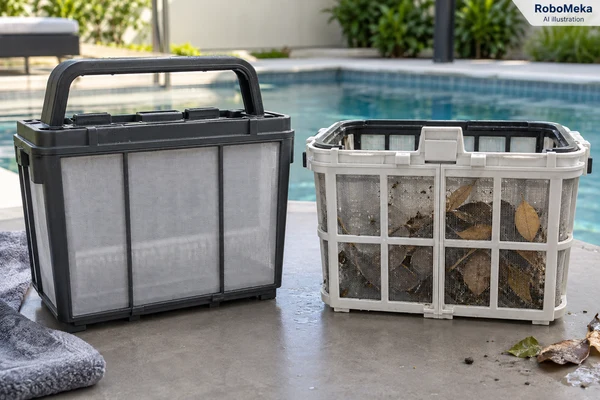
Large leaves and acorns challenge the intake opening, internal passage, filter surface, retention system and operator workflow in different ways. Buyers should define the debris mixture, evaluate useful flow as the load builds, and document the exact approved filter and intervention plan instead of treating basket litres as a universal pickup claim.
Introduction
A robotic pool cleaner can be well suited to ordinary leaves yet struggle when the debris mix includes curled leaves, acorns, seed pods, bark, and short twigs. The buyer answer is to evaluate the whole collection path: the opening must admit the material, water flow must carry it inward, the filter must retain it without blocking prematurely, and the robot must still travel for a useful part of the cycle. A large basket label alone does not prove that sequence.
This guide is about routine or event-driven loads of large organic debris. It is not a guide to sand, silt, algae, or the special work of reopening a neglected pool. The proposed checks are procurement methods, not records of RoboMeka factory tests or customer installations. Buyers should use the exact model manual and supplier evidence before making a claim about a particular leaf or nut.
What makes large organic debris a different cleaning task?
Large debris challenges shape, stiffness, and volume before it challenges filter fineness. A wet leaf may fold through an inlet, while a rigid acorn of smaller area may stop at the opening. A narrow twig can enter lengthwise and then bridge across an internal passage. Several light leaves can cover a screen and reduce water flow even though their combined mass is small.
Maytronics' filter guidance distinguishes a fine spring filter intended for large debris such as leaves and twigs from ultra-fine filtration for smaller material. The point is model-specific: it shows that filter configuration follows the debris task, not that every Dolphin or every pool robot has the same filter set or capacity.
A current Maytronics dual-level filtration manual likewise assigns its spring-filter configuration to dirty pools with large debris and its ultra-fine cartridge to day-to-day use. This supports the need to identify the supplied filter, while leaving inlet size, hard-object pickup, capacity, and exact model availability to separate verification.
Acorns deserve separate attention. They are denser and harder than most leaves, vary greatly by species, and may arrive with caps attached. A product statement that says “leaf pickup” therefore does not automatically cover acorns. Ask for an inlet dimension, approved debris description, and representative sample evaluation instead of translating a broad marketing phrase into an unsupported promise.
Qualify the debris before comparing robots
Describe the material as a mixture
A useful buying brief records the dominant leaf size, whether leaves are flat or curled, the approximate size range of acorns or pods, the presence of twigs, and whether the load is freshly fallen or waterlogged. Photographs beside an ordinary ruler can communicate scale, provided no one leans over the pool or enters the water to collect them during operation.
Do not compress the description into “heavy debris.” That phrase could mean many large leaves, a few stones, dense sand, or a filter already filled with fine material. Each creates a different constraint. Keep hard foreign objects, broken glass, and sharp metal outside a robot trial; they require safe manual removal by the responsible pool operator.
Record the arrival pattern
A short storm may place a concentrated mat in one corner. Daily tree fall may distribute a smaller load across the floor. Wind can keep material at the surface until it becomes saturated, while circulation can concentrate it near fittings. The desired robot may need to clean after a predictable event rather than absorb an entire week's accumulation in one cycle.
For first cleanup after winter or long closure, use the separate seasonal opening debris guide. This article assumes the pool is otherwise ready for normal robotic cleaning and asks whether the proposed model can handle a defined organic load without unsafe improvisation.
Follow the complete debris path
Inlet clearance comes before filter capacity
Measure or obtain the supplier's documented intake geometry for the exact model. The relevant dimension is the usable opening in its normal configuration, not the widest exterior gap visible in a photograph. Flaps, guards, brush position, and the angle at which the robot meets material can reduce effective admission.
A leaf that remains against the intake is different from one that enters and later blocks the filter surface. During a safe, representative trial, note where material accumulates. Do not reach beneath a running robot or remove a guard to watch the inlet. Stop the unit, isolate it from power, and follow the manual before any inspection.
Flow must continue as the load builds
Pickup depends on maintained water movement. If broad leaves cover the first exposed mesh, the robot can appear to lose suction before the basket is volumetrically full. A filter-full indicator, where offered, may help the operator, but buyers still need to know what it measures and whether the feature is available on the quoted revision.
The Hayward TigerShark product sheet identifies a spring-cleanup filter element for larger debris as an optional accessory for the listed models. That is useful evidence that large debris can require a dedicated filter configuration. It is not evidence that this accessory fits another cleaner or that it handles every acorn and twig.
Retention matters during turns and retrieval
Debris that enters the basket should remain there when the robot reverses, climbs, stops, and is lifted. A bottom door or inlet flap may reduce backflow, but its performance depends on the actual load and condition. Observe whether leaves spill back as the unit reaches the wall or drains during retrieval.
Retrieve only by the method in the model manual. Never lift by a floating cable unless the instructions explicitly use it only to bring the robot within reach and then direct lifting by the handle. Let water drain in the approved position before moving a heavy, loaded cleaner across the deck.
Compare filter choices without confusing particle size and debris size
A micron rating describes particle retention under defined conditions; it does not state the maximum object that can pass the inlet. A coarse mesh may admit flow through a leaf load better than a fine pleated surface, but the basket, seals, and internal path still determine what is captured. Buyers should compare the entire approved assembly.
Use the robotic pool cleaner filter selection guide for a broader filter comparison. For sand or suspended fines, see the sand, silt and algae limitations guide. Those tasks should not be merged into an acorn test because a configuration optimized for fine particles may load differently from one intended for leaves.
| Buyer question | Evidence to request | Inadequate shortcut |
|---|---|---|
| Will the inlet admit the debris? | Usable inlet geometry and representative material trial | Basket litres alone |
| Will flow continue? | Pickup observations at several load stages | Unloaded suction figure |
| Will debris remain captured? | Turn, stop, and retrieval observations | One clean-floor photograph |
| Is the filter appropriate? | Exact approved filter part and manual reference | Generic micron claim |
| Is intervention manageable? | Safe emptying frequency under the defined load | Long cycle time alone |
Build a representative large-debris trial
Use a controlled and honest load
The proposed trial should use safe organic material representative of the target market, with the approximate size mix and wetness documented. Do not add stones, sharp fragments, oversized branches, or enough material to create a deliberately abusive test. State the starting load in a repeatable way, such as a photographed tray or counted sample, without presenting the exercise as a universal standard.
Place the material across several realistic floor locations rather than directly feeding it into the intake. Include an open-floor patch, a wall-floor transition, and any ordinary area where leaves gather, provided the robot is approved for that surface. Keep the test separate from raised drains, steps, and other special geometry so the result answers the debris question.
No swimmers should be in or near the operating cleaner, and deck access must remain controlled. For a corded unit, use only the approved supply and cable arrangement. Follow the exact manual, applicable local electrical rules, and a qualified electrician's direction for the supply setup; no outlet distance should be inferred from another model's manual. Stop, unplug or otherwise isolate the cleaner as specified before handling the basket or checking any moving area.
Observe the cycle in stages
Record early pickup, behavior after the first substantial leaf layer, travel near the end of the cycle, and the material left behind. A video from a safe deck position can show whether an acorn is bypassed, pushed, admitted, or released. It cannot by itself prove why the event occurred.
The test should have a clear stop condition. Stop if a hard object jams a moving part, the robot behaves abnormally, the cable enters an unsafe arrangement, or the manual requires intervention. Repeatedly restarting a jammed robot is not a capacity test. It can damage components and obscure the useful finding that the selected configuration needs review.
Send your debris photos and pool requirements to request a proposed model-specific sample brief. Include representative leaf, acorn, pod, and twig sizes, the expected loading pattern, the pool surface, and the intervention frequency your customer can accept.
Judge cycle performance by useful work, not runtime
A two-hour cycle is not automatically better than a ninety-minute cycle if the filter loses useful flow after twenty minutes. Conversely, an operator who can empty a basket once during a severe leaf event may obtain an acceptable result from a model that is not intended to hold the whole load. The quotation should state the operating assumption.
Track the time or progress to the first required intervention, the number of safe emptying events, and the residual debris pattern. Avoid publishing a pickup percentage unless the test method and measurement are defensible. A simple description such as “collected the wet leaves but bypassed most capped acorns in this proposed fixture” is more useful than an invented efficiency score.
Cycle selection can affect the result. A floor-only pattern may spend more time on the relevant zone than a full floor-wall-waterline program. Confirm which modes exist on the actual model and whether the supplier approves them for the load. Do not assume a longer program increases inlet size or basket capacity.
Turn trial evidence into a procurement specification
The specification should identify the exact filter assembly, basket or bag, inlet configuration, cleaning modes, and any approved accessory used during evaluation. If the supplier changes a flap, brush, filter panel, or software revision, decide whether the change could affect pickup and whether the representative check should be repeated.
Factory testing can use a proposed reference load for consistency, but it should be labeled as a controlled comparison rather than a customer-pool result. Record the material description, water condition, distribution method, starting filter state, cycle, and stop criteria. Shipment inspection can confirm that the delivered filter parts and manuals match the approved sample; it cannot reproduce every tree species or pool flow pattern.
Ask how the supplier handles jam reports and replacement parts. A large-debris product needs accessible filters, model-matched flaps or basket components, and clear isolation instructions. Service documentation is part of suitability because routine leaf loads create more frequent handling than a lightly contaminated pool.
Plan the operator workflow after a leaf-heavy cycle
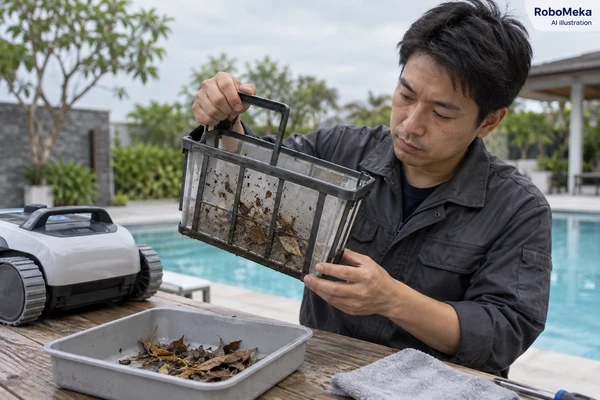
The operator needs a dry, stable place to drain the robot and open the filter according to the manual. Wet leaves are bulky and can make a nominally light basket awkward. Gloves may be appropriate for ordinary debris handling, but they do not make unknown sharp or hazardous material safe. Local waste and drainage rules govern disposal.
Use the filter basket cleaning and disposal guide for the proposed post-cycle routine and the pool robot maintenance guide for broader care. Do not knock a loaded basket against the deck, pry material from moving parts while energized, or use unapproved chemicals to dissolve organic residue.
If the same load repeatedly blocks the intake, adjust the product recommendation or operating plan rather than normalizing unsafe clearing. A surface skimming strategy, pre-cleaning after extreme weather, or more frequent short cycles may reduce what sinks, but each measure has its own equipment and safety requirements. The robot does not have to be the only tool to be a useful tool.
State the sales claim with appropriate limits
An honest claim names the debris and the conditions. “Configured for routine leaf pickup with the supplied coarse basket” is more defensible than “handles all large debris.” Acorns, seed pods, twigs, and heavy leaf mats should remain separate qualification items unless representative evidence supports them.
Model, region, and manual limits must remain visible. A filter option offered in one market may not be supplied elsewhere. Similar housings may use different baskets. Confirm availability, approved compatibility, replacement supply, and instructions for the quoted item before the dealer builds a campaign around it.
The best outcome may be a boundary. If a robot reliably collects leaves but not large capped acorns, that fact can guide the target application and reduce support disputes. Procurement quality improves when the product description says what was evaluated, what was not, and what the operator must do after exceptional debris events.
Frequently asked questions
Can every pool robot pick up acorns?
No. Acorn size, shape, density, and caps vary, while inlet geometry and internal passages vary by model. A statement about leaf pickup is not enough. Ask for documented opening dimensions and a representative trial using safe material similar to the target pool's debris, then state the observed limit rather than promising universal pickup.
Is a larger filter basket always better for leaves?
No. Volume helps only after debris enters and water continues flowing. A narrow intake, bridging twig, covered screen, poor retention flap, or difficult emptying routine can become the practical limit first. Compare admission, flow under load, retention, service access, and approved filter options together.
Should I use the finest filter for leaves and acorns?
Not automatically. Fine filtration is useful for small particles, but broad leaves may cover a fine surface quickly. Use the filter assembly specified by the manufacturer for the exact model and debris task. Never remove filtration or combine unapproved panels merely to increase apparent flow.
How many cycles should a heavy leaf load require?
There is no universal number. The answer depends on debris quantity, distribution, filter loading, cycle pattern, and acceptable operator intervention. Define the starting load and desired finish, then record useful work per cycle. Severe weather may justify preliminary removal or an intermediate basket emptying under the approved procedure.
What should a buyer photograph after the trial?
Photograph the remaining floor pattern, material retained in the basket, any debris at the inlet, and the exact filter configuration after the robot has been safely stopped and isolated. Include a scale reference where helpful. Do not open guards or place hands near moving parts to create a more dramatic image.
Conclusion
Large leaves and acorns are an intake, flow, retention, and handling problem, not simply a basket-volume problem. Define the organic debris mix, use the exact approved filter configuration, observe performance as the load builds, and record the intervention required. Those facts support a useful application boundary without confusing large debris with fine sediment or seasonal pool recovery.
Ask RoboMeka for a large-debris pool robot review with your pool layout, representative debris photos, expected loading pattern, target model requirements, and preferred operator workflow so a proposed configuration and sample evaluation can be discussed without unsupported performance promises.