The short answer
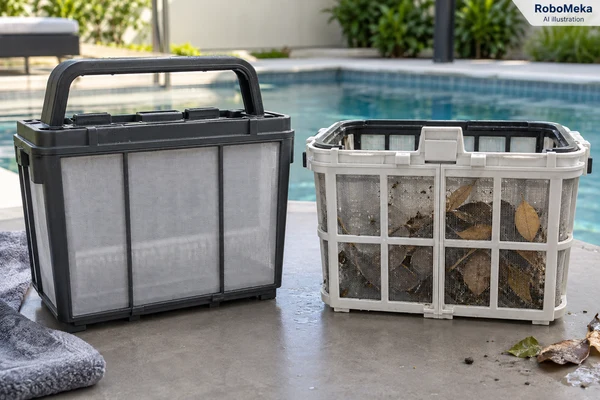
Pool robots can collect suitable loose particles when their intake, filter and travel match the task, but particulate removal does not establish water treatment or swimming safety. Investigate sticky deposits, persistent discoloration and returning sediment with qualified pool support. Evaluate where material remains and what the filter retains before assigning a cause.
Introduction
A sandy patch disappears while a robot passes, then a fine haze settles nearby. Another pool has a green deposit that remains attached after several cleaning cycles. Those observations describe different tasks. Treating both as a demand for stronger suction can lead a buyer toward the wrong product and an unrealistic customer promise.
A pool robot can collect suitable loose particles when its travel, intake, and filtration match the application. That does not mean it identifies unknown material, treats water, or establishes that a pool is safe for swimming. Sand collection, fine-sediment retention, attached-deposit removal, and water treatment need separate questions and evidence.
This guide helps distributors and private-label buyers define those boundaries before choosing equipment. It focuses on what remains in the pool, what the robot actually retains, and why material returns. The assessment examples are proposed buyer methods, not completed RoboMeka tests. Unknown deposits and water-condition concerns should be referred to qualified pool professionals.
Describe the material before comparing cleaners
Start with observable properties: loose grains, a powdery deposit, suspended cloudiness, a sticky film, or persistent discoloration. Record where the material appears and whether it returns after removal. Do not label every green patch algae or every pale powder ordinary dust from a photograph. Similar appearances can require different professional responses.
Maytronics' cleaning-performance FAQ distinguishes fine loose debris from sticky, algae-like material and recommends pool-technician analysis for the latter. That distinction is useful for intake conversations. It does not give a dealer the evidence needed to diagnose the water or prescribe treatment remotely.
For a known, permitted particulate task, ask whether the cleaner can reach the material, draw it into the intake, retain it, and carry it through retrieval without significant release. Each stage affects the customer's result. A clear trail behind the robot answers only part of that sequence.
Sand, silt and algae-like deposits are different buying problems
Loose sand creates a pickup and access question
Visible grains on a reachable floor are a concrete cleaning target. The robot must pass the location with an appropriate intake arrangement and collect the grains into its approved filter system. If the deposit sits in a corner, beside a fitting, or on a shelf, access may be the limitation even when open-floor pickup is acceptable.
Ask what the customer means by sand. An equipment buyer should not assume that sharp fragments, construction residue, or unknown heavy debris are suitable simply because they resemble granular material. Confirm the manufacturer's permitted debris scope and have unusual material assessed before placing the cleaner into service.
Fine sediment makes retention harder to observe
Silt-like deposits can be disturbed into the surrounding water during travel. A photograph taken immediately behind the robot may therefore look promising without proving capture. Evaluate the filter contents and the later condition of the same area, while recording other sources of water movement and newly introduced debris.
A stated filter grade is useful but incomplete. It does not establish whole-system capture under every loading condition or show whether the cleaner reaches the affected area. The separate pool robot filter-selection guide covers configuration choices; this article concerns interpreting the cleaning result without confusing displacement with collection.
Attached or unidentified deposits require a scope decision
A sticky film or persistent stain may not be a routine loose-particle task. Do not keep running a robot merely to discover whether repeated scrubbing will remove it. Ask the pool professional to identify the issue and the finish supplier to confirm suitable care when the surface may be involved.
Particle collection must remain distinct from disinfection. CDC pool-health guidance emphasizes appropriate pool-water management, including disinfection and pH. A robot's visible cleaning result does not replace those responsibilities. Avoid health, bacteria-removal, or chemical-reduction claims without product-specific evidence appropriate to the claim.
Diagnose the pattern of material that remains
The position and timing of residual material help structure an inquiry. They do not establish a root cause by themselves. Ask whether the area was reached, whether debris moved, whether material appeared elsewhere, and whether the same patch returned after the robot was removed. These observations make the next technical conversation more precise.
| Observed pattern | Useful question | Evidence still needed |
|---|---|---|
| Untouched patch remains | Did the robot reach it? | Route observation and access details |
| Cloud follows the cleaner | Was material disturbed or captured? | Filter inspection and later observation |
| Trail remains despite repeated passes | Was the target within the supported task? | Intake condition and approved configuration |
| Deposit returns near an outlet | Is material entering from another source? | Pool-professional assessment |
| Surface stays discolored | Is this loose material or a finish issue? | Qualified identification and care advice |
A distributor can use this table to request better information without prescribing repairs. The most useful support report separates what the owner saw from what the owner suspects. A statement that the cleaner passed the area but a deposit remained is clearer than a conclusion that its pump has failed.
Preserve ordinary context in the photographs. Include a view of the whole affected zone and another showing the deposit, without enhancing contrast to make a cleaning difference look larger. Record recent weather or nearby work as background information, not as a confirmed source. These simple habits make the material easier for the supplier and pool professional to assess and keep a later before-and-after comparison from depending on selective images.
Investigate recurring material beyond the robot
Location can suggest where to look next
Repeated accumulation in the same area may relate to the pool's surroundings, circulation, or another source. Note nearby landscaping, access routes, and recent work without declaring them responsible. The buyer's role is to identify the need for assessment; the pool professional should investigate the installed system and uncertain contamination sources.
Changing the robot cannot solve every recurrence problem. If fresh material enters between cleaning sessions, a successful cycle can be followed by a dirty-looking floor. Sales language should distinguish maintenance assistance from prevention. A robot may help manage a permitted debris load while the underlying source remains a separate service matter.
A new finish changes the interpretation
Powder or loose material after resurfacing needs the finish installer's attention and startup instructions. Do not treat a new pool as an ordinary sand-pickup demonstration. The timing and method of cleaning belong to the finish-specific handover, and the robot manufacturer must also approve the intended application.
For established surfaces, use the vinyl, fiberglass and tile compatibility guide to define the installed finish and approved contact components. Surface compatibility is relevant even when the immediate complaint concerns debris. More aggressive brushing is not an automatic remedy for material that resists collection.
Define acceptance around an observable task
Agree what a successful result will look like before comparing samples. Describe the permitted material, the area, the initial condition, the cleaning mode, and the inspection method. A target such as collecting visible loose grains from an accessible floor is more defensible than promising complete removal of everything making the water cloudy.
Include residual work in the decision. A cleaner may be useful even if the owner must address a narrow inaccessible edge through an approved method. The important question is whether that limitation fits the customer's expectations and service capability. Hide neither the extra task nor the difference between a first recovery clean and routine upkeep.
Send RoboMeka your debris and application requirements with photographs, pool dimensions, surface type, and the expected cleaning outcome. Identify any unknown or attached material so the assessment can begin with the appropriate pool-professional input.
Plan a controlled debris evaluation
Begin with a pool ready for robotic use
Confirm that the pool meets the chosen robot's instructions and that its surface and water have been cleared for the planned work. Do not add unknown powders, chemicals, or abrasive material to create a dramatic demonstration. If artificial test debris is proposed, obtain permission for that specific material and method first.
Record the robot configuration and the starting filter condition. Use the specified intake, brush, filter, and cleaning mode. A comparison loses meaning if one sample runs with an optional filter and the other uses a standard configuration without that difference being disclosed. Price comparisons should follow the actual evaluated package.
Observe access before judging pickup
Watch whether the cleaner reaches the target and how it approaches. Note edges, slopes, drains, and other features that may change travel. An untouched pocket in a region the robot never entered does not provide evidence about its ability to retain the same particles on an open floor.
The pool-sizing guide helps frame overall application fit, while the seasonal-opening guide addresses unusually heavy initial loads. Use those distinctions to keep the trial within the task you intend to sell, rather than treating every dirty pool as equivalent.
Inspect retention and retrieval separately
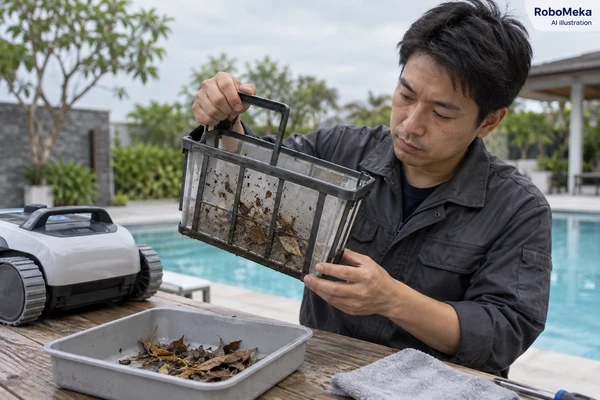
After the permitted cycle, retrieve and isolate the robot according to its manual. Inspect the filter through the approved procedure and record what it contains. Also note any visible release during normal retrieval. Do not shake, invert, or operate the machine in an unauthorized way to provoke a result.
Photograph the same target area from a similar position before and after the run. Record whether the later view was taken immediately or after the pool had settled. These records support an observational comparison, but they do not justify a precise mass-removal percentage unless a suitable measurement method was established in advance.
Keep water-treatment restrictions in the workflow
Robots and treatment products can have separate restrictions. A pool technician may select a treatment that changes when or how the robot may be used. The equipment dealer should obtain the cleaner maker's instruction for that condition instead of assuming that any treatment compatible with the pool is compatible with the robot.
For example, the LIBERTY manual warns against use following specified clarifier or liquid-flocculant additions because of filter obstruction and damage concerns. That is a restriction for the covered product. It illustrates why buyers must confirm their own model's instructions and cannot rely on a universal waiting-time rule.
Do not publish chemical recipes as an accessory to a robot recommendation. The useful dealer handover identifies the responsible pool-care professional, the requirement to check current water conditions, and the need to follow both product instructions. A robot that removes visible residue has not independently verified that treatment is complete.
Compare two plausible product outcomes honestly
Imagine a buyer evaluating two approved configurations against a modest loose-sediment task. One reaches the whole target area but leaves a visible trail of fine material. The other retains more observed sediment but requires an additional filter-care interruption. These hypothetical results create a practical choice involving cleanliness, operator time, and customer expectations.
The buyer should record the interruption and final result together. A favorable photograph without the extra handling would overstate convenience. Conversely, a longer routine may still suit a service team that values the observed outcome. The right recommendation depends on the intended user, not on declaring one specification universally superior.
If both candidates fail to address the deposit, pause the comparison and revisit its identity and scope. Repeating increasingly aggressive trials is not evidence of diligence when the task itself may be unsuitable. Professional identification can prevent wasted evaluation work and reduce the risk of damage to the finish or cleaner.
Convert sample evidence into sales and support material
Use narrow, verifiable wording such as collecting suitable loose floor debris with the approved filter configuration. State the tested conditions when referencing an assessment. Do not turn a visible sand demonstration into a claim about all silt, algae eradication, water clarity, or swimming safety. Those claims require different evidence.
Factory testing should document the actual sample configuration and test material when a supplier uses it to support a quotation. Ask whether production units will include the same filter and intake arrangement. A showroom demonstration using an undisclosed accessory cannot substantiate the performance of a lower-cost shipment configuration.
Shipment inspection can confirm the approved parts and care instructions, while customer requirements determine whether the package is appropriate. Keep replacement-filter availability and permitted cleaning procedures visible in dealer materials. A sample that works only with a hard-to-obtain consumable may create an avoidable support problem after the initial order.
Frequently asked questions
Can a pool robot pick up sand from the floor?
It can when the exact model supports the material and its intake, travel, and filter configuration suit the application. Confirm the debris scope and observe actual capture in an approved trial. A pile disappearing from view does not alone prove retention, and an inaccessible corner does not establish poor pickup on a reachable floor.
Why does fine sediment appear again after cleaning?
Possible explanations include material that was disturbed but not retained, an area the robot did not reach, or new material entering the pool. These are questions to investigate, not a remote diagnosis. Record the location and timing, inspect the approved filter condition, and involve the pool professional when the source or material remains uncertain.
Does a robot remove algae without water treatment?
Do not rely on robotic cleaning as a replacement for professional water management. A robot may collect suitable loose particulate material, but that result does not establish treatment or swimming safety. Sticky deposits, persistent discoloration, and suspected algae require appropriate assessment. The selected cleaner must also be used within its own environmental and treatment restrictions.
Should the finest available filter always be fitted?
No. Use an approved filter that matches the documented task and evaluate the complete routine, including loading and care. A filter label alone cannot establish capture, access, or acceptable operator effort. Confirm what is included with the actual model and what your customers can maintain before selecting an accessory or making a performance claim.
Can a robot collect residue after a clarifier or flocculant treatment?
Only if the exact cleaner's instructions permit the relevant condition and the pool professional confirms the appropriate sequence. Some manuals contain explicit restrictions. Do not assume that a fixed waiting period makes every treatment compatible, and do not use another brand's advice to override the instructions for the supplied model.
Conclusion
Good debris guidance starts by defining the material and the task. Separate access, pickup, retention, recurrence, and water treatment before assigning a cause or recommending equipment. A documented assessment of a permitted particulate task gives buyers a useful basis for selection while keeping unsupported hygiene and treatment claims out of the sales promise.
Ask RoboMeka for a debris-focused pool robot comparison with your target application, known material, required cleaning zones, and expected operator routine. Those details support a realistic sample plan and a clearer customer handover.