The short answer
Choose filtration around the intended debris, compatible filter assembly, completed cleaning task and owner maintenance routine. Ask what a micron claim measures, evaluate the exact configuration and control replacement identifiers. A smaller advertised number alone does not establish superior cleaning, easier care or suitability for every pool application.
Introduction
Robotic pool cleaner filtration should be selected around the debris customers actually remove, the time they can spend maintaining the filter, and the exact robot configuration. A small advertised micron number is only one piece of that decision. Buyers also need to understand filter fit, loading, cleaning access, replacement availability, and the relationship between the selected filter and a completed cleaning task.
For importers and distributors, filtration is a commercial issue as well as a technical one. An unsuitable filter bundle can create repeated support questions, unnecessary returns, or an accessory customers cannot replace locally. A well-defined bundle makes the product easier to explain and gives dealers a practical answer when owners describe leaves, dust, or mixed seasonal debris.
This guide provides a proposed evaluation framework, not results from completed RoboMeka factory testing. All trial examples are hypothetical. Manufacturer references illustrate specific documented distinctions; they do not establish the performance of an untested private-label product. Check the chosen model's instructions before selecting, cleaning, or changing any filter component.
What makes a pool robot filter suitable?
A suitable filter captures the intended debris during a useful cleaning cycle, fits correctly, can be maintained according to its instructions, and remains available as a replacement part. Evaluate these requirements together. A filter that captures fine sediment but requires an impractical cleaning routine may be a poor match for a leaf-heavy application.
Start with three questions: what enters the pool, how often does the owner clean it, and what result does the owner expect? Separate routine settled debris from an exceptional cleanup after weather or seasonal opening. Also distinguish physical debris collection from water treatment. A robotic cleaner does not replace the pool's prescribed circulation, sanitation, or professional water-care program.
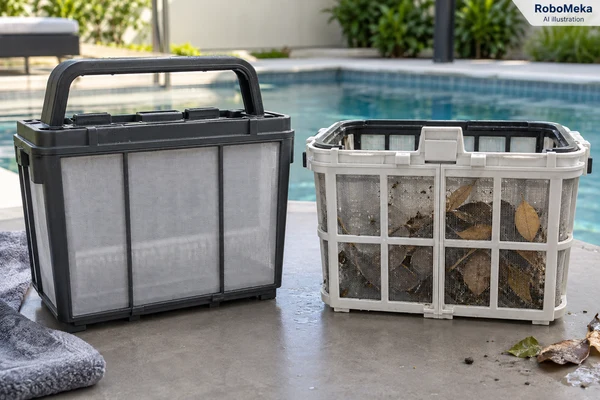
Maytronics' filter selection FAQ distinguishes spring filters and finer filter options, with availability depending on the Dolphin model. This supports asking about different debris applications and compatible accessories. It does not justify transferring that brand's micron values or compatibility claims to another platform.
Build the debris brief before comparing specifications
Describe the debris in ordinary language
Ask dealers for photographs and descriptions of the material owners encounter. Leaves, small plant fragments, fine settled dust, and mixed debris present different evaluation questions. Note whether the material is normally scattered across the floor, concentrated in corners, or deposited repeatedly under nearby vegetation. Avoid turning uncertain photographs into precise particle-size claims.
Document seasonal changes. A pool surrounded by deciduous trees may need a different initial cleanup arrangement from its normal maintenance routine. The purchasing question is whether the supported filter options cover those tasks and whether the owner can change them correctly. An optional accessory is useful only when its purpose is clear and its replacement identity is controlled.
Record the maintenance expectation
Identify who will empty and rinse the basket, where that work happens, and how often the person can do it. A residential owner cleaning one pool and a service operator moving between properties have different workflows. Include access to an appropriate rinse location and a place to keep removed parts without losing clips or panels.
Translate convenience claims into observable actions. Can the user identify the opening direction? Does the basket lift out without tools where the design promises tool-free access? Can the person reinstall it and confirm closure? These questions help a distributor compare usability without pretending that a short demonstration proves long-term durability.
Interpret micron claims with the right questions
Micron descriptions can help characterize a filter, but a quoted number is incomplete without an explanation of how it was established. Ask what the value refers to, which test method was used, and whether the claim describes the media or the assembled filtration system. Do not assume two suppliers use identical definitions.
Request supporting documentation for the actual supplied component. A specification for a different panel, an earlier revision, or a visually similar accessory is insufficient. Where a supplier cannot explain a numerical claim, keep it unverified and rely on a clearly described comparative trial for the purchasing decision. Do not publish the unverified number as a proven capture guarantee.
The assembled result also depends on correct installation and intact parts. A basket with a poorly seated lid or an incompatible panel is not equivalent to the approved assembly. Inspect the accessible fit points according to the manual. Never modify the basket or add improvised fabric to chase a smaller filtration number; unsupported changes can invalidate the intended operating configuration.
Compare filtration as a complete ownership system
| Evaluation area | Question to ask | Evidence to retain |
|---|---|---|
| Debris suitability | Which supported filter matches the intended material? | Model-specific option list and trial observations |
| Fit and identity | Which basket and panel revisions are supplied? | Part numbers, photographs, approved assembly |
| Loading behavior | Does performance change during the intended task? | Timed observations and interventions |
| Cleaning access | Can the intended user clean and refit it correctly? | Handover trial and instruction reference |
| Replacement supply | Can dealers obtain the correct consumable? | Service list, ordering identifiers, supplier terms |
| Claim support | What does the stated filtration value mean? | Applicable method and component documentation |
Use the table to structure a quotation comparison. A supplier offering two filter sets should identify whether both are included, which one is installed at shipment, and how the instruction booklet explains their purpose. A lower quoted unit price may omit the accessory needed for the intended market, while a larger bundle may add parts customers never use.
Plan a controlled filtration evaluation
Establish a traceable starting condition
Record the robot model, sample identifier, firmware where relevant, filter part number, selected mode, and pool surface. Follow the manufacturer's permitted operating conditions. Photograph the clean filter assembly before the trial and record its previous use. A worn sample filter should not silently stand in for a new production component.
Define the debris scenario and the evaluation boundary before starting. Use only material and methods approved for the test setting and equipment. Do not introduce hazardous powders, chemicals, or foreign objects simply to create a difficult demonstration. Where naturally occurring debris is used, acknowledge that its amount and distribution may vary between runs.
Separate coverage from capture
A robot cannot collect material from an area it never reaches. Record missed zones independently from debris left along a traveled path. This distinction helps avoid blaming the filter for a navigation issue or praising filtration because the camera shows only a particularly clean section of the pool.
Observe the whole supported cycle, including any maintenance intervention. If the basket is emptied midway, log when and why. A result achieved after two interruptions may still suit an application, but the sales explanation must include that routine. Do not describe the same result as unattended completion.
Include the end of the cycle
Inspect the accessible debris container after safe retrieval and isolation as instructed. Note retained debris, visible damage, unusual seating, and the time required for permitted cleaning. Photograph the same areas using similar framing. These records support a purchasing discussion; they are not a substitute for a validated laboratory filtration-efficiency test.
Then repeat the relevant scenario with the alternate approved filter configuration. Keep the other conditions as comparable as practical and explain unavoidable differences. Changing the robot mode, debris load, and filter simultaneously makes it difficult to know what caused the observed result.
Prepare a filtration inquiry brief with your typical debris, target pool types, preferred accessory bundle, and expected cleaning routine. Request the exact filter options for our cordless pool cleaner category or corded pool cleaner category before approving a sample configuration.
Evaluate loading and maintenance without inventing performance figures
A clean-filter demonstration provides only the beginning of the ownership story. Your proposed trial should also ask whether the robot completes the intended task as debris accumulates and whether the prescribed maintenance restores normal operation. Do not assume a particular reduction in flow unless suitable measurements support it.
Maytronics' filter maintenance FAQ notes that ultra-fine filters can remain obstructed by small particles even when they appear clean. For a distributor, that is a reason to include the exact manufacturer's cleaning guidance in handover material. It is not permission to use one brand's washing method on every filter.
Ask the proposed supplier to explain permitted rinse methods, inspection points, replacement indicators, and prohibited cleaning products. Follow those instructions rather than borrowing advice for another media type. If the filter does not return to the expected condition after approved cleaning, stop extrapolating and request service guidance.
Evaluate clarity as well as effort. A user should understand which surfaces may be handled, which parts must remain assembled, and how to recognize a correctly closed basket. Confusing instructions are a product-launch problem even if an experienced technician can make the component work.
Hypothetical worksheet: a distributor with two debris profiles
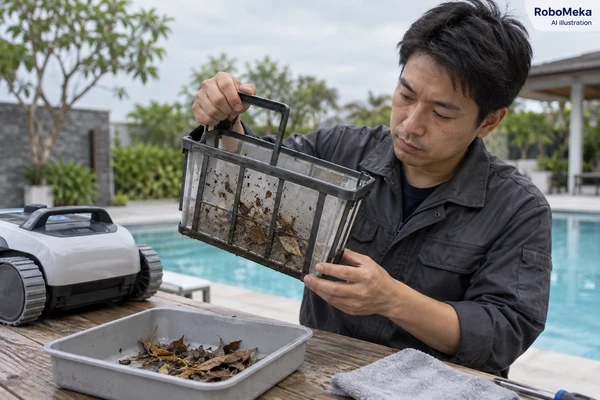
Consider a hypothetical distributor serving suburban pools near trees and enclosed courtyard pools that mainly collect fine settled dust. No field results are assumed. The purchasing team is considering one compatible robot platform with two supported filter options and wants to decide which bundle belongs in each channel.
For the tree-adjacent profile, the team defines a routine mixed-leaf scenario and a separate heavier seasonal scenario. It records complete-cycle coverage, required basket cleaning, and owner handling. For the courtyard profile, it defines an observable settled-dust task and records whether the traveled surfaces meet the agreed appearance criterion after the cycle.
The worksheet has six decision fields: application, installed filter, alternate filter, permitted maintenance, unresolved evidence, and proposed sales wording. A conditional approval might state that the routine tree-pool application is acceptable while seasonal opening remains unverified. This wording is more useful than a blanket statement that the robot handles all debris.
The commercial comparison then adds accessory purchase cost, inventory complexity, dealer training, and replacement availability. These are company-specific inputs, not market estimates. If carrying both filters increases support complexity, the team can simplify the bundle or improve identification before launch. The right answer follows the evidence and channel requirements.
Control replacement parts and shipment inspection
Keep identifiers visible and consistent
Assign a purchasing identifier to each approved filter assembly and accessory pack. Match it across the purchase order, parts list, packaging, and dealer ordering system. Similar-looking panels should not share an ambiguous description such as premium filter when the underlying fit or material differs.
Ask how the supplier communicates revisions. A change to a latch, frame, panel, or included adapter may affect compatibility even when the product name remains unchanged. Agree which changes require renewed fit checks or application evaluation. Keep photographs of the approved assembly alongside the written specification.
Check the ordered bundle at shipment
Pre-shipment inspection should confirm that the agreed filter type, quantity, instructions, and accessory labels are present in the sampled units. This does not establish microscopic capture performance. Treat lot checks and design validation as separate evidence, with separate acceptance criteria and records.
For background on discussing production controls, use our manufacturing information. Request project-specific evidence rather than treating a factory description as proof that every filter claim has been independently verified. The purchasing record should show what was checked, who reviewed it, and what remains open.
Write product claims that dealers can defend
Describe a supported application and configuration instead of announcing that one filtration number makes the product superior. Appropriate wording identifies the included filter, the optional compatible accessory, and the cleaning task each is intended to address. Where the result is based on an internal trial, retain the conditions and avoid implying universal performance.
Keep filtration separate from wall capability, pool sanitation, and energy claims. Maytronics' pool selection FAQ considers several application inputs, including surface and cleaning scope. Your product page should likewise avoid using an impressive filter specification to cover unrelated selection questions.
If power architecture remains undecided, review our corded versus cordless pool cleaner guide. Then return to filtration as its own approval item. Customers need a clear connection between debris, the supplied basket, routine care, and available replacement parts.
Frequently asked questions
Is the lowest micron rating always the best choice?
No. Choose a supported filter for the intended debris and maintenance routine, and ask how any numerical rating was established. A lower advertised number does not independently prove better completed-cycle cleaning. Compare the correct assembly under representative conditions and include cleaning effort, compatible accessories, and replacement availability in the decision.
Can we offer different filters for different seasons?
Yes, when the exact robot supports those options and the instructions explain their use. Confirm part numbers, inclusion in the bundle, and replacement ordering. A seasonal accessory should have a clear purpose and a simple identification method, so owners do not install an incompatible panel or assume every filter works identically.
Does a clean-looking filter need further attention?
Appearance alone may not establish that the filter is ready for use. Follow the selected model's cleaning and inspection instructions, including its stated replacement indicators. Record persistent performance concerns after permitted care and ask the supplier for guidance. Do not substitute aggressive cleaning methods taken from an unrelated filter design.
Should shipment inspection verify the micron claim?
Routine shipment inspection can check filter identity, fit, quantity, condition, and packaging against the approved specification. It does not automatically verify a particle-capture rating. Supporting that claim requires an applicable method and suitable evidence for the actual component or assembly, with the scope clearly distinguished from ordinary visual lot inspection.
Conclusion
Robotic pool cleaner filtration is best purchased as a complete application and service package. Define the debris, approve compatible assemblies, evaluate the intended task, and make maintenance understandable. Numerical claims become more useful when their evidence and boundaries are clear. Replacement control then helps preserve the approved configuration after the first sale.
Send your pool-cleaner filter requirements to prepare an inquiry brief covering debris profiles, destination market, quantity range, and desired accessory options. The current form prepares a downloadable brief; email it with supporting pool photographs to info@RoboMeka.com for a configuration discussion.