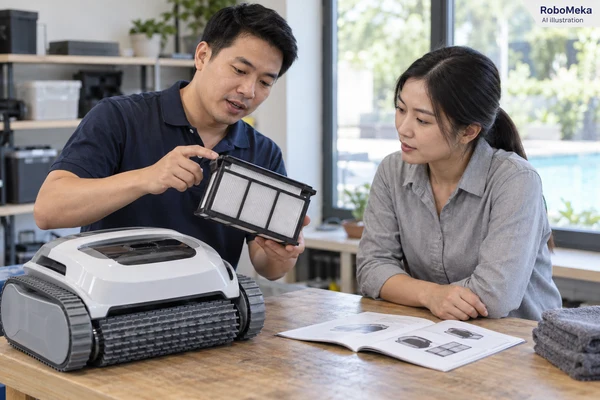
The short answer
Post-cycle care should isolate the robot, use approved retrieval, capture bulk solids, rinse the exact filter as its manual directs, inspect frames and media, and follow local disposal rules. A clear rinse stream does not establish disinfection, water quality or swimming safety, and damaged filters should be replaced with model-matched parts rather than patched.
Introduction
The right post-cycle routine is simple in principle: stop and isolate the robot, retrieve it by the approved method, drain it on a stable surface, empty captured debris into an appropriate waste container, rinse the filter as the manual directs, inspect it, and reinstall it correctly. The exact sequence and permitted cleaning method depend on the model; a generic hose-and-go assumption can damage a fine panel or expose the operator to moving parts.
This guide provides a proposed buyer and dealer workflow. It does not claim that rinsing disinfects equipment, makes pool water safe, or removes chemical hazards. It is not a record of RoboMeka service work. Unknown sharp, biological, or chemical material requires the pool operator's established safety and waste procedures rather than improvised handling.
Why post-cycle handling belongs in product selection
A filter basket is handled after almost every useful cleaning cycle. Access height, latch force, loaded weight, drainage, debris release, mesh durability, and replacement availability affect the real ownership experience. A buyer who compares only suction and runtime can miss the task operators perform most often.
A full basket can also change robot behavior. Broad leaves can cover filter surfaces, fine material can restrict flow without making the basket look full, and wet debris can make retrieval heavier. Cleaning restores the filter to its intended service condition, but it is not proof that the robot has cleaned the pool completely.
The Maytronics filter-cleaning FAQ recommends cleaning after each cycle for the covered Dolphin filters, shows basket or panel removal and water rinsing, and adds model-dependent notes for ultra-fine, bag, and cartridge filters. Those instructions should not be transferred wholesale to another model or material.
Start with safe shutdown and retrieval
No swimmer or bystander should be in or near the operating cleaner. End the cycle with the approved control, wait for moving parts to stop, and isolate the equipment as the exact manual requires. For a corded cleaner, switch off and unplug in the prescribed order. For a cordless unit, use its approved off or safety state before opening any cover.
For corded equipment, the supply arrangement must already comply with the model manual, applicable local code, and a qualified electrician's direction. There is no universal outlet distance or deck arrangement. Never handle plugs, power supplies, or connectors with wet hands, and do not service a unit that remains capable of starting.
Retrieve by the manufacturer-approved cable, handle, hook, or lift points. A floating cable may be permitted to draw some robots to the edge but not to lift their weight. A loaded basket increases the strain. Allow water to drain in the prescribed orientation and use a stable stance; do not twist or reach over a slippery coping edge.
Prepare a controlled cleaning area
Choose a firm, shaded, slip-resistant surface with drainage and waste handling appropriate to the site. Keep the robot away from the pool edge while the lid is open so removed debris cannot fall straight back into the water. Protect connectors and the power unit from spray.
The cleaning location should keep runoff away from electrical equipment, food areas, play spaces, public walkways, and sensitive landscaping. Local rules may restrict where pool-related rinse water or captured material can go. The site operator is responsible for those requirements; a dealer should not promise that a particular drain, gutter, or garden area is acceptable everywhere.
Have the ordinary tools allowed by the manual ready. These may include a hose, a waste container, and appropriate gloves for routine debris. Do not introduce a pressure washer, wire brush, solvent, bleach, detergent, or pool chemical unless the exact manufacturer instruction permits it. Stronger cleaning is not automatically better cleaning.
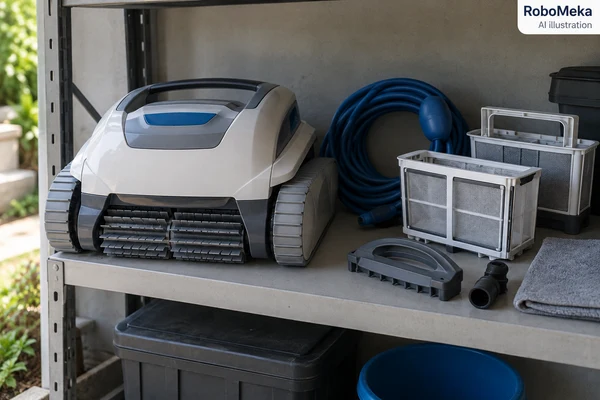
Open the filter only after isolation
Follow the actual latch sequence
Top-load baskets, bottom-load cartridges, and filter bags open differently. Read the diagram before forcing a lid. A latch that resists may be packed with debris or still under load. Rocking, prying, or striking it can crack the frame and create a poor seal at the next cycle.
The Maytronics Liberty filter-basket instructions show a model-specific sequence: open the cover, lift the basket, release the bottom lid, remove debris, and rinse the filter from inside and outside. The same manual emphasizes quick rinsing after removal to prevent debris hardening. It is an exact source for that listed robot, not a universal direction to open every basket bottom.
Support the loaded basket
Wet leaves, acorns, sand, and water can make a basket heavier than it appears. Lift by the designed handle and support it over the prepared area. Do not hold a filter by delicate mesh or pleated panels. If the load is too heavy or contains an unexpected object, set it down and use the site's safe-material procedure.
Observe whether debris falls back through an inlet flap or bottom door during removal. Backflow may explain why a clean-looking robot leaves a pile near the retrieval point. Record the event for support rather than holding the basket closed with an improvised clip.
Separate debris before rinsing
Empty bulk material into the chosen waste container before applying water where the basket design allows. This reduces the amount of leaves, twigs, insects, and sediment sent into drainage. Open the release over the container and use gravity; do not beat the basket against a wall or deck.
Ordinary leaves and natural material still need disposal according to local rules and site policy. Pools can also collect sharp fragments, animal waste, dead animals, personal items, chemical residues, and other unknowns. Do not sort such material by hand. Isolate the area and use the responsible operator's protective and waste procedure.
Do not make hygiene claims from appearance. A clear rinse stream does not show that a filter is disinfected, and ordinary fresh-water rinsing does not establish swimming-water quality. Pool treatment, contamination response, and reopening decisions belong to qualified pool professionals and relevant health guidance.
Rinse in the direction and pressure the manual allows
Many baskets benefit from rinsing from the clean side toward the dirty side so lodged material leaves rather than penetrates deeper, but the exact panel design governs. Follow the model diagram. Rotate the basket slowly and rinse seams, corners, hinges, and latch channels without directing spray into electrical connectors or sealed compartments.
Rinse only as the exact manual permits; do not use a pressure washer unless the manufacturer expressly approves it for that component. The Hayward TigerShark manual provides product-specific filter instructions and safety information for its named models; buyers should use that manual for those products and the relevant manual for any other cleaner.
Rinse water may remain cloudy when very fine particles are embedded. Repeat only within the approved procedure. If the filter no longer cleans to the manufacturer's acceptance condition, has persistent restriction, or requires chemicals not authorized by the manual, replace or escalate it instead of improvising.
Inspect before reinstalling
Check the filter media and frame
Look for tears, punctures, separated seams, warped frames, cracked hinges, damaged handles, and loose panels. Check whether the mesh or pleats remain seated and whether the bottom door closes evenly. Use the manual's replacement criteria where provided.
A hole can release collected debris; a warped frame can bypass unfiltered water; a stiff latch can fail to close fully. Do not repair media with glue, tape, stitching, or a generic screen. Obtain the exact approved replacement part for the model and hardware revision.
Check the robot cavity without reaching into moving parts
With the machine safely isolated, visually inspect the basket chamber for ordinary loose debris as allowed by the manual. Do not place fingers or tools into an impeller, belt, track, brush, or concealed opening. If material is beyond the owner's permitted access, use authorized service.
Confirm that seals, flaps, and guides are present and seated without dismantling them. A misplaced panel or basket can cause bypass or prevent the lid from closing. If reinstallation requires force, stop and verify orientation; do not clamp the lid shut over a misaligned filter.
Establish a repeatable post-cycle record
Dealers evaluating samples should record the debris type, approximate load, filter configuration, cleaning cycle, loaded handling, release behavior, rinse time, visible condition, and replacement concerns. This creates useful experience without inventing laboratory precision.
| Observation | Procurement value | Caution |
|---|---|---|
| Basket releases debris cleanly | Supports routine handling assessment | Does not prove sanitation |
| Mesh rinses clear under approved method | Supports readiness for another cycle | Does not establish remaining filter life |
| Panel remains discolored | May justify support review | Color alone does not prove blockage |
| Frame or seam is damaged | Supports replacement decision | Do not patch an unapproved repair |
| Debris returns during retrieval | Supports retention review | Does not prove an inlet-flap defect |
A proposed factory handling check can verify access, latch operation, part identity, and an approved rinse routine on a clean sample. It should not be presented as a contaminated-field simulation or customer project. Shipment inspection can confirm basket part numbers and spare quantities but cannot establish service life.
Send your filter-handling requirements to request a proposed sample evaluation brief. Include expected debris, operator environment, cleaning frequency, water access, local disposal constraints, desired spare parts, and the exact model or filter type under consideration.
Match the routine to the debris type
Large leaves and acorns call for easy bulk emptying and inspection for bridging or impact. Fine sand and silt may require more careful rinsing of pleats or mesh. Hair and fibrous debris can wrap around accessible areas, while sticky or oily residues may fall outside ordinary water-rinse instructions.
Use the large leaves and acorns guide for inlet and loading decisions, and the sand, silt, and algae guide for fine-particle expectations. A filter chosen for one task may demand a different cleaning frequency from another.
Do not combine unknown material with household laundry or dishware. Some manufacturer manuals permit particular machine-cleaning methods for specified filter bags or cartridges, while others do not. Apply only the instruction for that exact component and consider the site's hygiene separation policy.
Decide when a filter needs replacement
Replacement may be appropriate when the frame is warped, media is torn, seams separate, a latch no longer secures, panels do not seat, or approved cleaning no longer restores intended function. Manufacturer troubleshooting and service advice should guide the decision. Do not set a universal number of cycles.
Keep replacement filters identified by product number and compatibility. A similar-looking panel can differ in fit, media, or sealing. For OEM procurement, agree how revisions are controlled and whether old and new parts are interchangeable in writing.
Track failures by filter lot, robot serial or revision, debris environment, cleaning method, and date. This can reveal a handling or configuration pattern without claiming a root cause prematurely. Photos should show the part after safe removal, not an operator holding it above an energized open robot.
Design a dealer-friendly maintenance package
A useful package can include the correct illustrated manual, labeled replacement filters, a safe draining or caddy recommendation, and a short handover card that mirrors the manufacturer sequence. It should state what the operator may clean and what requires service.
The pool robot maintenance guide covers brushes, tracks, cable, storage, and broader after-use care. The caddy and storage guide helps plan where a drained robot and its supply go after the filter is serviced. Linking these routines reduces the chance that a clean basket is returned to a wet, sun-exposed, or unstable storage arrangement.
Provide a channel for part identification and unusual debris incidents. A customer who cannot identify the basket may order an incompatible panel or continue using a damaged frame. Clear support boundaries build trust more effectively than claiming the filter is maintenance-free.
Handle runoff and waste without universal claims
Disposal rules differ by municipality, facility type, and contamination. The safest general instruction is to capture bulk solids, minimize uncontrolled rinse material, and follow the local authority and site operator's requirements. Do not direct customers to a storm drain, sanitary drain, lawn, or compost system without verified local permission.
Commercial pools may have written procedures for bodily-fluid incidents, chemicals, sharps, or other hazards. A robotic filter basket does not change those procedures. Isolate the equipment and engage the responsible manager when collected material is outside normal leaves, insects, and soil.
Never tell customers that the robot, basket, or rinse process sterilizes pool water. A robot collects material within its design; it does not certify disinfectant residual, microbiological quality, or bathing safety. Those decisions require appropriate testing and qualified management.
Improve the workflow through sample evaluation
During product selection, ask several intended operators to perform the proposed routine on safely simulated ordinary debris. Observe reach, grip, latch clarity, splash direction, loaded handling, rinse time, and reinstallation. Keep the robot stopped, disconnected, and on a stable dry work surface.
Do not describe this usability proposal as a factory sanitation test. Its purpose is to find ambiguous instructions and handling burdens before launch. Revise the dealer guide only within the manufacturer's approved procedure; do not simplify away an isolation step.
Frequently asked questions
Should I clean the filter basket after every cycle?
Follow the exact model manual. Many manufacturers recommend cleaning after each cycle because retained debris can dry, restrict flow, or become harder to remove. Debris load may require earlier attention. Never open the cleaner during operation; stop and isolate it first.
Can I use a pressure washer or detergent on the filter?
Only if the manufacturer expressly permits that method for the exact filter. High pressure and chemicals can damage mesh, pleats, frames, or coatings. Ordinary manufacturer-approved water rinsing is the default for many models, but pressure and direction still matter.
Where should leaves and dirt from the basket be discarded?
Capture bulk solids in an appropriate container and follow local waste, wastewater, and site rules. Do not assume storm drains, sanitary drains, landscaping, or compost are acceptable everywhere. Unknown sharp, chemical, or biological material requires the responsible operator's hazard procedure.
Does rinsing the basket disinfect it or make the pool safe?
No. Rinsing removes visible material according to the equipment procedure; it does not establish disinfection, microbiological quality, chemical balance, or swimming safety. Qualified pool professionals and applicable health procedures govern water treatment and reopening decisions.
How can I tell when the filter needs replacement?
Use manufacturer criteria and look for tears, separated seams, warped frames, damaged latches, poor seating, or restriction that approved cleaning does not resolve. Confirm the exact replacement part by model and revision. Do not patch filter media with tape, glue, or generic screen.
Conclusion
Safe filter handling combines isolation, controlled retrieval, bulk-debris capture, manual-approved rinsing, careful inspection, correct reinstallation, and locally compliant disposal. It is a routine equipment-care task, not a hygiene guarantee. Buyers should evaluate the workflow and spare-part system as carefully as suction, runtime, and navigation.
Ask RoboMeka for a filter-handling and spare-parts review with your target model, expected debris, operating environment, preferred cleaning routine, local disposal constraints, and replacement-stock needs so a proposed evaluation can be prepared without unsupported sanitation or service-life claims.