The short answer
Use a robotic pool cleaner during seasonal opening only after the pool, equipment and water meet the manufacturer's operating requirements. Remove oversized debris with appropriate tools, let qualified professionals address water treatment, and inspect the filter during the initial workload. Evaluate routine cleaning separately from unusually heavy opening conditions before making capacity claims.
Introduction
The cover comes off after seasonal closure, revealing wet leaves in the deep end and sediment along the floor. A customer asks whether a new pool robot can clean everything before the weekend. For a distributor, the first decision is not which cycle lasts longest. It is whether the pool is ready for robotic cleaning and which parts of the opening job belong to other equipment or qualified pool professionals.
Use a robotic pool cleaner at seasonal opening only after the pool and water meet its operating requirements. Remove unsuitable oversized debris, inspect the installation, and agree how the first cleaning workload will be managed. A product selected for routine maintenance should not automatically be described as a recovery machine for a neglected pool.
This guide gives B2B buyers a staged opening brief, an evaluation framework and a way to set realistic customer expectations. The example is a proposed purchasing exercise, not a completed RoboMeka customer project. Keep people out of the pool during operation. A pool robot collects debris; it is not a sanitizer or a substitute for water-quality clearance.
Separate pool opening from routine maintenance
Seasonal opening can include cover handling, equipment inspection, restoring the normal operating arrangement, water testing and physical debris removal. Routine robotic cleaning is one possible task within that larger process. Treating the whole opening as a robot performance test confuses the product's role and can expose it to conditions the manufacturer does not permit.
Maytronics' summer-opening guide places cover cleaning, equipment preparation and chemistry review before the cleaner stage. For procurement, that sequence supports a readiness gate: establish suitable pool conditions before evaluating the robot. The guide is not a universal treatment recipe, and exact procedures still depend on the installation.
Ask customers what the pool looks like before discussing cleaning time. Is the water clear enough for the permitted operation and retrieval? Are there branches, stones or foreign objects on the floor? Has a professional inspected concerns about the liner, fittings or equipment? These questions identify preparation needs without making unsupported promises about what a cleaner can recover.
The opening brief should also state the business role. A dealer selling equipment to homeowners needs clear preparation instructions. A service company may need a cleaner that supports repeated approved tasks across a route. A private-label importer needs a defensible description of the intended workload. Those buyers may share a keyword while requiring different specifications.
Classify debris before choosing a filter or cycle
Large and potentially damaging objects
Branches, stones, sharp fragments and miscellaneous objects do not become suitable robot debris because they happen to be underwater. Remove them using appropriate pool tools and a safe method before a cleaner is deployed. Do not test pickup by adding hazardous items. If safe removal or identification is uncertain, involve an appropriate pool professional.
Record the distinction between excluded objects and supported debris in the sales brief. A large intake opening is not a guarantee that every object can pass through the cleaner without damage. The manufacturer must identify its intended use and limitations. Avoid a demonstration that measures how much abuse a sample can survive instead of its performance on a relevant task.
Loose leaves and plant material
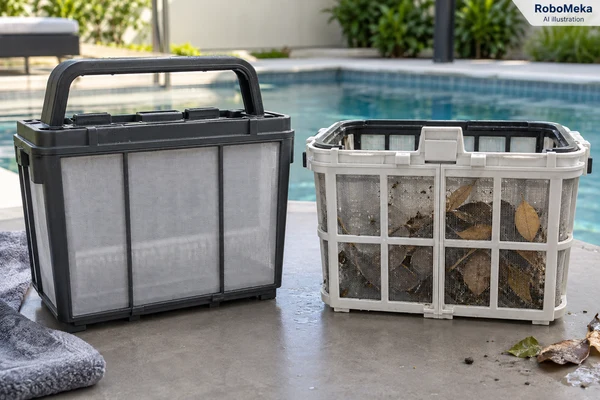
Scattered leaves create a different loading pattern from a compacted layer of wet material. Describe their distribution and whether preliminary manual removal is needed. The useful question is how the selected cleaner handles an approved residual workload and how often its basket requires attention, not whether the nominal cycle can run while the filter is already overloaded.
Do not use basket volume as a direct prediction of cleaning duration. Leaves vary in size, condition and packing behavior. Keep the test observations tied to the actual starting condition. A record showing frequent filter checks may still support a useful product, provided the handling workload fits the customer's routine and is explained honestly.
Fine settled sediment
Fine sediment raises questions about approved filter media, flow and visible collection. The goal is to recover material, not merely move it off the observed patch of floor. Compare before-and-after zones and inspect the basket using a consistent method. Do not claim a particular particle-removal threshold unless the exact filter and test evidence support it.
Read the separate pool robot filter selection guide when comparing coarse and fine media. For seasonal opening, the additional question is when to change the approved configuration as the workload changes. Any staged filter approach must use manufacturer-supported parts and instructions, rather than improvised fabric or inserts.
Establish a readiness gate before the first cycle
The readiness gate should confirm the pool's physical condition, the cleaner's condition and the water's suitability for the selected model. It is a project checklist, not a replacement for professional pool management. Where chemical correction is required, qualified pool professionals should determine treatment and when the cleaner may be returned to service.
| Readiness item | Evidence or observation | Action if unresolved |
|---|---|---|
| Pool structure and finish | No unresolved damage affecting the application | Refer to the pool supplier or professional |
| Large foreign objects | Appropriate preliminary removal completed | Keep the robot out until cleared |
| Operating water conditions | Confirmed within the exact model's limits | Obtain professional review and correction |
| Robot and accessories | Inspection completed after storage | Repair or replace through authorized support |
| Safe access | Deployment and retrieval method available | Resolve access before operation |
| People and pool use | Cleaning window controlled | Postpone the cycle until the pool is clear |
A cleaner brought out of storage deserves inspection before it enters the pool. Check the accessible components described in the manual, confirm that approved accessories are present, and follow the prescribed charging or power-supply preparation. Do not open sealed assemblies or make electrical modifications to overcome a startup problem.
Use the correct instructions for the product's storage history. A corded robot and a cordless model may need different preparation, and battery-storage requirements vary. An owner saying it worked last summer is useful history but not a current condition check. Record any missing part, visible damage or unexplained warning before agreeing to an opening trial.
Match filter servicing to the opening workload
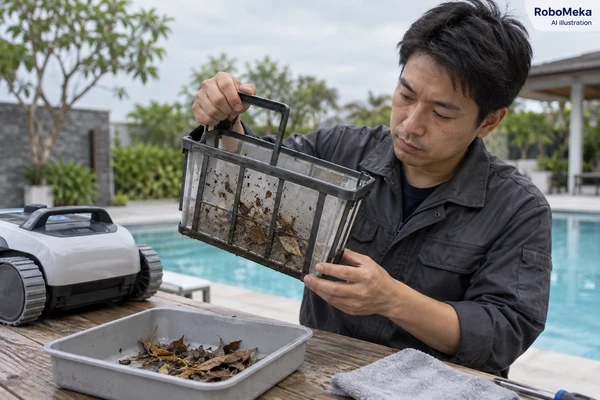
The first cleaning workload should be observed closely enough to identify when the filter needs attention. Do not assume a routine maintenance interval will suit seasonal debris. Follow the manual's inspection and cleaning requirements, and shorten the observation interval when the permitted workload warrants it. Stop and service the cleaner through the approved procedure.
Maytronics' maintenance guidance explains that clogged filters impede water flow and calls for filter cleaning after use. The purchasing implication is straightforward: filtration maintenance is part of usable performance. An advertised cycle duration does not establish useful cleaning throughout that period under every debris load.
Measure the operator's work as well as the robot's running time. A model that requires an inconvenient sequence to remove, rinse and replace the basket may impose more labor during opening. Conversely, a quick-access basket is only helpful if the approved filter arrangement also suits the debris. Evaluate those features together rather than scoring them independently.
The proposed opening configuration should identify the supplied basket, optional media and replacement part numbers. If a second filter is needed to support the intended routine, include it in the commercial comparison. A low base price can be misleading when the customer must immediately buy accessories required for the task described on the listing.
To define that opening workload before sourcing, send RoboMeka your seasonal pool-cleaning requirements. Include pool dimensions, typical opening debris, the preparation provided by the operator and the desired ongoing maintenance role so the sample brief can address the right task.
A proposed first-clean evaluation for a distributor
Consider a hypothetical distributor supplying homeowners whose pools close during colder months. The distributor wants to evaluate routine cleaners after appropriate opening preparation. The proposed test separates the residual opening workload from a later routine workload. It does not ask a sample to process an unknown layer of debris or establish that the pool water is safe.
Record the starting condition
Prepare a pool sketch with fixed observation zones and photographs from repeatable positions. Record the model, mode, approved filter, water conditions and preliminary debris removal. Describe what remains on the floor in practical terms, including its distribution. Avoid presenting a rough visual estimate as a measured debris mass or concentration.
Identify what counts as an intervention before starting. Retrieving the cleaner to empty a loaded basket, repositioning it and changing a filter are meaningful events. They may be expected within an approved opening workflow, but they must be recorded. A clean final image cannot show whether the job required one routine cycle or repeated operator assistance.
Observe the first permitted pass
Run the cleaner within its instructions with no people in the water. Record coverage, visible debris movement and any stop condition. Use normal access points to inspect progress; do not enter the pool or reach into operating equipment. If unexpected objects appear or the cleaner behaves abnormally, stop through the approved controls and investigate.
Inspect the filter and the remaining floor condition after the permitted pass. Compare collection with redistribution. A patch cleared near the start may reappear as suspended material settles, so choose observation timing consistently and explain it in the record. Do not turn a short visual improvement into a claim about complete filtration or water sanitation.
Repeat only with a clear purpose
A further approved cycle may help assess residual debris, but repetition should answer a defined question. Perhaps the buyer needs to know whether the remaining task is within normal maintenance scope or whether a supported finer filter is appropriate. Follow the manufacturer's operating and service limits, including any requirements between cycles.
If repeated cycles leave the same zone untouched, investigate access, geometry and cleaning scope. More runtime may not resolve an unsupported feature. For example, steps and shelves require their own assessment, discussed in pool robots for steps, benches and tanning ledges. Do not conceal a coverage limitation by reporting only an overall impression.
Compare with a routine maintenance condition
After the opening work and professional water management are complete, assess a representative routine workload separately. This second condition is often closer to the product's main customer use. Keep the two records distinct so a successful maintenance run does not appear to prove recovery performance, and an unusually demanding opening does not unfairly define everyday capability.
The resulting decision may be to approve the cleaner for routine use with explicit opening preparation. It may instead identify a need for another supported configuration or a different service workflow. Either outcome is more useful than declaring a sample powerful without specifying the conditions under which that judgment was made.
Write acceptance criteria that a supplier can answer
Specify the permitted pool types, cleaning zones, debris condition and accessories in the sample brief. Ask the supplier to identify exclusions before quoting. Agree how starting conditions will be recorded and how interventions will be reported. The cleaning-robot sample testing guide provides a broader framework for keeping comparisons reproducible.
Separate functional acceptance from marketing language. A functional record can state whether the robot completed a permitted mode, collected the agreed debris and could be serviced as instructed. A marketing statement such as handles spring opening needs a defined meaning. Require the proposed wording to match the evidence rather than stretching a narrow observation into a broad promise.
Do not demand a universal number of cycles to clean a seasonal pool. Starting conditions vary too much for that statement without a carefully defined test. If a supplier offers a number, ask which pool, debris, preparation and filter configuration produced it. Keep that context visible wherever the figure is used.
Prepare dealer support before the opening season
Seasonal demand concentrates questions about missing accessories, storage damage, charging and unexpected debris. Prepare a short support form that captures the exact model, pool condition and sequence already attempted. Photographs of accessible components and the installed pool can help, provided customers are not asked to open equipment or enter an unsafe area.
Keep consumable filters and approved replacement parts linked to the exact revision. Factory testing should confirm the agreed configuration and functions, while shipment inspection verifies that the relevant accessories and current instructions are packed. Neither activity establishes that the robot can recover a neglected pool outside its intended use.
The handover should explain when to stop trying additional cycles and seek assistance. Examples include unresolved damage, unsupported objects, operation outside the model's water limits or recurring abnormal behavior. This is practical product support: it helps dealers distinguish preparation issues, application mismatch and potential equipment faults without guessing from a single complaint.
Frequently asked questions
Can a pool robot replace all manual work at seasonal opening?
No. Opening may require cover cleaning, removal of unsuitable objects, equipment inspection and professional water management before robotic cleaning begins. The robot should perform its documented role within that process. A cleaner intended for routine debris removal should not be presented as a universal solution for every condition found after closure.
Should the finest filter always be installed for the first clean?
Not automatically. Choose an approved filter for the actual debris and follow the manufacturer's instructions. A large leaf workload and fine residual sediment may call for different supported arrangements. Assess loading and servicing needs during the proposed evaluation, rather than assuming that a finer nominal rating produces the best complete opening workflow.
How many cleaning cycles will an opening require?
There is no useful universal number. Preparation, debris quantity and type, pool geometry, filter condition and the model's capabilities all affect the task. Record the result after each permitted cycle and investigate persistent limitations. Any quoted cycle count should identify the conditions behind it and remain within the manufacturer's operating requirements.
Can a robot make green or cloudy water safe for swimming?
No. A robotic cleaner is not a sanitizer and cannot provide water-quality clearance. Have a qualified pool professional assess and manage the water, including whether robotic operation is appropriate. Visible debris collection must not be described as proof that the pool is safe to reopen or that treatment requirements have been met.
What should importers ask suppliers about spring-opening claims?
Ask for the exact starting condition, preliminary preparation, cleaner configuration, permitted operating limits and recorded interventions. Request a clear distinction between opening support and routine maintenance. Verify which filters and accessories were used, then make sure the delivered bundle and sales description match the documented evidence rather than a simplified demonstration caption.
Conclusion
A useful seasonal-opening product brief starts with readiness, separates unsuitable debris from the robot's intended workload, and includes filter servicing in the performance assessment. Evaluate the first-clean condition and routine maintenance separately. That approach gives buyers a clearer specification and gives dealers a practical explanation when a customer's pool needs preparation first.
For a configuration and sample discussion, contact RoboMeka with your seasonal opening brief. Share the destination market, pool applications, expected quantities and the preparation your customers can provide so the proposed cleaning scope is realistic from the beginning.