The short answer
Teach the complete model-specific routine, from permitted setup and retrieval to filter care, storage or charging. Keep owner maintenance separate from authorized service, identify replacement parts precisely and collect safe symptom records. Clear handover instructions support ownership without implying maintenance-free operation or making unsupported reliability claims.
Introduction
Robotic pool cleaner maintenance should be taught as a clear ownership routine: prepare correctly, operate within the manual, retrieve safely, care for permitted user-accessible parts, and recognize when service is required. For distributors, this routine belongs in the product launch plan. An attractive machine with unclear care instructions can create avoidable support work and inconsistent customer expectations.
The useful question is not simply how often to clean a robot. Buyers need to know which tasks the owner may perform, which tools or cleaning methods are permitted, how replacement parts are identified, and what information a service team needs when something changes. Those answers depend on the exact model and configuration.
This guide proposes a distributor handover and service-record framework. It does not report actual RoboMeka repairs, customer incidents, or reliability figures. The worked example is hypothetical. Always follow the selected model's instructions; do not apply another manufacturer's electrical, charging, chemical, or storage limits to the product in front of you.
What should a distributor teach at handover?
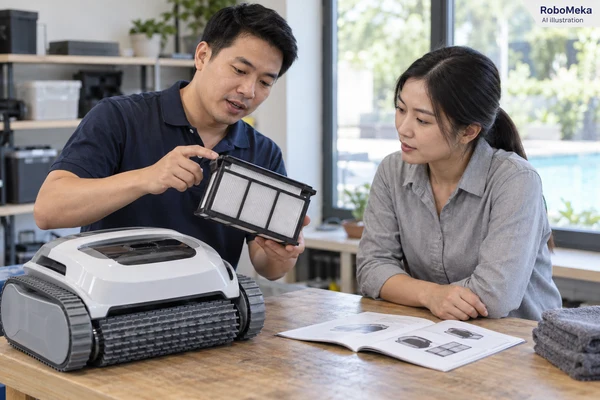
Teach the complete supported routine and the boundary between owner care and technical service. The owner should be able to identify the model, locate the correct instructions, prepare the approved operating arrangement, retrieve the robot as directed, clean the accessible filter, and explain a problem without dismantling sealed components.
Demonstrate the actual supplied configuration. If the sample has one filter but the retail bundle contains another, the handover may be misleading even when the outer robot looks identical. Match the robot, charger or supply, accessories, instructions, and replacement identifiers before creating training photographs or translated quick-start material.
Maytronics' Dolphin storage guidance addresses removal after cleaning and protected storage for its products. This illustrates why care continues after the cycle ends. It does not establish a universal storage temperature, power-supply position, or battery procedure for every pool cleaner.
Separate owner care from service work
Define permitted routine tasks
Use the manufacturer's manual to identify tasks intended for the owner. These may include cleaning a removable debris container, inspecting accessible parts, and storing the equipment correctly, depending on the model. List the relevant instruction section next to each task so the dealer can verify the procedure when questions arise.
Do not expand the owner task list because a technician finds a repair easy. Sealed housings, electrical components, batteries, charging equipment, and water-sealing arrangements require the appropriate authorized service process. A generic troubleshooting article is not permission to open, bypass, modify, or improvise repairs to those systems.
Define stop-and-escalate situations
Teach users to stop using equipment when damage, abnormal heat, unusual odor, exposed electrical damage, or other concerning conditions appear. Follow the manufacturer's isolation and service instructions. Do not ask a customer to reproduce a potentially unsafe symptom for a better video or repeatedly restart a unit that requires inspection.
The dealer should know where to route the case and what information can be collected safely. A clear escalation route is more useful than a long list of speculative fixes. Keep contact information and model identification easy to find on the handover record and the customer support page.
Design the after-cycle routine around the manual
Retrieve and drain correctly
Retrieval procedures vary by design. Confirm the approved method before the first use, including any retrieval accessory or function. Do not assume that a cord, charging connection, or decorative housing feature is a lifting point. The intended user should understand the sequence without needing to improvise at the pool edge.
Maytronics' removal FAQ describes power isolation and lifting by the handle for the Dolphin procedure it covers. Follow the selected robot's own instructions and allow draining as directed. Do not turn that model-specific example into a universal cable-pulling recommendation.
Include the handling environment in the demonstration. The deck should permit the approved procedure, and the user should have a suitable place for the drained robot and removed filter. If the site makes safe handling difficult, resolve that application issue before delivery rather than expecting the customer to adapt an unsupported method.
Clean only the permitted components
Identify which filter elements are removable and how their orientation is shown. Demonstrate the approved cleaning method and correct reassembly. A quick-start sheet can highlight the sequence, but it should reference the complete manual and should not invent shortcuts or stronger cleaning methods.
Maytronics' filter-care FAQ discusses cleaning after cycles and notes that fine particles may obstruct some filters despite a clean appearance. Use the evaluated model's procedure, including its replacement guidance. Washing-machine, dishwasher, pressure, or chemical advice must never be generalized across filter designs.
Inspect before putting the robot away
Follow the manual's user inspection points and check that accessible components are correctly refitted. Record damage or parts that no longer seat as intended. Do not force a closure, alter a latch, or add improvised sealing material to keep the machine in service. Request the correct replacement or service advice.
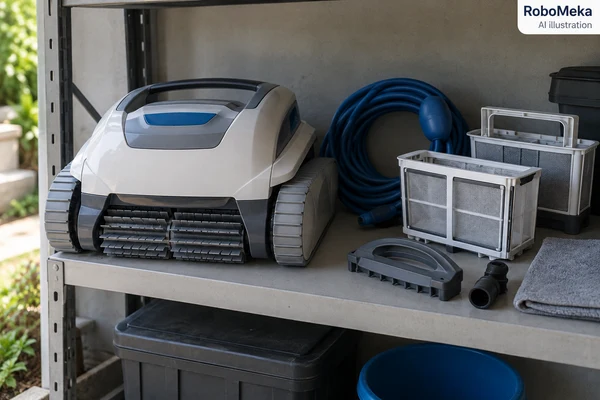
The owner should also know where to keep accessories so they remain associated with the robot. Mixing chargers, supplies, baskets, or retrieval tools from different products can create confusion and unsuitable configurations. Clear labels and a consistent storage location are practical distributor controls.
Build a maintenance handover matrix
| Ownership stage | Handover question | Dealer record |
|---|---|---|
| Before operation | Is the setup permitted for this model and site? | Manual revision and installation notes |
| End of cycle | Can the owner retrieve and drain it as instructed? | Demonstrated method and accessory identity |
| Filter care | Can the correct filter be cleaned and refitted? | Part number and instruction reference |
| Storage or charging | Is the approved arrangement understood? | Supplied equipment and model-specific guidance |
| Performance change | Can the user describe the symptom safely? | Fault intake form and support route |
| Replacement parts | Can the dealer identify the compatible item? | Model, revision, and approved parts list |
This matrix is a proposed distributor tool, not a maintenance standard. Complete it with the selected product's documentation. If a field remains unresolved, ask the supplier before launch. A translated instruction leaflet should not be used to conceal missing technical answers.
Treat charging and seasonal storage as separate topics
For cordless robots, obtain the exact charger identification, charging procedure, permitted environment, and storage instructions from the manufacturer. Follow those requirements without creating generic intervals or charge-level targets. Battery care can vary between designs, so advice copied from another cordless product may be inappropriate.
The Maytronics LIBERTY user manual is an example of product-specific charging and safety documentation. It should be used for the applicable LIBERTY configuration, not as an instruction sheet for a private-label robot. Request equivalent documentation for the actual product you intend to sell.
For both corded and cordless products, explain the approved off-season procedure and storage location. Record how the owner will protect and organize the robot, accessories, and supply or charger. Do not claim that leaving any cleaner permanently submerged is acceptable unless its own instructions explicitly support the intended arrangement.
Seasonal restart should also follow the manual. The owner may need to review accessible condition, part fit, and the approved operating setup after storage. Suspected damage or an unclear condition belongs with service support, not an improvised attempt to run the robot until the problem becomes obvious.
Prepare a distributor handover inquiry with your destination market, intended users, language requirements, and service model. Review the cordless pool cleaner and corded pool cleaner categories, then request care documentation for the exact configuration under discussion.
Collect useful fault information without remote guesswork
Ask for the identity and context first
Record the model, serial or batch identifier, purchase details, configuration, and instruction version where available. Ask what the robot was doing when the symptom appeared and whether anything changed, such as an accessory replacement or selected mode. These facts help service staff distinguish cases that sound similar in ordinary conversation.
Collect safe photographs of accessible areas and the displayed error information. Ask the owner to describe what happened, rather than to diagnose a pump, battery, or motor failure. Preserve their words and separate them from the dealer's interpretation. A symptom record is more reliable when assumptions are visibly labeled.
Record only permitted troubleshooting
If the manual allows a basic check, record the instruction followed, the result, and whether the symptom returned. Do not combine several actions and then claim that one of them solved the issue. If the permitted checks do not resolve the concern, escalate through the agreed support channel.
Avoid promising a warranty outcome before the responsible party reviews the case. Maintenance records can clarify events, but they do not automatically establish user fault or product defect. Apply the actual warranty terms and applicable obligations through the appropriate service process, without inventing exclusions in dealer scripts.
Hypothetical example: a change in cleaning performance
Consider a hypothetical owner who reports that a previously satisfactory robot now leaves debris behind. No cause or repair result is assumed. The dealer records the model, selected mode, pool conditions described by the owner, filter identity, and when the change began. The owner is not asked to open the machine.
The dealer then checks whether the manual permits a filter-care review and requests a safe photograph of the accessible assembly. If the owner follows the approved cleaning procedure, the action and subsequent observation are logged. If the issue persists, the record goes to the authorized service route rather than expanding into unsupported electrical troubleshooting.
The case worksheet separates original symptom, documented care, observed result, unresolved question, and next responsible person. This structure prevents a service conversation from becoming a chain of guesses. It also helps the distributor identify whether the handover material failed to explain a routine task clearly.
If several similar reports later appear, the distributor can review them for common configuration or instruction issues. That review would require actual records; it should not be presented as evidence of a known failure pattern before data exist. The hypothetical example illustrates a process, not a reported product problem.
Plan consumables and replacement compatibility
Identify parts by more than appearance
Maintain an approved parts list tied to model and revision. Include the supplier's identifiers and clear photographs where useful. A filter that looks similar may not fit correctly, and a charger with a familiar connector is not automatically compatible. Dealers should verify the exact item before supplying a replacement.
Ask how the supplier handles superseded components and whether an updated part requires additional instructions. Record compatibility decisions so each dealer does not have to rediscover them. Where interchangeability is uncertain, keep the request open until the responsible technical team confirms it.
Build stock around the service plan
Separate routine consumables from items requiring authorized repair. Estimate stock using the planned installed base, replenishment lead times, and actual service information as it becomes available. Do not invent failure rates to make a spreadsheet look complete. Begin with explicit assumptions and revise them when evidence accumulates.
Discuss service arrangements alongside manufacturing and quality controls. A factory description cannot establish spare-part availability, repair turnaround, or warranty coverage. Those commitments need a project-specific agreement identifying responsibilities, communication routes, and the records required for a service case.
Check understanding rather than only distributing a leaflet
Ask the intended user to explain the routine back in their own words and demonstrate permitted handling where appropriate. This is a proposed training method, not a test of customer competence. It reveals confusing labels, missing accessories, and instruction steps that a dealer may have skipped because they seemed obvious.
For translated materials, have technical terminology and warnings reviewed against the approved source manual. Keep illustrations aligned with the supplied configuration. A clear diagram of the wrong basket or charger can be more misleading than a longer correct explanation.
Separate the quick-start guide from service documentation. Owners need the supported daily sequence and escalation route. Service partners need the applicable authorized procedures and technical records. Neither audience benefits when its document implies permission to perform tasks outside the intended role.
Review support questions after launch and update explanations when justified by actual cases. Preserve document revision history so the team knows which instructions a customer received. Changes to advice should remain consistent with the manufacturer's requirements and the product configuration already in the field.
Keep maintenance claims proportionate
Avoid phrases such as maintenance-free or no owner effort when the product requires retrieval, filter care, storage, or charging. Describe the actual routine and the features that make it manageable. A clear expectation at purchase is more useful than a broad convenience promise that the handover later has to qualify.
Similarly, do not convert a simple care demonstration into a claim about years of durability or reduced return rates. Those conclusions require appropriate evidence. If buyers are still comparing ownership workflows, our corded versus cordless pool cleaner guide provides the broader selection context.
Frequently asked questions
How often should a pool robot filter be cleaned?
Follow the exact model's instructions and account for the debris encountered during use. Do not apply a universal interval across every basket or filter design. Include the approved cleaning procedure, inspection points, and replacement indicators in the handover, and ask for service guidance when permitted care does not resolve a concern.
Can owners repair a sealed battery or electrical fault?
Owners should not open sealed batteries, electrical housings, or other components outside the manufacturer's permitted care procedures. Stop operation when damage or concerning symptoms appear and follow the approved service route. A distributor should collect safe identification and symptom information without asking the customer to improvise a repair or reproduce unsafe behavior.
Can the robot remain in the pool between cleaning cycles?
Use the selected model's instructions to answer that question. Storage and between-cycle arrangements vary, and a generic convenience claim should not override the manual. Explain retrieval, draining, filter care, and storage or charging during handover so the owner understands the complete routine required by the supplied product.
What information should accompany a service request?
Include the model and identifying number, purchase details, supplied configuration, symptom description, displayed errors, and safe photographs where useful. Record any troubleshooting explicitly permitted by the manual and its result. Keep observations separate from guessed causes so the responsible service team can review the case without relying on an unsupported diagnosis.
Conclusion
A strong pool robot maintenance program makes permitted owner care clear and gives dealers a disciplined route for unresolved problems. Match the handover to the supplied configuration, control replacement identifiers, preserve service records, and keep charging and storage guidance model-specific. Those steps support a more understandable ownership experience without promising unsupported reliability outcomes.
Send your distributor service requirements to prepare a downloadable inquiry brief. Include destination market, quantity range, documentation languages, and proposed service responsibilities. Email the completed brief to info@RoboMeka.com to discuss model-specific care documentation and after-sales planning.