The short answer
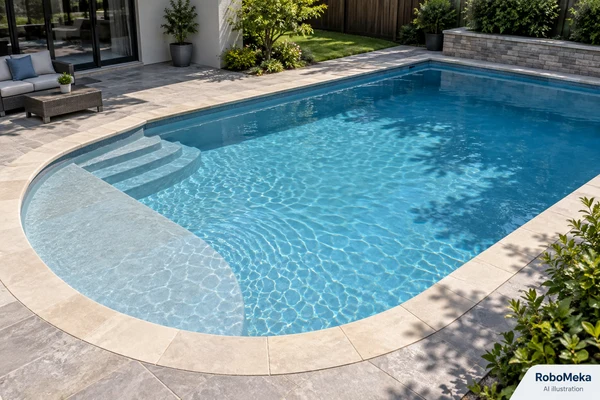
A freeform or kidney-shape listing is an initial qualification, not a guarantee of complete coverage. Buyers should map lobes, narrow waists, concave pockets, coves and slope transitions, define acceptance by cleaning zone, compare repeated approved cycles, and report stable residual areas without claiming to know hidden navigation logic.
Introduction
A pool robot labeled for freeform or kidney-shaped pools is a candidate, not a guaranteed coverage result. The buyer answer is to validate how the exact model reaches concave curves, broad coves, narrow waists, offset deep ends, and irregular wall transitions over repeated cycles. Pool length and area can qualify basic capacity, but they do not describe the routes that make irregular pools difficult.
This guide proposes a coverage-validation method for importers, dealers, and pool professionals. It is not a record of RoboMeka testing, delivery, or customer performance. It also does not cover steps, benches, or tanning ledges as the primary question. Those features need their own assessment even when they are part of a freeform pool.
What freeform and kidney shape mean for a cleaner
A kidney pool usually has two rounded lobes joined by a narrower waist, often with changing wall curvature. A freeform pool can combine convex arcs, concave pockets, asymmetric ends, coves, offset slopes, and nonparallel walls. Two pools with the same area and longest dimension can demand very different route behavior.
The navigation challenge is not that curves are inherently uncleanable. It is that the robot must distribute its travel across zones that do not provide regular straight-line references. A turn that works in a broad lobe may send the robot repeatedly away from a tight concave pocket. Wall-climbing behavior can also change where radius and slope change together.
Manufacturers sometimes list shape compatibility directly. The Maytronics Niya Tracker 25 product page, for example, lists rectangular, round, free shape, and kidney among pool attributes for that floor-cleaning model. That is relevant product information for the named configuration, not proof that it covers every irregular pool or every cleaning zone.
The Aiper Scuba N1 Plus dealer page also names rectangular, round, kidney, and custom-designed shapes for that particular model. Agreement between two product pages shows how manufacturers can define a shape field; it still does not convert the field into a universal coverage guarantee or transfer approval between products.
Keep shape, size, and feature questions separate
Pool sizing asks whether cable length, rated pool length, runtime, depth, and operating envelope suit the vessel. Shape validation asks whether travel reaches the actual lobes, curves, pockets, and transitions. A product can pass one screen and fail the other.
Use the robotic pool cleaner sizing guide for basic dimensions and power-source fit. Do not solve irregular coverage by automatically choosing the next size class. A longer cable or larger battery does not necessarily improve turn logic, contact on a cove, or access through a narrow waist.
Steps, benches, shelves, and tanning ledges create elevation and water-depth questions. Use the steps and ledges guide for those features. In this article, mark them on the pool map as excluded or separately evaluated so they do not distort the floor-navigation result.
Map the pool as cleaning zones
Divide the floor by geometry
Create a top-down drawing from construction documents or reliable measurements. Mark the left and right lobes of a kidney pool, the waist, shallow floor, slope, deep floor, wall-floor coves, and any concave pockets. For a freeform pool, create named zones that an observer can recognize during the cycle.
The map does not need survey-level precision to be useful, but uncertain dimensions must be labeled. Avoid estimating curves from one wide-angle photograph. The pool builder or qualified professional should confirm drawings where geometry affects product selection.
Mark transition lines
Robots often turn or change contact behavior at a slope break, cove, or wall transition. Record where the shallow floor begins to descend, whether the deepest area is centered, and whether the waist aligns with that slope. These lines help explain repeated paths without inventing a software diagnosis.
For surface approval and traction, consult the vinyl, fiberglass, and tile guide. Shape compatibility does not override surface limits. A robot designed for kidney pools may still require a particular brush or may not be approved for the installed finish.
Translate marketing terms into testable questions
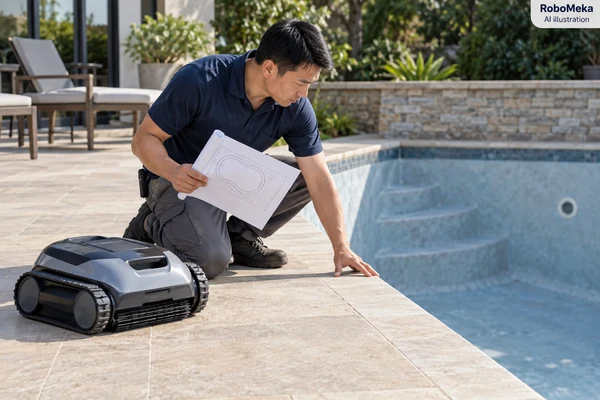
“Smart navigation,” “mapping,” “sonar,” and “systematic coverage” describe different implementations across brands. Ask what the exact model senses, whether it stores a persistent map, how it handles curves, which modes use navigation features, and whether the listed shape support applies to floor only or to walls and waterline too.
The Maytronics Wave 200 XL manual provides a useful model-specific example: it distinguishes rectangular and shaped pool profiles and offers scanning choices, with additional profiles configured by an official technician. That manual does not mean consumer models expose the same controls. It demonstrates why buyers should ask what “shape support” means operationally.
Do not treat a rendered coverage diagram as measured evidence. Ask for the conditions, model, cycle, starting point, and acceptance method behind any performance statement. If those details are unavailable, plan a representative sample evaluation rather than filling the gap with assumptions.
Define coverage before observing it
A useful criterion can distinguish gross zone reach, repeat access, debris pickup, and residual pockets. “Visited the area” means the robot entered a zone. It does not mean the brush contacted the full surface or that debris was collected. “Cleaned the pool” is too vague for a sourcing decision.
| Coverage question | Useful observation | What remains unproven |
|---|---|---|
| Did it reach every major zone? | Route enters each mapped lobe and pocket | Uniform cleaning within each zone |
| Did it repeat narrow-waist passage? | Multiple crossings in both directions | Performance from every start point |
| Did it contact concave coves? | Brush and tracks remain supported | Debris removal from the full curve |
| Did it leave a stable residual pattern? | Missed areas recur in mapped locations | Root cause in hardware or software |
| Did it finish without intervention? | No retrieval or redirection was needed | Equivalent result under another load or mode |
Agree what residual work is acceptable. A small manual touch-up in one pocket may be reasonable for one operator and unacceptable for another. The purchasing document should state that boundary rather than hide it inside a broad coverage claim.
Prepare a representative navigation trial
The pool should be in its normal approved operating condition. Remove only loose objects that the pool operator normally clears and that the robot manual identifies as preparation. Do not alter water level, circulation, fittings, or surface conditions to improve the route. Fixed obstacles require their own compatibility review.
Use a visible but safe test medium appropriate to the filter, distributed lightly across mapped zones. Avoid adding dyes, chemicals, excessive debris, or particles that may stain or enter circulation. Existing ordinary debris can also be mapped if its starting distribution is clear.
Keep swimmers and bystanders away from the operating cleaner. Observe from the dry deck and do not enter the water to redirect it. For corded products, use the approved supply and cable arrangement. Supply setup must follow the exact manual, local electrical requirements, and a qualified electrician; no outlet distance is universal. Stop, unplug or otherwise isolate the robot as directed before touching it, its cable, filter, or moving parts.
Use more than one permitted starting location over the evaluation series. A single favorable launch into a difficult lobe can conceal whether the robot naturally returns there. Record the start point, selected mode, cycle duration, filter condition, and any intervention.
Observe route behavior without claiming hidden logic
From a safe deck position, mark zone entries, waist crossings, long repeated paths, turns at curves, slope transitions, and periods spent in each major region. Video can support later review, but keep the camera wide enough to identify location. A close shot of the robot does not show overall distribution.
Describe only what can be observed. “The robot reversed at the concave wall and returned to the deep lobe” is valid. “The algorithm failed to map the radius” is a diagnosis that needs manufacturer evidence. Hardware, surface contact, filter loading, cable pull, and navigation logic can produce similar visible patterns.
For a corded cleaner, plot the cable route and any constraint separately. The corded cable guide helps distinguish poor reach caused by deployment from route distribution caused by the cleaner. A cordless comparison can remove that variable but introduces runtime and retrieval considerations.
Use repeated cycles to find stable misses
One cycle can show a serious problem, such as never entering a lobe, but it cannot establish a reliable coverage pattern by itself. Repeat the approved mode from realistic start points with a clean filter and comparable pool conditions. Record variation rather than selecting only the best result.
A stable miss recurs in the same mapped zone. A variable miss changes among zones across cycles. Stable misses may support a specific application boundary; variable misses may require a broader acceptance method, longer observation, or another model. Neither pattern alone reveals the root cause.
Do not invent a “percentage cleaned” from visual impressions. If quantitative coverage is required, define the grid, observation method, treatment of overlaps, surface zones, and uncertainty before testing. Otherwise, a map showing reached, intermittently reached, and consistently residual areas is more trustworthy.
Send your freeform pool drawing and coverage priorities for a proposed evaluation brief. Include reliable dimensions, curves and slope transitions, surface, desired zones, target model, power preference, and the amount of manual touch-up the customer can accept.
Evaluate curves and corners differently
A smooth convex curve may guide the robot gradually, while a concave pocket can cause repeated short reversals or leave a triangular residual area. A sharp inside corner in an otherwise freeform pool is another geometry again. Mark them separately rather than reporting that the cleaner “handles curves.”
Wall-floor coves affect how a cleaner begins climbing. A robot may clean a broad cove while failing to stay supported through a tighter radius. For models with wall capability, record floor coverage first and vertical coverage second. The wall and waterline guide provides a separate acceptance method for those zones.
Do not require a floor-only model to climb merely because its page lists kidney shape. Read the cleaning-coverage field together with shape. The Niya example above lists floor coverage; the shape attribute should be interpreted within that declared zone.
Account for debris and filter loading
Navigation observations can change when the filter loads and water flow or contact behavior changes. Begin each comparable cycle with the filter in the manual-specified condition and record the debris load. If movement deteriorates broadly late in a cycle, do not label that a freeform mapping failure without further review.
Use the filter selection guide to match media to ordinary debris. Keep large leaf, sand, and algae questions separate from the initial navigation check. The objective is to determine whether geometry is covered, not to overload the robot and then infer route limitations.
If the target market has a characteristic debris pattern, add it in a later representative phase. A lobe beneath a tree may fill the basket before the robot reaches the other end. That is a combined workflow issue requiring a suitable cycle and emptying plan, not proof that kidney shapes as a category are unsupported.
Compare candidates using the same pool map
Run each approved candidate under comparable conditions and plot its zone reach, repeatability, residual areas, intervention, retrieval, and operator time. Do not reward a longer runtime automatically; more minutes in one lobe may not improve whole-pool distribution.
A narrower robot may enter a tight pocket but cover broad areas more slowly. A larger robot may traverse open lobes efficiently but miss a concave corner. The best candidate is the one whose observed pattern and operating workflow match customer priorities, not necessarily the one with the strongest generic navigation claim.
Compare the exact production configuration. Tracks, brushes, firmware, filter, cable, and mode selection can matter. If a supplier changes one after sample approval, review whether the route evidence remains representative.
Create a defensible factory and shipment plan
A factory can run a proposed shaped reference fixture to compare units, but a fixture should have documented geometry and limitations. A simple oval is not a proxy for all kidney pools. State that the check verifies consistency in the fixture rather than customer-pool coverage.
Factory testing might confirm turning, sensor response, drive consistency, and completion of a reference path. It should not be described as proof of a proprietary algorithm unless the supplier provides that evidence. Do not invent map screenshots, coverage percentages, or certification.
Shipment inspection should verify model, revision, brush or track type, filter, cable length, supply, firmware-identification method if applicable, manual, and retrieval accessories. A visual inspection cannot prove navigation, but it can stop an unreviewed substitution from reaching the field.
Write the dealer claim at the right level
A sound claim says that the exact model is listed for specified pool shapes and that coverage should be validated against individual curves, transitions, surfaces, and zones. If a representative trial exists, describe the observed pool and method. Do not promise zero missed spots or complete coverage for every freeform pool.
State whether the model covers floor only, floor and walls, or floor, walls, and waterline. “Suitable for kidney pools” without the cleaning-zone boundary can mislead a buyer. Keep step, ledge, drain, and overflow exclusions visible.
Provide an escalation process for stable missed zones. The dealer should request a pool map, safe video, model details, mode, filter state, and cable setup rather than telling the customer to keep restarting. Support evidence can lead to a revised starting routine, manufacturer review, model change, or honest application exclusion.
Frequently asked questions
Do all robotic pool cleaners work in kidney-shaped pools?
No. Some models officially list kidney or freeform shapes, while others are intended for simpler pools. Even a listed model needs validation for the actual curves, waist, slopes, surface, and requested cleaning zones. Confirm the exact product page and manual before purchase.
Is pool length enough to choose a robot for a freeform pool?
No. Length helps qualify cable, runtime, and model range, but it does not describe concave pockets, offset lobes, coves, narrow passages, or slope transitions. Use a top-down zone map and repeat coverage observations alongside the sizing check.
How many cycles are needed to judge navigation?
There is no universal number. Use enough comparable approved cycles and start positions to identify stable and variable residual areas. One cycle can disqualify an unsafe or clearly unsuitable setup, but a favorable single cycle does not prove repeatable whole-pool coverage.
Does smart mapping guarantee that no spots are missed?
No. “Mapping” and “smart navigation” vary by product, and real coverage depends on geometry, surface contact, mode, filter state, cable conditions, and other factors. Ask what the exact feature does and validate the zones important to the customer.
What should I send a supplier when one lobe stays dirty?
Send the exact model and revision, a pool drawing with the residual zone marked, dimensions, surface, slopes, selected mode, start point, filter condition, cable deployment, cycle history, and safe wide-angle video. Report observations without guessing that software or motors caused the pattern.
Conclusion
Freeform and kidney pools require route evidence, not just a size rating or shape label. Map the lobes, waist, curves, coves, and transitions; define coverage by zone; repeat approved cycles; and separate navigation from steps, surfaces, filters, and cables. The result should be a clear operating boundary rather than a universal promise.
Ask RoboMeka for a freeform-pool coverage review with your verified pool plan, surface, cleaning zones, target model, power preference, debris profile, and acceptable residual work so a proposed sample evaluation can focus on the geometry that matters to the purchasing decision.