The short answer
Verify pool steps, benches and tanning ledges as individual cleaning zones. Confirm model support, geometry and water depth, then distinguish reaching a feature from cleaning and collecting debris there. Wall climbing alone does not establish shallow-feature performance or remove remaining manual care.
Introduction
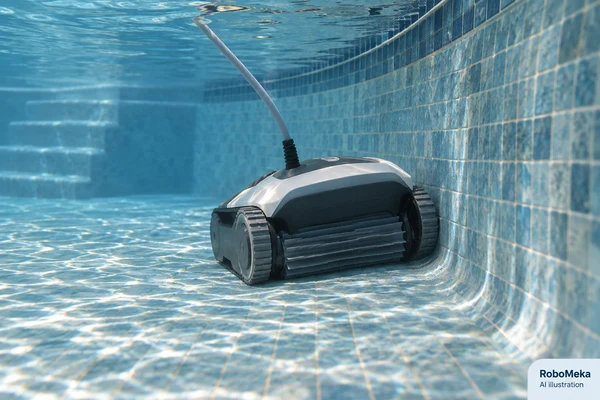
A pool robot can climb a vertical wall and still leave the neighboring entry steps dirty. For a distributor, that difference matters before the customer opens the box. A photograph showing the cleaner at the waterline does not establish that it can cross a step, remain submerged on a shallow shelf, turn on a narrow bench, or collect the debris it dislodges there.
Some models specifically address these features; others exclude them. The useful purchasing question is therefore precise: which steps, benches, and tanning ledges can this configuration clean, under what conditions, and what work remains for the owner? That question produces a defensible product recommendation and a clearer sales description.
This guide explains how to build that decision from a pool sketch, manufacturer documentation, and a proposed sample evaluation. The examples are hypothetical purchasing scenarios, not records of completed RoboMeka testing or customer installations. All operation must follow the selected model's instructions, with swimmers out of the pool during evaluation.
Can a pool robot clean steps and tanning ledges?
Only when the exact model supports the feature and the pool geometry meets its requirements. Wall climbing, waterline scrubbing, step access, shallow-water operation, and debris collection are different capabilities. A robot may perform one without performing the others. Buyers should specify each required area instead of using whole-pool cleaning as an undefined promise.
Maytronics' current stair-cleaning FAQ distinguishes robots with dedicated step-cleaning features from models without them. It also identifies depth and physical support as relevant limitations. That is a model-specific distinction, not evidence that every contemporary pool robot can clean every shelf.
Do not rely on an older category statement when a supplier has introduced a revised model. Conversely, do not transfer an updated model's features to older stock with a similar name. Ask for the precise model code, revision, operating mode, and applicable manual before approving a feature statement for a private-label product.
Describe the feature before assessing the cleaner
Entry steps have several dimensions
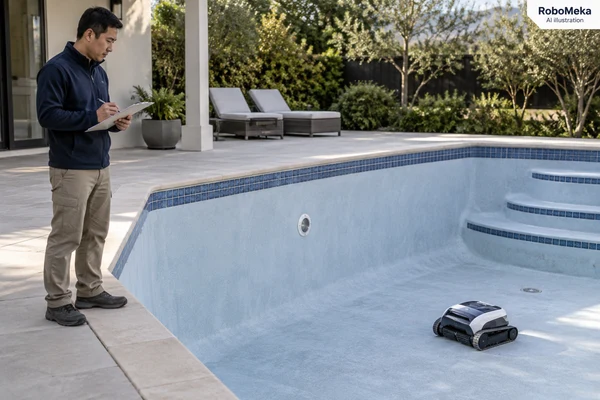
The horizontal tread is only part of the problem. Record tread width and depth, riser height, edge shape, and the water depth above each tread at the pool's normal operating level. Note whether the steps form a broad staircase, a curved corner arrangement, or a narrow ladder-like sequence built into the shell.
Use the pool builder's drawing or a safe measurement from the deck. Avoid estimating depth from a photograph because perspective and refraction can disguise the usable space. A step that appears broad enough may offer little room for the robot to establish contact before it must change direction again.
Benches require access and an exit
A submerged bench may extend along a wall yet connect to the floor through a difficult transition. Ask whether the cleaner can approach it, move along its usable length, and return without intervention. A successful climb onto one end does not establish that the full seat or its junction with the wall receives cleaning.
Record obstacles such as support columns, curved ends, handrails, and seat contours. Identify any area where the machine could become supported on only part of its footprint. These details belong in the supplier review; buyers should not improvise attachments or alter the robot to force access.
Tanning ledges combine shallow depth with large area
A tanning ledge can be spacious in plan view while still falling outside a robot's permitted operating depth. The water level may also vary during ordinary pool use. Ask the supplier which minimum depth applies to the advertised cleaning function, how it is measured, and whether the feature has additional shape restrictions.
Chairs, umbrella sockets, and changing shelf boundaries create a second set of questions. The proposed use case should show the ordinary layout, including items the owner can reasonably remove. A demonstration on an empty rectangular shelf does not establish coverage around a furnished ledge.
Separate access, contact, and collection
A useful evaluation tracks three outcomes independently. Access means the robot reaches the feature through its supported operation. Contact means the relevant cleaning components actually work across the intended surface. Collection means the target debris leaves the feature and is captured or otherwise handled as the approved cleaning method describes.
A machine can briefly reach a step, turn away, and leave its rear edge untouched. Another may dislodge debris through a supported flushing action without carrying its entire body across the tread. These mechanisms should be described accurately. Buyers do not need every model to operate identically, but they do need the customer promise to match the mechanism.
For related vertical-surface evaluation, use the pool robot wall and waterline testing guide. Keep its conclusions separate from shallow-feature results. A good waterline score should not automatically compensate for a required bench that the machine never reaches.
Build a feature-by-feature acceptance table
| Pool feature | Evidence to request | What a sample evaluation should record |
|---|---|---|
| Broad submerged step | Supported tread geometry and water depth | Access, time on tread, debris remaining |
| Narrow upper step | Explicit inclusion or exclusion | Whether safe supported operation is possible |
| Long wall bench | Entry and exit behavior | Length reached and persistent missed sections |
| Shallow tanning ledge | Minimum depth for that mode | Coverage at the documented operating level |
| Curved corner steps | Applicable shape limitations | Turning, reversals, and recovery |
| Shelf with fittings | Obstacle and clearance guidance | Avoided areas and required preparation |
| Separate raised spa | Separate application confirmation | Manual transfer or exclusion from scope |
Assign each row a status such as documented, evaluated under stated conditions, excluded, or unresolved. These labels prevent a single successful video from turning into approval for the entire category. An unresolved upper step should stay visible even if the floor and lower steps perform well.
The pool robot sizing worksheet can supply the broader site context. Attach the feature table to it so the overall pool dimensions, finish, access points, and cleaning window remain available to the technical reviewer.
Read supplier evidence with a purchaser's eye
Start with the supplied manual and a written feature description. Check whether the phrase step cleaning means surface travel, directed water movement, occasional contact, or a dedicated program. Request the conditions behind any demonstration, including the actual depth, finish, mode, firmware where relevant, and number of runs shown.
Maytronics' model-selection guidance treats pool shape, coating, and intended cleaning area as distinct selection inputs. Apply that discipline to your own buying brief. An appropriate model for one pool is not automatically appropriate for another with the same length.
A promotional clip is useful for understanding a mechanism but rarely sufficient for acceptance. It may omit the approach, failed attempts, manual repositioning, or final condition of the feature. Ask for an uninterrupted view of the relevant sequence and a clear account of interventions rather than requesting a more dramatic edited demonstration.
If your range includes shallow shelves or unusual entry layouts, send RoboMeka your pool-feature requirements. Include a dimensioned sketch, surface finish, normal water level, destination market, and the cleaning areas you want assessed so the product discussion can focus on documented suitability.
A proposed sample test that answers the real question
Agree on the supported setup first
The supplier and buyer should agree which features are within the sample's declared scope before the robot enters the pool. Use the specified filter, brushes, mode, and preparation procedure. Record the normal water level and confirm that conditions meet the manual. Do not lower water, disable sensors, or modify the cleaner to create an artificial result.
Keep the pool free of swimmers throughout the test. Position equipment and cables according to the manufacturer's instructions, and use the approved retrieval method if intervention is necessary. Where a feature is outside the documented operating range, record the exclusion without attempting to prove otherwise by experimentation.
Photograph the same areas before and after
Select consistent deck viewpoints that reveal the tread surface, bench ends, and shelf perimeter. Keep lighting and camera position as similar as practical. Mark the areas on a sketch instead of attaching improvised markers to the pool finish. If glare prevents a clear judgment, describe the observation as inconclusive rather than assigning a cleaning score.
Use only suitable, agreed test debris that will not stain, scratch, or contaminate the pool. Record its placement and condition. Natural debris observations can be useful, but changing wind and incoming material make comparisons less controlled. Keep those observations separate from a deliberately prepared sample evaluation.
Record interventions as part of the result
An operator may be tempted to reposition the robot beside a missed step and continue filming. If the manual permits repositioning, it can be evaluated as a separate assisted workflow. It must not disappear from the report. Count the interventions and explain when they were needed because that effort becomes part of ownership.
Likewise, distinguish a complete supported cycle from a short demonstration. One successful approach can show possibility; repeated independent cycles help reveal consistency. Agree the number of evaluation runs in advance, and retain unsuccessful runs. A small sample remains limited evidence even when its results look favorable.
Inspect the remaining task
After the cycle, identify debris left in corners, at step noses, along wall junctions, and around fittings. Record whether it was never contacted, moved to another area, or collected incompletely. These categories help the supplier understand the mechanism and help the buyer decide whether the remaining work is acceptable.
Avoid turning every observation into a numerical percentage. A claimed coverage value needs a defined area, measurement method, and repeatability. A clear marked photograph with named missed zones can be more decision-useful than a precise-looking figure derived from an observer's impression.
Interpret three possible purchasing outcomes
The feature is central to the sale
Consider a hypothetical retailer targeting modern pools with broad tanning ledges. If those shelves drive customer interest, shallow-feature performance is a qualification gate. A strong floor result cannot replace it. The retailer should require explicit support and representative evidence before positioning the product for that segment.
If evidence remains incomplete, the commercial choice is to narrow the target application, delay the claim, or evaluate another configuration. This is less costly than publishing a promise that customer support must later reinterpret. Price, appearance, and app functions should be compared after the essential application has qualified.
The feature is a small manual-care area
Now consider a conventional pool where the owner accepts occasional manual cleaning of a few entry steps. A robot that reliably handles the supported floor and walls may still fit well. The dealer should show the remaining task during handover and explain which tool or approved maintenance method the owner will use.
This is a legitimate product fit when communicated before purchase. Estimate the handling burden during evaluation rather than calling it negligible. A task that one owner finds simple may be inconvenient for another with restricted deck access or limited ability to reach the relevant area.
The feature creates recovery problems
A robot repeatedly requiring assistance at a bench needs a different assessment from one that simply leaves the bench untouched. Review whether the application is supported, whether setup is correct, and whether the supplier has an approved remedy. Do not accept a sales workaround that contradicts the manual or requires regular unsafe retrieval.
Record the consequence for the rest of the pool. A feature that repeatedly interrupts the cleaning cycle can affect an otherwise satisfactory floor result. The purchasing decision should therefore consider successful completion and recovery, not merely the amount of debris removed during uninterrupted segments.
Carry the findings into stock and dealer documentation
Translate the accepted scope into plain language. Name the supported areas and any material conditions nearby. Avoid placing a broad whole-pool claim in the headline while hiding step exclusions in a downloadable file. The product page, carton, manual, dealer script, and customer service response should tell the same story.
For production orders, retain the approved sample identity and the brush, drive, and software configuration where applicable. A supplier change affecting feature behavior should trigger review. Shipment inspection can verify model identity, included accessories, physical condition, and required documents; it cannot independently establish every installed-pool performance claim without the relevant evaluation.
Build a service intake question around the missed area. Ask whether the complaint concerns floor, wall, waterline, step, bench, or shelf. Request a safe photograph and the model details before recommending changes. This avoids treating every report of incomplete cleaning as a filter problem or navigation failure.
Give dealers a concise acceptance statement for each unusual installation. For example, a hypothetical statement could identify the lower bench as evaluated under recorded conditions and the upper entry tread as requiring manual care. The customer can then compare the offer with their actual priority. Keep that statement attached to the quotation so later discussions do not depend on recollection of a demonstration. If the pool layout or water level changes materially, review the affected feature rather than assuming the original result still applies.
Frequently asked questions
Does wall climbing mean the robot will clean pool steps?
No. Wall climbing establishes a different behavior from crossing a riser and cleaning a shallow horizontal tread. Check the exact model's step specification and the feature dimensions. Some designs provide dedicated step-cleaning methods, while others leave these areas for manual care.
Can a pool robot clean a tanning ledge with little water above it?
That depends on its documented minimum depth and supported shelf function. Do not infer shallow-water operation from a photograph or place the robot on an unsupported ledge to test it. Ask for the applicable limit and compare it with the pool's ordinary operating water level.
Is flushing debris off a step the same as vacuuming the step?
They are different mechanisms and should be named accordingly. A supported flushing feature may move debris into an area where the robot can collect it. Evaluation should follow the debris through the complete cycle, rather than judging success only by whether the original step looks clearer.
How should dealers explain areas the robot cannot clean?
Identify them before purchase and describe the remaining owner routine in practical terms. An annotated pool sketch helps. Connect that advice with the pool cleaner maintenance guide so manual care, filter cleaning, retrieval, and storage form one understandable ownership plan.
Can a new brush make an unsupported shelf compatible?
A brush change should only follow the manufacturer's approval for that model and application. It cannot be assumed to change depth limits, navigation behavior, or the geometry the cleaner can negotiate. Request written confirmation and evaluate the approved configuration if the supplier proposes a change.
Conclusion
Steps, benches, and tanning ledges need their own purchasing decision. Measure the feature, confirm model support, observe access and cleaning separately, and document the remaining task. That approach lets distributors sell capable machines with precise expectations and gives technical teams a useful basis for evaluating exceptions.
For a private-label or distribution project, contact RoboMeka with your feature-coverage brief. Share the pool layouts you expect to serve, the required cleaning zones, planned order quantity, and sample acceptance criteria to discuss an appropriate product review.