The short answer
Match the robot's documented application range to a complete pool profile, including dimensions, shape, finish, difficult transitions and retrieval access. Then check the required cleaning scope and ownership schedule. A matching length rating or longer runtime alone cannot establish coverage of every step, shelf or connected pool section.
Introduction
Sizing a robotic pool cleaner requires more than matching a pool's longest dimension to a catalog limit. Buyers also need to account for shape, depth transitions, surface compatibility, desired cleaning areas, operating access, and the time available for the complete ownership routine. A length rating is a screening input, not a guarantee that every feature of a pool will be cleaned.
For importers and distributors, the commercial goal is a repeatable selection process. Dealers should know what information to collect, which applications require technical review, and how to explain areas that remain outside the robot's supported scope. That process is especially valuable when a product range serves several pool shapes and different owner routines.
This article offers a proposed site worksheet and a hypothetical selection example. It does not report completed RoboMeka installations, measured coverage, or verified runtime. Manufacturer references support limited selection distinctions. Confirm all size limits, surface compatibility, operating conditions, and retrieval procedures against the documentation for the exact model offered.
How do you choose the right pool robot size?
Select a robot whose documented application range includes the pool, then verify that its supported cleaning functions and operating routine match the customer's actual requirements. Check geometry and access before treating nominal pool length as decisive. Where the documentation leaves an important feature unresolved, request clarification or arrange a representative evaluation.
Maytronics' model-selection FAQ identifies size, shape, coating, cleaning scope, and use preferences as selection inputs. Those categories provide a useful starting point, but they do not qualify another manufacturer's robot. Your purchasing file needs the proposed model's own limits and exclusions.
Keep the answer understandable for sales staff. A suitable model must fit the application, reach the intended areas through supported operation, and work within the owner's maintenance schedule. Additional features are useful only when they address a real requirement and can be explained without hiding unresolved compatibility questions.
Build a pool profile before requesting a model
Measure the basic geometry
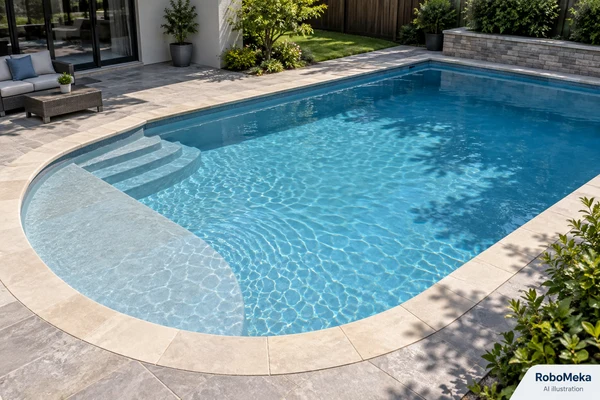
Record overall length, maximum width, minimum width at narrow sections, and the depth profile. A simple dimensioned sketch is often more useful than several attractive photographs without scale. Mark shallow and deep ends, sloping floors, separate lobes, and any restricted connection between sections.
For an irregular pool, do not assume that the bounding rectangle describes the cleaning task. Two pools with identical overall dimensions can present very different routes and transition demands. Record the actual layout and ask the supplier how its stated size recommendation applies to that geometry.
Mark features that need separate review
Identify steps, benches, tanning shelves, islands, raised areas, drains, and unusual wall-to-floor transitions. Distinguish connected water areas from spaces the robot is expected to reach without assistance. A raised spa or disconnected basin should not silently become part of one automatic cleaning promise.
Photograph the difficult features from useful angles. Include a scale reference where safe and practical, but do not enter the water or alter the pool merely to obtain a measurement. The responsible site operator can provide dimensions or construction information where direct observation is insufficient.
Define the desired cleaning scope
Write down whether the customer needs floor cleaning, supported wall cleaning, waterline work, or a combination. State any areas that will continue to receive manual care. This is not a weakness in the brief; it prevents a sales conversation from replacing a precise requirement with the phrase cleans the whole pool.
Ask how the customer judges completion. A pool service operator preparing for an opening time may have a different requirement from a homeowner performing regular maintenance between swimming sessions. The machine should be selected for that task, not for an imagined maximum workload unrelated to normal use.
Treat size ratings as model-specific boundaries
A catalog recommendation may be expressed as pool length, surface area, or a stated application category. Request the underlying conditions and read the accompanying qualifications. Do not convert between length and area using an assumed shape and then publish the result as the manufacturer's rating.
Likewise, do not calculate cleaning capacity by multiplying a brush width by travel speed unless a validated method supports that claim. Repeated travel, turning, transitions, and incomplete access can separate theoretical swept area from useful cleaning. A purchasing worksheet can include calculations, but its assumptions must remain visible.
Ask whether the quoted rating applies to floor-only cleaning or a broader mode, and whether a particular configuration is required. Record the answer with the model revision and source document. A salesperson's informal assurance should not override a clear limitation in the supplied instructions.
Compare the application with a selection matrix
| Pool input | Selection question | Action if unresolved |
|---|---|---|
| Overall dimensions | Is the pool within the documented application range? | Request model-specific confirmation |
| Shape and passages | Can the required sections be covered as intended? | Provide a plan and arrange evaluation |
| Surface finish | Is this coating approved for the configuration? | Obtain compatibility guidance |
| Steps and shelves | Are these explicitly included in the cleaning scope? | Define manual care or another solution |
| Owner schedule | Can the complete routine fit the available window? | Compare supported cycles and handling |
| Access and retrieval | Can the user operate and remove the robot correctly? | Review the site and approved procedure |
| Debris profile | Does the supplied filter match the task? | Specify compatible filtration options |
Use the matrix as a dealer intake form. A blank cell means the question is open, not that the application is acceptable. This simple convention prevents incomplete inquiries from turning into confident model recommendations before technical staff have reviewed the important details.
Match operating time to the real cleaning window
Include more than the advertised cycle
The available window should include preparation, the supported cleaning cycle, retrieval, draining, filter care, and storage or charging as instructed. Ask who performs those steps and whether that person is available when the cycle finishes. A robot can fit the pool dimensions while still fitting the owner's routine poorly.
For cordless models, request the charging and operating information for the proposed mode and configuration. For corded models, review the prescribed power-supply and cable arrangement. Neither architecture removes the need to inspect the actual cleaning result. Longer operation does not independently demonstrate better coverage.
Avoid turning maximum runtime into capacity
If a supplier lists a maximum runtime, ask what conditions produced it and how it relates to the intended task. Do not divide that figure by an assumed cleaning rate to create a new pool-size claim. Where the data are incomplete, a representative sample evaluation is a better next step than an invented capacity calculation.
Also ask about repeat-cycle instructions and maintenance between cycles. A customer who wants another run immediately may need a different workflow, but that decision must follow the product's permitted operation. No robot should be marketed as continuously usable merely because it connects to an external supply.
For a broader architecture comparison, read our corded versus cordless pool cleaner guide. The sizing decision should then return to documented limits, coverage requirements, and the customer's available working window.
Prepare a pool-sizing inquiry with a dimensioned sketch, surface finish, desired cleaning scope, and typical debris. Review our corded pool cleaner category and cordless pool cleaner category as starting points for configuration discussions, not substitutes for site qualification.
Review surface compatibility and difficult transitions
Pool finish is a separate selection input from size. The robot's intended brush and drive configuration must suit the documented application. Do not assume that a product approved for one finish has been evaluated on every tiled, coated, or textured surface. Ask for precise compatibility language and retain unresolved exclusions.
Transitions deserve attention because reaching a wall or crossing a floor change can affect whether a zone is serviced. Observe the route and result separately during a trial. A missed corner may require further evaluation; it should not automatically be diagnosed as insufficient motor power or an undersized battery.
Maytronics' climbing troubleshooting guidance illustrates that wall behavior can involve setup and operating conditions. Apply the selected model's guidance, and avoid treating every coverage issue as evidence that a larger machine is needed.
Include access, power preparation, and retrieval
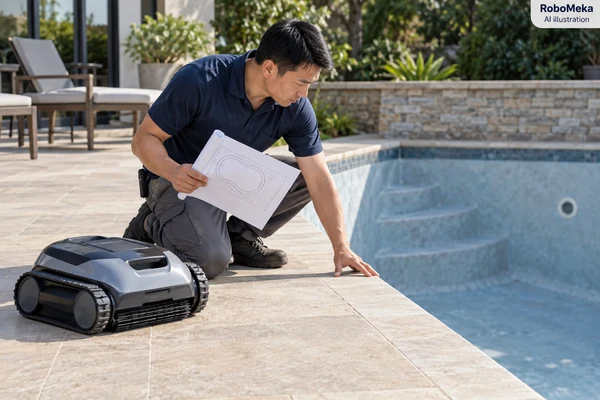
Document the usable deck space, storage route, permitted electrical arrangement, and intended retrieval point. A long pool with straightforward access may be easier to serve than a smaller pool surrounded by obstacles. Site suitability includes the person handling the robot, not just the surfaces beneath the water.
For a corded unit, have the installation arrangement checked against the manual and applicable local requirements. Do not assume the full cable length is available as a straight cleaning radius, or recommend extension arrangements without approval. Power-supply placement and routing are model-specific matters that belong in installation preparation.
For a cordless unit, confirm the approved charging location, charger identity, and retrieval method. Some products have model-specific retrieval features; others use approved accessories. The Dolphin LIBERTY 600 product page describes its own removal feature and supported surfaces. Those details are an example of configuration-specific information, not features assumed for every cordless robot.
Ask the intended user to review the handling sequence before purchase. High coping, a restricted path to storage, or difficulty reaching the approved handle may require a different site arrangement or product choice. Do not resolve those issues by recommending unsupported lifting techniques.
Hypothetical worksheet: equal length, different buying decisions
Imagine two hypothetical pools with the same overall length. Pool A is a simple rectangle with a consistent finish and accessible deck. Pool B has a narrow connection to a curved section, a broad shallow shelf, and limited retrieval access. The dimensions are intentionally unspecified because no actual model is being rated here.
A dealer first checks whether each pool falls within a candidate robot's documented range. For Pool A, the remaining questions focus on the desired cleaning scope, debris, and daily routine. For Pool B, the narrow connection, shelf, and handling route remain separate unresolved items even if the overall length is acceptable.
The worksheet records each requirement as documented, observed, excluded, or open. A hypothetical approval for Pool B could exclude the shallow shelf while requiring a trial of access to the curved section. That conditional decision may be appropriate if the customer accepts the remaining manual task. It is not equivalent to complete automatic coverage.
The distributor then uses the findings to create two dealer recommendations rather than one broad size slogan. This approach helps explain why two customers with similarly sized pools may need different configurations, different expectations, or additional evaluation before ordering.
Verify representative applications before expanding a range
Select trials around meaningful differences
Choose application scenarios that reflect the target customer base: geometry, finish, cleaning scope, debris, and access. Avoid collecting many nearly identical demonstrations while leaving the most common difficult feature unexamined. The number of trials should follow the uncertainty and intended claim, not a convenient marketing target.
Record the sample identifier, mode, filter, instruction revision, pool profile, and intervention history. Keep original observations and explain limitations. A trial proves neither unlimited durability nor every future production unit's performance; it supports a bounded application decision under the recorded conditions.
Connect approval to the supplied configuration
The purchase specification should identify the configuration used for approval, including accessories and relevant software version. Agree how substitutions or revisions will be reviewed. If the supplier changes a component related to the evaluated task, determine whether documentation review or renewed trials are needed before the change reaches customers.
Discuss these controls alongside manufacturing and quality planning. Factory location or production area cannot replace evidence for a particular pool application. Keep design qualification, shipment inspection, and dealer handover as connected but distinct steps in the procurement record.
Make the dealer recommendation easy to audit
Create a short recommendation sheet that includes the pool profile, chosen model, supporting documents, included accessories, exclusions, and unresolved questions. Identify who approved the recommendation and when. This provides continuity if a different salesperson later handles the order or a service team investigates a complaint.
Use clear language for uncertainty. Needs surface confirmation is more useful than probably suitable. Requires manual shelf cleaning is more informative than near-total coverage. A precise limitation gives the customer a decision; a vague qualifier merely postpones the disagreement until after delivery.
Review the sheet when the customer changes the requirement. A new pool extension, different cleaning schedule, or additional waterline expectation can change the selection decision. Do not assume that an earlier recommendation automatically covers a materially different application just because the product and customer names remain the same.
Frequently asked questions
Is pool length enough to choose a robot?
No. Pool length helps screen documented size limits, but shape, surface, transitions, desired cleaning areas, and access also matter. Collect a pool profile and compare it with the exact model's instructions. Treat unclear features as open questions rather than assuming a matching length rating guarantees coverage of every area.
Does a longer runtime mean a larger pool capacity?
Not by itself. Runtime describes operation under stated conditions, while useful capacity depends on the task and coverage achieved. Ask about mode, configuration, and test conditions, then evaluate the representative application. Include retrieval and maintenance in the owner's available window instead of converting time into an unsupported area rating.
Will a wall-cleaning robot automatically clean steps and shelves?
Do not assume so. Steps, shelves, and transitions need explicit model-specific review because their geometry and depth can differ from the main floor and walls. Ask which areas are included in the supported scope and document any manual care. A climbing demonstration elsewhere in the pool does not resolve those questions.
Should distributors recommend a larger model as a safety margin?
A larger nominal rating does not automatically solve surface, access, or geometry problems. First identify the unresolved requirement and ask whether the alternative model addresses it with documented capability. A margin may be a reasonable purchasing choice, but it should follow evidence and workload needs rather than replace application qualification.
Conclusion
The right robotic pool cleaner fits a documented pool profile and an achievable cleaning routine. Measure the geometry, define the required areas, check surfaces and access, and retain evidence for uncertain features. This gives distributors a repeatable recommendation process and helps owners understand both the supported result and their remaining maintenance tasks.
Send your pool dimensions and application requirements to prepare a downloadable inquiry brief. Include a sketch, destination market, quantity range, surface details, and preferred cleaning schedule. Email the completed brief to info@RoboMeka.com for a model-specific sourcing discussion.