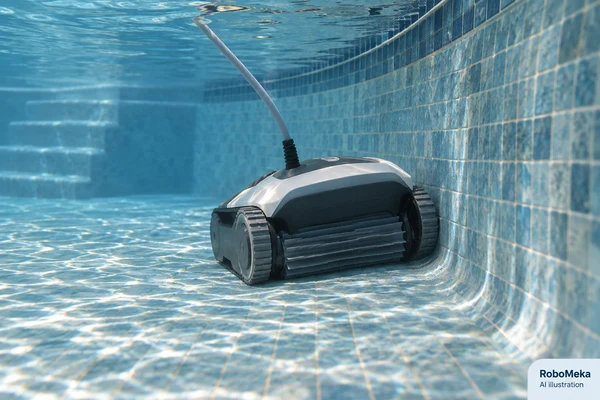
The short answer
Evaluate wall access, climbing, waterline traversal and cleaning results separately. Record the pool surface, geometry, supported mode, maintenance state and interventions before judging a sample. A short climbing video cannot establish complete waterline coverage or performance on every pool surface; preserve the limits of each observed application.
Introduction
A pool robot reaching the top of a wall is not the same as cleaning the complete waterline. For distributors, that distinction matters because customers often interpret a short climbing video as a promise of broad coverage and visible cleaning. A useful evaluation separates reaching a surface, maintaining contact, traveling across it, and removing the intended debris.
Wall and waterline claims also depend on the exact model, mode, pool construction, surface condition, and maintenance state. Importers should ask for evidence that matches the proposed sales application. A successful demonstration on one smooth rectangle cannot establish performance on every tiled, curved, or irregular pool in the target market.
This guide sets out a proposed buyer evaluation method for pool robot wall and waterline cleaning. It contains no claimed RoboMeka test results. The example is hypothetical, and the suggested records are purchasing tools rather than a published certification standard. Operate and retrieve the robot only as permitted by its own instructions.
What should a wall and waterline claim mean?
Define the claim as a set of observable functions. Wall access asks whether the robot reaches the specified wall area. Climbing asks whether it progresses along that surface as intended. Waterline traversal asks whether it moves across the relevant boundary zone. Cleaning asks whether the agreed contamination is removed from the areas actually contacted.
These functions should not be merged into one pass mark. A robot might repeatedly climb the same section while leaving other wall areas untouched. Another may reach the waterline briefly without providing the traversal the buyer expects. Reporting the individual observations makes the result useful for model selection and for honest dealer explanations.
Maytronics' selection FAQ treats floor, wall, and waterline cleaning as selection criteria. The practical implication is limited but important: confirm the exact model's intended cleaning scope before evaluating or advertising it. Do not infer waterline capability from a product photograph or a general category name.
Qualify the pool before judging the robot
Record geometry and surface finish
Create a simple plan showing straight walls, curved sections, corners, steps, shelves, and changes in depth. Mark the surface finish and any areas requiring separate review. Photographs should show the wall-to-floor transition as well as the waterline. A close-up of tile texture alone does not explain how the robot reaches it.
Identify coatings or surfaces the supplier has not approved. Request written clarification before running a sample on an uncertain finish. The purpose is to evaluate a supported application, not to discover compatibility by risking the customer's pool. Existing surface defects should be documented so they cannot later be confused with an observed trial outcome.
Confirm operating conditions and configuration
Use the manufacturer's stated operating limits and pool preparation instructions. Record water condition information relevant to the manual, but do not create universal chemical or temperature thresholds. If pool care is outside the evaluator's competence, have the responsible pool professional confirm readiness before the trial.
Log the selected cleaning mode, filter assembly, accessible brush configuration, firmware where relevant, and sample identity. Check whether the mode actually includes wall or waterline work. A floor-only setting cannot be used as evidence that a product lacks a function available in another supported mode.
Maytronics' wall and waterline troubleshooting FAQ discusses several model-related checks, including mode and filter condition. Use that as an example of why setup matters; apply only the instructions appropriate to the exact product being evaluated.
Write acceptance criteria before the demonstration
Acceptance criteria should describe a customer task and an observation method. For example, a buyer could require the sample to reach designated supported wall zones during its prescribed cycle and record residual debris in those zones afterward. The buyer must decide what result is commercially acceptable before seeing the demonstration.
Avoid arbitrary universal percentages. A coverage threshold can be useful when the observation method is defined, but an unsupported claim of complete cleaning invites disagreement. Specify how the zones are identified, how often they are observed, and how uncertain visibility will be recorded. Mark obscured areas as unobserved rather than automatically clean.
Include interventions in the criteria. If an operator repositions the robot, changes the mode, or cleans a loaded filter, record that event. The resulting cycle may answer a troubleshooting question, but it is no longer an uninterrupted demonstration of the original setup. Preserve both records rather than replacing the first with a more favorable clip.
Use a coverage and cleaning observation sheet
| Observation | What to record | What it does not establish |
|---|---|---|
| Wall approach | Location, orientation, and repeated attempts | Successful cleaning of the full wall |
| Climbing | Supported zones reached during the cycle | Waterline traversal |
| Waterline contact | Contact location and observed movement | Removal of all visible deposits |
| Cleaning result | Before-and-after condition in defined zones | Performance on different surface finishes |
| Recovery behavior | Return to normal movement after a transition | Reliability over the product lifetime |
| Intervention | Operator action, timing, and reason | Unattended completion |
This sheet keeps the discussion focused when several people watch the same trial. Sales staff may notice the most dramatic climb, while a quality reviewer notices repeated work in one corner. A shared observation structure captures both without asking either person to summarize the whole cycle from memory.
Design a practical trial sequence
Start with supported baseline conditions
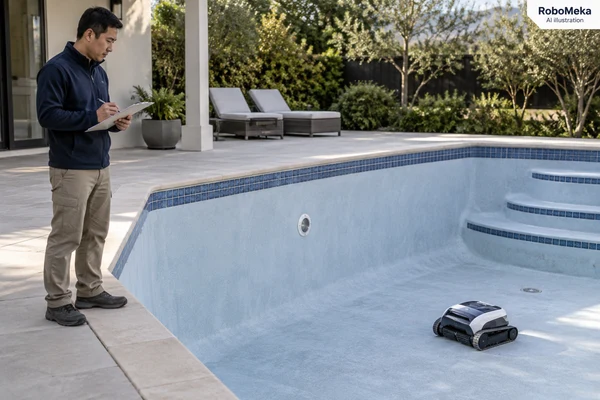
Inspect the accessible robot and filter parts as directed, establish the permitted setup, and photograph the evaluation zones. Keep people out of the pool during operation as required by the manual. The observer should work from a safe position and should not reach into the water to adjust a running machine.
Run the appropriate full cycle rather than selecting a favorable fragment. Record start and finish times, the chosen mode, and any abnormal stop. Where the robot provides logs or application records, preserve them with the video and written sheet. An app screenshot supplements observation; it does not independently prove every wall was cleaned.
Observe transitions as separate events
Watch the floor-to-wall approach, progress up the wall, movement near the waterline, and return to the floor. A problem at one transition can have a different explanation from a failure to travel laterally. Describe what happened before assigning a cause. This makes the record easier for a supplier's technical team to interpret.
Repeated attempts deserve context. Count or describe them consistently, but do not label every repeat as a defect. The purchasing question is whether the behavior fits the documented design and achieves the agreed task within the supported cycle. Request an explanation when the evidence is unclear.
Review residual debris and missed zones
After the cycle and safe retrieval, compare the defined areas with their starting condition. Use similar viewpoints and lighting where possible. Separate debris that remains in a contacted zone from debris in an area never reached. Do not claim removal of invisible contamination or pool sanitation from an appearance-based review.
If visibility is poor, record the limitation and repeat under suitable conditions when permitted. A blurry underwater video should not become a precise coverage measurement. Additional observation is preferable to a numerical conclusion that the evidence cannot support.
Prepare a wall-cleaning evaluation brief with pool photographs, surface details, difficult transitions, and the cleaning scope you intend to sell. We can discuss the relevant corded pool cleaner and cordless pool cleaner categories before you approve a sample plan.
Separate maintenance issues from application limits
When climbing changes, first preserve the observation and review the selected model's permitted troubleshooting steps. Check the documented mode and user-accessible maintenance items. Do not improvise weights, floats, brush changes, or chemical adjustments to produce a better video. An unsupported modification changes the configuration and may create additional risks.
Maytronics' filter-care guidance describes model-relevant cleaning considerations. For your trial, use the evaluated product's own maintenance procedure and record whether it was performed. The source is not evidence that any particular filter condition caused a result in an unrelated machine.
If approved care resolves an observed issue, record the original result, the action, and the repeated result. Then ask whether the required routine is reasonable for the intended owner. A maintainable product can still need a clearer handover. Conversely, a persistent problem on a supported surface may require supplier investigation rather than more operator experimentation.
Hypothetical example: tiled walls and a curved end
Imagine a hypothetical distributor evaluating a robot for residential pools with tiled walls and one curved end. The intended claim is floor and supported wall cleaning, with a separately assessed waterline function. No outcomes are assumed. The team marks straight-wall zones, the curved section, and two wall-to-floor transitions on a plan.
The first trial uses the documented wall-capable mode and approved filter. The observation sheet separates zone access, climbing, waterline travel, visible cleaning, and interventions. If the sample reaches the straight walls but the curved end remains unobserved, the team does not average that uncertainty into a claim of complete coverage.
A follow-up trial may clarify the curved section under the same permitted setup. If coverage remains uncertain, the purchasing decision can be conditional: approve only the validated application, request another suitable configuration, or exclude that pool geometry from the sales recommendation. These are commercial choices informed by evidence, not predetermined test results.
The final dealer note should describe the supported scope and any remaining manual cleaning. It should not show a successful straight-wall clip alongside text promising every curve, step, and ledge. Keeping the media and written claim aligned reduces confusion during later product application discussions.
Build evidence that remains useful after sample approval
Preserve the configuration and original media
Retain the sample identifier, configuration sheet, instruction revision, observation notes, full videos, and selected photographs. Name the files so another reviewer can connect them to a specific run. An edited marketing video may communicate a feature, but it should not replace the underlying evaluation record.
Record who observed the trial and whether they controlled the setup. A supplier demonstration, independent buyer trial, and customer report have different evidentiary limits. All can be useful when described accurately. None should be relabeled as third-party certification without an actual applicable certification process.
Revisit changes that could affect the claim
Agree which product changes require review before production substitution. Relevant changes could include the approved brush assembly, drive components, filter configuration, or control software. The exact trigger list belongs in the project specification rather than in a generic promise that every change is insignificant.
At shipment inspection, verify the agreed configuration and identifying documentation in the sampled units. A visual inspection cannot reproduce every application trial, but it can help detect a mismatched accessory or instruction set. Our manufacturing page provides context for those discussions; request evidence specific to the ordered model and lot.
Turn findings into honest product-page language
Separate documented capability from observed performance. A supplier manual may identify a waterline function; your trial may show how a particular sample behaved in a particular pool. Both statements can appear in the purchasing record with their source and scope. Neither should silently become a guarantee for all pool surfaces.
Use a short application statement dealers can repeat: supported cleaning areas, relevant surface limitations, preparation requirements, and remaining owner tasks. Keep exceptions close to the claim. A footnote several pages away is unlikely to correct an overbroad headline on a marketplace listing.
For buyers still choosing a power system, our corded versus cordless pool cleaner comparison addresses the broader ownership workflow. Wall and waterline evidence should remain a separate approval item because power architecture alone does not establish those functions.
Include retrieval in the evaluation handover
A successful cleaning demonstration still needs a workable completion routine. Confirm how the owner brings the robot to the designated retrieval point, isolates it as instructed, drains it, and handles the filter. The observer should evaluate whether the instructions are clear without attempting unsupported rescue techniques.
Maytronics' retrieval FAQ describes a specific Dolphin procedure involving power isolation and handle-based lifting. Other designs can use different approved retrieval arrangements. Teach the selected model's method, and never turn a general demonstration into universal advice to lift a robot by its cable.
Include retrieval access in the pool brief. High coping, restricted deck space, or an awkward storage route can affect whether an otherwise suitable cleaner is practical for its intended user. These considerations belong in the handover decision even though they are not measurements of wall-cleaning performance.
Frequently asked questions
Does climbing a wall prove waterline cleaning?
No. Climbing demonstrates movement on a particular surface under the observed conditions. Waterline cleaning additionally requires a supported function, relevant contact or traversal, and an acceptable result in the defined area. Record those observations separately so a short climbing demonstration does not become an unsupported promise of complete waterline coverage.
Can one pool trial support every surface claim?
A single trial provides evidence for its recorded configuration and conditions. It cannot establish performance on every coating, curve, or transition. Build the evaluation around representative supported applications, retain limitations, and ask for model-specific compatibility documentation. Unknown surfaces should remain unresolved until suitable evidence or manufacturer guidance is available.
What should we do when the robot stops climbing?
Record the symptom and follow the exact model's permitted checks, including mode selection and accessible maintenance where instructed. Stop if the manual requires service or if damage is suspected. Do not add weights, alter sealed components, or change pool chemistry experimentally to force a desired demonstration result.
Should wall performance be checked during shipment inspection?
Shipment inspection should verify the agreed configuration and the lot checks specified in the purchase agreement. Full application trials and visual configuration checks answer different questions. If a functional wall trial is included, define its pool, mode, observation method, sample selection, and limitations rather than assuming every shipped unit has been fully evaluated.
Conclusion
Useful wall and waterline evaluation separates access, climbing, traversal, and cleaning results. Document the pool, control the supported setup, retain complete observations, and translate the findings into bounded sales claims. This gives importers a clearer approval decision and gives dealers a practical explanation of what customers should expect.
Send your wall and waterline requirements to prepare a downloadable inquiry brief. Include destination market, quantity range, pool construction, representative photographs, and the exact cleaning areas you need. Email the completed brief to info@RoboMeka.com for a model-specific discussion.