The short answer
Choose a vacuum cleaner by defining the customer task, selecting an appropriate format, checking complete-configuration evidence, and reviewing ownership and supply arrangements. Separate essential requirements from preferences and unresolved claims. Record the chosen bundle, approval conditions, service responsibilities, and reasons for selection so later orders remain traceable.
Introduction
Buyers should choose a vacuum cleaner by defining the customer task, selecting an appropriate product format, checking configuration-specific evidence, and confirming that the proposed range can be supplied and supported. A high specification is useful only when it solves a purchasing requirement. The strongest choice is the product whose application, evidence, ownership demands, and commercial arrangements fit the intended sales channel.
For an importer, this decision is wider than choosing a machine for one home. Your range must make sense to retailers, customers, service partners, and the people approving inventory. An attractive sample can still be unsuitable if its tool bundle is confusing, replacement filters are unidentified, or its selling claims cannot be connected to the quoted configuration.
This guide provides a selection framework for manually operated household vacuum cleaners. Robot vacuums, specialist hazardous-dust equipment, and commercial machines need their own application and evaluation scope. The examples below are hypothetical procurement exercises, not reported RoboMeka projects or test results. Use them to organize customer requirements before requesting model-specific information.
Start with a customer job, not a product specification
Write a short description of the work the buyer expects the product to perform. Include the surfaces, typical debris, cleaning frequency, storage arrangement, and user handling needs. “A compact dry vacuum for frequent apartment cleaning” is a useful starting point. “The strongest vacuum at the lowest price” leaves almost every important decision unresolved.
Separate the primary job from occasional tasks. A product intended mainly for floors may also clean upholstery, but an occasional attachment should not distort the entire configuration. Conversely, a machine sold mainly for stairs needs a handling assessment that a flat-floor demonstration cannot answer. The customer job determines which compromises are acceptable.
Distinguish households from sales channels
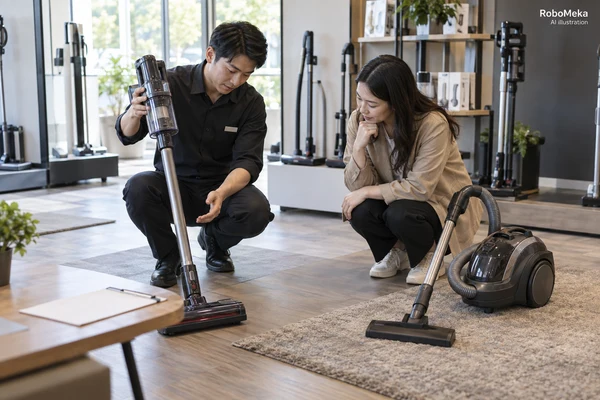
A retailer selling through a physical demonstration can explain attachments and care requirements in person. An online seller needs photographs, clear compatibility information, and instructions that work without that explanation. A distributor supplying both may need one common appliance with different documented bundles, rather than two unrelated products that multiply service stock.
Customer research should remain proportionate to the launch. Existing returns, support questions, retailer interviews, and documented product reviews can reveal recurring problems. Record their origin and limitations. A handful of complaints can identify a question worth investigating, but it cannot establish a market-wide defect rate or justify unsupported claims about competing products.
Choose the product format before comparing headline numbers
Decide whether the customer job points toward a corded canister or upright, a cordless stick, a handheld format, or a purpose-designed wet-cleaning product. These are starting categories, not universal rankings. Form affects reach, handling, storage, power arrangements, and the accessories needed to complete the task. Individual designs still require evaluation.
For a cordless proposal, consider where charging will occur and whether the user expects one continuous session or several shorter sessions. For a corded proposal, consider available outlets, cord management, and moving between rooms. Do not assume either power source automatically produces better cleaning. Ask what practical limitation the chosen format introduces in the target application.
Keep dry and wet applications separate
A dry vacuum should not be treated as a liquid-pickup product because the housing looks sealed or a supplier offers a similarly named accessory. Ask for the exact intended-use statement and compatible surface guidance. If wet cleaning is central to the requirement, review a purpose-designed configuration and its separate emptying, washing, and storage workflow.
Use the cordless stick product page and wet and dry product page to frame a category discussion, then request current specifications for the actual proposal. Category pages are not substitutes for an approved model specification. Record unresolved features as questions instead of transferring assumptions from one product family to another.
Turn the brief into a practical selection matrix
A matrix works best when it separates essential requirements from preferences. An essential requirement needs a clear acceptance condition. A preference can be traded against cost or another benefit. Keep a third category for unverified information; otherwise an impressive claim can quietly receive the same score as documented evidence.
| Decision area | Question to settle | Useful evidence | Selection consequence |
|---|---|---|---|
| Application | Which surfaces and tasks are included? | Intended-use guidance and relevant sample observations | Exclude unsuitable formats before price comparison |
| Cleaning system | Which head, filter, and mode support the task? | Identified configuration and relevant performance evidence | Compare complete bundles rather than isolated numbers |
| Ownership | Can users charge, empty, store, and maintain it? | Instructions and hands-on workflow review | Identify support burdens and accessory needs |
| Supply consistency | Can the approved configuration remain identifiable? | Revision records and proposed change controls | Link future orders to the selection decision |
| Commercial fit | Can the channel support the proposed order? | Configuration-specific quotation and responsibility schedule | Advance only a financially and operationally credible proposal |
Avoid choosing weights before agreeing what each criterion means. “Quality: five points” is too vague to audit. “Filter can be removed and refitted according to the instructions without uncertainty” is observable. A proposed scoring system should explain its scale and identify who owns each judgment, especially where purchasing and service teams value different outcomes.
Ask for evidence in the same configuration
Tie every important claim to the appliance, head, filter, operating mode, and relevant conditions. A specification sheet from another bundle may help start a conversation, but it should not become the approval record for your order. A changed floor head or filter can make a visually similar product a different comparison.
Use published test-method scopes to ask informed questions, not to imply that every product has been independently tested. IEC 62885-2:2026 addresses performance measurement for covered household dry vacuums, including mains and cordless types. Scope exclusions and method applicability still need checking for the proposed appliance.
This purchasing framework does not reproduce the standard or prescribe a laboratory procedure. Ask the supplier or competent laboratory which method, edition, configuration, and report support a claim. Keep your own application review distinct from formal testing. A useful customer demonstration and a controlled comparison can answer different questions without either replacing the other.
Separate acceptance from investigation
Give an evidence gap an owner and a next action. A missing attachment identifier may require a revised specification. An unclear performance claim may require the underlying report. A poorly understood handling issue may require another application review. Each should have a defined decision point, rather than becoming an indefinite promise to clarify after ordering.
For detailed technical questions, use the vacuum suction and power sourcing checklist. For comparative construction and usability evidence, see the vacuum quality comparison guide. Those specialist reviews should feed the same selection record instead of producing unrelated spreadsheets with conflicting product identities.
Evaluate the ownership workflow before selecting a winner
Walk through the sequence a customer will actually follow: unpack, assemble, prepare the power supply, select a tool, clean, empty, maintain, and store. Look for moments where instructions are unclear or the customer must improvise. Small workflow problems can be commercially important when they recur across many users.
Manufacturer guidance illustrates why this assessment extends beyond suction. Dyson's vacuum selection guidance connects choice to surfaces, cleaning habits, dimensions, weight, and runtime. That is a branded consumer example, not independent evidence for another manufacturer's products. Your procurement review should establish these details for the proposed model.
Include maintenance in the customer proposition
Ask how customers identify a blocked path, remove permitted parts, clean the relevant filter, and confirm correct reassembly. Follow the model's instructions rather than applying generic washing advice. Consider whether replacement consumables can be ordered without a support conversation and whether the packaging identifies them consistently with the service catalog.
Include storage and installation preparation where relevant. A wall-mounted holder needs an appropriate installation plan and a suitable location; a freestanding arrangement has a different space requirement. The product should not be selected around a showroom setup that the target household cannot reproduce. Capture these conditions in customer-facing materials as well as the internal brief.
If your shortlist is ready for a configuration discussion, send your vacuum cleaner requirements. Include the customer job, destination market, preferred format, intended tools, and unresolved evidence questions. The inquiry page prepares a local brief for review; it does not automatically send an email or confirm a quotation.
Compare supplier capability without confusing it with product suitability
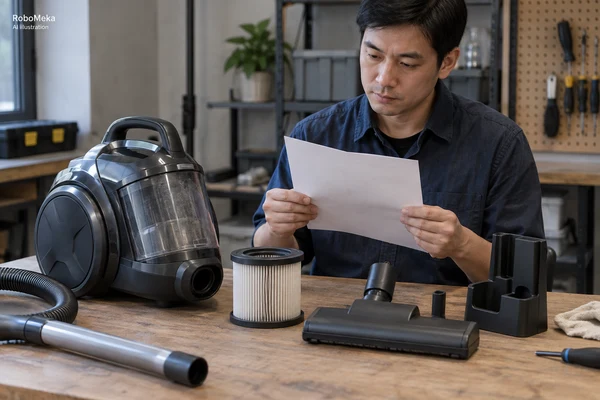
Factory information helps establish what to investigate, but it cannot decide which product fits the customer. Ask who controls the approved specification, how component changes are communicated, and how production and service teams identify the same configuration. A guided discussion around your sample is more useful than collecting general claims about manufacturing strength.
Management-system evidence also has a defined role. The ISO and IAF explanation of ISO 9001 certification distinguishes management-system certification from certification of the product itself. A certificate should therefore be reviewed for its own scope, not used as proof that a particular vacuum delivers superior cleaning.
For a proposed RoboMeka project, the business describes an 8,000-square-meter factory in Shenzhen. Treat that as company background supplied by the owner, not independent confirmation of output, audit status, or model performance. Request relevant documents and agree the scope of any manufacturing review around the actual purchasing decision.
Build a commercially useful shortlist
Shortlist only configurations that meet essential requirements or have a credible, explicitly conditional path to doing so. Ask shortlisted suppliers to price the same baseline. Separate optional heads, packaging changes, language versions, development work, and service stock so the comparison does not reward an incomplete proposal.
Review the consequences of each option beyond the initial sample. An additional bundle may require separate packaging, identifiers, inventory, instructions, and retailer training. A shared platform can simplify some work, but common appearance does not establish interchangeable parts. Require confirmed compatibility rather than assuming it from a similar connector or product name.
Keep price and supply assumptions visible
A quotation should identify quantities, configuration, validity, and the agreed delivery basis. Requested lead times are targets until the supplier confirms dependencies and approvals. Avoid turning a provisional discussion into a customer promise. The supplier, MOQ, lead time, and warranty guide explains how to connect these commitments.
Discuss the support model before buying inventory. Decide who diagnoses issues, which parts can be supplied, who approves claims, and how costs and transport responsibilities will be handled. A lower purchase price may still be a sensible choice, but that decision should be made with the proposed support responsibilities visible to the buyer.
Apply the framework to a hypothetical range decision
Imagine a distributor serving compact homes with mostly hard floors and some rugs. Its retailers report demand for convenient everyday cleaning and simple storage. The distributor initially requests the highest suction specification available. The application brief reveals that easy handling, understandable tool selection, and accessible consumables are equally important to the proposed range.
The team compares a corded option and two cordless bundles. It does not declare one category universally superior. Instead, it removes a proposal whose intended-use information remains unclear, asks another supplier to identify the quoted filter, and evaluates the remaining bundle in the tasks customers are expected to perform. Missing evidence remains a condition, not a silent pass.
Document why the decision could change
Suppose the preferred option meets the application brief but its replacement filter arrangement is unresolved. The distributor records a conditional selection, assigns a buyer to confirm part identifiers and supply terms, and keeps an alternative available. It does not claim that one successful demonstration proves future reliability or that an attractive sample guarantees delivery consistency.
After the open issue is resolved, the selection record names the configuration and the reasons it was chosen. It also states which changes would require review, such as a new floor head, changed maintenance instructions, or a replacement power bundle. This gives purchasing a practical reference when a later quotation appears similar but is not identical.
Carry the selection decision into production and delivery
The final output should be an approval package rather than a supplier ranking alone. Connect the application brief, approved configuration, evidence, sample observations, open conditions, quotation, and service responsibilities. Give the package a revision date and an accountable owner so later teams can identify which information governed the order.
Factory testing and shipment inspection should refer to that agreed package within their respective scopes. They do not retroactively resolve a poorly defined product choice. If an accessory or claim changes, determine whether the difference affects the original application decision, customer instructions, supporting evidence, or commercial terms before accepting the substitution.
Review early customer feedback against the same requirements after launch. Distinguish an application mismatch from unclear instructions, a damaged shipment, or a product issue requiring investigation. This keeps the next range decision grounded in traceable information. Do not publish return-rate or reliability claims unless the underlying records, population, and time period support them.
Frequently asked questions
Should buyers choose the vacuum with the highest suction specification?
Not without checking what was measured and whether the complete product fits the customer task. Compare the relevant head, filter, mode, handling, and ownership requirements. Use a high suction figure as a question to investigate, not a substitute for application evidence or an automatic reason to select a supplier.
Is one vacuum format suitable for every sales channel?
No format should be assumed to fit every channel. Online sales, staffed retail, and distributor networks can require different explanations, bundles, and support arrangements. Start with the customer job and the channel's ability to communicate intended use and maintenance. Then decide whether a common platform or separate configurations are justified.
Can a factory certificate replace sample evaluation?
A certificate and a sample review answer different questions. Check the certificate's subject, scope, issuer, and relevance, then evaluate the proposed product against your application requirements. Neither factory size nor a management-system certificate establishes the cleaning performance, usability, or suitability of a particular vacuum configuration for your target customers.
What should buyers send before asking for a vacuum quotation?
Send the destination market, sales channel, customer application, preferred format, essential tools, expected quantities, branding needs, and target schedule. Identify which specifications are confirmed and which need discussion. Include the evidence and service questions that could affect selection so the supplier can quote an identifiable proposal instead of an assumed configuration.
Conclusion
Choosing a vacuum cleaner for B2B sourcing is a sequence of connected decisions. Define the customer job, select a plausible format, compare complete configurations, and require evidence appropriate to the claims. Review ownership and support before settling commercial terms. Preserve the reasoning in an approval package that production, shipment, and service teams can use.
To move from research to a focused supplier discussion, prepare your vacuum cleaner sourcing brief. Describe the application and the decisions still open, then review the downloaded brief before contacting info@RoboMeka.com. Model capabilities, samples, quantities, lead times, and warranty arrangements remain subject to configuration-specific confirmation.