The short answer
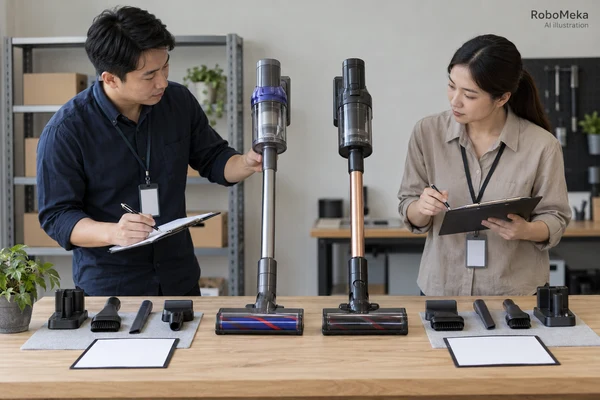
Compare equivalent vacuum configurations against a defined customer task. Clear essential requirements first, then review build, usability, durability evidence, consistency and service traceability with supported ratings. Keep unknowns visible and test whether reasonable changes in priorities reverse the shortlist, rather than treating one weighted total as proof of overall superiority.
Introduction
Compare vacuum cleaner quality by matching the offered configuration and customer task, then reviewing build, usability, durability evidence, production consistency and service traceability separately. A polished housing, strong suction claim or management-system certificate cannot answer every quality question. The buyer needs a decision framework that distinguishes observable differences from unsupported assumptions.
This approach is especially useful when several suppliers quote similar-looking products at different prices. One may include a better-documented assembly or more practical service arrangement; another may offer an attractive finish while leaving critical evidence unresolved. Neither appearance nor document volume establishes the complete answer. Comparable evidence and agreed priorities make the purchasing decision defensible.
This article presents a quality-comparison framework for manually operated household vacuum cleaners. It is not a shipment-inspection procedure or a report of RoboMeka testing. Proposed factory reviews and evaluations should be adapted to the actual product. The objective is to select a configuration with understandable strengths, limitations and support obligations before price negotiation closes the shortlist.
Define what quality means for this purchase
Start with the product's role. A lightweight cordless appliance intended for stairs and furniture has different usability priorities from a larger floor-cleaning model. Define the surfaces, typical handling, maintenance expectations and sales proposition before evaluating suppliers. Without that context, one team may reward a large container while another penalizes the same design for bulk.
Separate minimum requirements from tradeable preferences. Applicable conformity requirements, documented suitability for the intended use and other essential conditions belong in an initial acceptance review. A product that has not cleared a required condition should remain unresolved regardless of its cosmetic or usability score. Weighted preferences should compare candidates that are eligible for the intended purchase.
Then identify quality dimensions that can genuinely influence the selection. Build may cover joints, latches and accessible assembly details. Usability may cover carrying, controls and emptying. Durability concerns need evidence related to repeated use. Production consistency and service traceability address how the accepted design is maintained and supported after initial samples.
Use the cordless stick vacuum overview to define a relevant configuration, or the wet and dry floor cleaner overview for a separate wet-cleaning brief. Do not score dry and wet products as interchangeable simply because both remove household dirt. Their operating tasks and maintenance obligations require different criteria.
Compare equivalent configurations before comparing quality
Request the exact appliance, head, filters, battery or supply variant and accessories included in each offer. Identify prototype status and relevant revisions. A premium demonstration bundle should not compete against another supplier's entry configuration unless that difference is intentional and clearly priced. The comparison must describe what the customer would actually receive.
Create a common starting condition for observations. For example, compare controls and tool changes using the offered assemblies and the manufacturer's instructions. Record any preparation or adjustment made before review. If a supplier replaces a latch or tool during the process, identify the resulting revision rather than treating observations from both versions as one unchanged product.
Keep performance evidence distinct from impression. A reviewer can observe whether a handle feels comfortable during a defined task, but cannot establish pickup performance by looking at the finish. The vacuum suction evidence checklist explains how to connect advertised parameters with supplier documentation without giving a large number an automatic quality premium.
For formal comparative performance work, the public scope of IEC 62885-2:2026 identifies covered dry-vacuum categories and measurement limitations. It also explains why controlled comparative conditions can matter. Ask a qualified laboratory which provisions fit the product and intended claim instead of labeling a casual side-by-side demonstration a standardized evaluation.
Read build quality through function and repeatability
Examine accessible joints, tool connections, container closures and controls in their intended use. Ask whether a connection engages clearly, remains secure during the defined task and can be released as instructed. An audible click may improve user confidence, but sound alone does not prove retention strength or long-term durability. Describe the observed function rather than assigning quality from a sensory impression.
Distinguish cosmetic variation from functional concern. A visible seam might be acceptable within an agreed appearance specification, while a poorly seated seal could affect operation. The reviewer should identify the location, observation and relevance to the requirement. Avoid vague notes such as cheap plastic or premium feel unless they are translated into something another person can assess.
Material descriptions also need context. A named polymer, metal component or coating is not automatically superior for every part. Ask why the proposed material and construction suit the function and which evidence supports that choice. Where internal details matter, request controlled technical information or qualified assessment rather than dismantling a sample without an agreed purpose.
Use photographs and short records to make observations traceable. Identify the unit, revision and feature shown. A close-up can document a gap or damaged latch, but it does not establish the frequency of that condition across production. Keep the specific observation and the wider supplier-quality question separate until relevant evidence connects them.
Assess usability with an ordinary ownership sequence
Review the sequence from storage to cleaning, emptying, maintenance and storage again. A product may feel comfortable while moving across an open floor yet become awkward when carrying it upstairs or removing an attachment. Those transitions matter because the customer experiences the complete sequence, not just the moment that looks most convincing in a demonstration.
For handling, record the assembly used, the task and the observer's relevant comments. Different users may disagree about balance, grip or control placement. That variation can reveal a segmentation issue rather than a simple defect. Avoid declaring universal comfort from a single reviewer, especially when the planned customer group includes different heights or handling preferences.
For maintenance, ask whether users can identify and access the parts they are expected to clean or replace. Instructions should distinguish washable and non-washable components and explain any drying requirements. The sealed filtration guide provides context for filtration claims; usability review adds the practical question of whether the proposed care routine is understandable.
Document meaningful friction. Repeated tool changes, an awkward emptying position or unclear reassembly cues can affect ownership even when the appliance performs its primary task. Decide whether the issue can be resolved through design, instructions, a different accessory bundle or a narrower customer proposition. Do not let a high aggregate score erase a specific recurring inconvenience.
Use a weighted comparison only after defining the evidence
The following weights are a hypothetical purchasing example, not an industry benchmark. They show how a buyer might compare an ordinary household range after essential conditions are cleared. Change the weights to reflect actual customer requirements before reviewing supplier results, and keep the reason for each weight in the decision record.
| Quality dimension | Illustrative weight | Evidence to examine |
|---|---|---|
| Build and functional assembly | 30% | Identified joints, latches, seals and agreed construction observations |
| Ownership usability | 25% | Handling, controls, tool changes, emptying and maintenance sequence |
| Durability evidence | 20% | Relevant methods, tested revisions, outcomes and limitations |
| Production consistency | 15% | Variation records, configuration control and corrective-action examples |
| Service traceability | 10% | Part identification, replacement route and revision compatibility |
Use a defined rating scale. In this example, a score of three means the configuration meets the agreed preference criterion; five means a materially better outcome supported by relevant evidence. An unanswered question is marked unresolved, not quietly assigned an average score. The worksheet should display both the rating and the source behind it.
If you are building that comparison, send your vacuum quality priorities and supplier questions. Include the intended customer task, offered configurations and the quality dimensions that affect the purchase so a sourcing discussion can focus on reviewable differences.
Examine durability evidence without inventing a service life
Ask what the supplier means by durable. The statement may concern a component cycling method, a complete-appliance endurance program or a limited demonstration. Request the tested identity, conditions, sample information, outcomes and acceptance basis. Evidence can be useful within its scope without supporting an unrestricted promise that the product will last a particular number of years.
Connect repeated-use evidence to the part's real function. A latch, wheel, flexible connection and motor do not face identical demands. A program relevant to one component cannot automatically qualify another. Have a technical reviewer assess whether the method and conditions address the intended risk, especially when the supplier proposes an accelerated test or a relationship to customer use.
Read failures and interventions along with successful completion. If maintenance, replacement or adjustment occurred during an evaluation, the record should say so. That intervention may be permitted by the method or relevant to normal ownership, but hiding it changes the conclusion. A concise, candid report can be more useful than an impressive total with no supporting context.
A small sample can identify a problem or inform a design decision without establishing a population failure rate. If the business needs statistical reliability estimates, the study must support that inference. Do not convert a few favorable samples or short factory testing videos into a lifetime claim. Record what the evidence establishes and what remains unknown.
Evaluate the supplier's ability to maintain the accepted design
Ask how the supplier identifies the approved configuration and controls changes to it. Relevant examples might concern an incoming component substitution, a revised latch or a change to filter media. Request a documented explanation of the issue, the decision and the affected product identifiers. The purpose is to understand an operating process, not collect a perfect-looking presentation.
Management-system evidence can inform this review, but it is not product evidence. The ISO and IAF guidance on expected ISO 9001 certification outcomes explains that certification concerns the organization's quality management system and does not certify the product itself or establish product superiority. Check scope and relevance without awarding automatic performance points.
Look for understandable handling of nonconformities. Ask how the supplier separates affected units, investigates the cause, records correction and checks the effectiveness of the response. A representative documented example may reveal more than a broad statement about strict quality control. Do not assume every supplier has the same process or claim RoboMeka has supplied such records without verification.
Consider consistency between samples. If comparable units show noticeable differences, ask whether assembly, component variation, preparation or measurement conditions could explain them. Retain every valid observation and its context. The sample evaluation guide provides a broader approval workflow; this comparison uses its records to judge whether a candidate's apparent strengths are dependable enough for the decision.
A hypothetical shortlist and sensitivity check
Imagine two hypothetical candidates that have cleared the buyer's essential conditions. Candidate A receives scores of four, three, three, four and three across the five dimensions in the example table. Candidate B receives three, four, four, three and four. All scores are illustrative and assume relevant supporting evidence; they are not evaluations of actual products.
Using the stated weights, A scores 3.45 out of five and B scores 3.55. That small difference should not be presented as proof that B is universally better. It reflects the buyer's chosen priorities and the assigned ratings. Review the underlying observations to see whether a particular issue matters more than the narrow numerical lead.
Now move ten percentage points from usability to build quality, because a different customer segment places greater importance on construction. A rises to 3.55 and B falls to 3.45. This simple sensitivity check shows that the preferred candidate changes with reasonable priorities. The next action may be a clearer segment decision or targeted evidence on the most consequential uncertainty.
If a durability rating is unsupported, do not calculate a confident final winner from invented data. Leave the candidate conditional and request the missing evidence. Nor should a documented failure of an essential requirement disappear inside a high average. The worksheet supports judgment by exposing tradeoffs; it does not replace the purchasing team's responsibility to resolve decisive questions.
Include service quality in the final comparison
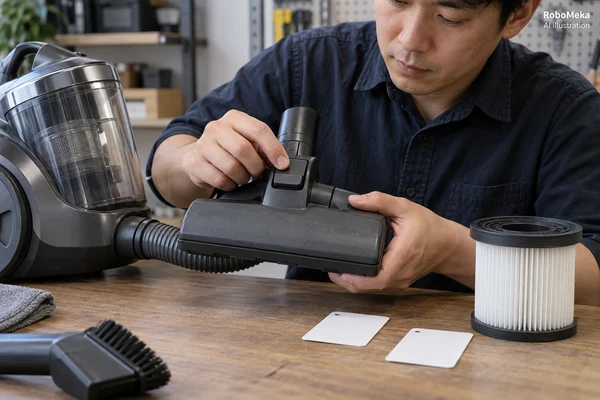
Ask whether the service team can identify and obtain the correct replacement assembly. Part numbers, revision references, instructions and approved compatibility make a practical difference when a customer needs help. A supplier with an attractive spare-parts photograph but no clear identification or commercial terms has not yet resolved the service requirement.
Compare the replacement route as well as the part itself. Some components may be intended for user replacement, while others require trained service. Clarify the responsible party and the agreed procedure. Use the spare-parts planning guide to connect the shortlist decision with stock and documentation planning without assuming future availability.
Record the final decision in terms another buyer can understand: the selected configuration, its supported advantages, accepted compromises and any outstanding conditions. Link the relevant evidence and revision references. This gives later purchasing, content and support teams a consistent explanation instead of leaving them with an unexplained total score and a supplier name.
Frequently asked questions
Does ISO 9001 certification prove a vacuum cleaner is high quality?
It concerns the organization's quality management system, not certification of the individual vacuum or proof of superior performance. Review the certificate's relevance as part of supplier assessment, then request product-specific evidence for the offered configuration. Build, usability, durability and conformity questions still need their own appropriate records and purchasing decisions.
Should a heavier vacuum receive a higher build-quality score?
No. Weight can reflect different materials, battery size or construction choices, and it can affect handling. Evaluate whether the design meets its functional and customer requirements using relevant observations and evidence. Do not treat heaviness as a shortcut for durability or lightness as proof of weakness without examining the actual assembly.
How should buyers handle inconsistent results between samples?
Retain the valid results and identify the units, revisions and review conditions. Investigate whether preparation, component differences or assembly variation could explain the outcome. A small sample does not establish a production failure rate, but inconsistency can justify a targeted inquiry or additional evaluation before the buyer relies on the apparent performance.
Can a weighted score decide the supplier automatically?
A weighted score can organize preferences after essential requirements are satisfied, but it should not conceal missing evidence or decisive limitations. Keep ratings traceable and examine how reasonable changes in priorities affect the ranking. If a small adjustment reverses the result, resolve the underlying customer priorities or important uncertainties before selecting a winner.
Conclusion
A useful vacuum quality comparison connects equivalent configurations with customer requirements, observable usability and credible durability and consistency evidence. Separate minimum conditions from weighted preferences, keep unknowns visible and test whether the shortlist remains sensible when priorities change. The result should explain why the selected product fits the intended purchase.
For your next comparison, prepare a vacuum quality sourcing brief with the proposed application, candidate bundles and the evidence still needed. Use it to agree a defensible shortlist and practical acceptance conditions before moving into production planning.