The short answer
Validate dark-floor behaviour on representative, level, protected surface samples with safety sensors intact. Record cleaning coverage, false stops and recovery for the exact configuration. Never cover cliff sensors or use an unprotected staircase to demonstrate that a robot can traverse a dark surface.
Introduction
A robot vacuum reaches a dark rug, reverses, and leaves the room unfinished. The visible result is simple, but the explanation is not. The machine may be responding to a surface condition, an uneven edge, a sensor issue, an obstacle setting, or another model-specific limitation. Calling every refusal a defective cliff sensor can send a purchasing team toward the wrong decision.
For buyers, dark-floor compatibility should be established through controlled surface observations with every safety sensor intact. The objective is to learn whether the offered robot can clean the intended level floor under documented conditions. It is never to make a robot cross a questionable area by defeating its protective systems.
This guide proposes a surface-validation plan for robot vacuum product selection. It covers sample choice, observation records, troubleshooting boundaries, and supportable retail claims. The proposed trials are not completed RoboMeka test results, and behavior described for other manufacturers is not a specification for an unverified RoboMeka model.
Why can dark-floor behavior be confusing?
Floor sensing and room navigation perform different jobs. A robot may know where it is on a map yet decline to travel across a particular surface. A complete-looking map therefore cannot prove that every floor finish in that room is suitable for cleaning.
iRobot's Error 6 guidance for specified Roomba series identifies dark surfaces, dirty cliff sensors, uneven surfaces, and actual edges among possible causes of that error. The important lesson is diagnostic: one alert can have multiple causes. The listed behavior applies to the models covered by the guidance, not to every robot vacuum.
Visible color does not describe the whole surface
Two materials described as black can differ in texture, gloss, pattern, pile, and physical shape. A flat dark tile, a patterned rug, and a thick mat edge are different test conditions. A buying specification that says only “works on black floors” is too broad to evaluate consistently.
Record the actual material and its condition. If optical properties matter to the supplier's sensor design, ask for an explanation and the relevant validation method. Do not infer a technical reflectance value from a photograph or assume that a surface's appearance to a person fully predicts the robot's response.
Other sensors can also affect movement
Obstacle handling, wall following, floor tracking, and cliff protection can contribute to the observed route. A robot avoiding a reflective area may not be reporting a cliff event. A robot stopping on a rug may be physically obstructed at its edge rather than rejecting the color.
iRobot's Careful Drive documentation notes that dark surfaces, reflective areas, and low or narrow objects can affect that particular feature. This illustrates why the active mode and sensor function matter. It should not be interpreted as a general cliff-sensor specification or a conclusion about all dark flooring.
Establish the safety boundary before testing
Use a continuous level floor with adequate space, no exposed drops, and a prepared route. Protect any nearby stairs or raised edges with appropriate physical barriers according to the product instructions. Keep the evaluation supervised and remove people, animals, loose cables, and fragile items from the test area.
Do not cover, alter, disconnect, or disable cliff sensors to make a dark surface pass. Do not attach reflective material to sensor windows or use a software workaround intended to defeat drop-off protection. An apparent improvement achieved by compromising the safety system is not evidence of product compatibility.
Keep stair protection outside this application test
A dark-surface assessment does not validate stair safety. Do not demonstrate the robot at an unguarded stair edge, on a table, or on a makeshift raised platform. Appropriate engineering validation of protective systems is a separate task requiring a controlled setup and competent supervision.
Likewise, a successful pass across a black rug cannot establish that the robot will stop at every drop-off. The two observations address different questions. Keep the report title and conclusion specific so a surface result is not later reused as a broad safety claim.
Select surfaces that match the intended market
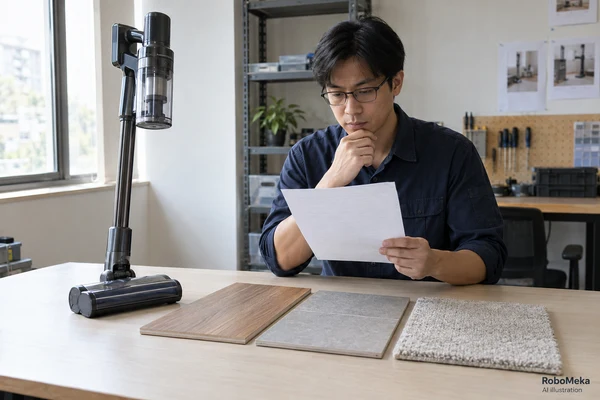
Begin with customer requirements and actual floor samples where practical. A distributor serving homes with dark stone tiles needs different evidence from a retailer targeting patterned rugs. Use a small, defined material set that can be preserved for repeat evaluations rather than an unexplained assortment of showroom flooring.
For installed floors, document the material, finish, approximate age or wear where relevant, lighting, joints, and nearby transitions. For loose test samples, ensure they are stable and appropriate for the machine. A sample that shifts under the wheels introduces a mechanical variable and may create a hazard.
Separate color from edge geometry
If comparing a dark and a pale sample, use comparable construction and geometry where possible. Otherwise, a raised edge or different pile can dominate the result. Record unavoidable differences and limit the conclusion accordingly.
Do not improvise a thin painted board and describe it as representative of all dark carpet. The specimen should match the application being discussed. For a rug, note pile, backing, border, fringe, and whether the intended model supports that type of textile in the selected cleaning mode.
Preserve a reference surface
Include an ordinary compatible reference floor on which the sample robot completes the same short task. This provides context when a candidate struggles everywhere rather than only on the dark material. The reference should be selected from the manufacturer's permitted surfaces and remain unchanged during the comparison.
The floor-use selection guide helps connect surface observations with the wider cleaning application. A robot that traverses a material still needs a separate assessment of pickup and, where applicable, mopping suitability.
Prepare the robot in its documented condition
Record the model, hardware revision, firmware, app version, cleaning mode, and fitted accessories. Inspect and maintain sensor windows, wheels, and cleaning components according to the manual before beginning. Use the specified cleaning materials and method; do not apply an improvised polish or chemical treatment to the sensors.
Document that preparation in the record. It helps distinguish a clean, correctly assembled sample from a later unit that may need routine care. If a sensor window is damaged or an error persists before the surface trial, stop and arrange the appropriate supplier evaluation rather than proceeding with an uncertain baseline.
Confirm that the floor is dry where required and free of unsuitable debris. Do not combine a dark-floor comparison with wet surfaces, heavy dirt, and furniture changes in the same trial. A narrow initial question produces a result that the supplier can investigate.
For a relevant sample brief, send RoboMeka photographs and descriptions of your target floor surfaces. Include the material, finish, rug construction where applicable, intended cleaning modes, and any observed error so the discussion can focus on the offered configuration.
Use a repeatable surface-validation sequence
Start on the approved reference surface and run a short, supported task. Then introduce the selected dark-surface condition while keeping other factors as consistent as practical. Observe approach, travel, turning, exit, and completion. Do not repeatedly push the robot onto a surface it is refusing to traverse.
| Test condition | Record during the run | Interpretation boundary |
|---|---|---|
| Reference floor | Normal movement and completion | Establishes a baseline for this unit |
| Uniform dark surface | Approach, reversal, stops, alerts | Describes the tested material and mode |
| Dark patterned area | Response at individual transitions | Does not represent every dark pattern |
| Same approved surface under another normal lighting condition | Any changed route or alert | Lighting is one variable, not an assumed cause |
| Surface after documented routine sensor care | Whether the behavior changes | Improvement does not prove the original root cause |
| Repeat after a relevant approved update | Changed behavior with version recorded | Applies to the evaluated software configuration |
Choose the number of repetitions and sample units according to the purchasing decision. Report those numbers explicitly. A few application observations can reveal a compatibility concern, but they should not be converted into an unsupported percentage reliability claim.
Observe the whole route
Record whether the robot crosses the surface only from one direction or also turns and exits normally. If it enters a dark area and then becomes stranded, an initial successful crossing hides the practical problem. Follow the intended cleaning task through its documented end state.
A fixed camera view or a marked floor plan can help show where the response occurs. Include a run identifier and keep personal information out of the frame. An edited clip containing only successful passes is unsuitable as the sole sample-approval record.
Record alerts exactly
Capture the displayed or spoken alert without translating it into a diagnosis prematurely. Note whether the robot reversed without an alert, stopped with a message, or continued while leaving an area. These are different observations and may require different supplier questions.
Where the app offers diagnostic logs, use the manufacturer's supported export process with appropriate consent and minimal necessary data. Do not access hidden service modes or modify sensor settings simply to obtain a result. The evaluation should represent the customer-accessible product.
Investigate a failed run one variable at a time
Begin with the operating instructions and the actual error. Confirm routine cleanliness, correct assembly, permitted surface type, and current settings. If the behavior is inconsistent with the documented use case, provide the supplier with the controlled record and request a model-specific explanation.
Distinguish refusal from loss of traction
A robot that reverses before contacting a rug edge presents a different event from one whose wheels spin on the edge. Record wheel movement, body contact, and the timing of the response. Avoid assigning the first event automatically to the cliff system or the second automatically to motor weakness.
Use the threshold and furniture-clearance guide when geometry is part of the problem. A dark mat with a raised border can involve both sensing and physical access, so those variables need separate evidence.
Distinguish avoidance from map selection
Check whether an existing map exclusion covers the area, where the product provides such features. Verify the selected room and active task using harmless, level-floor conditions. A software instruction to avoid a zone can resemble surface rejection if the evaluator reviews only the robot's path.
Do not remove a safety-related exclusion near a real hazard for the sake of diagnosis. Reproduce the relevant application question in a safe prepared area instead. The purpose is to understand behavior without changing the protection of the customer's home.
Know when to stop troubleshooting
Repeated sensor errors, visible damage, unexplained behavior on the reference floor, or an unsafe operating condition should lead to supplier service. A buyer does not need a complete internal engineering diagnosis to decide that a sample is not ready for approval.
Document the unresolved condition and the required response. If a supplier proposes a revised firmware or replacement unit, retain the original result and compare the new configuration against the same relevant surfaces. Do not erase the history merely because the latest demonstration looks better.
Classify compatibility with clear limits
Use categories that support a real decision: demonstrated under the tested conditions, demonstrated with documented preparation, not suitable for the tested application, or unresolved. Link every category to the surface identifier, robot configuration, and observation record.
A hypothetical example shows why this matters. A candidate traverses a flat dark tile repeatedly but refuses the border of a thick patterned rug. The evidence supports a result for that tile and raises a separate rug issue. It does not support either “works on all black floors” or “cannot clean dark surfaces.”
If an important surface is unsuitable, consider another verified model or a different cleaning arrangement. Ordinary manual cleaning of an excluded area can be a realistic ownership limitation. Safety-system modifications should never be presented as the route to compatibility.
Keep cleaning effectiveness separate
Traversal only establishes access. Debris pickup, edge cleaning, and approved mopping behavior require their own observations. A robot can cross a dark rug without removing the intended debris, just as a machine can clean well on a floor it reaches only with manual assistance.
Use the cleaning robot sample-testing guide to integrate those results into a complete acceptance record. Keep the individual findings visible so a strong pickup result does not conceal a surface-access limitation.
Carry the evidence into production and support
Retain representative surface samples or sufficient documented specifications for re-evaluation. Identify changes that should trigger review, including sensor hardware, optical covers, firmware, or relevant settings. A cosmetic cover change can matter if it affects the sensing arrangement, so ask the supplier to assess the impact rather than assuming it is irrelevant.
Factory testing and shipment inspection should be proportionate to the approved product. The qualification matrix can be broader than a routine production check. Agree which checks confirm consistency with the approved sample, and preserve records linking the shipped revision to the validated configuration.
Customer support should request a concise description of the surface, the exact alert, the cleaning mode, and the model identifier. A photograph of the material and a short safe observation on a level floor may help. Do not ask customers to film an unguarded stair test or defeat sensors to confirm a theory.
Product pages should explain meaningful limitations in plain language. If compatibility was established for selected materials, say so and offer a way to discuss unfamiliar surfaces before purchase. Avoid an unqualified “all floor types” statement based on a small test set.
Frequently asked questions
Do all robot vacuums have problems with black floors?
No universal conclusion is justified. Behavior depends on the complete model, software, surface, geometry, condition, and operating mode. Manufacturer support articles describe particular products. Evaluate the actual material and offered configuration rather than generalizing from one robot or one rug.
Can cliff sensors be covered to make a dark rug work?
No. Covering or modifying cliff sensors compromises a protective system and is not a valid compatibility solution. Keep sensors intact, follow documented maintenance, and seek model-specific support. Choose a suitable product or a different cleaning arrangement if the surface remains incompatible.
Does a cliff-sensor error prove the floor is too dark?
No. Depending on the model, an alert can have several causes, including sensor condition, uneven geometry, or an actual edge. Record the exact message and follow the manufacturer's diagnosis. Avoid assigning a cause from color alone.
Should buyers test near stairs to confirm safety?
Not as part of this surface-compatibility exercise. Use a continuous level floor with appropriate physical protection from nearby drops. Safety validation requires its own controlled engineering process. Successful dark-floor traversal does not establish performance at every stair or drop-off.
Will a firmware update fix a dark-floor problem?
It may change behavior on a particular product, but no general promise is appropriate. Ask the supplier what the update addresses and repeat the relevant safe surface test afterward. Record the new version and preserve any remaining limitation in the product information.
Conclusion
Dark-floor compatibility is a material-and-model question that deserves controlled observation. Preserve all safety systems, separate surface response from geometry and settings, and document the exact conditions behind each result. A narrow, well-supported compatibility statement is more useful to customers than a broad promise that cannot be reproduced.
For an application-focused sourcing review, ask RoboMeka to assess your dark-floor robot vacuum requirements. Provide the surface details, intended cleaning routine, and any existing observations, and request a sample plan tied to the exact product under consideration.