The short answer
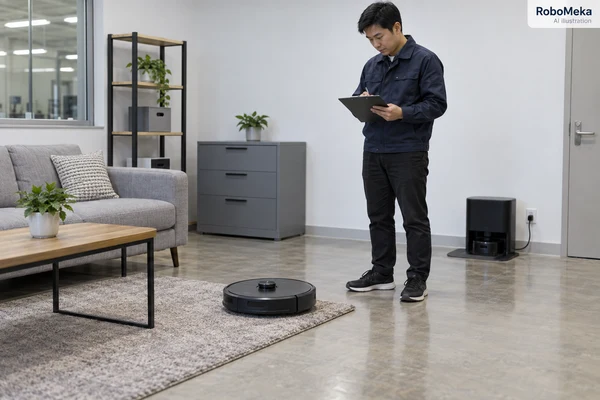
Sample testing should support a defined purchasing decision. Identify the configuration, control relevant conditions, retain valid results and record interventions. Separate application fit from compliance, durability and shipment inspection; one successful sample cannot establish every requirement for future production.
Introduction
Cleaning robot sample testing should answer a purchasing question: does this identified configuration perform the intended job well enough, under conditions that matter to the customer, to justify the next project stage? A short demonstration is useful for orientation, but it is not a substitute for a recorded evaluation. Importers need to know what worked, what failed, what changed and what remains untested.
Begin with a written application brief and a small set of observable acceptance criteria. Evaluate the supplied robot, battery, dock, accessories and software as a system. Repeat important scenarios, record interventions, and distinguish cleaning effectiveness from convenience features. A product that finishes only after frequent human rescue may not suit a hands-off retail proposition even if its final cleaning result looks acceptable.
This article provides a proposed evaluation workflow for purchasing and quality teams. It is not a report of tests already conducted by RoboMeka, a laboratory procedure or a claim about any particular model. Use the RFQ framework to agree the intended configuration before samples arrive, then adapt the evaluation to the product's documented operating limits.
What decision is the sample supposed to support?
Separate feasibility, approval and production release
A feasibility sample helps determine whether a platform could serve an application. An approval sample represents a defined configuration intended for purchase. A production sample may help compare manufactured units with that approved reference. These roles overlap only when the configuration and evidence justify it. Label each sample's purpose so a preliminary demonstration does not quietly become production approval.
Write a decision statement before preparing the test area. For example, an importer might need to decide whether a robot vacuum is suitable for mixed-floor apartments, not whether it can complete every possible household task. The statement determines which scenarios are essential and which are useful exploratory checks. It also makes it easier to explain why an attractive feature does not compensate for a failed core requirement.
Keep compliance, transport qualification and destructive safety evaluation outside casual application trials. Such work may require specialist facilities, controlled procedures or qualified personnel. Never deliberately defeat a safeguard or improvise a hazardous test to make a purchasing video. Request relevant documentation and arrange appropriate expert review instead of treating a sample checklist as permission to test beyond the manual.
Define outcomes before seeing the results
An acceptance criterion should identify the task, conditions, observation and decision rule. “Good cleaning” is too vague. A more useful requirement describes the surface, approved debris, preparation, operating mode and the evidence that will be reviewed. Exact thresholds should come from the buyer's needs and an appropriate method, not an arbitrary number added after the sample performs poorly.
Distinguish a failed requirement from an inconclusive result. If a test is interrupted by an unrelated power outage, the record may justify a rerun. If the product stops because its normal navigation cannot handle the approved layout, that is part of the outcome. Agree how exceptions will be treated before the evaluation so convenient reruns do not erase genuine limitations.
How should incoming samples be documented?
Photograph the unopened package and record any visible transit damage before unboxing. Check the model, serial or identifying label, accessory count, charger and supplied documents. Note whether the sample is a prototype, a production-representative unit or a modified demonstration unit. If the supplier cannot confirm its status, retain that uncertainty in the evaluation summary.
Record firmware and app versions where visible, together with the initial settings. Save the operating instructions used for the trial. If an update occurs during testing, divide the results by version rather than treating them as one unchanged dataset. A navigation improvement after an update may be valuable, but it does not justify silently rewriting the behavior observed before that update.
Do a non-invasive readiness review before operation. Confirm that the intended electrical supply, charging arrangement and environment match the instructions. Inspect accessible parts for obvious damage and follow the specified first-use preparation. If the sample appears unsafe or damaged, stop and seek manufacturer guidance. A purchasing deadline is not a reason to energize a questionable appliance.
How do you make performance comparisons repeatable?
Control the conditions that can change the answer
Use the same relevant surface, layout and preparation when comparing samples. Record battery state, selected mode, installed attachment and filter condition. For robots, document starting position and any saved map. For outdoor or pool products, environmental conditions may vary; record them and avoid presenting an uncontrolled comparison as a precise ranking.
Separate the measured result from the observer's interpretation. “Operator intervened to release the brush” is an observation. “The brush design is unsuitable for every pet owner” is a much broader conclusion that the event alone does not support. Keep videos and notes linked to the sample and scenario so another reviewer can understand what happened without relying on memory.
Performance methods are product-specific. IEC's cordless vacuum performance listing and mains-operated vacuum performance listing illustrate that even closely related products can require different measurement scopes. Ask a qualified laboratory which method applies if you need comparable formal results. An internal buying trial should not be labeled a standardized test unless its procedure genuinely meets the applicable requirements.
Record variation rather than selecting the best run
Repeat important scenarios when practical and retain every valid result. If the sample succeeds once and fails on another comparable run, investigate the difference rather than selecting the more attractive video. State the number of units and repetitions in the report. A limited evaluation can still inform a decision, provided its limitations are visible.
Avoid drawing a population-level reliability claim from a few demonstration units. Your sample may reveal a failure mechanism or support a configuration choice, but it does not establish a field failure rate. If the commercial decision depends on durability or statistical confidence, ask a qualified test specialist to design an appropriate program and budget for the time it requires.
Which scenarios matter for each product family?
| Product | Useful application scenario | Record separately |
|---|---|---|
| Cordless vacuum | Representative floor and attachment combination | Pickup, handling, runtime and maintenance |
| Robot vacuum | Multi-room cleaning with the intended floor mix | Coverage, interventions, docking and residual debris |
| Robotic mower | Approved lawn layout and operating window | Coverage, passage behavior, docking and site exclusions |
| Pool robot | Suitable pool with defined cleaning zones | Floor result, wall behavior, retrieval and filter care |
Indoor cleaning products
For a manual vacuum, separate pickup from the effort required to maneuver, empty and maintain the machine. Test the intended accessories instead of assuming the floor head represents the whole bundle. Record how the operator accesses the filter and brush, whether instructions are understandable, and whether normal maintenance requires tools or consumables absent from the retail package.
For a robot vacuum, distinguish mapping from cleaning and object avoidance. A robot can create a useful map but still need help with certain objects or transitions. iRobot's navigation support guidance describes different mapping approaches across its models, reinforcing the need to evaluate the actual implementation rather than a broad technology label. Do not transfer another manufacturer's performance claims to the sample under review.
Include a normal recovery scenario within the instructions: a pause, a permitted restart or a return to the dock. Record whether the user understands the message and can resume without specialist support. These observations help predict onboarding and service workload without pretending to measure long-term reliability. Keep any unusual failure for engineering review rather than improvising a repair during the trial.
Outdoor and pool equipment
For a mower, qualify the site before operation. Record lawn boundaries, permitted routes, obstacles, docking conditions and excluded hazards. Do not use a difficult property to test outside the model's stated limits. Husqvarna's work-area guidance highlights the relationship between working time and area capacity for its products; use that distinction when asking how the proposed mower's rating was established.
For a pool cleaner, record pool shape, surfaces, access and the intended floor, wall or waterline scope. Follow the specific manual for entry, removal, power and charging. Maytronics' pool-selection guidance treats size, shape and cleaning zones as selection factors. A successful floor-cleaning trial cannot by itself validate a waterline-cleaning claim or compatibility with every surface.
Midpoint CTA: prepare an evaluation brief
Before requesting another sample, prepare your sample evaluation requirements. Include the intended application, unresolved purchasing decision, proposed test conditions and documents already available. RoboMeka can discuss the configuration and evidence needed for the next step. The current form downloads a brief rather than sending it automatically; email that file to info@RoboMeka.com for a project-specific discussion.
How do you evaluate usability and service needs?
Ask someone outside the project team to follow the instructions
An experienced engineer may know how to recover a product without realizing that the manual omits a necessary step. A colleague unfamiliar with the sample can reveal unclear prompts, missing diagrams or confusing accessory names. Observe without immediately coaching, while maintaining safe supervision. Record where help was required and whether the instructions could reasonably resolve the problem.
Use the language and sales-channel context intended for the customer. App setup, account creation, network compatibility and permission requests may create different friction from mechanical operation. Test only with authorized accounts and avoid collecting unnecessary personal information. If the software service is not available in the intended market, treat that as a substantive project issue, not merely a translation task.
Connected-product review should include support and updates, not just pairing success. NIST's consumer IoT profile provides a framework for asking about the broader connected system. Request clear responsibility for software maintenance, vulnerability reporting and end-of-support communication. A successful app demonstration does not establish that those responsibilities have been arranged.
Time the work without turning it into a universal claim
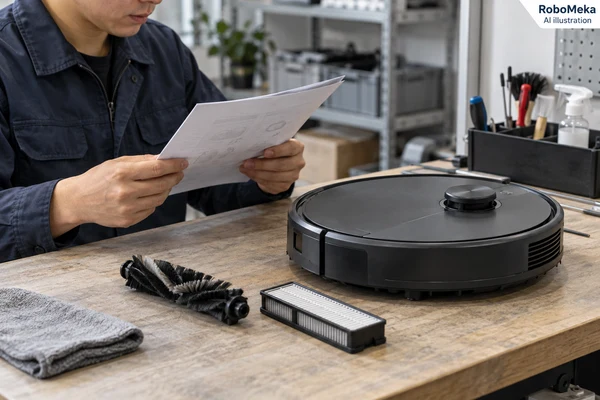
You can record how long your evaluator takes to empty a bin, clean an approved filter or replace a user-serviceable accessory. Label these as observations from the specified trial. They are not guaranteed customer times. Differences in familiarity, debris and workspace can matter, but the observations still help compare design choices and identify unusually awkward maintenance steps.
Connect the findings to the service plan. If a common recovery step requires a tool or spare part, identify who will provide it. If disassembly is restricted to trained technicians, document the escalation route. The buyer's evaluation should not encourage customers to perform repairs beyond the manual simply because a test engineer could do so in a workshop.
How should failures and changes be handled?
Use a finding log with an identifier, sample reference, scenario, observation, supporting evidence and proposed next action. Classify the commercial importance separately from the suspected cause. A minor-looking symptom might block the intended application, while an obvious cosmetic defect might have a straightforward correction. Let engineering investigate cause rather than labeling every problem a manufacturing defect at first sight.
Require the supplier's response to identify what changed and how the correction will be evaluated. A replacement sample should carry its own identity and revision record. Revisit affected scenarios and relevant neighboring functions; correcting one behavior may alter another. Preserve the original result and the retest result so the approval history remains understandable to someone who joins the project later.
Keep conditional approvals explicit. An approval subject to a revised manual is not the same as approval subject to an unresolved core cleaning function. State what can proceed, what cannot, who closes the condition and what evidence is required. Avoid phrases such as generally acceptable when the purchasing and quality teams may interpret them differently.
A hypothetical sample-to-order decision
Imagine an importer evaluating two robot vacuums for small apartments. Both complete the main hard-floor route, but one repeatedly needs help at a permitted transition in the representative layout. The team also finds that its app instructions omit an important setup step. These are hypothetical observations, not RoboMeka test results or evidence about any named manufacturer.
The purchasing decision should separate the two findings. The documentation issue may have a clear revision and review path. The transition issue may require a different configuration, an application limitation or rejection for the intended customer. A lower quotation does not resolve either issue. Conversely, one unsuitable layout does not justify claiming the platform is unusable for every market.
Before ordering, the team retains the approved configuration record, closes the conditions and defines a separate production verification plan. ASQ's overview of acceptance sampling explains why a lot-level decision is a different activity from evaluating a selected sample. The buyer should agree shipment inspection and release authority separately, rather than assuming the sample report covers future production automatically.
Frequently asked questions
How many samples should an importer test?
There is no universal number that makes every project adequately evaluated. The right plan depends on the decision, product variation, risks and confidence required. State how many units and runs were evaluated, avoid reliability claims unsupported by that scope, and ask a qualified specialist when a statistical or durability study is needed.
Can a supplier's demonstration replace our own trial?
A demonstration can explain features and help identify useful scenarios, but it may not represent your customers, configuration or operating conditions. Request the setup details and underlying evidence. Where application fit matters, arrange a representative evaluation rather than assuming a successful demonstration transfers unchanged to the intended market.
Should we test after a firmware update?
If the update affects behavior relevant to your acceptance criteria, review the change and retest the affected areas. Record versions before and after the update, and keep the results separate. Ask how production and customer units will receive the approved version so the evaluated configuration is connected to the supplied product.
Does a failed scenario always mean rejecting the product?
No. First determine whether the scenario was valid, within the documented limits and important to the intended application. The outcome may justify correction, a restricted use case, another configuration or rejection. Record the decision and evidence rather than hiding the result or extending it into an unsupported universal claim.
Conclusion
Cleaning robot sample testing is most valuable when it produces a traceable decision, not a collection of attractive demonstrations. Identify the sample, control relevant conditions, retain valid results and distinguish observed behavior from broader claims. Close important findings before approval, then connect the approved configuration to production and service planning.
To organize your next evaluation, send your product application and sample requirements. Include the target market, typical surfaces or site conditions, essential outcomes and unresolved questions. Email the prepared brief to info@RoboMeka.com. The next step is a documented configuration discussion, not an assumption that one sample or one test proves every purchasing requirement.