The short answer
Match the product to the debris layer: a surface skimmer collects supported floating material, while a floor-cleaning robot addresses its specified underwater zones. Verify combination products function by function. Neither category replaces the pool’s required water-treatment and circulation arrangements.
Introduction
A customer sees leaves floating on a pool and asks for a cleaning robot. Another sees fine debris settled across the floor and uses exactly the same words. A distributor who treats those inquiries as identical can recommend an impressive product that works on the wrong part of the pool.
A robotic surface skimmer and a floor-cleaning robot address different cleaning layers. One travels at the surface and collects suitable floating material; the other operates underwater to clean the areas specified for its design. Some products combine functions, but buyers must verify those functions individually rather than infer them from the broad term pool robot.
For retailers, importers, and private-label buyers, the decision is often whether to offer one category, both categories, or a carefully qualified bundle. This guide provides an assortment framework and proposed sample checks. It contains no claimed RoboMeka field results, guaranteed savings, or assumption that every described feature is available in RoboMeka's range.
What is the difference between a pool skimmer and a pool robot?
The word skimmer needs clarification first. A fixed skimmer is part of a pool's installed circulation arrangement. A handheld skimmer is a manual collection tool. A robotic surface skimmer is a mobile device designed to collect material at the water surface. This article compares the robotic surface category with underwater floor-cleaning robots.
The practical distinction is where the product works. A surface-only robot should not be presented as a solution for settled sand on the floor. A floor robot should not be sold as a floating-leaf collector unless the exact model includes a supported surface function. Wall and waterline functions are also separate features requiring confirmation.
For a current category example, Aiper's EcoSurfer S2 product page describes a floating robot that collects surface debris. Its listed filtration, charging, and control features belong to that product. They are useful comparison headings, not specifications that can be assigned to all skimmers.
Begin with the customer's recurring debris problem
Floating material drives one purchase
Ask what accumulates on the surface, where it gathers, and when the owner notices it. Trees, nearby planting, wind exposure, and seasonal events can change that pattern. Photographs from several ordinary days provide better context than one image taken immediately after a storm or immediately after manual cleaning.
The important commercial question is whether surface collection remains a recurring burden after the pool's installed equipment is operating properly. A mobile skimmer should be considered within that routine. It should not be used to obscure a circulation problem that belongs with a qualified pool professional.
Settled material drives another purchase
Ask where debris settles and which underwater areas need attention. Floor size, depth transitions, corners, wall requirements, and pool finish shape the application. Record whether the customer needs regular maintenance between swims or expects the robot to handle an unusual restoration task outside normal use.
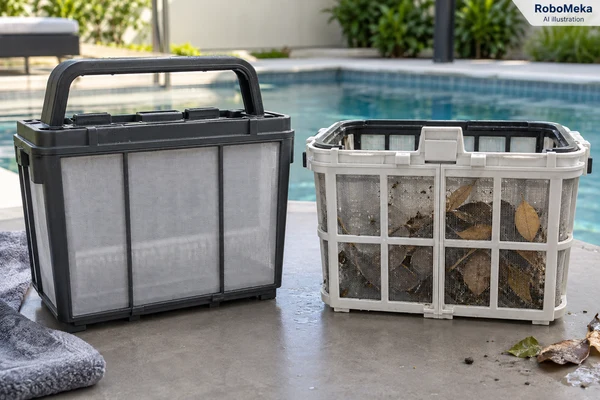
Match the filter to the debris as well as the machine to the pool. A basket suitable for larger material may not meet the buyer's fine-debris expectations. The pool robot filter selection guide explains why filter configuration and maintenance belong in the purchasing brief rather than being treated as minor accessories.
A visible surface film needs a careful question
Do not assume every visible film, discoloration, or cloudy condition can be resolved by mechanical collection. Ask the pool professional to identify unusual conditions. A skimmer's ability to capture a particular floating test material does not establish treatment of all films, oils, microorganisms, or dissolved contaminants.
This distinction should appear in customer-facing language. CDC pool guidance identifies disinfection and pH management as essential to controlling germs. A mechanical cleaning purchase does not replace the site's water-testing and treatment responsibilities, which should follow qualified guidance and applicable instructions.
Compare the categories by the job they can support
| Buying question | Robotic surface skimmer | Floor-cleaning robot |
|---|---|---|
| Primary work area | Water surface | Submerged areas documented for the model |
| Typical requirement | Collect suitable floating debris | Collect settled debris and perform supported brushing |
| Site details to review | Surface routes, edges, obstructions, access | Dimensions, depths, finish, transitions, cleaning zones |
| Collection system | Surface intake and compatible basket or filter | Underwater intake and compatible basket or filter |
| Important handling task | Retrieve, empty, inspect, and prepare for use | Retrieve, drain, clean filter, and prepare for use |
| Power questions | Verify battery, solar, or adapter arrangement | Verify corded or cordless operating routine |
| Frequent misunderstanding | Assumed to clean the pool floor | Assumed to collect all floating material |
| Water treatment role | Does not replace the treatment program | Does not replace the treatment program |
The table is an initial selection aid, not a substitute for product instructions. Hybrid products need a separate row for each supported function. Compare their performance and handling in each mode instead of assuming that one broad feature count means every cleaning layer receives equal attention.
Assess the pool layout from two viewpoints
Surface access is a route problem
Sketch the open water, narrow connections, corners, steps that reach near the surface, and obstructions. Note ladders, cover equipment, and other fixtures that affect the robot's route. Ask the supplier how the model behaves near those features and which conditions are excluded.
During a permitted sample trial, observe whether the skimmer reaches the important debris areas and leaves them again without help. A long advertised operating duration is less useful if the device repeatedly remains in an unproductive corner. Record interventions and unresolved zones rather than judging the product only by time powered on.
Underwater coverage is a separate map
For the floor cleaner, mark depth changes, wall finishes, benches, drains, and difficult transitions. The pool cleaner sizing guide provides a useful site worksheet. Do not copy the surface robot's observed route onto the underwater machine's application assessment.
Where the customer has steps or shallow shelves, request explicit support for them. Neither category should inherit responsibility for those areas simply because both are present in the pool. A bundle can still leave a defined manual-care task, and the dealer should explain that task before the purchase.
Choose an assortment structure with a clear sales role
Offer the floor cleaner as the primary category
This structure suits an assortment aimed at customers whose main complaint is settled debris or supported wall maintenance. A surface skimmer can remain an optional complementary product if repeated surface collection is also a meaningful burden. The sales process should establish the primary task before discussing extra features.
For a small distributor, a focused range can simplify training, stock, and spare parts. The tradeoff is that sales staff need a reliable way to identify inquiries the range does not solve. Referring an unsuitable surface-only requirement for further review is better than forcing every lead into the same machine.
Offer a surface product as a distinct category
A robotic skimmer may have a clear role for owners already satisfied with their underwater cleaning arrangement. The product page should make that role obvious in its first description and images. Avoid presenting a surface machine as a low-cost equivalent to a full underwater cleaner.
Evaluate regional operating conditions and the actual charging routine. If solar assistance is advertised, ask what the supplier's operating claim assumes and how the owner manages less favorable conditions. Do not turn a solar feature into an unconditional promise of continuous operation at every shaded or seasonal installation.
Offer a bundle after qualifying both machines
A bundle needs two application approvals and one coherent owner routine. Confirm whether the manufacturers permit simultaneous use in the relevant configuration. If that point is unclear, plan separate operating periods until the suppliers provide guidance. Do not create compatibility claims by assuming two independent machines cannot interfere with each other.
If you are choosing between a single-category range and a complementary bundle, send RoboMeka your pool-cleaning assortment brief. Describe the dominant debris problems, target pool layouts, intended price positions, destination market, and support resources so the discussion can focus on the product roles you need.
Test surface collection and floor cleaning separately
Define the surface test conditions
Agree on suitable representative debris and the starting distribution. Record pool layout, weather, surface conditions, normal installed-equipment settings, and the sample configuration. Keep swimmers out during the trial. Do not disable pool safety equipment or change the circulation arrangement without the responsible professional's approval.
Observe approach, capture, retention, and escape from constrained areas. A robot may contact a leaf but push it away, or collect material and release it during a turn or retrieval. These are different observations that a simple basket photograph can miss. An uninterrupted view of a relevant sequence helps explain the result.
Define the underwater test conditions
Use the exact supported mode and filter for the intended task. Record starting debris, significant geometry, and the condition of the pool finish. Evaluate the complete agreed cycle, with safe observation from the deck and the approved retrieval procedure. Keep sample preparation consistent enough that comparison has meaning.
Assess the required zones independently. Good floor pickup does not establish wall cleaning, and a cleaner reaching the waterline does not establish surface skimming. The wall and waterline testing guide can help define those additional functions when they are part of the buying requirement.
Measure the owner effort as well as collection
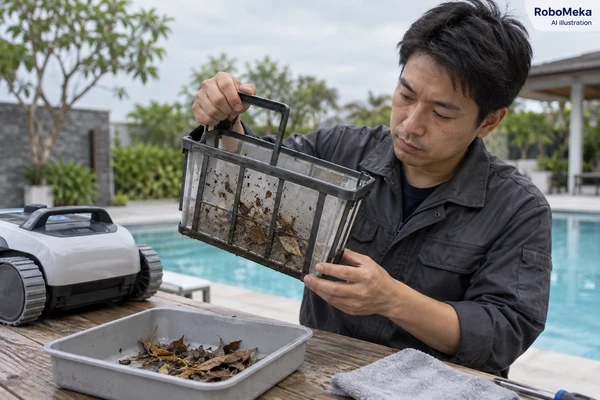
Record launch preparation, interventions, retrieval, basket emptying, rinsing, and readiness for the next cycle. Separate active handling time from elapsed machine time. A long autonomous run can still require awkward collection or frequent basket service under a heavy debris load.
Agree on measurement rules before comparing samples. For example, identify whether cleanup of the surrounding deck belongs in the observed routine and how incomplete runs are recorded. The resulting comparison becomes more useful when buyers can see the work that remains after the machine stops.
Evaluate a bundle without inventing savings
Consider a hypothetical dealer serving pools near deciduous planting. Owners already use floor cleaners but still manually collect floating leaves. A surface skimmer could address a separate task. The dealer would first verify collection and route behavior, then determine whether the additional emptying and charging routine is acceptable to customers.
The business case should use observed handling records and actual commercial inputs. Include acquisition cost, likely service parts, storage requirements, training, and support exposure. Keep estimates labeled as estimates. Do not claim a fixed reduction in chemical use, energy bills, or maintenance hours merely because two devices collect different debris.
A paired offer can simplify purchasing, but it also creates expectations of system-level convenience. Decide who supports each unit, how warranty claims are routed, and whether a fault in one product affects the customer's use of the other. Those responsibilities should be clear in the dealer agreement and customer documents.
Stock planning needs the same discipline. Separate baskets, chargers, brushes, and replacement assemblies can multiply inventory. Before approving a bundle, ask which parts require local stock, how variants are identified, and how long replacements are expected to remain available under the supplier's written commitment.
Plan how the bundle behaves commercially when only one item needs replacement or return. Record separate product identities even if both appear under one sales package. The customer, dealer, and warehouse should be able to identify the affected unit without shipping an unrelated machine back for inspection. Agree whether accessories remain with each product and how missing components are handled. These choices influence packing instructions and service workload. They also make the offer easier to expand later: a customer buying a surface skimmer after purchasing a floor cleaner should receive the same clear compatibility and ownership information as someone purchasing the pair together. A bundle discount alone does not create that consistency.
Turn category differences into useful merchandising
The first product image should show the correct operating layer. A floating skimmer belongs on the surface; an underwater cleaner belongs in its supported submerged application. Lifestyle photography can explain context, but staged images should not suggest capabilities that the documentation does not support.
Write titles and comparison filters around customer tasks. Useful distinctions include surface collection, floor cleaning, supported wall cleaning, waterline work, charging method, and handling procedure. Avoid a single automation score that hides which areas a product actually addresses.
If selling a hybrid device, make mode changes and owner actions visible. Ask whether functions run within the same cycle, require repositioning, or depend on a selected accessory. Customers should understand those details before interpreting an all-in-one description as simultaneous, uninterrupted coverage.
Keep claims tied to evidence. Factory testing for a sample may establish a specific collection function under defined conditions; shipment inspection may establish that the correct basket, charger, labels, and documents are included. Neither should be described as proof that every pool will stay clear without regular attention.
Frequently asked questions
Can a robotic surface skimmer replace a floor-cleaning robot?
A surface-only model does not perform the floor robot's underwater task. It may complement that task by collecting suitable material while it floats, but settled debris still needs an appropriate cleaning method. Check any hybrid model's actual supported functions rather than relying on its category name.
Does owning both products eliminate manual pool cleaning?
No universal conclusion follows from owning two machines. Steps, constrained areas, unusual debris, basket care, and other maintenance may still require attention. Evaluate the full routine and describe remaining tasks. A useful bundle reduces specified work under supported conditions; it should not imply that pool ownership becomes maintenance-free.
Should the two robots run at the same time?
Only when the relevant manufacturer instructions and application review permit it. Check potential interactions, access, and retrieval requirements. If simultaneous operation is not documented, plan separate use while obtaining clarification. Never test interaction with swimmers in the pool.
Is a solar skimmer suitable for every pool location?
Suitability depends on the model's charging and operating requirements and the site's exposure and obstructions. Ask how shade, seasonal conditions, and the approved backup charging routine affect the intended use. A solar panel is a feature to evaluate, not an unconditional operating guarantee.
Which category should a new distributor stock first?
Start with the recurring customer task the business can qualify and support. Review inquiry patterns, pool types, dealer capability, and service parts before choosing. Add a complementary category when there is a distinct application and a practical support plan, rather than simply to increase the number of products offered.
Conclusion
A robotic skimmer and a floor cleaner belong to different parts of the pool-care routine. Build the assortment around debris location, documented coverage, site access, and owner handling. Qualify each product separately, then assess whether combining them creates a useful and supportable offer for the intended customer.
For help framing a distribution or private-label inquiry, contact RoboMeka with your target cleaning tasks. Include the pool profiles, surface and underwater requirements, planned quantities, and service expectations so the product discussion can address a clearly defined assortment.