The short answer
Water operation, battery charging and storage are separate temperature conditions. Compare the limits in the exact robot manual with measured pool water and the actual charging or storage location. Permission to operate does not promise identical climbing or runtime throughout the range, and a seasonal calendar cannot replace those checks.
Introduction
A pool can feel cold while the equipment shed becomes hot in afternoon sunshine. A heated pool can remain suitable for cleaning while the robot's overnight charging location falls outside its permitted range. These are different exposure conditions, and a single temperature line in a sales brochure may answer only one of them.
Pool robot water temperature limits apply to operation in the pool. Charging limits apply to the battery and charging environment, while storage instructions govern periods out of service. Buyers should qualify all three for the exact model. Permission to operate within a stated range also does not guarantee identical climbing, coverage, or runtime throughout that range.
This guide helps importers, dealers, and facility buyers convert temperature information into an application decision. It addresses seasonal use, measurement, documentation, and customer handover. Proposed assessment methods are purchasing recommendations, not reports of completed RoboMeka testing. For actual operating limits, use the current instructions supplied for the selected robot and its charger.
Read temperature as a set of conditions
Treat water operation, charging, short-term parking, and seasonal storage as separate entries in the specification. Identify which component and operating state each limit describes. A waterproof robot does not make its charger suitable for immersion, and a broad storage range does not authorize operation at those same temperatures.
The Maytronics LIBERTY user manual illustrates this separation through distinct water conditions, charging recommendations, temperature warnings, and off-season storage instructions. Its values apply to the covered LIBERTY models. Buyers should request equivalent documentation for their selected product rather than borrowing those values for a private-label specification.
When documents disagree, ask the manufacturer to identify the applicable revision and resolve the conflict in writing. Do not average two limits or choose whichever makes the product easier to sell. A generic support page, an older manual, and a regional model sheet can describe different products or instructions despite similar branding.
Distinguish operating permission from cleaning performance
An operating range defines a permitted environment. It does not necessarily promise that every cleaning feature performs identically at its endpoints. Buyers should therefore ask two questions: whether use is allowed and whether the required result has been demonstrated under comparable conditions. Keep those answers separate in the application brief.
Maytronics' water-conditions FAQ specifically notes that colder conditions within its published guidance can affect climbing performance. This supports a model-specific performance qualification. It does not establish a universal cold-water threshold, a fixed reduction in performance, or the same behavior for another manufacturer's cleaner.
A customer who only needs floor debris collection may have a different acceptance condition from one who requires wall and waterline cleaning. The dealer should identify the required zones before discussing seasonal suitability. Calling a robot functional because its motor runs does not establish that the promised task remains achievable.
Measure the environment that the instruction actually names
Pool water needs its own reading
Use a suitable pool-water measurement and record when and where it was taken. A weather forecast describes air, not the water surrounding the cleaner. A heater setpoint is a control setting, not proof that the entire pool has reached that temperature. The record should identify the measurement method without implying laboratory precision.
Where readings appear close to a manufacturer's limit, avoid treating a rounded display as exact permission. Check the instrument's suitability and ask the supplier how to handle uncertainty. A buyer should not design a trial to push beyond a stated boundary. Select conditions clearly within the allowed range and document the result conservatively.
Charging conditions are local
Evaluate the actual approved charging location. Direct sun, an enclosed cabinet, a nearby heat source, or an unheated building can make that location different from the reported outdoor temperature. The robot also arrives there after use, so handover instructions need to address any waiting or preparation required by its manufacturer.
Do not improvise methods to force the robot into readiness. Follow the maker's temperature-warning and charging instructions, and seek service guidance when warnings persist. Opening a battery housing, adding an unapproved heater, or repeatedly attempting a blocked charge is not part of a reasonable customer routine.
Storage is an ongoing condition
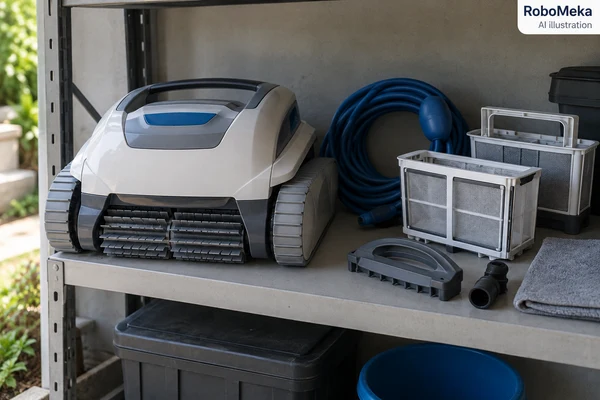
A shelf that appears suitable at delivery may become unsuitable later in the season. Ask where the customer will actually keep the cleaner and accessories during the hottest and coldest periods. Protected storage should satisfy the product's instructions throughout that period, not merely on the day the dealer installs the product.
The Maytronics winter-storage guide emphasizes preparation and attention to storage conditions. Use that as a reason to discuss the storage environment, while obtaining the selected model's own battery, draining, temperature, and inspection requirements. A general winter-care article cannot replace its manual.
Build a temperature qualification sheet
A short specification table can expose missing information before an order. Include the source document, affected component, permitted condition, and the person responsible for checking it. Leave unknown entries visibly unresolved. Empty documentation should not silently become a sales assumption that ordinary outdoor conditions are acceptable.
| Product state | Evidence to request | Site information to record |
|---|---|---|
| Cleaning in water | Model water-temperature range | Measured water conditions during intended use |
| Charging after use | Charger and battery instructions | Approved charging location and exposure |
| Short-term parking | After-cycle care and placement rules | Shade, access, and protection between sessions |
| Seasonal storage | Storage and battery-care instructions | Expected storage conditions and inspection access |
| Return to service | Manufacturer restart procedure | Condition check and current water measurement |
Keep measurement units consistent while preserving the original source values. If a translated manual provides both Celsius and Fahrenheit, ask the supplier to correct any mismatch. Dealers should not publish a conversion that changes the effective boundary or presents more precision than the original specification.
Attach the sheet to the customer's application record rather than leaving it as a general catalog note. When a site has more than one pool, identify which measurements and storage arrangements belong to each installation. A robot approved for one location should not be moved to another on the assumption that the same season produces the same conditions. This is particularly relevant when a service team shares equipment between indoor and outdoor facilities.
Qualify cooler-season use by task
An open pool is not automatic permission
A pool owner may keep the pool open after the robot's suitable operating season has ended. The closing date is therefore not the cleaner's cutoff. Likewise, a mild afternoon does not establish that morning water is appropriate. The operator needs a simple check tied to the actual model instructions.
Define the fallback cleaning arrangement before selling a robot for extended-season use. That arrangement should come from the pool service provider and the pool's care requirements. A buyer can accurately describe robotic assistance during a permitted period without implying that the machine replaces every task throughout the entire year.
Heated pools need the same review
Heating does not remove the need for upper-temperature limits or suitable charging storage. Identify whether the cleaner is intended for the type of pool and its required cleaning zones. Do not infer spa or hot-water suitability from a general swimming-pool claim. A separate application may require different equipment.
Also check that supporting equipment can remain in its instructed location. A poolside supply unit or charging station has its own exposure requirements. When the environment changes, the entire operating arrangement needs review rather than a narrow focus on whether the robot itself remains submerged.
Send RoboMeka your seasonal operating requirements, including measured water conditions, target cleaning zones, and the intended charging and storage locations. These details help determine which documentation and sample evidence belong in the sourcing brief.
Design a useful temperature assessment
Establish a permitted reference condition
Begin with an approved model configuration, a known pool surface, and conditions within all documented limits. Record brushes, filters, mode, and power state. For a cordless cleaner, follow the charging procedure before assessment. The aim is a repeatable purchasing comparison, not an unofficial stress test of the battery or seals.
Observe the tasks the customer values. Floor pickup, wall access, waterline work, retrieval, and the after-use routine may each matter. The wall and waterline testing guide provides a broader framework for evaluating those cleaning zones. Temperature should become a recorded context for the result, not a substitute for observing it.
Compare conditions without changing everything else
If a second permitted seasonal condition is available, retain the same evaluation scope and configuration as far as practical. Record changes in debris, surface condition, filter loading, and operating mode. A different result cannot be confidently attributed to temperature when the pool and cleaner have also changed substantially.
A buyer does not need a laboratory claim to make a useful decision. A transparent report can say that the required task was completed under stated conditions and remains untested elsewhere. That is stronger than extrapolating a short demonstration into a promise of year-round reliability across an entire export market.
Include the transition after cleaning
The assessment should follow the machine to its normal post-use location. Verify that retrieval, draining, permitted cleaning, and preparation for charging or storage fit the customer's routine. A robot that cleans satisfactorily but cannot be supported in the available environment may still be an unsuitable purchase.
Record operator involvement as well. If the manual requires a preparation step, include its practical implications without inventing a standard waiting time. Buyers comparing products should compare the full routine needed to maintain compliance, especially where the next cleaning session depends on battery charging.
Avoid turning a cold-weather complaint into a diagnosis
A customer reporting poor climbing during autumn has provided context, not a confirmed cause. Ask for the measured water temperature, model identity, selected mode, filter condition, and recent changes. Keep the troubleshooting within the manufacturer's approved owner tasks. Damage, persistent errors, or uncertain electrical conditions belong with qualified support.
The surface-compatibility guide explains why the installed finish and contact configuration also matter. The maintenance guide addresses routine care and service boundaries. Using those records together helps avoid replacing parts simply because a performance change coincided with cooler weather.
Do not advise customers to override a temperature warning or falsify a sensor reading. If the measured environment appears permitted but the warning persists, collect the relevant details and request the maker's diagnostic procedure. A warning that cannot be explained is a support issue, not permission to keep restarting until it disappears.
Write seasonal claims that dealers can support
Replace broad expressions such as all-season operation with a description of the documented application and its conditions. A listing can state that buyers must follow the model's operating and storage temperature instructions. If seasonal performance evidence is available, identify the tested task and environment without extending it to untested features.
A hypothetical importer selling into both mild coastal and colder inland markets may use the same robot with different handover emphasis. Coastal customers may need careful attention to shaded charging and hot storage locations. Inland customers may need a clearly defined transition to winter storage. Those are planning scenarios, not claims that geography alone determines suitability.
Training should prepare dealers to explain the difference between a permitted range and a guaranteed outcome. They should know where to find current documents and how to resolve conflicting information. A concise local-language card can help, provided it accurately reflects the approved manual and points to the full instructions.
Preserve temperature requirements through delivery
Factory testing should identify its environmental conditions if the result is being used to support a customer application. A supplier's standard indoor demonstration does not automatically establish performance in a colder outdoor pool. Ask which observations are documented and which seasonal conditions still need evaluation by the buyer.
Shipment inspection should verify the included charger, manual revision, model labels, and any temperature-related warning information against the approved specification. If the supplier changes the battery, charger, or control system, request an assessment of the affected instructions. Do not assume that the previous temperature guidance survives every component change.
After delivery, keep a clear route for updated instructions. A dealer who stocks several revisions needs to connect the right document to the right product. This avoids a common support failure: sending a customer a familiar manual whose operating conditions or warning behavior belong to a different version.
Frequently asked questions
What is the minimum water temperature for a pool robot?
There is no single minimum that applies to every pool robot. Use the operating-water range in the current manual for the exact model and configuration. Then check whether the required cleaning features have any additional qualifications. A category-level specification from another brand is not an acceptable substitute for the product's own instructions.
Can I use air temperature to decide whether cleaning is allowed?
No. Measure the pool water for a water-temperature requirement and assess the actual charging or storage environment for those separate requirements. Air forecasts, heater settings, and a person's impression of the water are incomplete evidence. If a reading is uncertain or close to a limit, seek clarification instead of assuming permission.
Does an allowed operating range guarantee normal wall climbing?
Not necessarily. Some manufacturer guidance identifies performance qualifications within an allowed range. Ask what the published limit covers and evaluate the cleaning zones your customer needs. Record results under their actual conditions. A cleaner moving across the floor does not independently demonstrate that it can complete the required wall or waterline task.
Can the robot be charged immediately after cold-water use?
Follow the exact model's charging preparation and temperature instructions. The water reading alone does not establish that the cleaner and charging location meet those requirements. Do not invent a universal waiting period or use an unapproved warming method. Persistent temperature warnings should be referred to the supplier's authorized support process.
Is a garage always suitable for winter storage?
No. The relevant question is whether the actual storage location stays within the model's requirements and provides the specified protection and access. An unheated garage or sun-exposed cabinet may vary considerably. Complete the manufacturer's preparation procedure, including any battery instructions, and plan the recommended checks before the next season.
Conclusion
Temperature suitability depends on the complete product routine: water operation, retrieval, charging, parking, and storage. Match each state to current model documentation and measured conditions. Evaluate the required cleaning outcome separately from simple operating permission, and make seasonal limitations understandable at quotation and customer handover.
Request a temperature-focused pool robot specification review from RoboMeka with your intended market, water conditions, cleaning tasks, and available charging and storage arrangement. A complete brief supports a more useful model comparison and sample plan.