The short answer
A pool cover and a robotic cleaner need a coordinated operating routine. Obtain permission for the exact combination before any under-cover use, keep moving cover parts clear of the robot and accessories, and preserve safe retrieval access. A timer or app does not establish that the two products communicate or can operate together.
Introduction
A homeowner programs a pool robot for an evening cycle, then closes the automatic pool cover as part of the usual routine. The two actions sound compatible because both products are described as automatic. That description does not establish that the cleaner can operate below the cover, that a cable can cross its travel path, or that either controller knows what the other product is doing.
A swimming pool cover and a robotic cleaner need a coordinated operating routine. Obtain permission for the exact combination before any under-cover use, preserve retrieval access, and keep moving cover parts clear of the robot and its accessories. Scheduling features do not establish communication or compatibility between independently controlled products.
This guide gives distributors and project buyers a way to assess that interface. It proposes documentation and evaluation methods rather than reporting a completed RoboMeka installation. Keep people out of the pool during cleaner operation. Follow the cleaner, pool and cover manufacturers' instructions, and remember that debris removal does not replace sanitation or professional water-quality management.
Can a robotic pool cleaner run under a cover?
There is no universal permission. The answer depends on the specific robot, cover, operating mode and installation. Request written confirmation from the relevant manufacturers before approving under-cover use. If the instructions prohibit the combination or leave it unresolved, plan cleaning with the cover fully removed or retracted in accordance with its operating procedure.
Permission to leave a cleaner in water is a different question from permission to run it beneath a cover. Maytronics' guidance on leaving a Dolphin in the pool distinguishes ordinary removal from certain timer or Eco Mode arrangements. It does not establish compatibility with an arbitrary third-party cover. Buyers must keep those two decisions separate.
A video of a robot moving beneath a cover also leaves important questions unanswered. It may not identify the model revision, cover construction, depth, chemical conditions or retrieval procedure. Do not reproduce the arrangement merely because it appears possible. Use demonstrations as prompts for supplier questions, not substitutes for operating permission.
Identify the cover system and its movement
Floating thermal covers
A floating thermal cover rests close to the water surface and may have a manual reel. Ask how it is removed, where the reel sits, and where the operator stands while handling it. A robot's surfacing, waterline movement or retrieval path may interact with this arrangement even when the cleaner spends most of its cycle on the floor.
Do not describe a floating cover as a safety cover unless the exact product has the relevant documented status. The cleaner selection does not establish cover safety. For an operating plan, the important points are the manufacturer's requirements, full removal when required, clear handling space and a defined place for both pieces of equipment after use.
Automatic track-guided covers
An automatic cover adds moving fabric, a leading edge, tracks and a housing area. Map these features on the same sketch used for the robot's operating cable and storage position. A cable placed neatly along the deck may still cross the cover's travel route. The location must be assessed with the complete mechanism in mind.
The T4 instructions linked from Cover-Pools' official owner-manual library require objects to be removed before covering the pool. That product-specific instruction illustrates why a buyer cannot approve combined operation from the cleaner manual alone. Obtain the instructions for the actual installed cover and apply its requirements directly.
Seasonal covers
A seasonal cover changes the task from a daily operating routine to closure and reopening. Ask whether the robot will be removed and stored before closure, and who prepares the pool when the cover comes off. Do not promise unattended cleaning throughout seasonal closure without explicit model and cover permissions covering that arrangement.
Keep debris on top of a cover out of the pool during removal using the cover manufacturer's procedure. The robot should not be sold as a reason to ignore cover care. Opening debris can create a very different workload from routine cleaning, and the purchasing brief should describe the intended role accurately.
Separate five compatibility questions
Treat storage, operation, cover movement, retrieval and control behavior as separate approvals. A positive answer to one does not resolve the others. This structure is especially helpful when several companies provide the pool, cover, robot and maintenance service, because each may otherwise assume another party has reviewed the combined arrangement.
| Question | Information needed | Practical outcome |
|---|---|---|
| May the robot remain in the water? | Exact cleaner manual and mode | Defines permitted residence conditions |
| May it operate beneath this cover? | Cleaner and cover approval | Defines whether combined operation is allowed |
| May the cover move with equipment present? | Cover operating requirements | Establishes removal and clearance steps |
| Can the robot be retrieved safely? | Pool layout and approved method | Confirms usable access before a trial |
| Do the controllers coordinate? | Documented integration, if any | Prevents assumptions about automatic interlocks |
Capture a source and revision for each answer. A general email saying the products should work together is weaker than a response identifying both model numbers, the operating arrangement and any conditions. Ask the supplier to correct ambiguous wording before it becomes part of the project handover or private-label installation instructions.
Where no approved combined arrangement exists, use a sequential routine. The cover is handled according to its instructions, the permitted robot task is completed, and equipment is removed and stored before the next cover operation where required. This may add handling time, which belongs in the product comparison rather than being hidden from the customer.
Design the deck layout around both products
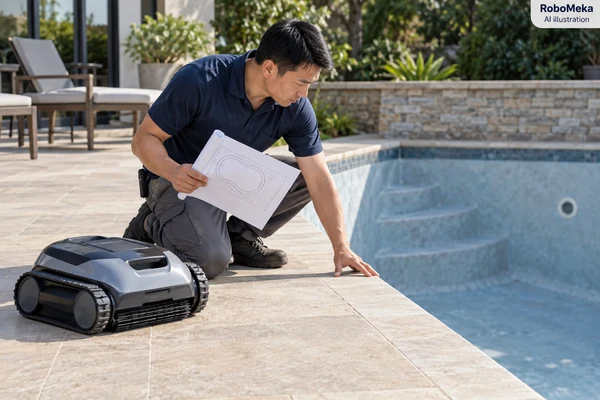
A poolside layout should show the cleaner's permitted power-supply position, cable route, retrieval point, cover controls, reel or housing, and the path to storage. Include doors and walking routes. A product may fit the pool dimensions while its accessories create an inconvenient or unsuitable arrangement on the surrounding deck.
For corded robots, follow the specified electrical and separation requirements. Do not run a cable through a cover housing, across moving tracks or through an improvised opening to make the layout work. No electrical modification should be used to create compatibility. Have any installation concerns resolved by the appropriate qualified professional.
Cordless equipment changes the layout but does not remove every interaction. A retrieval hook, charging area, surface-parking behavior or required removal step may still matter. Compare these details using the guide to cordless pool robot retrieval and charging, then transfer the relevant requirements to the combined pool sketch.
Plan a dry location for the operator to place and service the removed cleaner. Avoid arrangements in which the robot must sit on cover fabric or on the mechanism housing while it drains. Check whether the stored unit or caddy blocks access to the cover controls, emergency equipment or ordinary circulation around the pool.
Build an operating handover that survives interruptions
The handover should describe the pool's permitted states in everyday language. Examples include cover secured and pool closed, cover fully open with cleaning underway, and cleaning equipment removed before the pool is released for use. The actual states and sequence must follow the installed products' instructions. Avoid inventing a universal procedure that overrides them.
Name the person responsible for checking the pool before a scheduled cycle. At a household, that may be the owner; at a managed property, it may be a trained operator. A timer can issue a start command, but responsibility for access restrictions, debris conditions and required preparation remains part of the operating plan.
Also define what happens when the sequence is interrupted. If a cleaning cycle fails to start, a filter needs attention or the cover cannot move normally, the operator needs a clear stop-and-review instruction. Do not allow a schedule to keep retrying while the underlying condition remains unknown. Preserve the equipment's normal protections and seek authorized support.
For a coordinated application review, send RoboMeka your robot and pool-cover requirements. Include both product identifiers where known, the pool sketch, intended cleaning times and the required storage arrangement so unresolved interface questions can be identified before selection.
A proposed dealer evaluation without unsupported combined use
Consider a hypothetical dealer specifying a robot for a residential pool with an automatic cover. The cover's requirements call for a clear pool before closure, and no under-cover operating approval is available. A useful trial would evaluate a fully open cleaning routine and the handover between equipment, rather than experimenting with the cover closed.
Review documents before moving equipment
Create a short record identifying the pool, cover, cleaner and accessories. Attach the relevant manual sections and note any unresolved questions. Confirm the permitted water conditions and cleaning zones. If the instructions conflict or the robot cannot be retrieved from an approved standing position, resolve that issue before a wet trial.
The document review should include the customer's existing routine. A family that always covers the pool immediately after use may have little patience for a long separate cleaning window. That is a legitimate selection constraint. It may favor a different permitted cycle or service arrangement, but it does not justify ignoring either manufacturer's instructions.
Rehearse the handling sequence with equipment inactive
Show where the cleaner and accessories will be placed before deployment and after removal. Check access to the cover controls and the storage route. Keep all equipment inactive while discussing potential conflicts. Do not pull cables through moving hardware or operate the cover to see whether it catches an object.
Record the time and effort involved in normal handling. The purpose is to assess whether the customer can carry out the permitted routine reliably. If the operator must repeatedly relocate heavy equipment or clear a crowded path, address the layout or selection. A technically possible arrangement can still be a poor everyday fit.
Observe a permitted cleaning cycle
Operate the robot only after the pool has reached the approved cleaning state, with no people in the water. Record the cycle mode, starting debris, cleaning result and required intervention. Evaluate coverage using the same principles described in pool robot wall and waterline testing, where relevant to the selected model.
After the cycle, follow the approved removal, filter-care and storage procedure. Confirm that the equipment is clear before the cover is operated where required. Document any confusing handoff, rather than describing the process as fully automatic simply because the cleaner's underwater movement did not require manual steering.
Do timers and smart-home controls solve the interface?
Only a documented integration can establish what information the controllers exchange and what actions they permit. Two products connected to the same wireless network do not necessarily communicate. A smartphone that displays both apps does not create an interlock preventing the cover from closing or the cleaner from starting in an unsuitable state.
Ask which conditions are actually detected. A controller might know that it sent a close command without verifying the cover's physical position. A robot app might show a scheduled cycle without confirming that the pool is ready. Treat these as questions for the manufacturers, not assumptions to fill with marketing language such as intelligent coordination.
Do not add an unsupported smart plug, bypass a control circuit or modify a safety feature to link the products. If the project requires integration, obtain a manufacturer-supported solution and appropriate installation support. The procurement document should identify the interface, responsible supplier, permitted behavior and procedure after a communication failure.
Keep water management and cover care in the plan
A cover changes the pool's exposure to the surrounding environment, but its presence does not make every cleaning schedule appropriate. Inspect actual debris accumulation and follow the operating limits for both products. Avoid promising a fixed reduction in cleaning frequency without evidence from the installation and a defined observation period.
Professional water management remains necessary. The robot is a debris cleaner, not a sanitizer, and neither its schedule nor a cover establishes that the water is suitable for swimming. Have qualified pool professionals manage chemistry and any treatment-related waiting conditions. Keep the cleaner out of unsupported treatment conditions and follow the applicable manufacturer guidance.
Factory testing may verify the selected cleaner's functions under documented conditions, but it cannot certify compatibility with every installed cover. Shipment inspection should confirm model identity, accessories and the approved documentation package. The customer handover must still address the actual installation. The pool-cleaner maintenance guide can support the equipment-care portion of that handover.
Frequently asked questions
Can I assume a floor-only robot is safe under any cover?
No. Cleaning scope does not establish cover compatibility. The robot, cable, retrieval method and control behavior still require review, and the cover's instructions may require objects to be removed. Obtain permission for the exact arrangement. If approval is absent, use a permitted routine with the cover fully removed or retracted.
Does permission to leave the robot in water include closing the cover?
Not automatically. Residence in water, active cleaning and cover movement are separate conditions. A model may permit a particular repeating mode while the cover manufacturer imposes different requirements. Check both sets of instructions and retain the written answer with the product and installation records before making a customer-facing claim.
Will a cordless robot eliminate cover conflicts?
It removes the operating cable, but other conflicts can remain. The cleaner may need access to the surface or a particular retrieval location, and the cover may require all equipment to be removed. Assess the exact model and operating routine. Cordless describes the power arrangement, not universal compatibility with another product.
Can a smart plug coordinate the robot with an automatic cover?
Do not use an unsupported smart plug or electrical modification to create coordination. A safe interface requires documented manufacturer support and any appropriate professional installation. Ask how actual equipment state is confirmed, what happens after lost power and who supports faults. A shared schedule alone is not proof of an interlock.
What should dealers include in a combined-product handover?
Include the exact equipment identities, permitted operating states, clearance requirements, retrieval method and responsibility for each step. Explain how scheduled cleaning is cancelled or postponed when the pool is not ready. Keep the manuals accessible and record unresolved compatibility questions as unresolved rather than converting them into assumptions during installation.
Conclusion
The most useful pool-cover compatibility assessment is a complete operating routine supported by both manufacturers. Separate permission to remain in water from permission to clean under a cover, examine the moving parts and handling routes, and verify any claimed integration. Build the sales promise around what the customer can carry out consistently.
To discuss a product configuration around that routine, contact RoboMeka with your pool and cover application brief. Share the destination market, expected quantities, cover type and permitted cleaning window so the specification can reflect the real installation.