The short answer
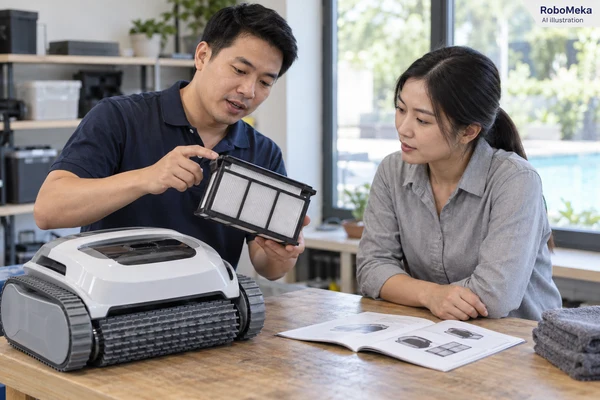
Compare cordless pool robots through retrieval, drain-down, permitted cleaning, dry charging and readiness for the next cycle. Verify both normal pickup and supported low-energy recovery. An automatic retrieval feature is a convenience with conditions, not a reason to omit a safe approved backup procedure.
Introduction
A cordless pool robot finishes cleaning while its owner is inside the house. When the owner returns, the machine is resting underwater beyond comfortable reach. Whether that situation is easy to manage depends on the retrieval method, pool access, remaining operating capability, and instructions supplied with the product. Battery runtime alone does not answer it.
For distributors and private-label buyers, the complete product is a workflow: prepare, launch, clean, locate, retrieve, drain, maintain, dry as required, and charge. A machine that cleans well but creates an awkward handover between these stages may disappoint the intended customer. Each stage belongs in sample evaluation.
This guide focuses on retrieval and charging rather than repeating a battery-capacity comparison. It proposes buyer checks and hypothetical ownership scenarios; it does not claim completed RoboMeka tests or guarantee that any particular retrieval feature is available from RoboMeka. Use the exact manufacturer's instructions throughout, with swimmers out during evaluation.
What should buyers verify before choosing a cordless pool robot?
Verify how the cleaner is located and brought within reach, what happens if the owner misses its preferred pickup opportunity, and how it is prepared for charging. Confirm the included accessories and identify any required items supplied separately. Then assess whether the routine fits the customer's pool and practical ability to handle the machine.
Automatic parking, wall approach, waterline waiting, app notifications, and a retrieval hook describe different functions. A product may include some and omit others. Ask what each function does under normal completion, an interrupted cycle, and a low-battery condition. Do not combine the terms into one unsupported promise of effortless retrieval.
For a current example, Polaris' Freedom product page lists several retrieval approaches and a charging station. Those features illustrate the questions buyers can ask; they should not be attributed to another model without its own documentation.
Start with the retrieval location and the person using it
Map practical deck access
Record where the owner can stand securely and reach the pool edge. Note raised walls, narrow coping, cover equipment, landscaping, and areas unavailable for normal access. A robot arriving at a wall is not automatically arriving at a usable pickup point. The site needs a safe way to complete the final transfer out of the water.
Use the pool cleaner sizing guide to capture dimensions and geometry, then add preferred retrieval locations. Ask the supplier whether the model's behavior fits that layout. Do not assume that a single demonstrated pickup point can be selected or repeated unless the product supports that control.
Evaluate the handling action, not just dry weight
A published dry weight is useful, but the owner handles the robot through a sequence involving reach, drainage, lifting, and carrying. Observe the complete approved movement with a representative adult operator. Record difficulties without encouraging overreaching or an improvised lifting method.
The designated handle and any retrieval attachment serve particular purposes. Confirm which component brings the robot toward the edge and which component supports lifting it out. Do not assume a hook, pole, lid, brush, or housing edge is an approved lifting point. Use the manual's method and obtain clarification if the distinction is unclear.
Include the path to the care and charging area
After removal, the owner needs a suitable place for draining, filter care, drying where required, and charging. Record the distance and obstacles between these locations. A convenient underwater retrieval can still lead to an inconvenient ownership routine if the equipment must be carried through a crowded or unsuitable route.
Ask whether a transport accessory is included, optional, or unsupported. Assess it as part of the exact configuration offered. A product photograph showing a caddy does not establish that the quoted carton contains one or that any generic cart provides an equivalent handling method.
Distinguish the available retrieval functions
| Function or situation | Buyer question | Evidence to request |
|---|---|---|
| End-of-cycle parking | Where does the cleaner normally stop? | Manual description and representative observation |
| Waterline waiting | How is the opportunity signaled and what limits apply? | Mode-specific instructions |
| On-demand retrieval | What input is required and when will it work? | Supported procedure and operating conditions |
| Hook and pole | What is included and how is it used? | Accessory identity and approved retrieval sequence |
| Missed pickup | What happens after the initial opportunity passes? | Documented fallback routine |
| Low battery | Which retrieval functions remain available? | Model-specific explanation |
| Interrupted cycle | How does the operator recover the machine? | Approved stop and recovery method |
| Inaccessible edge | Is there a supported alternative location or method? | Site review and supplier confirmation |
Use the table as a sample-approval record. A blank answer is an unresolved ownership requirement. It should not be filled by assuming that the robot will repeat a wall approach or that an app command always remains available after the cleaning cycle ends.
Test the missed-pickup scenario deliberately and safely
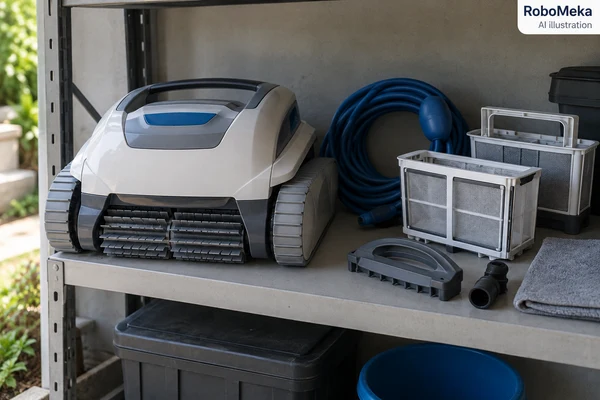
The owner may not be present at the exact end of a cycle. A procurement test should therefore include the documented fallback workflow, not just the easiest demonstration. Agree the scenario with the supplier, remain within permitted operating conditions, and keep the pool supervised and free of swimmers.
The Polaris Freedom quick-start guide describes a limited waterline waiting sequence and a later hook-and-pole retrieval route for the relevant mode. This example shows why buyers need mode-specific instructions and a fallback, even when a product advertises convenient waterline pickup.
For another model, establish its own sequence before testing. Record how the operator identifies the robot's location, which supplied equipment is needed, and how long active handling takes. Do not extend the trial into unsupported deep discharge or repeatedly attempt an unavailable function to force the machine to move.
If the documented recovery method cannot be performed safely from the site's accessible deck, stop the evaluation and obtain professional assistance or a different product recommendation. Entering the pool to rescue an operating machine should never become an informal standard procedure in a buyer's test plan.
Verify app dependence without assuming underwater connectivity
Ask which indications are available on the cleaner, which require an app, and when communication is expected to work. A phone showing the last reported state is not necessarily a live view of the machine underwater. The supplier should explain notification timing, connection requirements, and any limitations relevant to retrieval.
Include a permitted test in which the owner does not receive or notice the notification. Can the normal fallback still be completed using the supplied instructions? The answer helps determine whether app connectivity adds convenience or is essential to a particular promised workflow.
Keep setup and support realistic for the destination market. Confirm the required app, account process, supported devices, and language availability where these affect the owner routine. Do not reduce a retrieval problem to a network change that weakens the customer's security or lies outside the manufacturer's instructions.
If retrieval convenience is central to your product positioning, send RoboMeka your handling and pickup requirements. Include the target pool layout, accessible deck areas, intended customer routine, destination market, and the fallback behavior your sample evaluation needs to establish.
Make drainage and filter care part of the comparison
Observe the approved drain-down sequence
Follow the manufacturer's lifting and drainage instructions, and use only designated handles or supports. Record where water drains and whether the operator can maintain a secure position. Avoid measuring convenience by lifting faster than the approved method or skipping the drainage stage shown in the instructions.
A useful sample comparison includes the actual transfer to a stable care area. Record whether the robot must be rotated or opened and whether those actions are explained clearly. If the procedure is ambiguous, obtain clarification before repeating it. Do not improvise modifications to drainage openings or valves.
Check debris retention during removal
A clean pool floor at the end of a cycle is only one part of the result. Observe whether collected material remains contained during the permitted retrieval and emptying process. Use agreed, suitable debris and avoid creating a contamination problem for the sake of a demonstration.
Record release events as observations, along with the handling sequence. Do not assume that every release is a filter failure; the basket installation, condition, or approved procedure may need review. The pool cleaner filter selection guide helps connect collection performance with practical basket care.
Separate active work from waiting
Measure the time the operator is actually occupied and the elapsed time until the robot is ready for its next stage. Draining or drying can involve waiting even when active handling is brief. Customers planning a second cycle need that complete schedule, not only the advertised cleaning duration.
Keep any measured values tied to the sample and conditions. A short buyer trial can compare workflows, but it should not produce an unconditional time-saving claim. If the intended users have different access or handling needs, evaluate those conditions before extending the conclusion.
Specify charging as a separate dry operation
Use the exact approved charging equipment
Confirm the charger or station model, supplied mains arrangement, and compatibility with the exact cleaner version. Connector fit is not evidence of electrical compatibility. Do not use substitute chargers, improvised adapters, extension arrangements prohibited by the manual, or altered power equipment to make a sample setup convenient.
Ask how replacements are identified and supplied. A distributor may need a clear compatibility record across cleaner revisions and market versions. Keep that record available to service staff so a lost charger does not lead to a recommendation based only on appearance or a similar product name.
Define the charging location before purchase
The charging area must meet the manufacturer's environmental, distance, electrical-protection, and access requirements. Use a dry, suitable location and have any necessary installation assessed by a qualified professional. Do not infer that a charger can tolerate the same exposure as the underwater robot.
Product descriptions such as outdoor charging should be read with their conditions. Rain, direct sun, temperature, and splash exposure may be restricted. Obtain the full instructions and include the practical location requirements in dealer handover. A sheltered-looking corner is not automatically a compliant charging location.
Make readiness observable
Follow the exact drying and preparation instructions before connecting or docking. Ask which indication confirms charging, which shows completion, and how an error is presented. The owner should be able to tell the difference between a robot resting on its base and a robot actually receiving charge.
During the sample check, record the normal sequence and the instructions for a failed or interrupted charge. Do not provoke a fault by wetting connections, blocking ventilation, changing the charger, or exceeding temperature limits. Safe observation of normal operation is sufficient for a buyer's workflow assessment.
Evaluate readiness for the next cleaning window
Consider a hypothetical owner who wants cleaning completed before an afternoon swim and again before guests arrive the next day. The buyer's schedule should include the supported cycle, retrieval availability, manual care, required drying, and charging. A battery-runtime figure does not describe the full interval between usable cycles.
If the schedule does not fit, review the intended cleaning frequency and supported operating modes with the supplier. Do not assume that a brief partial charge provides a full cycle unless the exact model's instructions support that expectation. Keep readiness indications and the permitted use of partial charge in the customer guidance.
For some applications, a corded alternative may offer a more practical routine; for others, avoiding an operating cable may be valuable. The corded versus cordless pool cleaner comparison helps frame the broader choice. The decision should reflect the customer's complete cleaning window and handling requirements.
Translate the workflow into a purchasing specification
The quotation should identify the cleaner, charger, retrieval accessories, required separately supplied items, and relevant documents. If the sales proposition relies on a particular retrieval function, name it and define the conditions. Keep any optional app or accessory dependencies visible in the same purchasing record.
Specify sample acceptance through observable actions: locate the cleaner after completion, perform the documented missed-pickup procedure, retrieve using the designated method, complete care, and confirm charging in an appropriate location. These criteria are more useful than an undefined easy-to-use score.
For shipment inspection, check accessory inclusion, part identity, visible condition, labels, and correct instructions under the agreed inspection plan. A missing retrieval hook or incorrect charger can break the ownership routine even when the cleaner itself appears correct. Record discrepancies against the approved sample configuration.
Give service staff a stage-based intake form. Ask whether the issue occurs during locating, approaching, lifting, draining, cleaning, charging preparation, or charge indication. This directs the next question to the actual problem and reduces the temptation to interpret every failure to restart as a battery defect.
Retain a completed handover record for dealer demonstrations. It should show that the operator practiced the supported fallback retrieval and recognized the normal charging indication, not merely watched the robot clean. Where the customer uses a different pool or charging location, identify those differences for review. This keeps a successful showroom demonstration from becoming an unsupported promise about access and handling at the customer's home.
Frequently asked questions
Does automatic parking mean the robot will be easy to reach?
Not necessarily. Ask where parking occurs and compare that behavior with the pool's accessible edges. The final transfer still requires a safe, approved handling method. A machine stopping near a wall may remain inconvenient at a raised, obstructed, or otherwise inaccessible section.
What happens if the owner misses waterline pickup?
The answer is model- and mode-specific. Obtain the documented fallback procedure and verify it during a permitted sample evaluation. Do not assume the robot waits indefinitely or can repeat its approach after the battery has reached its normal operating limit.
Can a pool pole be used to lift any cordless cleaner?
Use only the designated attachment and procedure for the exact model. A pole or hook may be intended to bring the cleaner within reach rather than support every lifting action. Confirm the role of the handle and retrieval accessory before demonstrating removal to customers.
Can the cleaner be charged immediately after removal?
Follow the manufacturer's drainage, cleaning, drying, and charging-preparation instructions. Do not connect wet equipment or assume every charging design has the same requirements. Use the approved charger in the specified environment and confirm the normal charging indication.
Should charging speed decide which model to buy?
It is one part of the schedule. Compare cleaning, retrieval, manual care, required drying, and recharge readiness together. A faster charger may not resolve difficult access or a missed-pickup routine that the intended owner cannot perform safely.
Conclusion
A cordless pool robot should be evaluated from launch through readiness for its next cycle. Verify the normal pickup, missed-pickup fallback, handling method, drainage, and charging requirements as one practical routine. This gives buyers a firmer basis for product selection and more useful instructions for owners.
To build a workflow-focused sourcing brief, contact RoboMeka with your retrieval and charging requirements. Share the target pool layouts, expected cleaning schedule, planned quantities, and service needs so the product discussion can identify the functions and sample checks that matter.