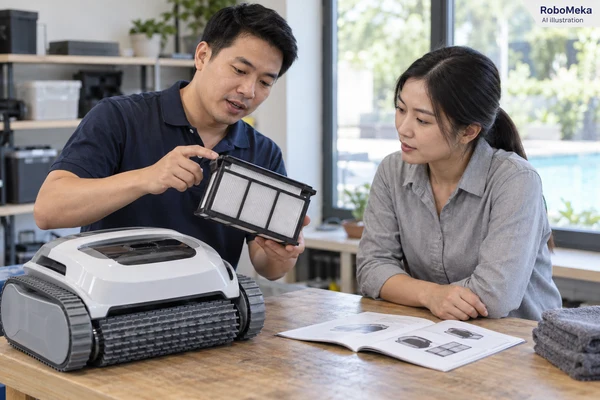
The short answer
Specify a pool robot caddy around the exact cleaner, accessories and movement route. Check restraint, handle access, wheel clearance and dry storage space, then assess vehicle transport separately. A storage cover does not make every location suitable, and a poolside caddy should never be assumed to replace protective shipping packaging.
Introduction
A pool cleaner sits on a caddy in a showroom, with its cable neatly wound and its handle within reach. At the customer's property, the same bundle must pass through a narrow door, cross a rough paving joint and fit in a crowded equipment room. The accessory that looks convenient in a photograph may not match the actual handling route.
Specify a pool robot caddy around the exact cleaner, supplied accessories and movement path. Check fit, restraint, wheel clearance and storage conditions, then assess vehicle transport separately. A poolside caddy is not automatically shipping packaging, and a cover does not make every storage location suitable for the cleaner, battery or power supply.
This guide helps importers, distributors and facility buyers evaluate the complete handling system. Its proposed assessment is not a record of completed RoboMeka testing. Use the manufacturer's approved lifting and storage methods, isolate equipment before handling it, and keep people out of the water whenever the robot operates. A cleaner supports debris removal, not sanitation.
What problem should the caddy solve?
A caddy can organize approved equipment and reduce the need to carry it along a suitable route. It may support the cleaner, cable, power supply or other specified accessories. Those functions depend on its design and compatibility. Begin with the customer's handling problem rather than assuming that any wheeled frame is a useful upgrade.
Polaris describes the VRX iQ Plus caddy as a transport and storage accessory supplied with that cleaner. That is a product-specific bundle. It does not establish that a visually similar caddy will support another robot correctly or that its use extends to stairs, vehicle transport or every outdoor surface.
Ask whether the customer's main difficulty is the wet lift from the pool, movement across the deck, carrying accessories, or off-season storage. A caddy may help only after the initial lift is complete. If extraction across a high edge is the real constraint, review the approved retrieval method before recommending an accessory that cannot solve that part of the task.
Also distinguish a storage stand from a transport caddy. A stand may support the cleaner in a prescribed position without being designed to move it. Conversely, a wheeled accessory may need a particular parking surface and loading arrangement. The specification should describe intended functions plainly rather than using stand, trolley and caddy interchangeably.
Confirm model fit at every contact point
Cleaner support and orientation
Request the compatible cleaner model list and accessory part number. Check where the cleaner rests, which features retain it and which orientation is required. Avoid improvised padding, straps or adapters unless the manufacturer approves them. A cleaner that can be balanced on a frame is not necessarily supported as intended during movement or storage.
Inspect the loaded arrangement with the robot inactive and drained as required. Look for interference with brushes, tracks, wheels, covers and accessible controls. Confirm that loading and removal can follow the instructions without forcing parts or using a cable as a handle. Any uncertainty should be resolved with the supplier before a handling trial.
Power supply, charger and cable
A holder for a corded power supply should match the specified unit and attachment method. It should not be treated as approval to operate electrical equipment in an unsuitable location. Check the robot's complete operating requirements separately, including the supply position and environmental protection. Do not modify plugs, holders or wiring to make a mismatched bundle fit.
For cordless products, distinguish a place to store the charger from an approved charging arrangement. Charging may require conditions the caddy's storage position does not provide. The cordless pool robot retrieval and charging guide explains why charging belongs in the complete workflow rather than being assumed from an accessory photograph.
Cable supports should accommodate the model's required coiling method without sharp bends or strain on connectors. Check whether the operator can secure the cable before moving the caddy and whether loose sections can reach the ground or wheels. A tidy display is useful, but the evaluation should show how the user achieves it after an ordinary cleaning cycle.
Small accessories and replacement parts
Confirm where the supplied filter, retrieval hook or other accessories will be stored, if the design provides for them. Do not overload an accessory holder with unrelated equipment. A missing hook or charger can interrupt use even when the robot itself is ready. The bundle specification should make clear what is included and what needs separate storage.
Record replaceable caddy components such as wheels or approved fasteners when the supplier supports field replacement. Availability and part identification matter to distributors managing several robot revisions. Avoid mixing visually similar parts without approval, since a small fit difference can affect support or assembly even when the overall frames look alike.
Assess the route from the pool to storage
Use a sketch or short site walkthrough to identify the handling route. Record door width, thresholds, changes of surface, turns and any slope. Compare the route with the caddy manufacturer's permitted use. Do not take a sample down steps or across a steep surface to discover its limits experimentally.
The relevant width is the fully loaded system, including handles, cable loops and attached accessories. A bare frame that passes through a door may not represent the actual bundle. Likewise, a storage space must allow the user to place and remove the robot safely, rather than only accommodating its static footprint on paper.
| Route or storage feature | Question for the evaluation | Possible purchasing consequence |
|---|---|---|
| Narrow doorway | Does the approved loaded arrangement fit? | Different storage point or accessory choice |
| Paving joint or threshold | Is passage within documented use? | Route change or supported handling method |
| Steps | What method does the manufacturer permit? | Separate carrying or another location |
| Sloped parking area | Is stable parking permitted here? | Select a suitable level storage area |
| Crowded equipment room | Can loading and unloading be completed? | Reserve working clearance, not just footprint |
| Long outdoor route | Are exposure and surface conditions suitable? | Assess practical handling and protection |
Do not claim a universal labor reduction because a caddy has wheels. The benefit depends on the route, operator and equipment. For a proposed evaluation, observe an appropriately briefed adult completing the permitted task and record difficulties. The result should describe that arrangement, without turning one person's experience into an ergonomic certification.
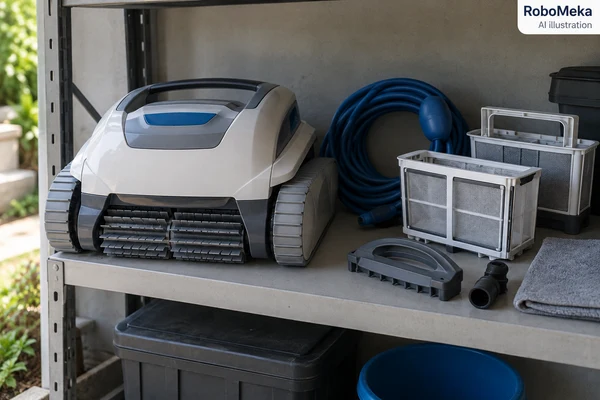
Separate daily storage from off-season storage
Daily storage prepares the robot for its next ordinary use. Off-season storage may require different cleaning, drying, battery care and inspection arrangements. Follow the exact manual rather than copying instructions from another model in the same category. A caddy can organize the equipment, but it does not replace those preparation steps.
Maytronics' Liberty storage guidance distinguishes after-cycle care from extended storage, including battery-specific preparation. The procurement lesson is to provide model-specific storage instructions with cordless equipment. Do not turn one brand's battery procedure or temperature range into a universal rule for every cleaner.
Check the actual storage location during the hottest, coldest and wettest parts of the intended season. An equipment shed may be dry during a demonstration yet unsuitable at another time. Ask the customer to compare its conditions with the documented limits. If they cannot establish suitability, choose an appropriate location before the product is put into service.
Keep water-treatment products and equipment-care responsibilities separate. A pool robot is not a sanitizer, and storing it beside treatment chemicals is not part of a cleaning claim. Have qualified pool professionals manage chemistry and the facility's appropriate chemical storage. Follow the cleaner manufacturer's requirements for its own environment and maintenance.
For an accessory bundle built around real handling, send RoboMeka your caddy and storage requirements. Include the cleaner configuration, movement route, storage space and whether the equipment will also travel between sites, so each part of the task can be reviewed.
What does a caddy cover actually protect?
A cover provides the protection described for that exact accessory when used as instructed. Check fit, fastening, ventilation and access to the handle. Do not assume a cover makes an outdoor location appropriate for charging or operating the power supply. Product storage and electrical operation remain separate questions even when one fabric cover fits over both components.
Maytronics' Dolphin Caddy Cover page describes protection while the equipment is not in use and notes ventilation and handle access. Those details are useful comparison criteria. They do not remove the need to follow the cleaner's environmental limits or establish equivalent protection for an unverified private-label cover.
Check how the cover is used after cleaning. If the equipment must drain or dry first, the routine needs space and time for that process. Avoid a sales photograph that encourages packing wet accessories tightly into an unsuitable enclosure. The customer's practical instruction should explain preparation, placement and inspection using the actual product guidance.
An included cover can also change the packaging and spare-parts plan. Record its part number, size and material identification supplied by the manufacturer. Ask how replacements are ordered and whether a revised caddy changes compatibility. A bundle should remain understandable after the original carton and showroom labels have been discarded.
Vehicle transport is a different handling condition
A poolside caddy should not be assumed to restrain equipment in a moving vehicle. Braking, cornering and vibration create a different task from rolling a cleaner across an approved deck. Follow the manufacturer's transport instructions and use suitable protective packaging and restraint. Do not transport a loaded caddy loose in a service vehicle.
Service buyers should describe whether equipment moves between pools, how often it travels and where it is loaded. Ask which components must be removed, drained or separately protected. If a cordless model is involved, verify the applicable battery transport requirements through qualified logistics support for the actual route and shipment type rather than improvising a generic rule.
Avoid using a retail carton repeatedly after it has lost its protective function. Inspect packaging before reuse and replace unsuitable components. The cleaning-robot export packaging guide addresses shipment planning; the caddy decision should connect to that plan while keeping operational movement and freight protection distinct.
For an importer, ask whether the caddy is shipped assembled or in parts and how each piece is protected. Assembly convenience affects the dealer's workload, while loose hardware or poorly restrained components can create receiving problems. Request the packing configuration and assembly instructions before agreeing carton dimensions or assuming the showroom arrangement matches the shipment.
A proposed caddy acceptance assessment
Consider a hypothetical distributor offering an optional caddy with a corded pool robot. Customers typically store equipment in a utility room reached by a level paved path and a doorway. The assessment would confirm the approved model combination, evaluate that representative route and review packaging. It would not establish suitability for stairs or vehicle movement without separate evidence.
Check the assembled product
Assemble the caddy using the supplied instructions and approved tools. Record missing components, unclear steps and any mismatch between the manual and parts. Do not correct a sample with drilling or substitute fasteners. If assembly is uncertain, seek clarification so the production instruction can be fixed rather than leaving dealers to invent their own method.
Load the inactive cleaner as prescribed and verify the intended contact points. Check accessory retention and normal access to the handle. Photograph the accepted arrangement for the procurement file. This record should show the actual sample and configuration; an AI-generated editorial image is not evidence that the fit assessment occurred.
Observe routine movement and storage
With an appropriately briefed operator, follow a route within the documented limits. Record clearances, handling steps and places where equipment must be repositioned. Do not deliberately tip the system or test failure loads. The aim is to establish practical fit for the intended application, not to conduct an improvised safety certification.
Place the system in the proposed storage area and verify that the user can complete the prescribed care routine. Check whether the cover can be fitted, the cable stored and the cleaner removed without rearranging unrelated equipment. Note the working space required. That space belongs in the customer recommendation alongside the nominal caddy dimensions.
Inspect the delivered bundle
Factory testing and assembly checks can confirm the agreed configuration, but shipment inspection must also verify what reaches the buyer. Compare the robot, caddy, holders, cover, hardware and instructions with the approved bill of materials. Record damage and omissions before accepting the shipment, using the pre-shipment inspection guide for the wider order controls.
Keep a final configuration record for after-sales support. A photograph of the complete approved bundle, the accessory part numbers and a current manual reference help dealers resolve questions later. If the supplier changes a holder or frame, review compatibility before carrying the previous approval forward to the revised shipment.
Frequently asked questions
Are pool robot caddies universal?
Do not assume so. Check the exact compatible models, support points, holders and approved loading method. Similar-looking cleaners can have different shapes or accessory arrangements. An unsupported adapter or improvised strap should not be used to turn a mismatched caddy into an approved system. Request written compatibility before specifying the bundle.
Will a caddy make a heavy robot easy to lift from the pool?
Not necessarily. A caddy generally helps with the tasks its manufacturer describes, which may begin after retrieval. The wet lift and drainage sequence still need their own assessment. If removal is the customer's main difficulty, review the approved retrieval method and pool access rather than assuming wheels solve that problem.
Can the robot stay outside if the caddy has a cover?
Only within the equipment and cover manufacturers' instructions. A cover's protection does not cancel temperature, moisture, charging or storage limits. Evaluate the actual location across the intended season and prepare the cleaner as required before covering it. Do not infer permission for electrical operation from a storage-accessory description.
Can a loaded caddy be placed directly in a service van?
Do not treat a poolside caddy as vehicle restraint. Follow the cleaner's transport instructions and use suitable protection and securing arrangements for the actual vehicle task. Drain and prepare components as directed. If the manufacturer has not approved the proposed arrangement, obtain guidance before using it for repeated travel between sites.
What should buyers include in a caddy purchase specification?
Include compatible cleaner and accessory part numbers, supplied components, assembly method, intended route and storage conditions. Describe any separate vehicle-transport requirement, and request packaging and replacement-part information. Match shipment inspection to the approved bundle so a missing holder, cover or hardware pack does not become a dealer-side surprise.
Conclusion
A caddy is useful when the whole handling arrangement fits the customer: the cleaner sits correctly, the route is suitable, the accessories remain organized and the storage conditions meet the manual. Evaluate freight and vehicle movement separately, and keep the delivered bundle tied to the approved configuration and instructions.
To review a practical accessory specification, contact RoboMeka with your handling and storage brief. Share the destination market, expected quantities, cleaner configuration and movement requirements so the proposed bundle addresses the work your customers actually need to do.