The short answer
Design packaging around the complete product bundle and actual distribution route. Agree the validation scope with a specialist, preserve the tested configuration and control packing changes. A stronger carton or one successful test does not automatically qualify every model, shipment route or future revision.
Introduction
Cleaning robot export packaging should protect the complete sellable bundle through the actual distribution route, preserve the approved presentation, and make receiving and customer setup straightforward. The right design depends on the product, accessories, handling stages and delivery channel. A carton that survives a factory demonstration is not automatically qualified for a warehouse, parcel network and customer return journey.
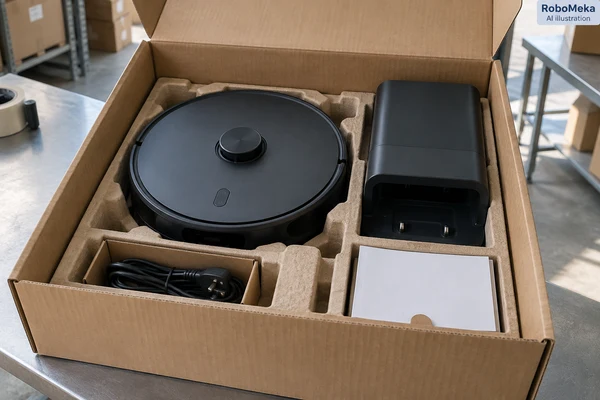
Consider a robot vacuum sold with a tall station. The package contains parts with different shapes, masses and vulnerable surfaces, yet the customer expects them to arrive as one coherent product. If a loose accessory rubs against the finish or the station can shift inside the box, attractive outer artwork will not solve the underlying problem. Packaging needs to be developed around the product system rather than added after every other decision is fixed.
This guide helps importers and private-label brands prepare a packaging brief, select appropriate validation with specialists, and control the approved packing arrangement. It offers planning recommendations and hypothetical examples, not a report of completed RoboMeka transport tests. Use the product detail pages to identify the bundle before discussing its packaging and shipping route.
What distribution route are you designing for?
Draw the journey before selecting the carton
List the expected stages from factory packing to the customer's opening experience. A shipment may move as palletized freight to a distributor, then become individual parcels after warehouse handling. Another program may ship retail cartons inside protective outer cartons. These routes can expose the package to different handling arrangements, so the purchasing brief should describe the route rather than simply request export-standard packaging.
Include who handles the goods at each stage and whether the package is opened, relabeled or repacked. If an e-commerce warehouse adds inserts or a dealer installs accessories, the original arrangement may not remain intact. Identify the final package presented to the delivery carrier. That is the system whose suitability needs to be understood, not just the box leaving the production line.
Add the possible return route. Customers may no longer have all original inserts and may not know how to secure the product. Decide what return instructions or replacement packaging your service process will provide. A plan that considers outbound delivery but ignores foreseeable returns leaves the support team to improvise when a product needs evaluation.
Match the validation question to the route
ISTA's test-procedure overview distinguishes different purposes, including screening and simulation-oriented approaches. Use that distinction to ask a packaging specialist which procedure is appropriate for the intended distribution environment. Do not request an impressive-sounding test number without explaining what the product and package will actually encounter.
Define the outcome you need to evaluate: product function, appearance, package integrity or another agreed criterion. A damaged outer carton and a damaged appliance are not interchangeable findings, but both may matter to the sales channel. State the acceptable presentation and functional criteria before testing so the team does not reinterpret an inconvenient result after the fact.
How should the product and accessories be restrained?
Treat every loose component as part of the design
Prepare a packing map showing the robot or appliance, dock, charger, wand, brushes, filters, cable and documentation as relevant. Identify what separates components and prevents movement under the intended handling conditions. A charger that fits into an empty corner during packing may move later if it has no defined restraint. Empty space is not automatically a safe accessory compartment.
Pay attention to protruding parts and cosmetic surfaces without assuming a particular material solution. A raised navigation housing, handle, wheel or control panel may need clearance or protection depending on the actual geometry. Ask the packaging designer how loads are transferred through the packed system. The right answer requires product information, not a generic rule to add more foam everywhere.
Record how consumables are protected from contamination or deformation when applicable. Keep manuals and small accessories easy to identify during unboxing. If the customer discards a hidden tool with the inserts, the bundle may be complete at the factory but incomplete in practical use. A clear packing sequence and visible accessory location can reduce that avoidable confusion.
Account for the differences between product families
A cordless stick vacuum may use a different packing arrangement for the body, wand and floor head. Confirm whether assembly is expected from the customer and how the instructions identify the pieces. Do not let the packaging imply that a configuration includes an attachment merely because a generic printed diagram shows it.
A robot and station bundle needs the relationship between the two units considered in the packing design. Mowers bring different dimensions and handling needs, while pool robots require their own cable, power-unit or charging-accessory arrangement. Product families can share design principles, but they should not inherit an unchanged insert design or test conclusion without appropriate review.
What belongs in the packaging specification?
| Specification item | Information to freeze | Practical check |
|---|---|---|
| Product bundle | Exact model, accessories and revisions | Does the packing map match the order? |
| Outer package | Dimensions, material specification and closure | Can production identify the approved construction? |
| Internal protection | Insert design, positions and assembly sequence | Are parts restrained consistently? |
| Presentation | Artwork, labels and language versions | Does the customer receive the intended market version? |
| Validation | Procedure, configuration and acceptance criteria | Can the test result be traced to this package? |
| Change control | Review owner and notification process | Will substitutions trigger appropriate review? |
Include drawings or clear photographs where they improve reproducibility. Written instructions such as pack securely leave too much room for interpretation. Identify the approved materials and packing sequence well enough that another operator can reproduce them. Keep the specification linked to the product revision; packaging and product changes should not travel through separate approval systems that never meet.
How do you plan packaging tests responsibly?
Use a qualified test plan
Provide the laboratory or packaging specialist with the actual product configuration, package design and distribution assumptions. Ask it to explain the selected method and the information needed before testing. ISTA's design-and-testing guidance emphasizes understanding the distribution environment and tracking changes to the product-package system. A test is useful only when the configuration and purpose are clear.
Avoid inventing drop heights, vibration settings or pass criteria from a general blog. Those details belong in the applicable procedure and the specialist's agreed plan. Improvised demonstrations may reveal a weakness, but they should not be marketed as formal qualification. Keep purchasing observations separate from laboratory results and use the correct description for each activity.
Plan the post-test review before starting. Identify which appearance, functional and package checks are required, who will perform them and how findings will be recorded. If a test arrangement limits when a package can be opened, follow that procedure rather than interrupting it for convenient photographs. The report should reflect the actual sequence followed.
Keep the tested identity traceable
Record the tested product and package revisions, accessory bundle and relevant preparation. Preserve the test report and supporting configuration information together. If production later uses a different insert, closure or accessory arrangement, do not assume the original result still applies. Have the responsible specialists decide whether further evaluation is required.
One successful test configuration should not become a claim that every future package is certified or damage-proof. Use certification or test logos only when their requirements and authorization genuinely apply. A supplier's statement that it has tested packaging before is not evidence that your exact bundle and route have been reviewed.
Midpoint CTA: prepare your packaging brief
If you are choosing between retail, distributor or parcel-delivery packaging, send your product and distribution requirements. Include the bundle, destination, expected handling stages, sales channel and any retailer specifications. The current form prepares a downloadable brief rather than sending it automatically. Email the brief to info@RoboMeka.com to begin a configuration-specific packaging discussion.
How do dimensions affect the commercial decision?
Packaging has a transport cost as well as a material cost. Carriers may consider package dimensions when calculating chargeable weight; UPS explains this dimensional-weight principle. Confirm the actual service, measurement rules and rates with the carrier or forwarder. Do not use a single divisor from an old quotation as a permanent rule for every route.
Compare candidate packages with the same product bundle and protection objective. A smaller carton may reduce occupied space but create difficult packing or insufficient clearance. A larger carton may improve access while increasing handling or transport costs. Ask for the total effect and supporting evidence rather than deciding that the smallest box or lowest material price is automatically best.
Keep freight estimates tied to measured final packaging. If engineering changes the station height or adds an accessory, update dimensions and logistics assumptions before confirming the commercial comparison. Early concept dimensions can be useful estimates, but they should remain labeled as such. A quotation based on a previous package is not a reliable final shipping budget.
What should be checked during production packing?
Control the packing process
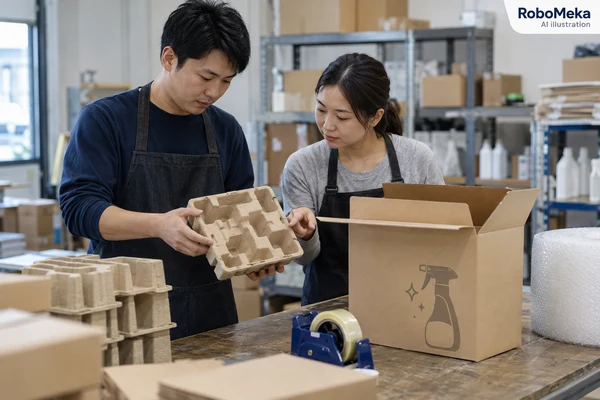
Make the approved sequence available where packing happens. Include the correct accessory count, insert orientation, protective materials and closure method. For multi-language or multi-market orders, establish how the operator identifies the right documents and labels. A good design cannot prevent mistakes if the production instructions do not distinguish the variations being packed.
Use a first-packed-unit review appropriate to the order and document the reference arrangement. Later checks should verify the agreed characteristics rather than relying solely on the outer carton appearance. If a packing material is unavailable, require a reviewed substitution rather than an informal change. A visually similar insert can behave differently or place the product in a different position.
Connect these controls with the pre-shipment inspection plan. Shipment inspection can verify conformity to the approved packaging arrangement within its scope; it is not a substitute for packaging design qualification. Keeping the activities separate helps both the inspector and the buyer describe what the evidence actually supports.
Treat batteries and liquids as separate questions
If the product or bundle includes batteries, have trained specialists review the actual shipment requirements. IATA's battery guidance is a starting point for air-transport questions, not a complete classification for your order. The presence of a protective carton does not establish that packaging, marking and documentation obligations have been met.
If a bundle proposes cleaning solution or another liquid, confirm whether it is actually included, appropriate for the product and accepted for the planned route. Do not add liquids to a previously evaluated package without review. Keep the product's permitted-use instructions, packaging design and logistics documentation consistent rather than solving those issues independently at the last moment.
A hypothetical retail-to-parcel redesign
Imagine a distributor that originally received robot vacuums in palletized retail cartons and later decides to fulfill individual online orders. The commercial team proposes sending each retail carton directly as a parcel. This hypothetical change does not prove the existing packaging is inadequate, but it changes the distribution question and requires review before assuming the original arrangement remains suitable.
The team maps the revised route and asks its packaging specialist to assess the product-package configuration. It also reviews labels, accessory presentation and customer return instructions. One candidate adds an outer carton; another revises the protective inserts. The decision should compare protection evidence, packing labor, dimensions and channel requirements, not simply the visible carton cost.
After selecting a configuration, the distributor updates the packing specification and obtains the appropriate validation. It then checks that production uses the approved version. The example illustrates a decision process, not a recommended package design or a claimed damage reduction. Without actual product and route evidence, a universal answer would be misleading.
How should arrival damage be investigated?
Ask the receiving team to retain product identity, carton references and photographs that connect outer damage to the contents. Record the condition before repacking where practical. Separate what is observed from the suspected cause: a cracked component does not by itself identify when or why the damage occurred. Preserve enough context for the relevant parties to investigate.
Review repeated findings against package revision, route and product configuration. Different damage patterns may suggest different issues, but conclusions need evidence. Feed the findings back into packaging review and supplier discussions without assuming that every customer return is a transport problem. The product's own functional history and the customer's report may matter as well.
Keep commercial claims handling separate from technical root-cause work. Carrier, insurance and supplier obligations depend on the actual agreements and applicable requirements. This guide does not determine liability. Its practical recommendation is to retain coherent records so specialists can assess the issue instead of trying to reconstruct it from disconnected photographs weeks later.
Frequently asked questions
Is a stronger outer carton always the best solution?
No. Protection depends on the complete product-package system, including restraint, clearances, inserts and the distribution route. A stronger carton may help a particular design but cannot automatically correct loose accessories or an unsuitable internal arrangement. Ask a packaging specialist to evaluate the actual weakness and the evidence needed for the proposed change.
Can we use one packaging test for several models?
Only when the responsible specialist confirms that the scope and configurations support that approach. Differences in mass, geometry, accessories or materials may matter. Record which variants the evidence covers and which remain unqualified. Do not extend a report to an entire product family solely because the cartons look similar.
Do we need to review packaging after adding an accessory?
Yes, review the change and decide whether further evaluation is needed. The new item may affect restraint, occupied space, package weight or the packing sequence. Update the specification and logistics assumptions accordingly. The review may be straightforward, but silently adding an item breaks the connection to the previously approved configuration.
Does a successful transport test guarantee no customer damage?
No. A test evaluates a defined configuration under a defined procedure; it is not a guarantee against every event in distribution. Keep the scope visible, control production packing and investigate real arrival findings. Accurate claims are more useful than describing a tested package as universally damage-proof.
Conclusion
Cleaning robot export packaging works best when the route, product bundle and acceptance criteria are defined together. Use appropriate specialist validation, freeze the approved arrangement and control production changes. Review dimensions and costs without losing sight of protection and customer handling. Treat test evidence as configuration-specific, not as a blanket promise.
For your next order, prepare a product packaging inquiry with the confirmed bundle, sales channel, distribution route and retailer requirements. Email the brief to info@RoboMeka.com. Those details provide a practical starting point for evaluating packaging options, coordinating shipment preparation and identifying the evidence needed before release.