The short answer
Define the production lot, approved configuration, inspection scope and release authority before the visit. Record findings and limitations against an agreed plan. Shipment inspection supports a lot-release decision; it does not replace sample qualification, application testing or destination-market compliance review.
Introduction
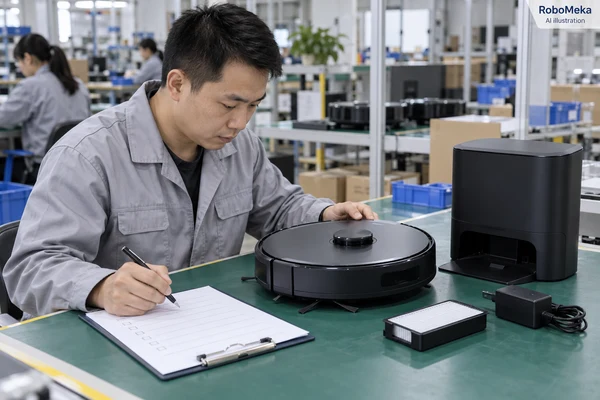
A cleaning robot pre-shipment inspection should connect the finished production lot to the approved order: the correct configuration, the agreed functional checks, complete accessories and packaging, and a documented release decision. It cannot replace product development, sample evaluation or destination-market compliance review. For an importer, the most useful inspection report explains exactly what was checked and what remains outside its scope.
Imagine receiving photographs of neatly stacked cartons but no evidence that the chargers inside match the approved bundle. The photographs may confirm that goods exist, yet they do not resolve the configuration question. Inspection becomes valuable when its checklist follows the purchasing risks rather than the easiest features to photograph. That requires preparation before the inspector arrives and before a shipping deadline creates pressure to accept unanswered questions.
This guide proposes a practical workflow for brands, distributors and purchasing teams sourcing vacuums, robot vacuums, mowers and pool robots. It does not report a completed RoboMeka inspection or prescribe a universal sampling plan. Start with the sample approval guide, then use this article to prepare a separate production-lot release process.
What should be agreed before inspection day?
Identify the lot and its approved configuration
Give the inspection provider the purchase order, product references, quantity, revisions and packing arrangement. Identify whether the shipment contains different models, accessory bundles, languages or destination configurations. A mixed shipment should not be treated as one interchangeable population merely because every carton carries the same brand. Record how the relevant lots or sublots will be identified and evaluated.
The reference pack should include the approved specification, accessory list, relevant artwork, manuals and any agreed visual standards. If an approval sample is available, record its identity and limitations. A prototype with provisional packaging is not an adequate reference for final carton approval. Make unresolved changes visible so the inspector is not asked to guess which version purchasing intended.
Confirm the production status required for a meaningful visit. Ask whether the goods are complete, accessible and ready for the agreed checks. If part of the order is still being assembled, explain how that affects the inspection scope and shipping decision. Do not write a universal readiness percentage into every project; agree the conditions that match the particular inspection arrangement.
Define the release authority
Name the people who can interpret findings, approve corrective action and authorize shipment. The inspector records evidence against the agreed plan; the commercial buyer may hold the final release authority. These responsibilities should not be left ambiguous. A report marked acceptable under a limited scope is not permission to ignore an unresolved requirement that sits elsewhere in the order.
Decide how urgent questions will be answered during the visit. Provide an escalation route that includes technical support where needed. If a charger marking differs from the reference, the inspector needs a documented answer, not an informal assurance that it is equivalent. Preserve that answer in the project record so a later reviewer can understand why the goods were released or held.
How should sampling be discussed?
Sampling is a structured decision method, not a promise that every shipped unit is perfect. ASQ's overview of sampling describes drawing conclusions about a population from selected observations. For purchasing purposes, the important question is which population, characteristics and decision rules the chosen plan covers. A sample size without that context is not an inspection strategy.
Ask a qualified quality professional to identify the relevant plan, edition, inspection level and decision rules where a standard is used. ASQ's Z1.4 and Z1.9 overview distinguishes attributes-based and variables-based systems. Do not choose a familiar AQL number simply because it appears in another supplier's quotation, and do not reinterpret that number as an allowed percentage of defective goods in every delivered lot.
Agree defect descriptions before inspecting. Cosmetic damage, missing accessories, functional problems and safety concerns need clear treatment, but a generic article cannot assign universally correct severity classes. The classification depends on the actual product and consequences. Suspected safety issues should be escalated to qualified personnel, not minimized to keep the count below a convenient acceptance limit.
A release checklist that follows the order
| Review area | Evidence to request | Question answered |
|---|---|---|
| Identity | Model, revision, serial or lot references | Are these the goods approved for this order? |
| Bundle | Product, dock, charger, accessories and manuals | Is the customer receiving the agreed configuration? |
| Workmanship | Recorded visual and assembly observations | Does the sampled presentation match agreed criteria? |
| Function | Results under the agreed safe check procedure | Did sampled units complete the specified checks? |
| Packaging | Packing arrangement, protection and artwork | Are the prepared goods consistent with the packaging specification? |
| Disposition | Findings, corrective action and written release | Who decided what may ship, and on what evidence? |
Use the table as a project framework rather than a substitute for a product-specific checklist. A robot and auto-empty station require different checks from a cordless stick vacuum. Likewise, a mower's installation-dependent functions may not be fully testable on a factory floor. State those limits explicitly instead of assigning a pass to functions that were never evaluated.
Which product checks belong in the visit?
Verify the complete sellable bundle
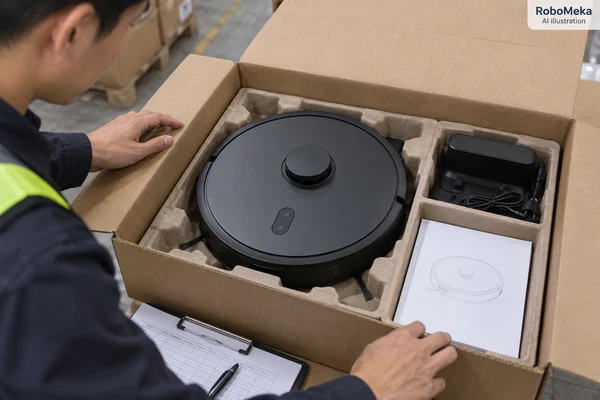
For a robot vacuum and station, identify both components and their pairing. Check the included charger or power arrangement, consumables and documentation against the approved bundle. If the order covers several colors or languages, ensure the inspection scope addresses those variations. Similar-looking cartons can conceal different customer-facing contents.
For a manual vacuum, review the wand, head, dust container and specified attachments as relevant to the actual design. Confirm that the supplied accessories are the ones ordered rather than judging the bundle solely by appearance. Record missing, substituted or damaged items with enough detail that the supplier can locate and correct the affected stock.
For mower and pool categories, distinguish a basic factory function check from application qualification. Pool wall coverage and mower site suitability depend on conditions beyond a carton inspection. Ask for the existing application evidence where needed and preserve the boundary between that evidence and the checks performed during the visit. A short power-on check does not demonstrate cleaning performance.
Use safe, agreed functional procedures
Specify how the inspector will prepare the product, operate permitted controls and record the outcome. Follow the product instructions and the agreed inspection provider's capabilities. Avoid ad hoc electrical tests, improvised water exposure or bypassing interlocks. If specialist testing is needed, identify the qualified facility and procedure separately rather than adding it casually to a general checklist.
Keep test conditions attached to the result. A charging indication, completed pairing or normal startup should be described accurately, without expanding it into a battery endurance or reliability claim. Note whether the unit required unusual intervention. If a firmware update is performed during the visit, document the change and decide which checks must be repeated for the updated configuration.
Midpoint CTA: prepare the shipment review scope
If your order is approaching production completion, prepare your shipment inspection requirements. Include the product references, approved bundle, destination market, quantity and outstanding approval conditions. Use the manufacturing overview to organize the discussion. The website prepares a downloadable brief; email it to info@RoboMeka.com rather than assuming the form automatically sends a request.
How should packaging and documents be checked?
Inspect what will actually travel
Review the final retail package, any outer shipping carton and the agreed pallet arrangement where relevant. Check that the product and loose accessories are restrained as specified and that presentation matches the approved packing instructions. A factory can assemble the correct appliance and still create a poor customer experience through an incomplete manual, missing insert or unsuitable accessory placement.
Packaging qualification and shipment inspection serve different purposes. ISTA's guidance on starting a packaging test program emphasizes understanding the distribution environment. A visit can verify that the agreed packaging configuration is being used; it should not be described as a full transport simulation unless that defined testing was actually performed and documented.
Record carton dimensions, weights or counts when they are part of the inspection scope, using appropriate equipment and stated methods. Connect labels and carton identifiers to the packing list. Do not assume that a photographed stack establishes quantity accuracy. If the inspector cannot access relevant goods or records, describe the limitation rather than filling the report with unsupported confirmation.
Keep transport documentation separate but connected
Battery-powered appliances may require shipment-specific transport review. IATA's battery guidance is a useful reference for air-transport documentation questions, but carrier acceptance and classification should be confirmed by trained specialists for the actual shipment. An inspector's visual checklist should not be presented as dangerous-goods approval.
Similarly, destination-market documentation should match the supplied configuration and relevant requirements. Record document references and open questions, then have the appropriate specialists assess them. A certificate image or report number in a shipment folder does not automatically establish applicability to a changed battery, charger or radio configuration. Keep the evidence trail understandable without making legal conclusions outside the inspection team's remit.
What should a useful inspection report contain?
The report should identify the inspected goods, reference documents, scope, sample selection approach and conditions. Findings need a traceable product or carton reference, a clear observation and supporting evidence where practical. Include photographs that explain the issue, not only wide shots of the room. A close-up should still be connected to the unit and lot it represents.
Separate measured results, observations and unresolved questions. For example, a missing accessory is directly observable; the reason it is missing may still require investigation. Avoid recording an assumed root cause as a proven fact. This distinction helps the supplier propose an appropriate correction and prevents the buyer from accepting a superficial explanation without evidence.
Summarize exceptions prominently. A long report with one important unresolved functional issue buried among successful appearance checks is difficult to use. Identify whether the finding affects shipment release, requires additional review or concerns an agreed follow-up outside the release scope. The summary should help the decision maker act without concealing the underlying detail.
A hypothetical discrepancy and release decision
Suppose an importer orders two packaging-language versions of the same robot. The inspector discovers that some cartons in one identified sublot contain the other language manual. This is a hypothetical workflow example, not a RoboMeka shipment event. The correct response begins by identifying the affected stock and checking the order's documentation requirement.
The supplier proposes replacing the manuals. The buyer should ask how the affected population will be found, how corrected cartons will be identified and what verification will follow. Replacing the manual in the one photographed unit does not establish that the wider problem is resolved. The corrective action should address the relevant stock, with a documented basis for the subsequent release decision.
If a separate functional finding remains open, the completed manual correction should not obscure it. Track each issue independently and identify any new inspection scope required. Shipment pressure is a commercial consideration, but it should not rewrite the evidence. If the buyer accepts a non-safety-related deviation within its authority, record the exact deviation, affected goods and agreed consequences.
How do you avoid repeating the same problem next order?
Feed findings into the production controls
A shipment report is more useful when recurring findings inform upstream controls. Ask whether the issue arose in purchasing, assembly, software loading, accessory picking or packaging. The supplier's investigation should connect the evidence to a plausible cause and corrective action. Do not claim the cause is solved solely because a replacement sample looks correct.
Track issues by configuration and revision rather than pooling every product under one brand-wide defect rate. Changes in product mix can distort a simple comparison between orders. If you calculate an inspection indicator, state the denominator and what was actually inspected. Avoid presenting a limited sampling result as a measured field return rate or a forecast for all future shipments.
Maintain a release archive
Retain the final report, photographs, corrective-action responses, approvals and shipping references together. Keep a clear record of which version of the checklist applied. If customer support later reports a problem, these records help establish what was supplied and what evidence supported release, without pretending they can explain every field event.
Arrange a receiving check appropriate to your own warehouse operation. Transit damage, shortages and document discrepancies may become visible after dispatch, so preserve a way to distinguish arrival findings from factory findings. The objective is a coherent product history, not automatic blame allocation. Agree commercial claims handling with the relevant parties separately from the technical investigation.
Frequently asked questions
Is a pre-shipment inspection the same as a factory audit?
No. A shipment inspection evaluates identified goods against an agreed scope, while a factory audit examines processes or organizational capability within its own scope. Both may inform purchasing, but neither automatically substitutes for the other. Ask what evidence each activity will produce and which purchasing decision it is intended to support.
Does passing an AQL inspection guarantee zero defects?
No. A sampling-based decision has a defined scope and associated risks; it does not examine every characteristic of every shipped unit. Use the correct plan and interpretation agreed with a qualified quality professional. Do not turn an acceptance result into a promise that no customer will encounter a problem.
Can we inspect before every product is packed?
That depends on the purpose and agreed scope. An earlier visit may review production progress or specific functions, but it may not verify final packaging and complete shipment quantities. State what is ready and what remains unchecked. Arrange additional verification when necessary rather than describing incomplete coverage as final shipment approval.
What should happen when an important finding is unresolved?
Keep the affected release decision open and escalate through the agreed authority. Request evidence, corrective action or specialist review appropriate to the issue. Record the decision and its scope. A shipping deadline should not silently convert an unanswered technical or safety question into an approved deviation.
Conclusion
Effective cleaning robot pre-shipment inspection starts before the visit: define the lot, approved configuration, checks and decision authority. During the visit, keep observations traceable and limitations visible. Afterward, close findings with evidence and preserve the release record. Inspection should clarify a shipment decision, not create a broader performance or compliance claim than the work supports.
To prepare a product-specific checklist, send your order and inspection requirements. Include the approved configuration, quantity, packing arrangement and unresolved questions. Email the resulting brief to info@RoboMeka.com. Use that information to agree what will be checked, by whom, and what evidence is needed before the goods are released.