The short answer
Choose equipment for renovation residue by its documented intended use and the identified material, not by suction pressure or a HEPA label alone. Keep household vacuum evaluations within approved domestic applications, and refer construction or uncertain dust to a supplier able to specify the complete suitable extraction and handling system.
Introduction
A customer finishes sanding a wall, sees a thin layer of pale residue and reaches for the household vacuum. The question for an importer is whether the product was designed and documented for that material. A powerful motor, a large dustbin or a filter described as HEPA does not answer it.
Household vacuum use and construction dust collection are different purchasing decisions. Identify the material and the work that produced it, check the exact machine's intended use, and select equipment that supports the complete collection and handling task. When the material is uncertain, do not use a household cleaner to investigate it.
This guide helps distributors define that boundary before approving product descriptions, sample demonstrations and customer-support instructions. It proposes a document-led evaluation for a domestic vacuum range. It does not describe a hazardous-dust trial, provide a construction exposure assessment or claim that RoboMeka products are approved for renovation debris. Start with the wider vacuum buyer selection guide, then narrow the intended application before comparing machines.
Why does intended use come before suction power?
Intended use states the applications and conditions the manufacturer supports. Suction pressure describes one aspect of a machine's air system under stated conditions. A high pressure figure cannot extend the product into an excluded application, establish containment during emptying or prove that its filters can handle a particular loading pattern.
Manufacturer wording can be quite specific. The Dyson DC24 operating manual identifies domestic use and limits fine materials such as plaster dust to very small amounts. This is an example from that model's manual, not permission to use other household vacuums for construction cleanup. A buyer must obtain the offered model's own current instructions.
The relevant sourcing question is therefore not “How much suction is enough for plaster?” It is “Does this exact product support the identified task, and what evidence defines that support?” If the supplier cannot answer, keep the application outside the approved sales scope. An attractive demonstration does not resolve an undocumented use boundary.
Read the restrictions beside the headline features
Review warnings, prohibited materials, permitted floor conditions, filter instructions and service limitations together. A retailer may publish a broad “all-purpose cleaning” headline while the manual describes ordinary dry household debris. Resolve that mismatch before translating the listing or distributing samples. The product name alone is not an adequate application specification.
Keep the document revision and market version with the purchase record. Similar-looking products can ship with different configurations or guidance. A screenshot from another model's online listing is useful as a question for the supplier, but it should not become the evidence supporting your own product claim.
Identify the task without handling unknown residue
Describe where the residue came from, whether work is continuing and who is responsible for identifying the material. “White powder after renovation” is too vague for equipment selection. The floor may contain a mixture from several activities, and its appearance cannot establish composition or suitability for household pickup.
Ask the project owner or contractor for the relevant material information and cleanup responsibility. If there is uncertainty about hazardous contamination, the appropriate specialist must determine the work method and equipment. Do not arrange an informal household-vacuum test using unknown construction residue, intentionally generate dust or collect a sample merely to make a product video.
Separate active dust generation from settled-residue cleanup. Connecting extraction to a power tool involves the tool interface, operating airflow and a continuous loading task. Cleaning an area after work involves a different route, collection method and disposal arrangement. One machine might support both only when its documentation and configured system explicitly establish that scope.
A finished room is not automatically a domestic cleaning task
The presence of furniture does not change the origin of residue. A recently installed kitchen may look ready for normal cleaning while still containing material left by trades. Conversely, ordinary household debris in a room that was renovated months earlier is not automatically construction dust. Classify the current material and task rather than using the room's appearance as the deciding factor.
For sales teams, this distinction prevents a common ambiguity: “suitable for new homes” can mean routine cleaning after handover or cleanup immediately after building work. Write the intended meaning. If the product supports only normal domestic maintenance, illustrations and retailer examples should show that application clearly.
Compare equipment categories by the complete job
A household vacuum, a workshop wet-and-dry vacuum and a specified dust extractor should not be treated as interchangeable because all three collect debris. Their approved materials, filter arrangements, disposal methods and connection options can differ. The category name is a starting point; the individual model and configuration still determine suitability.
Kärcher's commercial wet-and-dry vacuum overview describes filter loading and models with automatic or semi-automatic filter cleaning for demanding dust applications. The useful buying distinction is that sustained collection can require dedicated system features. That overview does not establish that every wet-and-dry vacuum is suitable for every construction material.
| Purchasing question | Evidence to request | What it does not prove alone |
|---|---|---|
| Is the material permitted? | Exact model instructions and application confirmation | A demonstration with unidentified powder |
| Is the collection task supported? | Specified configuration and operating conditions | A maximum suction number |
| How is the filter maintained? | Approved maintenance and replacement procedure | A washable-filter icon |
| How is collected material handled? | Compatible collection and disposal arrangement | A large bin volume |
| Is tool connection intended? | Approved interface and equipment documentation | A hose that physically fits |
Treat this table as a request framework, not an equipment certification scheme. Where a task requires specialist selection, the qualified equipment provider should specify the system. An importer of household cleaners should be willing to identify a task outside the range rather than improvise an unsupported product configuration.
Why a filter label cannot settle the question
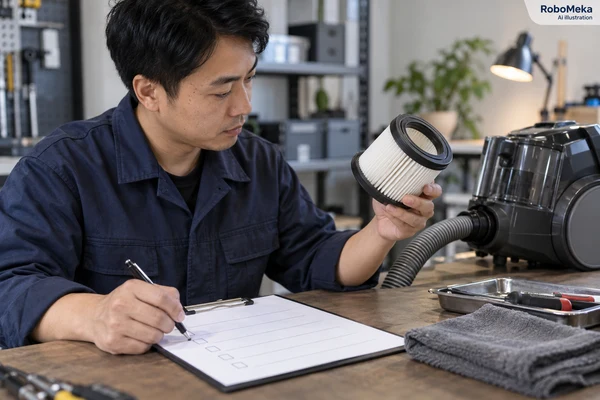
A filter claim and a complete-machine application claim answer different questions. Buyers need to know what component was assessed, under which method and in which assembled configuration. A replacement filter offered as an accessory does not automatically change the permitted use of the vacuum into which it is installed.
The operating task also includes joints, seals, collection arrangements and maintenance. A narrow claim about filter media does not explain how the user empties the container, replaces parts or responds to loading. Review those activities with the supplier before attaching a broad fine-dust statement to the product page.
The guide to HEPA filters and sealed vacuum systems explains how to separate component wording from system evidence. Use it to improve the questions in an RFQ, while keeping construction-material approval as a distinct requirement. Do not infer a dust-extractor classification from a domestic filtration feature.
Clarify what happens as the collection system loads
For a permitted application, ask how the product indicates maintenance needs and what the user should do when pickup changes. Request the documented filter-care method, replacement identity and limitations. An evaluator should not defeat a warning, remove a filter or repeatedly restart a stopped machine to extend an unsuitable demonstration.
Avoid turning scheduled filter care into a promise of unrestricted fine-powder use. Maintenance intervals must be read with the operating conditions and instructions. “Easy to wash” describes a care action; it does not establish how often cleaning will be necessary in an application that the manufacturer has never approved.
To establish the right product boundary, send RoboMeka your domestic cleaning application and the materials customers ask about. Include the market, intended product category and any supplier restrictions already identified so the sourcing discussion can distinguish supported requirements from tasks needing other equipment.
Review samples without creating an unsafe dust demonstration
The first sample review can be completed without collecting construction dust. Verify the model identity, supplied filters, assembly, warning labels, manual and spare-part references. Compare the physical sample against the quoted configuration. Ask an unfamiliar reviewer to find the intended-use restrictions using the material the customer will receive.
Any operating evaluation should stay within the manufacturer's approved domestic applications and agreed safe conditions. A normal-use pickup demonstration may assess handling or floor access, but its result must be described accordingly. It cannot establish suitability for building dust merely because the machine also collects an approved household test material.
Separate three kinds of evidence
Document review checks what the manufacturer permits and claims. Ordinary-use sample evaluation checks selected behavior of the supplied unit under controlled conditions. Specialist assessment addresses applications requiring equipment or expertise beyond that scope. Keeping those records separate prevents a familiar-looking test video from standing in for missing technical evidence.
A hypothetical buying decision illustrates the benefit. A distributor wants a lightweight vacuum for routine apartment maintenance and receives requests to advertise it for post-renovation cleanup. The sample handles the approved domestic task well, but the supplier provides no construction-dust approval. The defensible outcome is to retain the domestic positioning and remove the unsupported cleanup promise.
That result is commercially useful. It preserves a suitable product for its intended audience and gives customer service a clear answer. Rejecting an unsupported application does not require rejecting the entire model. The key is to prevent an unanswered request from drifting into the final listing through a photograph, marketplace keyword or sales script.
Write a quotation that exposes scope gaps
The RFQ should state the ordinary cleaning task and identify excluded or unresolved requests separately. Ask suppliers to confirm the supported floor types, debris scope, filter configuration and user maintenance documents. Require explicit clarification when a suggested application is absent from the manual rather than treating silence as agreement.
Request the cost and availability of approved filters, bags where applicable, seals and other user-replaceable collection components. Compare the complete supplied package with the demonstrated package. A sample containing an optional filter cannot support an order whose baseline bill of materials omits that part.
Use the cleaning robot RFQ framework to structure deviations and evidence requests. Although the framework covers several cleaning categories, the same procurement discipline applies here: each application claim needs an identified configuration, supporting document and accountable supplier response.
Ask what a production change would affect
A changed filter supplier, altered sealing surface or revised dustbin can matter to an approved collection configuration. Agree how such changes are identified and reviewed. Do not assume an unchanged retail name means every relevant part remains identical to the evaluated sample.
Shipment inspection should confirm the approved components, labels and instructions using an agreed inspection plan. It should not improvise dust trials on the packing line. Record missing evidence as missing evidence; a clean appearance, working power switch and matching carton are different checks from validation of the intended application.
Give customer service a useful first response
Support should first establish the model, material source, reported event and whether use has stopped. If a customer has collected uncertain renovation residue, do not begin with instructions to open, shake out or wash contaminated parts. The suitable handling response depends on the material and must come from the responsible specialist or manufacturer.
For a clearly permitted ordinary-use problem, follow the exact product's maintenance instructions. Record symptoms such as an alert, reduced pickup or unusual noise without assigning a cause from a brief message. The vacuum filter maintenance guide can help buyers plan documentation and spare-part support for those approved tasks.
Keep warranty assessment separate from initial assistance. A photograph of pale residue is not enough to determine material identity, product fault or responsibility. Ask for evidence proportionate to the issue and escalate uncertainty. Unsupported accusations of misuse can be as damaging to trust as unsupported promises about the product.
Retail staff should also know how to redirect an unsuitable inquiry. A concise response can explain that the offered range is intended for routine household cleaning and that the renovation task needs identified material and appropriately specified equipment. This gives the customer a next action without inventing a technical solution.
Make the application boundary visible before purchase
Place intended-use wording near the purchasing decision, not only deep in a downloadable manual. Match category names, comparison tables and image captions to that scope. A room with active renovation debris can imply a supported use even when the caption never says “construction dust.” Review images with the same care as text.
Avoid using one manufacturer's narrow allowance as a universal industry rule. Another product may prohibit the material entirely or require a different configuration. The owner needs instructions for the machine being sold, while procurement needs a record showing why the public claims are justified.
Where a retailer carries both domestic vacuums and specialist equipment, present the decision boundary clearly. Ask about the task before recommending a model. Separate product filtering by application from filtering by price, motor rating or bin capacity. That design helps customers reach a relevant category before detailed comparison begins.
Frequently asked questions
Can a household vacuum clean fine construction dust?
Only the exact product's documented intended use can establish what materials and conditions it supports. Do not assume permission from suction strength, filter wording or another brand's manual. For renovation residue, identify the material and task first. Uncertain or potentially hazardous material requires an appropriate specialist response rather than a household sample trial.
Does a HEPA filter make a vacuum a construction dust extractor?
No. A filter description does not by itself establish the complete machine's permitted applications, collection configuration or handling method. Buyers should request evidence for the assembled system and the intended task. Installing an accessory filter is not permission to exceed the original product's use restrictions.
Is a wet-and-dry vacuum suitable for every renovation job?
No. Wet-and-dry capability does not establish suitability for all dusts or all working methods. Ask the equipment supplier to identify the appropriate model, collection arrangement and documented limitations for the material involved. Keep liquid pickup, ordinary debris collection and specialist dust extraction as separate questions during selection.
Should buyers demonstrate performance using plaster powder?
Do not create an informal construction-dust demonstration to settle a missing application claim. Begin with documentation and use only agreed, safe evaluations within the manufacturer's approved scope. If specialist validation is required, it belongs with appropriately qualified personnel and suitable facilities, not a retail video or routine household trial.
What should a distributor say when the material is unknown?
Explain that appearance cannot establish suitability and pause the equipment recommendation for that task. Request identification from the responsible project party or specialist and consult the exact machine's guidance. Avoid telling the customer to vacuum a small amount as an experiment or to open contaminated collection parts before the handling requirements are understood.
Conclusion
The purchasing decision begins with the material, task and documented use boundary. Suction figures, filter labels and short pickup videos become useful only within that boundary. For a household vacuum range, clear exclusions and accurate customer guidance protect the meaning of sample approval and help buyers select the correct category when renovation work is involved.
For a focused product discussion, ask RoboMeka to review your household vacuum application brief. Share the routine cleaning requirements, proposed sales wording and unresolved material questions so the supplier evidence can be checked before quotation and range approval.