The short answer
Assess filter maintenance as a complete ownership routine: identify each component, follow its permitted cleaning method, account for drying and confirm correct reassembly. Compare active work and downtime separately from quoted spare costs. Maintain compatible part identifiers and negotiate supply terms rather than assuming washability guarantees low ownership cost or simple service.
Introduction
Vacuum filter maintenance should be evaluated as an ownership routine, not reduced to a washable or replaceable label. Buyers need to understand how users reach each part, identify the correct care method, restore the appliance and obtain compatible replacements. Those details affect customer workload, support questions and the practical cost of supplying the product.
A filter can be inexpensive on a component quotation while creating a difficult service experience. The user may need to remove several parts, wait for complete drying or identify a replacement among nearly identical versions. Conversely, an accessible arrangement can still require costly consumables. The purchasing decision should examine both the routine and the supply arrangement.
This guide helps importers assess filter access, cleaning instructions, drying downtime and replacement planning for a proposed vacuum range. It describes recommended purchasing checks, not completed RoboMeka tests or measured failure rates. Technical filtration classifications and whole-appliance emissions are separate evidence questions, addressed in the HEPA and sealed-system guide.
Which maintenance components should the supplier identify?
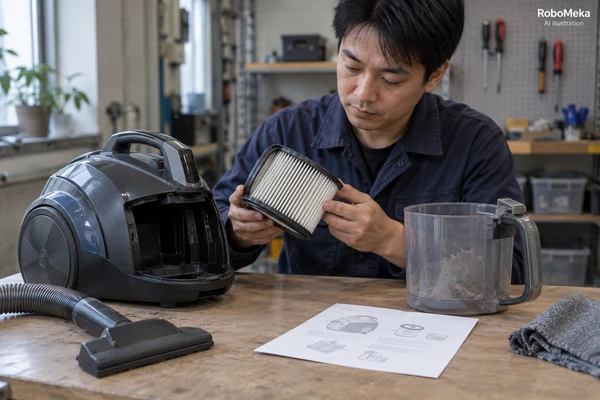
Request a model-specific service map showing every filter or screen that users are expected to access. Identify its part number, location, removal method and permitted cleaning procedure. Include seals or covers that must be reinstalled during the same task. A single photograph labeled filter assembly is insufficient when users interact with several distinct components.
Separate user maintenance from authorized repair. A component may be physically removable while remaining outside the owner's permitted service procedure. Do not ask purchasing staff to dismantle the motor housing or disturb protected assemblies simply to demonstrate access. The supplier should state which activities belong to the consumer, distributor service team or a qualified repair provider.
For each user-maintained part, ask what signals the need for attention. This might be a stated inspection interval, visible condition or a documented product indicator. Record the actual instruction and its limitations. Do not turn a suggested inspection schedule into a guaranteed period of maintenance-free operation across every household and debris condition.
Why must filters and containers have separate care instructions?
A dust container, coarse screen and fine filter can require different treatment even when removed together. Instructions that say wash the dust assembly may leave users unsure which pieces are included. Request separate names and illustrations, with clear guidance about anything that must remain dry. Check whether the names match the replacement-part catalogue.
Manufacturer guidance illustrates this distinction. Miele's Triflex maintenance instructions prohibit cleaning the specified fine dust filter with water while providing different care directions for other components. This is a model-specific example, not a universal method. It shows why a buyer should obtain component-level instructions instead of assuming every removable part is washable.
How should buyers evaluate access and reassembly?
Give an unfamiliar evaluator the proposed manual and complete sample. Ask them to perform the authorized maintenance routine without a supplier coaching each movement. Record where they hesitate, which release controls they misunderstand and whether a removed part has an obvious resting position. The purpose is to identify instruction or handling problems before the product reaches customers.
Observe the entire sequence from preparing the appliance through confirming correct reassembly. A quick filter extraction means little if the user spends several minutes aligning a cover afterward. Note grip requirements, opening clearances, loose components and whether the task requires a tool. Confirm that any necessary user tool is supplied or clearly specified.
Check correct installation indicators without defeating safeguards. A locating feature, alignment mark or positive closure can help users understand completion, but it needs to work in the actual arrangement. Record normal difficulties as usability observations. Visual inspection alone does not establish filtration efficiency or quantify leakage through an assembled system.
What should a practical maintenance observation record contain?
Identify the sample, part revision, instruction version and evaluator's familiarity with the product. Separate active work from waiting time and record any assistance. If a supplier intervenes, preserve that fact rather than presenting the corrected attempt as an unassisted success. A repeated attempt may show learnability, while the first attempt reveals the initial customer experience.
Include where the task occurs. A filter changed over a large workshop bench may be harder to handle above an ordinary household disposal bin. Use a plausible environment within the instructions and avoid deliberately awkward setups. Record any cleanup required after the task without presenting a visible observation as a formal airborne dust measurement.
What does washable actually mean for the offered part?
Washable is meaningful only alongside an approved procedure. Ask which component can be washed, how it is prepared, which water conditions or cleaning agents are permitted and how it must dry. Confirm that the instruction applies to the offered revision. Do not substitute a familiar household cleaning method when the supplier's directions are incomplete.
Dyson's cordless vacuum filter-care guidance includes complete drying before refitting and a minimum drying period for the filters it discusses. The purchasing lesson is to obtain explicit drying instructions for the actual part. Another brand's time or method should not be copied into a private-label manual without configuration-specific support.
Distinguish an elapsed-time instruction from confirmation that the part is ready. Ambient conditions can differ, and users need the exact manufacturer's guidance for readiness and reinstallation. Do not promise that every filter will be ready after one fixed number of hours in every climate. If the instruction is unclear, request clarification before approving customer-facing artwork.
Do not improvise accelerated drying with household appliances or concentrated heat. A proposed sample review should follow only the approved care method. If drying performance is commercially important, ask the supplier how it can be evaluated under stated conditions and what result supports the intended instruction. Keep that technical assessment separate from an informal buyer demonstration.
How should maintenance workload be compared between proposals?
Compare the same intended routine and write down the assumptions. Active minutes, waiting periods and replacement purchases are different burdens. Avoid collapsing them into one convenient score without explaining how the buyer values each. A household with limited drying space may prefer a different arrangement from one willing to rotate an approved spare.
| Maintenance question | Supplier information | Buyer observation | Purchasing implication |
|---|---|---|---|
| Which parts need attention? | Service map and identifiers | Correct part recognition | Manual and support content |
| How are filters reached? | Authorized removal sequence | Access and loose-part handling | Usability acceptance |
| What cleaning is allowed? | Component-specific care method | Instruction comprehension | Accurate care labels |
| What requires drying? | Readiness and drying guidance | Waiting and storage needs | Spare-filter option |
| Which replacement fits? | Compatibility and revision map | Clear identification | Service inventory controls |
| What changes over time? | Replacement criteria and change notice | Documented wear observations | Continued supply agreement |
Use quotation data for costs and actual observations for handling. Where a schedule or demand estimate is unknown, label it as an assumption requiring validation. A spreadsheet becomes misleading when speculative replacement frequencies look like measured field behavior. Keep the basis of each input visible to purchasing, service and finance teams.
Prepare a filter and maintenance inquiry with your intended customers, expected care routine and replacement-part requirements. Request the service map, approved instructions and spare quotations together so maintenance can be assessed as part of the product offer rather than postponed until after the first shipment.
When is an additional filter useful in the retail bundle?
An approved spare may reduce interruption when the installed filter requires washing and complete drying. It also increases the initial bundle cost and adds another item the customer must store correctly. Assess this choice against the actual care procedure and customer routine. Do not claim that a spare eliminates maintenance or allows use without required filtration.
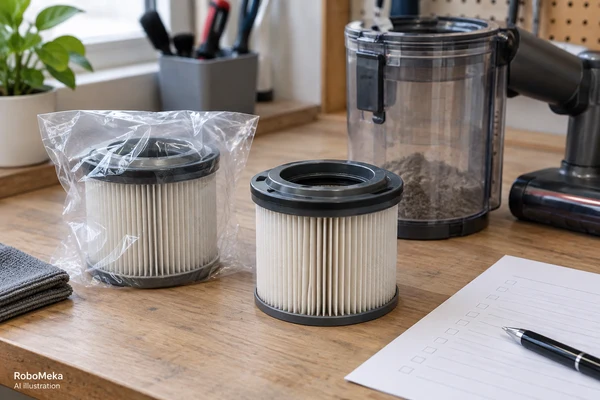
If a spare is supplied, make its identity unambiguous. It should match the approved configuration and arrive with suitable protection and instructions. A loose part at the bottom of the carton may be overlooked or mistaken for packing material. Explain its purpose and keep any necessary compatibility information with it when the outer carton is discarded.
Consider offering an optional service pack instead of automatically adding every consumable to each retail box. The decision depends on customer expectations, retailer fulfilment and quoted costs. Compare the pack's purchase price with the distribution effort it creates. A spare that is commercially available but difficult to identify or order may provide little practical reassurance.
What should a replacement-filter supply agreement cover?
Start with exact part numbers and compatible appliance revisions. Appearance is not a sufficient control: similar filters can differ in dimensions, seals, media or assembly details. Request a cross-reference that support staff can use from the customer's product identifier. Where a replacement supersedes an older part, obtain a documented compatibility explanation and effective date.
Ask for quotation units, order increments, packaging options and current supply terms. Request an explicit proposal for continued availability and how discontinuation notice would work. These are commercial terms to negotiate, not promises that should be invented in marketing copy. Record unresolved commitments before approving a service proposition that depends on them.
Agree how proposed changes are reviewed. A new media supplier, seal profile, adhesive or housing feature may affect more than physical fit. The supplier should identify the change and the evidence requiring review. Relevant specialists can determine whether an inspection, document review or additional testing is appropriate for the intended claim and maintained configuration.
The cleaning-product spare-parts planning guide provides a broader inventory framework. Apply it here to the actual filter family, with separate records for approved replacements, superseded items and parts awaiting review. Avoid leaving the service team to infer compatibility from a sales photograph.
How can buyers estimate ownership cost without inventing field data?
Build a scenario using quoted part prices, the buyer's own fulfilment costs and explicitly stated replacement assumptions. Include packaging, picking and customer identification work when relevant. Separate routine consumable purchases from damaged or incorrectly maintained parts. Do not characterize every replacement as a product defect or assume every support contact leads to a warranty claim.
Use several plausible scenarios rather than one apparently precise lifetime total. For example, a buyer could compare low and high replacement demand under its own assumptions and examine which supply arrangement remains manageable. Those scenarios are planning tools, not predictions about actual household behavior. Revise them when credible field evidence becomes available.
Keep labor and downtime distinct from cash spending. A washable arrangement may require fewer purchased replacements under an assumed routine but more active care and drying space. A different arrangement may be easier to handle but involve regular consumable orders. The best choice depends on the customer proposition and documented instructions, not a universal maintenance ranking.
What would a hypothetical maintenance comparison reveal?
Imagine an importer considering two proposed cordless stick vacuum platforms. Proposal A includes one washable filter and offers an approved spare separately. Proposal B uses a filter with a different permitted cleaning routine. No result is assumed, and neither proposal is a description of a confirmed RoboMeka model.
The buyer asks unfamiliar evaluators to follow each manual and records active work, assistance and storage needs. Suppose the hypothetical review identifies a confusing reassembly illustration in A and unclear replacement identification in B. Those are specific corrections the suppliers can address. They do not prove that one filtration system is technically more efficient than the other.
The importer then obtains spare quotations and compares the service implications under its own demand assumptions. It may select A with revised instructions and an optional spare, or B with clearer part labels and a documented supply arrangement. The decision should show why the chosen routine suits the intended customer instead of relying on the word washable alone.
How should a supplier demonstrate a corrected routine?
Request a new review using the revised instruction or part, with its identity recorded. An experienced employee repeating a memorized sequence does not show that a first-time user understands the correction. Preserve the original observation, the change made and the follow-up outcome. That creates a reviewable approval record without claiming broader reliability evidence.
What should shipment inspection verify about maintenance?
Shipment inspection can confirm that sampled units contain the approved filters, covers and any promised spare. Check part identifiers, visible condition, packaging protection and the correct manual revision. Where normal user access is included in the inspection plan, follow the approved procedure and record obvious closure or identification problems against agreed criteria.
Do not use shipment inspection to invent a replacement-life claim or infer filtration efficiency from appearance. Those questions need appropriate evidence. The inspection's value is confirming configuration and condition at the agreed sampling scope. An attractive spare carton does not compensate for a replacement whose part number cannot be linked to the purchased appliance.
Connect the review to the cleaning-product pre-shipment inspection process. Retain a service pack and instruction reference alongside the main sample where practical. This helps resolve later questions about whether a customer received the intended component or an unreviewed substitution entered the supply chain.
How should support information reduce avoidable maintenance errors?
Use the same component names on the product, manual, spare packaging and support page. Show the permitted removal and reinstallation sequence with the actual revision. A short care video can help when it demonstrates a difficult movement, but it should supplement accurate written instructions rather than omit drying, isolation or service boundaries for brevity.
Avoid blame-based support language. Ask what the user observed, which identifier is on the product and which steps were followed. Distinguish an unclear instruction from a damaged part or a technical fault needing qualified assessment. Useful issue categories let the importer improve documentation and supply planning without inventing a maintenance-related failure rate from incomplete contacts.
For wet floor cleaners, request a separate maintenance review. Tanks, rollers and other components can introduce different care requirements. The wet and dry cleaner category should not inherit a dry stick vacuum's filter schedule simply because both products appear in one retail range. Preserve model-specific service information throughout the assortment.
Frequently asked questions
Are washable vacuum filters always cheaper to own?
Not necessarily. Compare quoted replacement costs with the approved care routine, active work, drying interruption and any spare needed. Use explicit assumptions for replacement demand rather than invented lifetime savings. A washable design may suit one customer group while another values a different maintenance routine or simpler replacement ordering process.
Can the same cleaning method be used for every filter?
No. Obtain instructions for each identified component and revision. Some parts allow washing, while others require a dry method or replacement. The container and filter may also have different care requirements. Do not copy another manufacturer's instructions or assume that physical removability means every part can be washed together safely.
Should every retail bundle include a spare filter?
Only when the documented routine and target customer justify it. An approved spare can cover a drying interruption, but it adds cost, packaging and storage needs. Compare including it with offering a clearly identified service pack. In either case, confirm compatibility and explain that the appliance still requires all specified filtration components.
What information prevents replacement-filter ordering mistakes?
Use a part number linked to the appliance model and relevant revision, supported by clear photographs and a compatibility record. Document superseded parts and approved replacements. Keep the identifiers consistent across manuals, support pages and spare packaging so distributors can recommend the correct component without relying only on shape or color.
Conclusion
Filter maintenance belongs in the initial sourcing decision because it shapes daily ownership and long-term service work. Evaluate access, permitted cleaning, drying, reassembly and compatible supply together. Keep observed usability separate from filtration claims, and calculate ownership scenarios from quotations and stated assumptions that the buying team can review.
Discuss a vacuum maintenance and spare-parts brief with RoboMeka including the intended customer routine, preferred bundle and service expectations. Request the component map, care instructions and replacement proposal before approving the final configuration, so the product's maintenance promise can be supported after delivery as well as during sample review.