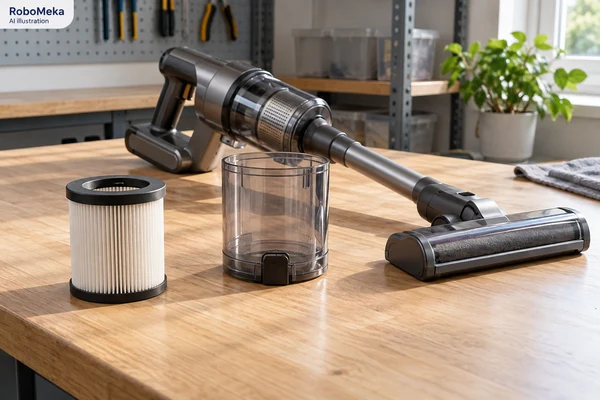
The short answer
A HEPA component report does not automatically establish whole-vacuum filtration, a sealed-system result or a health benefit. Identify the tested part and method, connect each proposed claim to applicable evidence, and control maintenance instructions, replacement filters and production changes for the approved configuration.
Introduction
A HEPA filter claim and a whole-vacuum filtration claim are not interchangeable. A filter can have documented efficiency while the assembled appliance still needs separate evaluation of its air path, seals and emissions. Buyers should identify exactly what was tested, under which method and conditions, before putting filtration language on a product page or retail package.
This is especially important when a supplier provides a filter certificate alongside a photograph of a complete vacuum. The document may be relevant to a component, but its scope does not automatically expand to the appliance, every replacement filter or a health outcome. A careful purchasing review connects each proposed claim to the specific evidence that supports it.
This guide offers an evidence and maintenance framework for importers reviewing vacuum cleaner products. It is not a laboratory report, certification statement or medical recommendation. The proposed checks help distinguish unanswered questions from demonstrated performance and keep consumer-facing language proportionate to the available evidence.
What does HEPA describe, and what does it leave unanswered?
The US EPA explains HEPA as a type of mechanical filter and describes a theoretical removal efficiency of at least 99.97% for particles of 0.3 micrometers. That definition concerns filtration. It does not establish that a particular assembled vacuum achieves the same result or improves a user's medical condition.
For sourcing, ask the supplier which named method or classification supports the offered filter. Different documents may describe media, a finished filter assembly or another scope. Do not treat a HEPA label, a particle-size number and a class designation as equivalent without reviewing the method and the item's identity.
The report should identify the tested part, revision and relevant conditions. If the part in the sample is not the part named in the report, ask for a documented explanation. A supplier may have a legitimate family-coverage rationale, but that rationale should be reviewed rather than inferred from similar dimensions or color.
Why is a percentage incomplete without its conditions?
An efficiency figure needs a defined challenge, particle-size basis, flow condition and measurement method. It also needs a clear statement of the object tested. A percentage detached from those details can look precise while leaving the buyer unable to determine whether it applies to the product being purchased.
Avoid combining a percentage from one report with a smaller particle size from another to create stronger wording. Likewise, a material supplier's data should not be presented as a completed appliance test. Keep the original claim wording, document reference and allowed interpretation together so marketing teams do not accidentally broaden the evidence during editing.
How can a complete vacuum differ from its filter?
The appliance includes joints, closures, housings and other routes through which air travels. The intended filtration path depends on how those parts fit and remain fitted during normal use. A component's efficiency does not answer whether all relevant air follows that path in the assembled product under the conditions being claimed.
A sealed-system statement therefore needs a defined technical meaning and suitable evidence. Ask whether it refers to a design feature, a production check or a whole-machine performance result. Those are different statements. A visual inspection of gaskets can support an assembly review, but it cannot establish microscopic emissions performance by itself.
Also distinguish normal operating exhaust from dust handling during emptying or maintenance. A report about one condition may not cover the other. If the product proposition includes cleaner disposal or reduced contact, evaluate that routine separately and avoid implying that a running-machine result proves what happens when the container is opened.
Which air-path questions should a supplier answer?
Request a simple system description identifying separators, pre-motor filters, exhaust filtration and user-accessible closures as applicable. The objective is not to obtain proprietary drawings unnecessarily; it is to understand the claimed filtration boundary and which replaceable parts preserve it. Ask how correct installation is indicated to the user.
Determine whether the filter can be installed incorrectly or whether an absent component is detected. Evaluate only normal, authorized assembly behavior. Never defeat a safeguard or operate an appliance without required filtration to create a dramatic comparison. Missing-part conditions that require engineering or safety assessment belong with qualified specialists, not casual purchasing demonstrations.
What evidence should buyers request before approving a claim?
Use an evidence map rather than a folder of unrelated certificates. Every proposed statement should point to a specific document or evaluation record. The map makes gaps visible and prevents a genuine but irrelevant report from being used as general proof of product quality.
| Proposed statement | Evidence question | Common boundary to preserve |
|---|---|---|
| HEPA filter installed | Which filter and classification? | Component identity matters |
| Stated filtration efficiency | What method, particle basis and conditions? | Do not omit the test object |
| Whole-machine filtration | Was the assembled appliance evaluated? | Filter data alone is insufficient |
| Sealed system | What does sealed mean in this claim? | Design inspection is not emissions data |
| Washable filter | Which part and care procedure? | Washability is model-specific |
| Performance after maintenance | What preparation and repeated use were assessed? | Fresh-filter evidence has limited scope |
Ask for the issuing organization, report date, model identifiers and the relevant conclusion. Confirm whether the document is a test report, supplier declaration or certification document. These can serve different purposes, and the presence of a logo does not tell the buyer what was actually evaluated or which market requirements it satisfies.
IEC's household cordless vacuum performance listing provides a performance-standard scope reference, not a certification of the offered product. A competent laboratory should advise which current methods apply to the intended filtration or emissions claim. Do not invent a standard reference from a catalogue description or assume one document covers every claim.
How should sample inspection support, rather than replace, laboratory evidence?
What can a non-destructive assembly review establish?
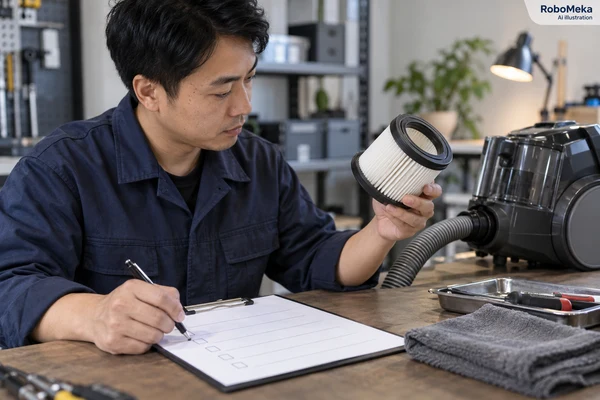
Compare the sample's filter and housing identifiers with the approved configuration. Check accessible seals, closures and seating features for obvious damage or assembly problems. Follow the manual when removing and reinstalling user-serviceable components. Photograph the correct arrangement so quality and customer support teams share the same reference.
Observe whether instructions are understandable to someone seeing the product for the first time. If a filter requires a particular orientation or locking movement, assess whether that is clear. A technically capable system can still create user problems if normal maintenance makes incorrect reassembly easy. Record the difficulty without claiming it proves a measured leak.
What requires specialist measurement?
Particle filtration and emissions results need appropriate equipment, methods and controlled conditions. A flashlight, smoke demonstration or phone video cannot establish a precise efficiency percentage. Avoid improvised challenge materials that may be unsafe or incompatible with the appliance. Commission suitable testing when the purchase depends on claims that visual inspection cannot answer.
Retain uncertainty when evidence is incomplete. The correct conclusion may be that component documentation is available while whole-machine performance is not established. That is more useful than declaring the product either excellent or defective on insufficient information. It allows the buyer to choose narrower wording or arrange further evaluation.
Prepare a filtration evidence inquiry with the exact claim you intend to use, destination market and proposed vacuum configuration. Starting with the intended wording helps identify which documents and measurements are relevant before packaging is finalized.
Why do replacement filters and washing instructions matter?
Filtration is part of a maintained system. A replacement that physically fits may differ in media, seals or construction. Ask for approved part numbers, revision control and a compatibility matrix. The distributor should be able to identify the correct spare without relying on a photograph or the assumption that all filters of the same shape are equivalent.
If a filter is washable, obtain the actual procedure, permitted cleaning materials and drying requirements. Some parts may not be washable at all. Dyson's filter-care instructions illustrate that drying and reinstallation are explicit parts of manufacturer guidance. Those instructions are not a universal schedule or method for another brand's appliance.
Evaluate the practicality of the supplied instructions. Can the user recognize the correct filter, remove it safely and determine that it is ready for reinstallation? Does the retail bundle or service range need an approved spare to cover the drying period? These questions concern usability and support planning, not proof of filtration efficiency after repeated washing.
If the product claim is intended to remain valid after a specified care sequence, request evidence covering that condition. A fresh-filter report should not be stretched into an unlimited lifetime claim. Agree how damaged seals, worn locking features and replacement-part changes will be handled through service guidance and supplier change control.
How can a hypothetical claims review prevent overstatement?
Imagine a private-label buyer receives three items: a filter assembly report, an appliance specification sheet and a draft package saying complete allergen protection. This is a hypothetical review, not a description of an actual supplier. The filter report names a part but contains no whole-vacuum result, and the specification sheet uses the word sealed without defining it.
The first decision is to separate established facts from proposed language. If the installed filter identity and classification are confirmed, a carefully qualified component statement may be supportable. The whole-machine statement remains open until the supplier clarifies its basis. The medical-sounding protection claim is not justified by the supplied filtration evidence.
The buyer then asks a laboratory or qualified reviewer what additional evaluation is needed for the intended appliance claim. Meanwhile, artwork can be revised to accurate, narrower language. This preserves progress without pretending that missing evidence exists. It also prevents the cost of printing packaging that later has to be withdrawn or relabeled.
An approval worksheet should contain the proposed phrase, evidence reference, covered configuration, reviewer decision and restrictions. For example, a restriction might require a nearby conditions note or exclude a different filter option. Sign off the final wording as part of the product configuration rather than treating copywriting as an unrelated last step.
What should be checked during production and shipment review?
Design approval and shipment inspection answer different questions. The former establishes the basis for the selected configuration and claims; the latter can verify that a sampled shipment contains the approved parts and assembly features. A passed visual shipment inspection does not create a new emissions result or prove that every manufactured unit is identical.
Define checks for filter identity, seating, accessible seals, missing parts and instruction accuracy. If the agreed inspection includes a specific functional check, state its method and acceptance rule. Avoid substituting an easy cosmetic check for a performance requirement simply because laboratory work is inconvenient during a shipping deadline.
Require notification of changes to filter media, suppliers, adhesives, gaskets or housing geometry when they may affect approved evidence. The appropriate response may be document review, targeted measurement or broader requalification, depending on the change. That judgment should be made with suitable technical input and recorded before the new configuration is released.
Link these controls to the sample approval process. Keeping the reference sample, part revision and claims record together makes it easier to determine whether a later complaint concerns user maintenance, a substituted component or a design question that needs specialist investigation.
How should filtration be explained to customers and support teams?
Use plain language that distinguishes the installed filter from the appliance's tested performance. Explain permitted maintenance without suggesting that every household needs the same schedule. Give support teams the exact product wording and evidence boundaries so they do not improvise stronger statements in emails, marketplace answers or distributor training.
Avoid turning a household vacuum into a general hazardous-material cleanup recommendation. Intended use must follow the product's documentation and appropriate professional guidance for the material involved. A HEPA component does not, by itself, authorize collection of every fine powder, construction contaminant or biological material a customer might encounter.
Keep benefit language proportionate. Useful information includes what filter is installed, how it is maintained and what an applicable test actually established. Broad claims about eliminating allergies, sterilizing a room or guaranteeing healthy air require a different level and kind of evidence. Do not infer those outcomes from a filtration percentage.
What should a distributor retain in its claims file?
Keep the final approved wording, applicable report, configuration identifier and replacement-filter reference together. Add the review date and the person or organization responsible for the technical interpretation. Preserve the original report rather than only a cropped screenshot of its conclusion, because exclusions and sample descriptions may appear elsewhere. When a retailer requests a shorter claim, check that the shortened version still preserves the same meaning. This simple record makes it easier to answer later questions consistently and prevents an accurate component statement from becoming a broader appliance promise through repeated copying between sales channels.
Frequently asked questions
Does a HEPA filter make the whole vacuum HEPA-rated?
Not automatically. A component report identifies performance within its stated scope, while the complete vacuum includes additional housings, seals and air paths. Ask what whole-machine evidence supports the intended wording. If only filter evidence is available, keep the claim clearly limited to the identified filter and its documented classification.
Can every HEPA filter be washed?
No universal washing rule applies. Follow the instructions for the exact filter and appliance, including permitted cleaning methods and complete drying requirements. Washing an unsuitable part may damage it. For sourcing, request approved replacement identifiers and any evidence needed to support claims after the specified maintenance sequence.
Does a filtration percentage prove an allergy benefit?
No. A filtration result under stated conditions is not, by itself, evidence of a medical outcome or a particular person's exposure. Keep health language separate from component and appliance performance claims. Describe the supported technical result accurately and obtain appropriate expert review if stronger benefit language is proposed.
Is visual inspection enough to verify a sealed system?
Visual inspection can identify obvious assembly defects and confirm accessible parts, but it cannot establish a precise particle-emissions result. Define what the sealed-system claim means, then obtain suitable evidence. Use sample inspection to check configuration and usability while specialist measurement addresses questions that cannot be seen directly.
Conclusion
Evaluate HEPA vacuum claims by connecting the exact wording to the exact test object. Filter media, finished filters, assembled machines and health outcomes are different evidence questions. Model-specific maintenance, replacement parts and change control help preserve the approved configuration after the initial sample review.
Discuss a vacuum filtration evidence brief with RoboMeka, including your intended claim, destination market and service expectations. The next step is to establish the applicable configuration and supporting documents before public wording or production packaging is approved.