The short answer
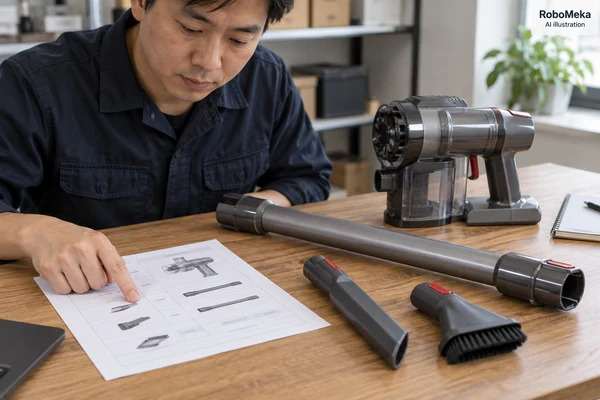
Choose a cordless vacuum for stairs and car interiors by testing the handheld body and supplied tools in the spaces customers actually clean. Compare wrist position, stair tread access, seat-gap reach, upholstery compatibility and complete-task battery use. Approve the accessory bundle and instructions alongside the machine before placing a production order.
Introduction
A vacuum can feel light on a showroom floor and become awkward within minutes inside a car. The motor body hits the seat bolster, the crevice tool cannot reach beside the console, and the attachment supplied for stairs is wider than the tread. These are access problems, and a larger suction figure does not solve them.
Choose a cordless vacuum for stairs and car interiors by evaluating its handheld configuration, tool geometry and complete cleaning task. The useful comparison includes wrist position, access around upholstery, attachment changes and debris disposal. Approve the actual kit customers receive, because a capable machine with the wrong tools can still disappoint.
This guide is for distributors, importers and private-label buyers building a compact cleaning range. The proposed evaluations below are purchasing methods, not reports of RoboMeka testing or promises about an unspecified model. They focus on ordinary dry household dirt and stationary-car interiors within the selected product's instructions.
Describe the job before selecting the handheld body
Start the customer requirements with a small collection of representative spaces. A straight carpeted staircase, an enclosed staircase with narrow corners, a compact car and a larger family vehicle pose different access problems. Photographs with simple measurements tell a supplier more than a request for a powerful lightweight vacuum.
For stairs, record tread depth, riser height, carpet construction, edge shape and the available landing. Establish whether the customer needs to vacuum carpet, clean wooden steps or dust stair rails. These tasks can require different tools. Do not assume that an upholstery brush suitable for one fabric is approved for every stair covering.
For a vehicle, describe seat material, footwell shape, accessible gaps and removable mats. The distance between a seat and the center console matters, but so does the space above that gap for the vacuum body and the operator's hand. A narrow nozzle can enter a slot while its connector prevents useful movement.
Decide whether this is primarily a floor vacuum with occasional handheld use or a handheld product used mainly on stairs and upholstery. The first customer may accept a larger body to support whole-home cleaning. The second may value compactness, straightforward controls and an appropriate tool bundle more highly. The broader cordless vacuum selection guide helps frame that initial range decision.
Compare working weight and wrist position
The relevant weight is the complete configuration in the user's hand: body, fitted battery, dustbin and attachment. A bare-body specification does not describe the effort required to use a powered upholstery tool at arm's length. Ask for the weighing configuration and reproduce it when samples arrive.
Balance deserves a separate observation. Two assemblies of similar weight can feel different if one places more mass ahead of the grip. During a supervised handling assessment, note whether the user can keep the wrist reasonably neutral, see the cleaning edge and change direction without repeatedly shifting grip. Record the observation rather than inventing an ergonomic score.
Controls also change the task. A trigger that must remain pressed may suit short bursts but become inconvenient during a longer seat-cleaning session. A continuous-run switch changes that interaction, although its position must still prevent accidental activation when handling the unit. Compare the actual interfaces and let different intended users describe their experience.
Keep staircase handling assessments on a stable landing or a ground-level fixture where possible. A procurement team does not need to stage overreaching on live stairs to judge tool fit. Instructions should support stable footing and unobstructed access; the product should never encourage users to balance a loose appliance on a narrow step.
Build an attachment kit around distinct surfaces
A compact powered brush may help with compatible upholstery and carpet, while a passive upholstery nozzle can be appropriate where agitation is restricted. A crevice tool addresses narrow gaps, and a suitable dusting brush addresses delicate trim. Their roles are different; a longer accessory list does not establish a better kit.
Dyson describes its model-specific mini motorized tool for upholstery and stairs and identifies the compatible vacuum family. That is a useful example of how an accessory claim should connect a cleaning task to a defined mechanical interface. It is not evidence that another brand's tool has equivalent compatibility or performance.
Ask the supplier whether a proposed hose carries power to a motorized attachment or supports only passive tools. A connector that physically fits does not prove electrical compatibility. Confirm latch engagement, rated accessory combinations and whether the tool can be removed without pulling on the hose or electrical contacts.
| Task | Candidate tool to evaluate | Main purchasing check |
|---|---|---|
| Carpeted stair tread | Approved compact powered brush | Head fits the tread and maintains contact near its edge |
| Stair corner or riser junction | Crevice or narrow upholstery nozzle | Connector allows access without scraping the surface |
| Fabric vehicle seat | Surface-approved upholstery tool | Pickup and fabric condition after the agreed procedure |
| Gap beside center console | Slim crevice tool or approved flexible tool | Reach with the handheld body outside the obstruction |
| Dashboard and sensitive trim | Approved soft dusting brush | Bristle cleanliness, contact pressure and material compatibility |
| Removable dry floor mat | Tool suited to the mat construction | Dirt recovery without pulling loose backing or threads |
Select accessories using the rules in the attachment sourcing guide. Include the exact part references in the quotation, because visually similar nozzles can differ in width, latch position or surface-contact material.
Check access with the body attached
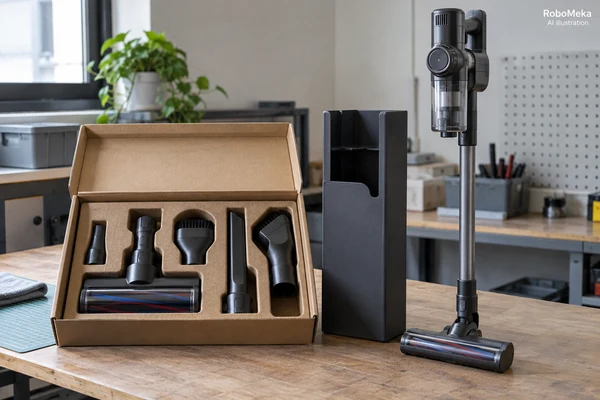
An accessory photograph rarely shows the whole movement needed to clean a recess. Fit every proposed tool to the sample and move it through a realistic approach path. Look for the point where a bin, battery or operator's hand reaches the seat before the nozzle reaches the dirt.
A flexible hose can decouple body position from nozzle movement. It also introduces another part to carry, store and inspect, and some hoses are unsuitable for powered attachments. Treat it as an option to evaluate, not a universal answer. The operating instructions must make supported combinations obvious.
At a stair riser, consider whether a rigid tool can lie flat enough to collect dirt along the junction. On a curved seat bolster, consider whether the attachment maintains contact or rides on its corners. Tool articulation, opening shape and the permitted cleaning direction may matter more than nominal nozzle width.
Before powered trials, conduct an unpowered fit check. It is a simple way to identify unsuitable geometry without rubbing a running brush against sensitive material. Mark inaccessible areas on a diagram and distinguish them from areas reached but not adequately cleaned. The remedy for poor access may be another tool; the remedy for poor pickup may require a different investigation.
Plan a task-based sample evaluation
Use a documented, repeatable sequence on approved representative materials. A possible evaluation includes a ground-level stair fixture, a compatible fabric seat sample, a crevice fixture and a removable mat. Describe it explicitly as a proposed buyer trial, with the final procedure agreed by the supplier and the buyer before testing.
For each station, record the surface, tool, power setting, battery starting condition and permitted debris. Use consistent dry test material appropriate for the machine; do not introduce liquids, sharp objects, hot debris or unknown powders. Establish how the material is distributed and how many cleaning passes are allowed.
Observe completion, remaining visible dirt, required tool changes and interruptions. If mass recovery is measured, agree the collection and weighing procedure, instrument resolution and treatment of material left inside the nozzle. Without a controlled method, a percentage on a spreadsheet can imply more accuracy than the evaluation supports.
Include a short narrative alongside the numbers. A product may remove the agreed debris but require awkward repositioning or repeated accessory changes. Another may offer easy access but leave embedded material that exceeds the customer's agreed acceptance condition. Record both, because the purchasing decision is about a complete job.
Send your requirements to RoboMeka with stair and vehicle photographs, surface-care restrictions, target retail positioning and the proposed attachment list. A clear application brief gives the supplier a concrete basis for discussing sample configurations and evaluation scope.
Measure battery use through the intended workflow
For this application, useful battery evidence answers whether the unit can finish the defined task with the specified tools and power settings. A no-load runtime or a low-power figure with a passive nozzle may not describe cleaning carpeted stairs with an electrically driven brush.
Design a workflow that includes cleaning, attachment changes and normal pauses. Record powered time separately from elapsed task time, because customers experience both. Note whether the unit restarts in the previous setting, whether the battery indicator is understandable and whether the user needs to stop before the task is complete.
Do not compare one sample in maximum mode against another in its least demanding mode and present the result as a direct capacity comparison. If different settings are needed to achieve the agreed cleaning outcome, report that difference openly. The cordless vacuum runtime guide explains how to keep configuration and outcome connected.
Confirm storage and charging instructions before marketing a product for cars. Interior temperatures, outdoor exposure and charging arrangements must remain within the model's documented limits. A handheld vacuum used in a parked vehicle should not automatically be described as suitable for permanent vehicle storage or charging from an unspecified adapter.
Protect upholstery, trim and the machine
Surface permission comes before pickup testing. Vehicle upholstery can include woven fabric, coated surfaces, decorative stitching and trim that need different treatment. Obtain the relevant vehicle or material care guidance, then select the accessory and procedure. A motorized brush should not be assumed suitable just because it removes dirt from a nearby carpet.
Dyson's car-interior cleaning guide recommends clearing loose belongings and removing mats before vacuuming, and describes working from seats toward the floor. These preparation steps illustrate why a realistic application demonstration should show the complete cleaning workflow rather than a single nozzle pass.
In your own instructions, distinguish ordinary dry vacuuming from stain treatment and wet extraction. Do not encourage users to collect spills with a dry-only appliance. Keep brushes and nozzle edges free of grit before moving from floor mats to delicate trim. Separate tools may simplify that routine for some customer groups.
Car use should take place while the vehicle is stationary, with safe access and enough space to work. Accessory instructions should also state how to stop and isolate the machine before removing blockages or servicing the brush. These details belong in the customer handover, not only in a supplier's internal file.
Include emptying and cleaning in the buying decision
The task does not finish when the seat looks clean. Check whether the handheld bin can be emptied into an ordinary household container without the user having to remove several unrelated parts. Examine the path taken by hair and lint, and follow the supplied method if material bridges the opening.
Ask which parts are washable, which must only be wiped and how completely washable parts must dry before refitting. Do not infer that a powered tool can be immersed because its roller is removable. The manual should distinguish the component from the complete assembly and show a clear reassembly check.
Evaluate accessory storage as part of the bundle. A useful slim nozzle that is routinely misplaced stops adding value. A bag or holder should secure the proposed tools without crushing bristles, loading latches or pressing the power control during transport. Inspect the arrangement with the actual production accessories.
Turn the approved kit into a production specification
Once a sample kit works for the intended application, record the body revision, battery and charger references, tool identities, instructions and packing layout. Keep photographs that distinguish the approved accessory from nearby alternatives in the supplier's catalog. A generic description such as small brush leaves room for substitution.
Factory testing can verify agreed functions such as accessory recognition, latch operation, brush rotation where applicable and basic airflow continuity. The supplier should propose a suitable process and evidence format. A production functional check does not replace the earlier application evaluation on upholstery and stair fixtures.
Shipment inspection should confirm the approved bundle is present, undamaged and correctly labeled. Sampled functional checks should use the agreed method and should not be represented as a complete requalification of every unit. Document missing tools, damaged bristles, incorrect manuals or inconsistent connectors as specific discrepancies with traceable photographs.
For support planning, identify replacement availability for the compact brush, crevice tool, hose and removable wear parts. The economically important failure may be a broken accessory latch that makes the entire kit inconvenient, even when the motor still works. Include these parts in the service discussion before launch.
Frequently asked questions
Is a stick vacuum suitable for both stairs and car interiors?
It can be, if its handheld configuration and approved tools fit both tasks. Evaluate the complete body and accessory combination on representative spaces. A floor-cleaning head, long wand and attractive suction specification do not establish useful handheld access. Surface compatibility, stable handling and a workable cleaning sequence still need separate confirmation.
Do buyers always need a motorized upholstery tool?
No. Its value depends on the fabric, embedded debris and material-care instructions. A powered tool may be useful on compatible carpet or upholstery, while a passive nozzle may suit a surface that restricts brush agitation. Request both options when the target segment is mixed, then compare them using the same agreed task.
Why can a narrow crevice tool still fail to reach a car gap?
The rest of the assembly can block the approach. A wide connector, dustbin or battery may touch the seat before the nozzle reaches the intended area. Evaluate insertion with the body attached and room for the user's hand. An approved flexible tool may improve access, but its compatibility and handling must be checked.
Should advertised runtime determine the accessory bundle?
Runtime should be measured with the bundle needed to complete the job. An accessory may change electrical demand, airflow or required cleaning time. Compare task completion and powered time under declared settings, and disclose any recharge or battery-change requirement. Choosing a weaker tool only to preserve a long runtime claim may undermine the product's purpose.
What should an importer inspect before shipment?
Inspect the exact body, battery, charger and attachment references against the approved sample record. Check packaging, connectors, latches, tool condition and the correct instructions using an agreed sampling plan. Confirm that surface-care guidance and accessory limitations match the supplied kit. Application performance approval should already have been completed before routine shipment inspection.
Conclusion
A convincing stairs-and-car vacuum kit solves access, handling and surface compatibility together. The practical buying sequence is to define representative spaces, choose approved tools, evaluate the complete workflow and freeze the resulting bundle. That produces a product story customers can understand and a specification that purchasing and service teams can verify.
Get a quote from RoboMeka by sharing your target market, expected order scope, stair and vehicle applications, and preferred accessory bundle. Ask for model-specific compatibility information and a sample evaluation plan before approving production.