The short answer
Choose vacuum attachments by the tasks they support and verify the complete connection route, including body, wand and adapters. Mechanical fit alone does not establish powered-tool compatibility. Control part identities, storage, carton contents and substitutions so the approved bundle remains understandable to customers and service teams throughout its commercial life.
Introduction
Vacuum cleaner accessories should be purchased as a controlled tool system, with each attachment linked to a task, compatible interface and identifiable replacement. Counting the pieces in a retail carton tells buyers little about actual coverage. A bundle can contain many tools yet omit the one a customer needs or include an attachment that fits mechanically without being approved for the application.
The central sourcing decision is which complete configuration supports the intended customer routine at a manageable cost. That requires attention to connection geometry, powered-tool requirements, storage, instructions and future substitutions. A small change to a release button or contact arrangement can create a service problem even when the new accessory looks almost identical in a catalogue photograph.
This guide explains how importers can specify, evaluate and maintain a vacuum attachment bundle. It presents proposed purchasing checks and hypothetical examples, not completed RoboMeka compatibility tests or guaranteed accessory availability. Begin with the tasks your customer needs, then require the supplier to identify the approved tools and the evidence supporting each combination.
How should a buyer decide which attachments belong in the bundle?
Describe the customer's cleaning route before requesting a standard accessory pack. A household may need routine floor cleaning, narrow-gap access and occasional upholstery care. Another may place greater value on a dedicated floor surface or compact storage. Name the essential tasks and their approved surfaces so the supplier can explain why each proposed tool is included.
Assign a clear role to every item. Two attachments with similar descriptions may have different reach, brush materials or intended surfaces, but those differences should matter to the target customer. If the supplier cannot explain a useful distinction, consider whether the second tool creates more packaging and inventory work than practical value.
Avoid assuming that an accessory name establishes performance. An upholstery tool still needs approved fabric applications and a suitable configuration. A hard-floor head must be assessed against the intended surface and care instructions. Use the floor and use-case selection guide to define applications before choosing the accessory assortment.
Which tasks should remain outside the accessory proposition?
An attachment should not expand the appliance's intended use without explicit technical support. A new nozzle does not make a dry vacuum suitable for liquids, hazardous debris or unsupported outdoor cleanup. Ask whether the accessory changes an approved application and request the relevant instructions. Keep limitations consistent across the main manual, accessory leaflet and retail description.
Separate reach, cleaning and storage requirements. A tool may enter a gap without performing the task acceptably, or clean an approved surface while fitting poorly in the customer's storage arrangement. Record separate decisions for these requirements.
What does accessory compatibility need to cover?
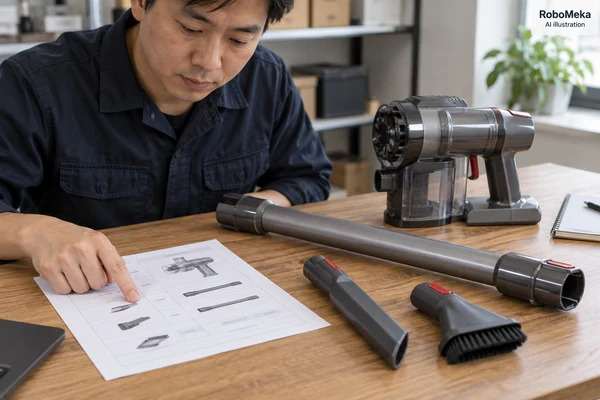
Start with mechanical fit, including insertion depth, orientation, latch engagement and release. The user should connect and remove the tool through the authorized procedure without forcing it. Review the complete connection route: an accessory used on a wand may behave differently when attached directly to the handheld body or through an approved adapter.
Then confirm functional compatibility. Powered accessories can involve contacts, supply requirements and control behavior that are not visible from the outer diameter alone. Ask the supplier to approve the exact body, wand, adapter and tool combination. Do not energize an improvised combination or bridge contacts simply because two connectors appear similar.
Manufacturer parts pages show why model identity belongs in this process. Dyson's combination-tool listing provides a specific part identifier and compatible-machine information. The lesson is to require a documented match for the offered accessory, not to infer universal compatibility within a brand or copy another manufacturer's interface claims.
Why is a connector diameter insufficient?
A shared diameter does not describe latch position, sealing features, insertion stop or powered contacts. Two parts can slide together but remain loose, fail to lock or lack the required electrical arrangement. Ask for the supplier's approved interface documentation at a level appropriate to purchasing and service. Physical similarity is a starting observation, not an acceptance criterion.
For a passive tool, confirm the supported assembly and task even when no electrical connection is involved. For a powered tool, involve competent technical review when the compatibility evidence is unclear. Purchasing staff should observe normal operation of an approved combination, while questions about unapproved electrical combinations belong with qualified specialists.
What should an accessory compatibility matrix contain?
Identify combinations precisely enough that another person can select the correct part without asking the original buyer. Include the appliance revision and any required intermediate component. A matrix with only marketing names can become ambiguous when a product family changes. Preserve separate entries for versions that are not interchangeable, even if their customer-facing names are similar.
| Accessory decision | Identification needed | Verification focus | Record to retain |
|---|---|---|---|
| Primary floor head | Head and appliance revisions | Approved surfaces and complete connection | Configuration approval |
| Powered small tool | Tool, wand or direct-body combination | Documented functional compatibility | Supplier compatibility evidence |
| Passive reach tool | Connector and intended assembly | Locking, reach and permitted task | Sample observations |
| Adapter or extension | Both interfaces and supported tools | Approved complete connection route | Explicit combination list |
| Dock or holder | Storage model and included tools | Retention, clearance and installation | Storage configuration record |
| Replacement accessory | Part number and supersession status | Match to installed appliance base | Service cross-reference |
Distinguish approved, excluded and unresolved combinations; an empty cell should not imply compatibility. Separate accessory listings must identify supported models accurately. Customers should not need to interpret connector photographs or experiment with several products to find the correct fit.
Keep supplier approvals and sample observations linked but separate. A written compatibility statement identifies the intended combination; a buyer's handling review can reveal a poor latch or confusing release. Neither alone establishes every durability, electrical safety or cleaning claim. Request appropriate evidence for the questions that determine the commercial offer.
How should a sample connection review be performed?
Use the complete configuration and instructions, with the appliance prepared as directed. Observe attachment, release and normal movement without applying improvised loads or bypassing safeguards. Check whether an unfamiliar user recognizes orientation and knows when the connection is complete. Record assistance, unexpected looseness or difficult release against the specific part identifiers.
Evaluate the transition the customer will actually make. Moving from floor cleaning to a small tool may require removing the wand, parking the head and finding a storage location. A connector can be easy to use in isolation while the complete changeover remains awkward. Record dropped parts, unsupported resting positions or confusing controls as practical observations.
Where durability matters, agree a suitable test method with defined cycling, loading and acceptance conditions. Do not invent a universal connection-cycle requirement or present a few manual insertions as lifetime evidence. The sample evaluation guide helps connect proposed checks, configuration records and evidence boundaries before samples are approved.
Send your vacuum attachment requirements with the essential floor, upholstery and reach tasks plus the proposed bundle. Ask for the compatibility matrix, part identities and sample configuration together so tool selection and connection review address the same purchasing decision.
How should powered and passive bundles be compared commercially?
A powered tool may support a particular task, but it can also add component cost, weight, maintenance and replacement complexity. A passive tool may simplify the bundle while requiring a different user technique or delivering different task coverage. Compare the intended use and evidence before deciding which version belongs in the range.
Ask for quotations that identify the exact attachment rather than an accessory allowance. Include any required wand, adapter or holder so the true configured cost is visible. If a supplier offers alternatives, request separate identifiers and document which evidence applies to each. Do not accept a cheaper substitute solely because its catalogue name matches the approved tool.
Assess how the attachment changes the complete appliance's handling and operating expectations. A powered tool can produce its own sound and alter the user experience. A long extension changes reach and how the assembly is held. Review the relevant conditions without treating a body-only weight or sound figure as a complete description of every accessory arrangement.
What does a storage review reveal about bundle usefulness?
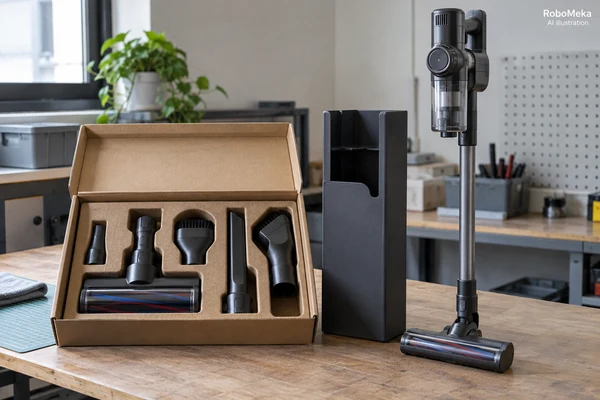
Measure and review the entire stored configuration, including tools supplied in the carton. A wall dock that holds the appliance but leaves several attachments loose may be unsuitable for a compact-home proposition. An accessory holder can solve that problem only if it fits the chosen dock, retains the actual tools and follows the installation instructions.
Installation preparation deserves a place in the purchasing brief. Obtain mounting requirements, clearance guidance and any restrictions on the supplied hardware. Do not assume one fixing method suits every wall construction. If a freestanding arrangement is offered, confirm its intended configuration and stability evidence rather than substituting an improvised display stand in product photographs.
Observe everyday tool removal and replacement. Users should identify the needed accessory and return it without detaching unrelated parts. Where relevant, provide storage that follows the component's drying and care instructions without suggesting a damp part is ready for use.
How can accessory identification survive unpacking?
Put useful identification on the item or on durable accompanying information, as appropriate to the product. The outer carton is often discarded, so a parts code printed only there may be difficult to recover. Keep names and illustrations consistent between the quick-start guide, full manual, support page and spare listing.
Avoid relying on color alone to distinguish compatible versions. Colors may change for a private-label order, and photographs can be inaccurate under different lighting. A clear identifier and configuration record provide a stronger basis for service decisions. If the physical part cannot carry a readable code, agree another reliable identification method before release.
How should packaging and shipment inspection control the bundle?
Create a carton-content specification that identifies each supplied component and quantity. Include accessories nested inside another compartment or attached to the main product. Define how missing items, wrong variants and obvious damage will be checked within the agreed inspection plan. An accessory count without identity checks can miss a substituted or incompatible tool.
Packaging should protect contacts, bristles, releases and exposed surfaces. Review movement between tools and customer removal. Transit evaluation needs a suitable method; an attractive unpacking photograph does not establish protection or justify a damage-rate claim.
Use the cleaning-product export packaging guide to connect the approved bundle with carton design. A new accessory can change compartment layout or carton dimensions even if the main appliance stays unchanged. Recheck the complete pack when the bundle changes, rather than assuming the previous packaging approval automatically covers it.
Which replacement and change-control terms should buyers request?
Request part-level quotations and proposed availability terms for accessories that customers may lose, wear or damage. Confirm order increments, packing units and the process for identifying the correct spare. Do not publish indefinite availability promises without an actual agreement. A practical service plan should identify the commercial terms still awaiting confirmation.
Require notice before changes to connectors, latches, powered contacts, brush materials or other features relevant to approved compatibility and use. The supplier should explain affected combinations and the proposed evidence review. Keep superseded and replacement identifiers linked so existing customers remain distinguishable from customers receiving the new configuration.
Another manufacturer's catalogue illustrates the importance of specific service identities: Miele's cordless accessory range lists distinct named accessory and filter products. It is not evidence of another supplier's stocking commitment. Buyers should obtain equivalent identification clarity and negotiate their own supply terms for the proposed range.
Link those terms to the spare-parts planning guide. An accessory used across several approved models may simplify inventory, but the shared-use claim must be documented. If a new revision breaks interchangeability, the service plan needs a way to route the right part to the right installed appliance.
How would a hypothetical importer choose a core and premium bundle?
Imagine an importer planning two bundles around one proposed cordless stick vacuum platform. The core offer targets routine floor cleaning and narrow gaps. The premium offer adds a documented upholstery task. The supplier proposes a powered small tool, a passive upholstery tool and an extra adapter, but the importer has not yet approved any combination.
The buyer maps each proposed item to the task and requests explicit compatibility. Suppose the hypothetical review finds that the powered tool connects directly but needs a different approved wand for extended use. That condition should shape the bundle and instructions. It cannot be hidden by photographing the tool beside a wand from the core offer.
The importer then compares complete configured cost, storage and replacement handling. It may choose direct handheld use for the premium task and omit the unnecessary adapter, provided the documented application supports that choice. The decision creates a clear difference between bundles without increasing the accessory count simply to make one carton appear more generous.
What should prevent a later substitution from undoing that choice?
Freeze the exact part numbers and approved combinations in the purchase specification. If the supplier proposes a replacement, review its fit, task coverage and affected evidence before accepting it. Keep retail images and carton contents aligned with the decision. A last-minute substitution can change the product proposition even when the total number of accessories remains identical.
How should product pages explain the final attachment offer?
Describe included tools separately from optional accessories, using the actual identifiers and supported applications. Show the correct connection and surface in explanatory images. Avoid suggesting a tool is included because it appears in a lifestyle photograph when it is actually sold separately. Customers and distributors should be able to understand the configured offer without reconstructing it from several pages.
Label AI-generated storage or connection scenes as illustrations. They are not evidence of factory inspection, compatibility or durability testing. Use approved configuration records and final product photography to establish factual details about the purchasable bundle.
Frequently asked questions
Does a matching connector diameter guarantee accessory compatibility?
No. Diameter does not establish latch geometry, insertion depth, sealing or powered-tool requirements. Confirm the complete approved combination, including any wand or adapter, through supplier documentation and suitable review. Do not force parts together or energize an unapproved arrangement. Similar appearance is insufficient for a compatibility statement on a retail listing.
Is a larger accessory bundle always better for buyers?
Only if the additional tools support tasks customers actually need. Extra pieces can increase carton size, storage demands and service complexity. Assign every tool a clear application, then compare the complete configured cost and practical routine. A smaller, well-defined bundle may be more useful than several overlapping tools with unclear purposes.
Can one replacement attachment serve several vacuum models?
It can when those combinations are explicitly approved and supported by relevant evidence. Maintain a compatibility matrix with model and part revisions, including any required intermediate components. Do not infer shared use from matching colors or family names. Record changes and superseded parts so the service team can identify the correct replacement reliably.
Should a dock be reviewed as part of the accessory bundle?
Yes. Check that it stores the supplied configuration, retains the actual tools and follows documented mounting or freestanding requirements. Include clearance and everyday removal in the review. A dock that holds the main body alone may not meet a compact-storage proposition when several included accessories have no practical place to go.
Conclusion
Source vacuum attachments through task coverage, documented compatibility and part-level control. Select the tools that complete the customer routine, verify the entire connection route and include storage, packaging and replacements in the decision. Keep revisions and substitutions visible so the approved bundle remains identifiable after production and throughout service.
Prepare a vacuum accessory and bundle inquiry with RoboMeka, including your core tasks, desired assortment and storage requirements. Request a configuration-specific quotation, compatibility matrix and replacement proposal so the bundle can be reviewed as a complete commercial offer before purchasing and retail content are finalized.