The short answer
Compare runtime for the exact battery, head, mode, surface and endpoint being offered. Motor-on time is different from elapsed task time and useful cleaning time. Combine duration with pickup and charging evaluation, and keep longest-runtime conditions visible wherever the claim appears.
Introduction
Cordless vacuum runtime is meaningful only when the operating conditions are attached to the number. A long duration with a non-powered tool in a low setting does not establish how long the same machine will clean carpet with its motorized head. Buyers should compare usable cleaning time in the intended configuration, together with the result achieved during that time.
For an importer, runtime is both a product-selection issue and a communication issue. An unsuitable battery and head combination can create complaints even when the advertised maximum is technically achievable. The practical question is whether customers can finish the expected task using a supported operating pattern, then recharge and maintain the appliance conveniently.
This guide proposes a repeatable evaluation for cordless stick vacuum sourcing. It does not report completed RoboMeka tests or establish a universal minimum runtime. Use it to define customer requirements, request comparable supplier evidence and translate sample observations into a clear retail proposition.
What should count as usable runtime?
Begin by separating motor-on time, elapsed task time and useful cleaning time. Motor-on time excludes pauses. Elapsed time includes movement between rooms, attachment changes and interruptions. Useful cleaning time should be tied to a stated cleaning outcome; a motor continuing to run does not prove that the expected pickup is maintained until shutdown.
The endpoint must be defined before testing. It might be automatic shutdown for a straightforward duration check, completion of a prescribed task, or a separately specified performance endpoint measured through an appropriate method. Record which endpoint was used. Comparing one supplier's shutdown duration with another's performance-based duration can be misleading even when both reports are accurate.
IEC's cordless vacuum performance listing identifies a dedicated measurement framework for household cordless dry vacuums. It is a useful starting point for formal evidence requests, but the public listing does not provide a complete laboratory procedure. Have a qualified laboratory identify the applicable method and edition when the outcome will support a standardized claim.
How does the cleaning task change the answer?
A customer cleaning a small hard-floor apartment may use different attachments and settings from someone cleaning rugs and upholstered stairs. Describe the task in surfaces, approximate accessible area, debris and attachments. Floor area alone is incomplete because furniture, passes and cleaning expectations determine how long the operator actually works.
Avoid converting minutes into a universal square-meter capacity. A carefully prepared open room and a furnished room with many edges are different workloads. If the sales proposition uses an area claim, establish a documented layout and operating procedure for that claim. Make clear whether the stated area reflects one pass, an agreed pickup endpoint or another condition.
Which variables must be recorded for a fair comparison?
The test sheet should identify the complete sample, not merely the battery's printed capacity. Record the vacuum model, serial identifier, battery part number, charger, floor head, filter and firmware where applicable. Include whether the sample is a prototype or a production-representative unit, because later changes can make early results unsuitable for final artwork.
| Variable | Record before the run | Comparison risk if omitted |
|---|---|---|
| Operating mode | Fixed setting or automatic mode | Unlike energy demand |
| Attachment | Powered floor head or other tool | Different task and consumption |
| Surface | Material, carpet specification and layout | Different head loading and movement |
| Battery preparation | Charging procedure and rest conditions | Inconsistent starting state |
| Appliance condition | Filter, bin and brush preparation | Unequal restrictions or maintenance |
| Endpoint | Shutdown, task completion or other rule | Different definitions of runtime |
| Interruptions | Duration and reason | Motor time confused with elapsed time |
Follow the manufacturer's permitted operating and charging conditions. Record ambient conditions when relevant, without inventing a correction factor for temperature. Keep preparation consistent between candidates and retain the original logs. If a sample is already used, disclose its known history rather than treating it as equivalent to a new unit with unknown battery behavior.
Dyson's V11 runtime support page explicitly identifies power mode, floor type and tool as influences on its model's duration. That is an illustration of why conditions belong beside a claim, not evidence of runtime for a different supplier's product.
How should fixed modes and automatic modes be tested?
What does a fixed-mode trial reveal?
Use a fixed mode to establish a controlled reference where the product permits it. Select the same documented setting for each repeated run of that candidate. Matching mode names across brands is not sufficient: normal, standard and medium may represent different behavior. Record the chosen setting and compare the cleaning outcome rather than assuming equivalent names imply equivalent power.
A high-power setting may be appropriate for a short difficult task but unsuitable as the default for a whole home. Evaluate whether the manual positions it as continuous operation or an occasional boost. The buying report should explain the intended mode strategy so the distributor does not advertise maximum output alongside longest duration as though both apply together.
What does an automatic-mode trial reveal?
Automatic control can change output according to the platform's inputs and logic. A duration measured on an easy surface may therefore say little about a mixed-floor route. Use a prescribed route with defined surface transitions and permitted debris conditions. Record mode indications and noticeable changes without claiming to know the internal algorithm unless the supplier provides documentation.
Repeat the route, retain variation and distinguish expected adaptation from unexplained behavior. If software changes during evaluation, start a new result group for the revised version. An improvement may be welcome, but it should not erase the original evidence. Ask whether the software in samples will match the software installed in the production order.
How can buyers combine runtime and pickup in one plan?
Run duration and cleaning effectiveness as connected but distinct checks. A vacuum that runs longer by using a weak setting may require additional passes, offsetting the apparent benefit. Conversely, a shorter run may be sufficient if the intended task finishes with an acceptable result. The decision should reflect the user's workload rather than a contest to keep the motor running longest.
For an internal application trial, define representative zones and inspect the result at agreed points. Document passes, residue and any intervention. Keep the procedure within the manual and use appropriate non-hazardous test materials. Where precise pickup percentages are needed, use suitable measurement equipment or a competent laboratory instead of estimating a number from a photograph.
The suction and air-watt guide explains why a pressure specification cannot replace that assessment. Runtime and suction are often marketed together, so review them together while preserving their separate measurement conditions. A coherent specification should allow a customer to understand what combination of output and duration is actually supported.
Prepare a runtime evaluation inquiry with your intended floor mix, task duration and accessory bundle. These details help define sample conditions and a realistic battery discussion before an advertised maximum becomes the only selection criterion.
What would a hypothetical mixed-floor worksheet look like?
Consider a hypothetical distributor planning a vacuum for apartments with hard floors, a rug and upholstered furniture. The proposed task includes twelve minutes on hard flooring, eight minutes on the rug and five minutes with a small tool. These are planning assumptions for this example, not recommended household times or product test results.
The motor-on requirement is twenty-five minutes, while the full session may take longer because of transitions and emptying. The buyer defines the acceptable cleaning result for each zone and observes whether one charged sample finishes the prescribed sequence. A spare battery is evaluated as a different bundle, not silently used to rescue the single-battery result.
Suppose a candidate completes the route but requires an extra rug pass. The report should record the additional time and final result, not simply mark the twenty-five-minute target as passed. Another candidate might finish within the assumed time but leave unacceptable residue. The worksheet exposes those trade-offs more clearly than a headline duration comparison.
Add a decision column for each scenario: acceptable, conditional or not established. Conditional acceptance might require a revised head or clearer instructions, followed by a defined retest. Keep commercial preferences separate from essential requirements. A lower price cannot make an incomplete task count as completed; it can only influence whether the buyer changes the intended product proposition.
How much margin should the buyer request?
There is no universal margin that fits every customer group. Consider uncertainty in room layout, operator technique and maintenance, then state the reserve you intend to assess. Treat the margin as a purchasing requirement rather than a scientifically derived guarantee. Test the proposed reserve instead of subtracting an arbitrary percentage from a catalogue claim.
If the sales concept depends on uninterrupted cleaning, observe how the user recognizes low charge and whether the warning leaves enough practical opportunity to finish or stop. An inaccurate display can undermine confidence even if total duration is acceptable. Record the display behavior and final shutdown separately from the measured time.
Why do charging and spare batteries belong in the comparison?
Runtime answers how long the machine operates; charging determines when it is ready for the next task. Use the supplied charger and documented conditions, and identify how the product indicates completion. Avoid assuming that a displayed full icon, a stated charge time and readiness after heavy use always represent the same event.
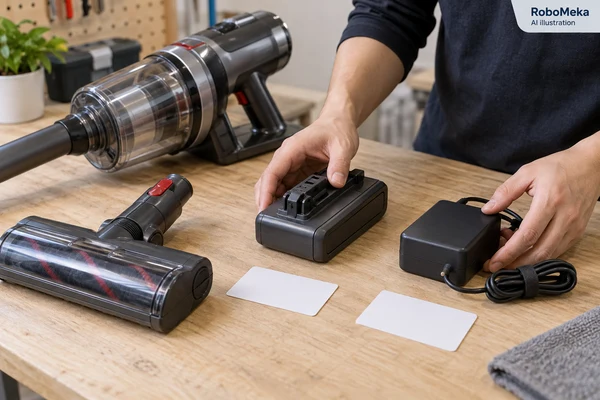
For a removable-battery design, check the permitted removal procedure, connector protection and storage instructions. Evaluate whether the intended user can identify the correct replacement pack and install it without confusion. A second battery adds flexibility only if charging arrangements and replacement supply fit the customer application and the authorized product configuration.
Do not describe battery capacity in ampere-hours as a stand-alone runtime ranking. Voltage, usable energy, control settings and the complete appliance load also matter. Even a watt-hour figure is an energy descriptor rather than a direct cleaning-time promise. Ask the supplier for configuration-specific evidence and confirm that replacement batteries preserve the approved specification.
Plan after-sales handling with qualified support and transport partners where necessary. Damaged batteries, transport classification and electrical safety are not suitable subjects for improvised buyer experiments. The application trial should remain non-destructive and within the manual; separate specialist review should address requirements beyond normal user operation.
How should aging and maintenance be evaluated honestly?
An initial sample run establishes behavior for that sample in that condition. It does not establish battery life over several years. If retention of runtime is commercially important, define a separate aging program with appropriate expertise, controlled cycles and acceptance criteria. Avoid turning a short evaluation into a projected lifespan claim through a simple multiplication.
Maintenance also affects what users experience. Record the state of the filter, head and bin before repeated evaluations. A permitted used-condition trial can reveal whether instructions are practical, but it must identify the preparation and remain distinct from the clean reference test. Never deliberately block the appliance to simulate aging or bypass a protection system.
Ask what information support teams can obtain when a customer reports short runtime: mode, attachment, surface, charge indication, error message and maintenance history. Build those fields into troubleshooting guidance. This can separate a misunderstood maximum claim from a defective component without presuming the customer is using the machine incorrectly.
How should the final runtime claim be presented?
Write a main statement and conditions note that agree with each other. If the longest duration uses an unpowered tool, say so near the claim. If automatic operation varies, explain the principal conditions. Do not hide an essential limitation in an unrelated manual page while showing a motorized floor head beside an unqualified maximum.
Maintain separate records for each retail bundle. A different battery, head or firmware revision can change the basis for the claim. Link approved wording to the relevant report and configuration, then include that reference in the production change-control process. Shipment inspection should confirm identity and completeness, while performance approval remains linked to the appropriate evaluation evidence.
Use the sample approval framework to document unresolved questions and retest triggers. A useful handover says exactly which modes and tasks were assessed, how many valid runs were retained and what was not established. That gives commercial and support teams a defensible explanation of the product's intended use.
Frequently asked questions
Why is advertised runtime longer than my floor-cleaning time?
The advertised maximum may use a lower mode or a different attachment from your floor-cleaning configuration. Check the stated conditions before comparing durations. For sourcing, require separate results for the powered head and intended surface, and record whether the quoted time ends at shutdown or another defined performance endpoint.
Does a larger battery always provide more useful cleaning time?
Not by itself. Battery energy, appliance demand, control behavior and task difficulty all affect the outcome. A heavier or larger pack may also change handling. Compare the complete approved configuration on the expected cleaning route, rather than choosing only by ampere-hours or assuming a proportional increase in runtime.
Should automatic mode be used for every comparison?
Automatic mode is important when customers will use it, but it can introduce workload-dependent variation. Include a prescribed application route and repeat it. A fixed-mode reference can help explain differences where available. Keep the two types of results separate and record software versions that may influence automatic behavior.
Can a short sample trial prove long-term battery durability?
No. It can show initial duration, charging behavior and usability for the evaluated sample. Long-term durability requires a suitable separate program and evidence. Avoid projecting years of service from a few charge cycles, and obtain clear battery replacement, support and configuration-control arrangements before launching the range.
Conclusion
Compare cordless vacuum runtime as a defined cleaning capability: the identified machine, battery, head, mode, surface and endpoint belong together. Include pickup, charging and maintenance so the selected bundle matches the task customers expect to finish. A qualified duration is more useful than an unexplained maximum.
Discuss a cordless vacuum evaluation brief with RoboMeka. Include your destination market, expected cleaning route and preferred accessory package so the next discussion can focus on a configuration and evidence plan appropriate to that application.