The short answer
Select a cordless vacuum package for a defined customer segment and task sequence. Compare complete-assembly handling, useful tools, storage and charging placement, battery compatibility and the service route. Clear essential approvals before applying weighted preferences, and choose a proposition that sales and support teams can explain without relying on headline specifications.
Introduction
Choose a cordless vacuum by matching the complete product package to a specific customer segment. Start with the cleaning tasks, handling needs and available storage, then consider attachments, the battery ecosystem and service arrangements. The most suitable proposal is the one that customers can use and maintain conveniently for the intended job, with evidence supporting that proposition.
For importers and private-label buyers, this is a portfolio decision as well as a product decision. A compact companion vacuum and a main household cleaner may both be cordless, yet serve different expectations. Building a range around a single maximum specification can obscure those differences and leave sales teams unable to explain why one package suits a particular customer.
This guide focuses on selection among manually operated cordless vacuums. It uses proposed buying worksheets and clearly hypothetical examples, not measured RoboMeka product results. Detailed suction and battery approval are covered in linked specialist guides. Here, the goal is to turn customer requirements into a coherent shortlist, accessory package and ownership proposition.
Name the customer segment before the product tier
Define the customer through a cleaning situation rather than a vague label such as premium. A small-home customer may need frequent hard-floor cleaning and compact storage. A household with mixed flooring may value a versatile main cleaner. Someone choosing a secondary appliance may prioritize stairs, upholstery or quick local tasks over a large floor-cleaning package.
These are hypotheses to validate through your own customer research, sales feedback or channel experience. Do not assume every apartment owner has the same priorities or every larger home requires the same machine. The useful brief records likely tasks and constraints while keeping uncertain assumptions visible for later review.
As a manufacturer-specific example, Dyson's vacuum selection guide discusses floor types, home size, attachments and cleaning habits. This illustrates how a brand organizes product choice around use. It is not independent proof of another supplier's capabilities, and its proprietary features should not be generalized to unverified cordless products.
Give each planned product a clear role in the range. Explain the core task, the main ownership benefit and the acceptable compromise in one short paragraph. If two proposed products have the same role and no meaningful documented difference, the buyer may need a clearer package distinction rather than another nearly identical model number.
Turn the segment into a practical task map
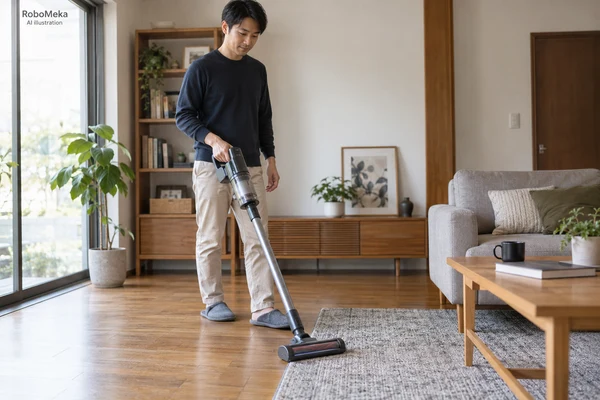
Describe where the appliance travels during a normal session. The route might include open hard flooring, a rug, edges near furniture and a short upholstery task. Another segment might mainly use the handheld assembly. The map should identify what the customer needs to accomplish without becoming a laboratory runtime protocol or assuming every advertised attachment is useful.
Separate essential tasks from occasional extras. A tool used in the core cleaning sequence may deserve inclusion in the baseline package. An accessory for an infrequent niche task might be optional if compatibility and ordering are clear. This avoids treating accessory count as a measure of versatility while overlooking whether customers can store and identify the tools.
Use the cordless stick vacuum overview to frame the initial supplier discussion. Ask for the current model sheet and proposed bundle before building retail positioning around a concept image. If the customer requires washing or liquid recovery, assess an appropriate wet and dry floor cleaner configuration separately; ordinary dry-vacuum versatility does not imply suitability for liquids.
Record the customer actions between tasks. Switching heads, removing the wand, moving furniture and carrying the appliance can influence convenience. A proposal that handles each individual task well may still create friction through frequent transitions. The shortlist should therefore compare a complete use sequence, including the accessories and instructions actually offered.
Evaluate balance and handling beyond the published weight
Total weight is useful, but where that weight sits also affects the experience. A top-mounted assembly may feel different on the floor and when held for an above-floor task. The battery, bin and tool can change the balance. Review the complete proposed configuration rather than comparing bare handheld-body weights that omit the parts customers need.
Ask reviewers to perform representative movements within the manufacturer's instructions. Observe lifting, turning, reaching under ordinary furniture and changing the grip where relevant. Record the task and the assembly used. Avoid declaring a product comfortable for everyone from one person's brief impression or from its position on a specification chart.
Controls deserve separate attention. Consider whether users must hold a trigger, press a power button or change modes during the task, and whether the controls are easy to reach without shifting grip awkwardly. Neither control style is universally best. The right choice depends on the customer proposition and what the actual product allows.
Carrying and parking can matter as much as cleaning movement. Ask how users carry the appliance between floors, where they place it during a pause and whether it needs a supporting surface or stand. Only describe free-standing capability when it is documented for the offered configuration and conditions. A balanced promotional image cannot establish stability.
Select tools by task fit and switching effort
Review the included floor head against the intended surfaces. A large head may cover open areas conveniently while being awkward around closely spaced furniture. A smaller tool may improve access but require more passes over an open area. These are selection tradeoffs to evaluate, not automatic judgments that one size or design is higher quality.
For upholstery, stairs and crevices, check the actual handheld assembly and attachment connection. Consider reach, grip, storage and how often the user must change tools. Ask whether each proposed accessory is included, optional or merely shown in general marketing material. The quotation should allow a buyer to distinguish a usable task package from a collection of unrelated options.
Pet-related positioning needs particular care. A generic pet label does not establish the ability to handle the customer's hair, surfaces and maintenance routine. The pet-hair vacuum evaluation guide explains relevant application questions. Use those findings to choose the package; do not let a named accessory replace evidence of task suitability.
Suction and head behavior also interact. When a candidate remains on the shortlist, use the cordless suction-system sourcing guide to examine the complete head, filter and control combination. This selection worksheet records the customer benefit of that assembly, while the specialist review establishes whether the claimed performance is supported.
Include storage and charging placement in the product choice
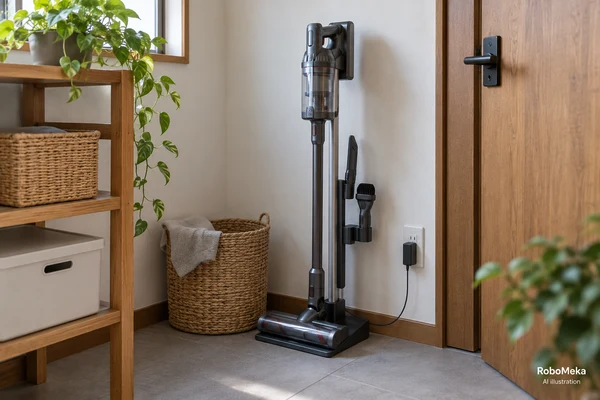
Ask where the customer is expected to keep the appliance. A wall holder, floor stand and loose charger create different space and installation requirements. Confirm which accessories are included and whether a holder also provides charging. Do not assume that an attractive display dock shown in a product image is part of the retail offer.
Installation preparation should follow the specific instructions and the intended location. Discuss available space, suitable power access and whether the customer can use the prescribed mounting method. A rental household may have different preferences from a customer with a dedicated utility room. Treat that as a segment consideration without making universal assumptions about either group.
Consider the complete stored package. A narrow main appliance can still require substantial space once tools, charger and spare components are included. Ask whether attachments have defined storage locations and whether users can retrieve them conveniently. A package that fits a product photograph may be less practical in the cupboard or corner the customer actually uses.
Observe the transition into and out of storage during sample review. Check whether the customer must remove parts, reposition cables or make several adjustments before starting. Record the action sequence rather than only the footprint. The ownership proposition becomes clearer when purchasing can explain how the appliance is ready for the next intended task.
At this stage, send your cordless vacuum customer and storage requirements with the target tasks, handling preferences and desired accessory package. These details help focus the supplier discussion on a configuration customers can use conveniently.
Choose a battery ecosystem that fits the package
At selection stage, ask whether the battery arrangement supports the intended ownership pattern. An integrated pack and a user-removable pack create different replacement and handling routes. A spare pack may be useful for some propositions, but it adds cost, storage and compatibility questions. Do not add it automatically just because the supplier offers it as an option.
Consider commonality across the planned range. Shared approved packs or chargers may simplify customer explanations and service stock, while different product roles may justify different solutions. Request explicit compatibility information for each proposed combination. A similar connector or voltage description does not establish interchangeability between models.
The vacuum battery architecture checklist covers those portfolio choices in detail. For the shortlisted combination, the battery and charger procurement guide explains the required identity and document review. Keep those technical approvals linked to the product role without allowing them to replace the handling and storage decision.
Treat maintenance convenience as part of everyday usability
Review emptying, brush access and filter care alongside the cleaning task. Ask which parts the customer handles, what instructions apply and whether replacement or drying time affects availability. A product that is easy to start can still be inconvenient to own if its routine care does not fit the customer's storage or cleaning habits.
For a concrete manufacturer-specific example, Dyson's cordless filter-care guidance requires filters to be fully dry before refitting and describes a drying period of at least twenty-four hours for its guidance. That example shows why care time matters in selection. Buyers must follow each shortlisted model's own instructions rather than apply Dyson's method to other filters.
Ask whether a spare approved filter is a sensible optional accessory for the intended segment. Its value depends on the manufacturer's care requirements, compatibility and replacement terms. Do not claim that every filter is washable or that every household needs a spare. The decision should connect a documented maintenance process with a clear ownership benefit.
Build a weighted shortlist around the segment
Clear essential requirements before applying a preference score. The offered configuration must be suitable for the intended use, and any required technical or conformity review must be resolved appropriately. Missing evidence should remain visible. A candidate does not become eligible simply because attractive accessories or styling compensate mathematically for an unresolved essential condition.
The following weights illustrate one possible mixed-task household shortlist. They are hypothetical buyer preferences, not market statistics or an industry scoring standard. A compact secondary-cleaner segment could legitimately use different priorities. Agree the weights before rating supplier proposals so the framework expresses customer needs rather than rationalizing a favorite sample.
| Selection dimension | Illustrative weight | Question for the shortlist |
|---|---|---|
| Core task and tool fit | 35% | Does the offered bundle suit the intended surfaces and task sequence? |
| Physical handling | 25% | Is the complete assembly practical to carry, steer and use above the floor? |
| Storage and readiness | 15% | Does the supplied storage and charging arrangement fit the customer setting? |
| Battery ecosystem | 15% | Are compatibility, replacement and range commonality appropriate? |
| Maintenance and modular service | 10% | Can routine care and approved part replacement be supported clearly? |
Give each rating an explanation and a reference to the observation or document behind it. A midpoint score can mean the proposal meets the defined preference; a higher score needs a supported benefit. If two candidates differ only slightly, examine the decisive observations rather than claiming the total establishes an objective winner for every customer.
A hypothetical two-package portfolio decision
Imagine a distributor considering a compact package for small living spaces and a broader mixed-floor package for main household use. Both are cordless, but the first prioritizes convenient retrieval, maneuverability and compact tool storage. The second places more emphasis on the complete task sequence and a suitable attachment assortment. These are proposed segment hypotheses, not claims about measured demand.
The compact package may score well for handling and storage while offering fewer optional tools. The broader package may support more tasks but require additional storage and more attachment changes. The buyer reviews whether those differences are meaningful enough for sales staff to explain without relying on vague good, better and best labels.
Suppose both packages can use a documented common charger but require different packs. The buyer evaluates whether that partial commonality still simplifies support. If the supplier cannot confirm the combination, the worksheet leaves it unresolved. The product decision should not assume an accessory ecosystem that exists only in the proposed marketing story.
Now consider a customer segment that rarely performs above-floor cleaning. Reducing the weight placed on handheld comfort may change the shortlist. Conversely, a stair-heavy task map may favor a different balance. This sensitivity review helps the buyer decide whether to offer two genuinely distinct packages or narrow the range to one well-defined role.
Confirm a practical service route before final selection
Identify the components intended for customer replacement and those requiring a service provider. Ask for part references, compatibility information and the proposed supply terms. Modular construction is useful only when the replacement route, documentation and parts are practical. Do not infer an easy repair from visible screws or an exploded product image.
Connect the service plan to the sales channel. A dealer-supported range and a direct-shipped retail package may need different customer instructions and service coordination. The buyer should understand who diagnoses a problem, who provides the approved part and what commercial terms remain open. These responsibilities influence the suitability of a product even before the first shipment.
Use the spare-parts planning guide to organize the agreed references and replacement needs. Once selected, preserve the bundle identity through quotation, sample approval and proposed shipment inspection. That final continuity check helps ensure the customer receives the package that justified the selection, including its tools, charger and instructions.
Frequently asked questions
Should importers choose the cordless vacuum with the longest runtime?
Only if its documented operating conditions and complete package suit the intended customer task. Longer duration can involve tradeoffs in weight, price or handling. Compare task fit, storage, attachments and support alongside the relevant runtime evidence, and avoid treating a maximum-minute claim as a universal ranking of otherwise different cordless products.
Is the lightest cordless vacuum always easier to use?
Not necessarily. Balance, grip, control placement and the attached tool affect how the appliance feels during different tasks. Review the complete offered assembly while carrying, steering and performing relevant above-floor work. A lower published weight is useful information, but it cannot establish comfort for every user or every cleaning situation by itself.
Should every retail bundle include all available attachments?
No. Include tools that support the core customer task and consider optional accessories where their purpose, compatibility and ordering route are clear. Extra tools can add cost and storage demands without improving the main proposition. Evaluate the entire task sequence so the package offers practical versatility instead of an impressive but confusing accessory count.
What should buyers check about a charging or storage dock?
Confirm whether it charges the appliance, only stores it or requires additional accessories, and whether it is included in the quotation. Review the manufacturer's placement and installation instructions against the target customer setting. Also consider tool storage and the actions needed to retrieve and return the complete appliance during ordinary use.
Conclusion
A strong cordless vacuum selection starts with a clear customer role and evaluates the entire ownership sequence. Match tools to tasks, examine complete-assembly handling, include storage and maintenance, and choose a supportable battery and service arrangement. Use weighted preferences to explain tradeoffs while keeping essential approvals and unknowns visible.
To build your shortlist, prepare a cordless vacuum selection brief describing the customer segment, surfaces, handling priorities, storage setting and desired package. Use that brief to compare coherent supplier offers and select a product proposition your sales and service teams can explain consistently.