The short answer
Start with the actual battery design and packing relationship, then have qualified dangerous-goods specialists determine the applicable classification, documents, marks, packaging and mode restrictions. Obtain a traceable UN 38.3 test summary for the supplied battery design, control revisions and recheck carrier acceptance before each route is booked.
Introduction
A battery-powered vacuum sample moves by courier without difficulty. The volume order later stops at airline acceptance because the battery configuration, state of charge, marks or supporting documents do not match the booked service. The product has not changed in the buyer's sales system, but the shipment scenario has changed completely.
Lithium-battery shipping readiness starts with the actual cell or battery design, its rated energy, condition and relationship to the equipment. It then depends on origin, destination, transport mode, package quantity, current rules and carrier variations. A UN 38.3 test summary is an important transport-traceability document tied to a tested battery design; it is not a universal permission to ship and does not replace correct classification, packaging, marks, labels, declarations or trained decisions.
This guide helps cleaning-appliance buyers organize evidence and questions. It is not dangerous-goods training, legal advice or a packing instruction, and it does not confirm that a particular RoboMeka battery or route is eligible. Engage qualified dangerous-goods professionals, the freight forwarder and the accepting carrier before offering a shipment. Use the export-packaging guide for the broader packaging project.
Identify the supplied battery design exactly
Begin with the battery manufacturer, model, chemistry, nominal voltage, rated capacity, watt-hour rating, cell configuration, mass and revision. Link that identity to the cleaning appliance, replacement battery or accessory in the order. A product family name is not enough when several packs fit similar housings.
Confirm whether the battery shipped for the pilot is the same design planned for production. Samples may use an engineering pack or a locally sourced substitute. Record authorized changes, because a test summary for one battery design does not automatically apply to another pack with different cells, protection circuitry or construction.
Preserve supplier and manufacturer identity as the documents define them. Rewriting the name to match the retail brand can break traceability. Private labelling of the appliance does not transform who manufactured the battery for transport-document purposes.
Keep the product record and shipment record connected
The product bill of materials should identify the approved pack. The shipment file should identify which approved pack is physically present and in what quantity. Serial or lot data can support the link where available, using the batch-traceability workflow.
Do not ask warehouse staff to open a sealed battery pack to confirm cells. Use controlled manufacturer records and external markings. Opening or modifying a pack can create electrical, fire and compliance risks and may invalidate the product.
Distinguish the packing relationship
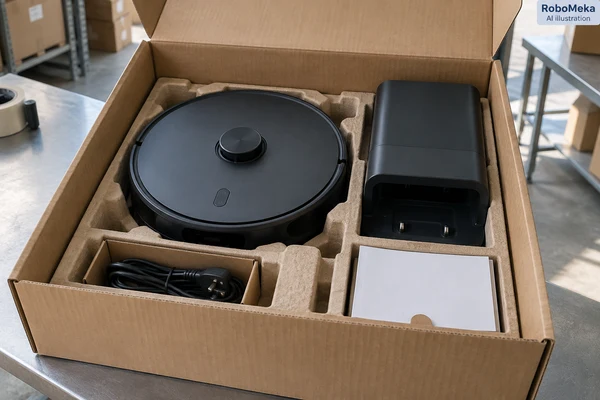
A battery may be contained in equipment, packed with equipment or shipped by itself. A cordless vacuum with the pack installed, a robot cleaner boxed beside a removable pack and a carton of replacement batteries are not the same transport scenario. The correct description must follow the physical shipment, not the SKU's usual retail presentation.
Check every package and overpack. An order can contain finished appliances, spare batteries and accessories in separate cartons. The booking team needs the quantities and configurations for the complete consignment. Do not classify the whole shipment from the easiest carton.
PHMSA's 2024 shipper guide separates guidance by battery type, size and packing configuration and then applies mode-specific provisions. It is a United States regulatory resource, not a substitute for rules governing every route, but it demonstrates why configuration must be established before selecting paperwork.
Control accessory and service-battery cartons
After-sales stock often follows a different route and packing method from the original appliance. The service team may request two batteries by express air even though volume products travelled by sea with batteries installed. Build a separate approved shipping process for replacement packs.
Returns need another review. Used, damaged, defective or recalled batteries can face different restrictions and hazards. Customer service should never send a generic return label for a suspected damaged battery without an approved dangerous-goods procedure and carrier acceptance.
Obtain the correct UN 38.3 test summary
Ask for a test summary that clearly identifies the cell or battery design in the product. Check the manufacturer details, test laboratory, report reference, test date, description, applicable test results and the responsible signatory or contact elements required by the governing framework. Qualified reviewers should assess completeness and applicability.
PHMSA's lithium-battery resource states that lithium cells and batteries offered for transport must have passed the design tests in UN Manual of Tests and Criteria subsection 38.3 and explains the test-summary availability requirement in the United States. The page advises checking with the manufacturer, distributor or vendor for the relevant summary.
The test summary is not the complete laboratory report, and buyers should not reject it merely because it is concise. Conversely, a long test report without a clear link to the supplied pack may be less useful for shipment readiness. Verify identity first.
Resolve mismatches before booking
Common mismatches include a different suffix, cell model, rated capacity, manufacturer name or pack photograph. Ask the battery manufacturer or competent technical function to explain the relationship in controlled documents. Do not edit the PDF locally to make it match.
Keep the summary accessible for the people who need it, with controlled access and revision status. A document stored only in one employee's email is likely to delay a repeat shipment.

Build a battery document register
Create a register for each approved battery and shipment configuration. It can identify the product models, battery design, test summary, safety data where required by the actual transaction, technical specification, packing work instruction, training or instruction record, booking confirmation, carrier approval and shipment documents.
The register should show document owner, source, revision, effective date and review status. A green “available” cell is not useful if the file belongs to an obsolete design. Link changes to the product-change process and determine whether transport review must be repeated.
| Record | Buyer question it should answer | Limitation |
|---|---|---|
| Battery specification | Which battery is in the product? | Does not establish transport eligibility alone |
| UN 38.3 test summary | Which tested design does the supplied pack reference? | Does not select the shipping instruction |
| Packing configuration | Is the battery alone, with or in equipment? | Must match the physical package |
| Route and mode review | Which current requirements and variations apply? | Can change with booking and carrier |
| Packing work instruction | How does the authorized team prepare this scenario? | Must be maintained by competent personnel |
| Acceptance record | Did the selected carrier accept the declared booking? | Does not authorize a different future route |
Verify current mode and route requirements
Regulations and carrier procedures change. Before each new route, have a competent person review origin, transit, destination, air, sea, road or rail legs, battery configuration and quantity. Mixed-mode transport may require more than one framework.
For air cargo, the IATA 2026 Battery Guidance Document says it is based on the 2025–2026 ICAO Technical Instructions and the 67th Edition of the IATA Dangerous Goods Regulations. The document also says it is guidance and should not be relied on as the source of regulatory compliance. That limitation should remain visible whenever it is cited.
Carrier and state variations can be stricter than a general guide. Obtain acceptance from the actual service. Do not promise an air option to a customer because another airline accepted a different shipment last year.
If you need to organize a project discussion, send RoboMeka the battery configuration, destination, quantity and expected mode. Final classification, packing, documents and carrier acceptance must be determined by qualified parties for the real shipment.
Treat state of charge as a controlled variable
State-of-charge requirements may depend on battery type, packing relationship, section, mode and current rules. The shipping plan should state any required limit and how production verifies it. Do not infer compliance from the product's display icon or a generic factory charging instruction.
Define the measurement or process method, sampling or unit scope, equipment control, acceptance decision and record. If the pack continues to charge after the shipping check, the process is not controlled. Likewise, a product stored for a long period may not remain at the original reading.
State of charge also interacts with product inspection and customer readiness. A required or approved transport state of charge may mean the customer must charge before first use. Manuals and retailer communication should set accurate expectations without telling customers to perform unsafe recovery steps.
Separate shipping preparation from battery performance testing
A shipping charge check does not establish runtime, capacity retention or battery health. Those are different evaluations. Keep transport records distinct from the cordless-vacuum runtime testing plan.
If a battery cannot hold an expected safe shipping state or shows damage, swelling, heat, odor or leakage, isolate the item under the site's emergency and damaged-battery procedure. Do not place it into a normal shipment merely because documents exist.
Approve packaging as a complete system
Qualified packaging personnel should select materials and methods for the specific transport provision. Controls can include protection against short circuits, unintended activation, movement and damage, but the exact construction and required performance must come from the applicable instruction and competent design.
Inspect the final packed configuration, not an empty carton drawing. Accessories can press switches, expose terminals or change internal movement. Retail packaging may need an outer transport package depending on the scenario. Do not copy marks or labels from an online photograph.
Packaging trials for general transit performance are not automatically dangerous-goods qualification. Keep the test scope clear. The receiving-inspection guide can help destination teams preserve evidence of impact or moisture without diagnosing battery safety beyond their training.
Prevent unintended operation
For equipment containing batteries, assess how switches and app features behave during transport. A mechanical guard, software state, removable key or other control may be appropriate depending on the product and rule. The design team and dangerous-goods specialist should approve the method.
Do not rely only on a printed “off” symbol. Verify the actual product condition after normal packing movements. Any check must be performed safely, with no hands near moving blades, brushes or wheels.
Control marks, labels and documents separately
Marks identify information on the package; hazard labels communicate regulated hazards; transport documents or declarations carry shipment information where required. Their need, content, format and placement vary. Train authorized staff to follow the current approved work instruction.
Do not preprint a universal lithium-battery mark on every retail carton “just in case.” Incorrect or obsolete communication can create rejection and compliance risk. Keep dynamic shipment information controlled at the appropriate packing stage.
Check language, durability, visibility and obstruction on the final package. Stretch wrap, carrier labels and overpack construction can conceal required communication. If an overpack is used, have the competent person verify the additional requirements.
Assign responsibilities across the supply chain
Identify the battery manufacturer, appliance manufacturer, shipper or offeror, freight forwarder, packer, broker, carrier, importer and destination receiver for the actual route. One company may perform several roles, but responsibility should not be assumed to disappear when a task is outsourced.
The supplier can provide battery identity and manufacturing documents. The forwarder can advise on route and booking. The carrier decides whether it accepts the consignment under its service and variations. The importer should ensure product and shipment information are consistent. Put deliverables and decision dates into the order schedule.
If a third party prepares the declaration or labels, provide accurate data and review the handoff. Outsourcing document preparation does not make an incorrect battery specification safe.
Maintain appropriate competence
Training and instruction requirements depend on role and applicable rules. The 2026 IATA guidance distinguishes formal training and “adequate instruction” in specific contexts and recommends documented procedures for the configurations a company ships. A qualified adviser should decide what applies; a buyer should not self-classify staff from a summary paragraph.
Record who approved the work instruction and when it must be reviewed. Update people when the battery, package, route or rule changes.
Include document gates in the production schedule
Battery readiness can control shipment even when finished goods are packed. Add milestones for approved battery design, receipt and review of the test summary, route classification, packaging approval, carrier quotation, booking acceptance and final document preparation.
Do not leave test-summary collection until container loading. If the document does not match the supplied pack, resolution may require the battery manufacturer and test laboratory. A same-day correction should not be assumed.
For a new design, connect the battery document gate to sample and production approval. Shipment evidence for an engineering pack cannot release a volume pack. Similarly, a cosmetic change that does not affect the battery still needs a controlled statement so the logistics team understands what changed.
Audit a proposed shipment without repacking it unsafely
A shipment-readiness audit can compare product identity, battery reference, quantity, pack relationship, approved work instruction, staff authorization and documents. Review sealed packages through safe records and external checks. Do not open or disturb a compliant package merely to create audit photographs unless the approved process requires it.
Trace a small sample from the production bill of materials to the test summary and shipment file. Check that the physical carton and booking scenario match. Record limitations, such as inaccessible battery markings, and rely on controlled upstream evidence.
If a mismatch appears, stop release through the agreed hold process. Do not alter a label or declaration without competent review. Preserve the original evidence and record the corrective action.
Plan samples, replacements and returns separately
Sample shipments often use express networks and small quantities, while production may use sea or consolidated air freight. Create an approved scenario for each. Success with a sample is not validation of volume shipping.
Replacement batteries are a frequent after-sales need. Include their transport restrictions and lead time in warranty-parts forecasting. If a market cannot economically receive individual packs by the planned service, the warranty remedy may need another design.
For returns, give customers instructions only through an approved process. Never tell them to conceal battery contents, reuse damaged packaging or send a swollen pack through ordinary post. Escalate uncertain cases to the carrier and qualified dangerous-goods team.
Frequently asked questions
Is a UN 38.3 test summary enough to ship a vacuum battery?
No. The summary supports traceability to a tested battery design, but the shipper must still determine the applicable classification, packing configuration, quantity limits, packaging, marks, labels, documents, training and carrier acceptance. Requirements depend on the real route, mode, battery and package.
What is the difference between a battery contained in and packed with equipment?
Contained in equipment generally describes a battery installed in the device, while packed with equipment describes a battery packaged with the device but not installed. Those physical relationships can lead to different provisions. A competent person must classify the actual consignment using current rules rather than relying on the retail SKU description.
Can the supplier use one battery document for several models?
Only when the document applies to the exact battery design used in each model and the shipment records preserve that relationship. Similar voltage, housing or marketing name is not enough. Verify manufacturer, design reference, rating and revision with the responsible battery and dangerous-goods specialists.
Do sea and air shipments use the same lithium-battery documents?
Not necessarily. Classification fundamentals may be related, but mode rules, packing provisions, documents and carrier requirements can differ. A multimodal route may involve several frameworks. Review the complete route and current carrier variations before preparing the shipment.
How often should battery shipping documents be reviewed?
Review them when the battery, cell, equipment, packing configuration, quantity, route, mode, carrier or regulations change, and at a defined periodic interval. Recheck the accepted booking for each shipment. An old approval should not be assumed valid for a new airline, destination or replacement battery.
Conclusion
Battery-shipment readiness is a controlled chain from the approved battery design to the physical packing configuration, current route decision, trained preparation and carrier acceptance. Collecting a PDF labelled UN 38.3 is necessary in many projects, but it is only one link. Buyers reduce delay by making identity, document ownership and logistics gates visible before production finishes.
To prepare the commercial handoff, send RoboMeka your product, battery arrangement, order quantity, destination and proposed transport mode. Battery design availability, test-summary applicability, shipment classification, packaging, documents, training and carrier acceptance require project-specific confirmation by qualified parties.