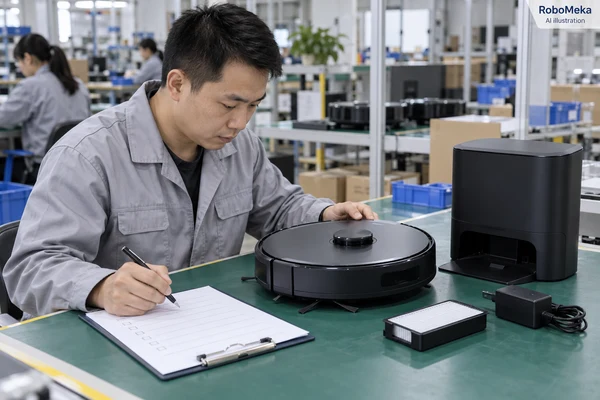
The short answer
Define product, unit, lot and logistics identifiers separately, then test whether a real carton scan retrieves the correct configuration and shipment record. Traceability depends on the links between records, not simply a printed barcode. Include split shipments, replacement units and service parts in the proposed workflow before production starts.
Introduction
A distributor receives a vacuum return with the correct brand name, but the service team cannot tell which charger or floorhead belongs to it. The carton has been discarded, the retail model covers two revisions, and the supplier asks for a production date that the customer cannot find. The missing information is not another product specification. It is the connection between a physical appliance and its history.
For cleaning appliances, useful traceability connects the product definition, individual unit or production lot, packing record, shipment and later service action. A barcode helps capture an identifier; it does not create those connections automatically. Buyers should test the information chain before accepting it as a production requirement.
This proposed workflow is for importers and private-label teams sourcing vacuums, floor washers and cleaning robots. It is not a description of an installed RoboMeka tracking system or proof that particular records are available. Define the required scope in your cleaning robot RFQ, then agree what the supplier and your own warehouse can reliably maintain.
Separate the product code from the individual appliance
An internal SKU can identify a saleable configuration in your business system. A retail product identifier supports trading-partner communication. A serial number distinguishes an individual unit within a defined identification scheme. A batch reference connects a group to a recorded production or packing event. These roles can cooperate, but they should not be treated as interchangeable.
GS1 US explains GTINs as identifiers for trade items. That is a different question from identifying which particular appliance a customer owns. Decide the required retail identification with your trading partners and GS1 support where relevant; do not invent a retail identifier by extending a factory serial number.
Write a small data dictionary before approving artwork. For every field, state its purpose, responsible owner, uniqueness boundary and permitted format. Include a real example using clearly fictitious values. This exposes problems such as calling both the supplier model and the buyer's retail SKU a product code in different spreadsheets.
Define what a lot actually means
A lot might correspond to a controlled production run, a packing operation or another documented grouping. Buyers should not assume it always represents one day or one component delivery. Ask what causes a new lot to be created and whether the grouping is narrow enough to support the investigations your business expects.
If a packing lot combines several assembly lots, preserve that relationship. Otherwise a carton record may identify when the box was closed without answering which configuration went inside. The required detail should follow a practical use case, such as identifying compatible service parts, rather than collecting every conceivable timestamp.
Design records around decisions your team must make
Start with three questions: what was shipped, what does this customer have, and which other goods need review if a problem is found? Then identify the minimum records needed to answer them. This keeps traceability connected to purchasing and service decisions rather than becoming a project to print increasingly complex labels.
For a vacuum, useful configuration fields may include the approved body revision, battery and charger identities, accessory bundle and relevant instructions. For a connected robot, the shipped software version can matter, but later updates must be recorded separately if that history is part of the agreed support scope. A shipment record should not pretend to describe the device's software forever.
Specify how unknown information is represented. A blank field should not silently mean both not applicable and not recorded. Clear status values help reviewers distinguish a product that has no detachable battery from one whose battery reference was accidentally omitted. Avoid requiring operators to fill gaps with plausible guesses.
Map units, cartons and logistics units
The warehouse needs to move between the outer package and its contents. For a simple order, a carton-to-unit list may be sufficient. Mixed cartons, repacking and pallet splits need a way to record changes without losing the original relationship. Decide who updates those records when the physical arrangement changes.
GS1's SSCC overview describes identification of logistics units such as pallets or parcels. A logistics identifier is not a substitute for knowing the items it contains. Whether you use that standard or another agreed warehouse reference, the important buyer question is what record the outer identifier retrieves.
| Record level | Practical purpose | Example question it should answer |
|---|---|---|
| Saleable configuration | Connect order, bundle and approved revision | Which accessories belong in this retail box? |
| Unit identity | Distinguish an individual appliance | Which returned machine is being evaluated? |
| Production or packing lot | Group related manufacturing records | Which recorded operation included this unit? |
| Carton contents | Connect packaging to contained goods | Which unit identifiers were packed together? |
| Logistics unit | Support handling and movement | Which cartons were on the received pallet? |
| Service event | Preserve later interventions | Was this unit repaired, replaced or returned unresolved? |
Treat the table as a proposed record design, not a requirement to buy a specific software platform. A manageable system that captures real events is more useful than a sophisticated database whose fields are populated retrospectively from memory.
Approve the physical label in its actual location
A label should remain accessible for its intended reader without requiring unsafe disassembly. A service identifier hidden beneath an installed battery may be inconvenient or unsuitable for customer support. Review the actual location with engineering and the instructions team, including how the customer can identify the appliance while it is safely stopped.
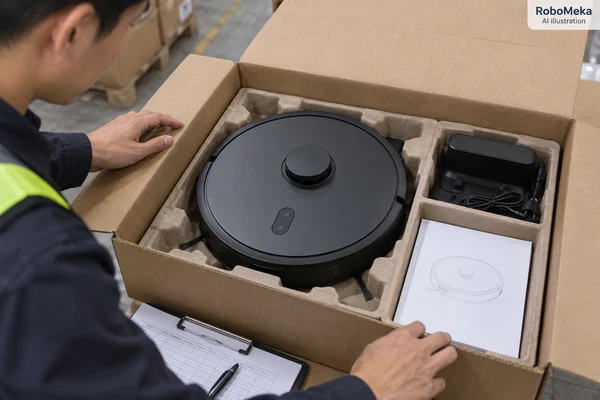
Check the carton as packed, not just an artwork PDF. Seams, curves, reflective surfaces and shipping labels may obstruct scanning. Warehouse staff should be able to locate the relevant identifier without confusing it with a carrier label or an accessory code. Human-readable text provides a useful fallback when a reader cannot scan the symbol.
Agree label materials and durability evaluation with qualified suppliers for the expected environment. A pool robot, garden mower and indoor vacuum do not face identical exposure. Do not choose an arbitrary abrasion or chemical test simply because it is easy to film. The method should match the label's material, location and intended use.
For a private-label project, send your identification and record requirements, including the systems your receiving and service teams use. This makes the scope of labels, data exports and verification part of the quotation rather than an undocumented request after production.
Test the scan-to-record path before volume production
Use a proposed trial that follows a small set of representative, safely handled samples through the actual process. Scan a unit, pack it, record the carton relationship and retrieve it from the receiving side. Verify the displayed configuration against the physical sample. A successful scan that opens the wrong record is still a failure.
Include ordinary exceptions. Try a duplicated identifier, an unreadable label, a cancelled packing record and a unit moved into a replacement carton. The system should make the exception visible and give an authorized person a controlled correction route. It should not allow the operator to resolve every problem by entering a new number without explanation.
Validate exports as well as the supplier screen
Ask for the file or interface your team will actually receive. Check whether leading zeros survive import, date fields remain unambiguous and identifiers are treated consistently as text. A spreadsheet that reformats an identifier into a number can break matching even when the supplier's original database is correct.
Record the export version and field definitions alongside the sample order. If the supplier later changes a column name or format, your warehouse should receive a controlled notice. Data changes can interrupt operations even when the appliance itself has not changed, so include them in the approved change-control process.
Keep shipment inspection and traceability checks connected
Shipment inspection should verify selected identity relationships, not merely count the presence of labels. An inspector might compare the appliance identifier, carton record and approved bundle reference, then record discrepancies according to the agreed inspection plan. State which database or export is authoritative so a missing link is investigated against the right baseline.
Do not interpret a passed sampling check as proof that every serial relationship is correct. The buyer needs both process controls and appropriately scoped inspection evidence. If a mismatch is found, decide how to establish the affected population before accepting a supplier's statement that it was an isolated packing error.
Where factory testing results are linked to unit identities, ask which results are stored and what they mean. A recorded functional check does not establish that the same unit underwent every laboratory assessment used for the model. Keep routine production checks, development evaluations and specialist reports clearly distinguished.
Handle split orders and repacking deliberately
Suppose a hypothetical purchase order is delivered in two shipments. The first shipment contains the initial approved revision; the second includes an authorized accessory change. A purchase-order number alone cannot tell the warehouse which goods require which replacement part. The shipment and configuration links must remain available at the unit or lot level that the project agreed.
Repacking deserves its own event record. If a damaged retail carton is replaced, preserve the product identity and record the new carton association. Do not erase the receiving discrepancy or transfer the label from an unrelated appliance. The operation should leave a reviewable explanation of what changed and what remained the same.
For mixed orders, reconcile quantities by configuration before treating the shipment as complete. An equal total count can conceal an excess of one bundle and a shortage of another. This is especially relevant when the same appliance body is sold with different docks, batteries or regional charger versions.
Use the information during customer support
Support instructions should explain where the customer can find the necessary identity and what information not to share publicly. A clear location photograph can reduce back-and-forth. If the identifier is missing, offer an investigation route using other permitted evidence rather than immediately concluding that the unit is unsupported or counterfeit.
A service record should distinguish the customer-reported symptom from the technical finding. Link photographs, configuration checks and any authorized intervention to the same case. The return-triage guide explains why an unresolved symptom should remain unresolved instead of being converted into a convenient fault category.
When a replacement is supplied, record the outgoing and incoming unit identities separately. Do not make the new machine inherit the old machine's test or repair history. If an accessory is retained by the customer, check compatibility against the replacement configuration before considering the service exchange complete.
Set access, retention and correction rules
Not every person needs the complete record. A warehouse operator may need carton contents and release status; a technical reviewer may need configuration history. Separate those practical access needs from customer contact details. The traceability design should avoid exposing personal information through publicly accessible scans or shared spreadsheets.
Agree retention with the people responsible for your commercial, service and applicable compliance obligations. There is no universal retention period that this guide can assign to every product and destination. State who maintains the data if the supplier changes systems or the commercial relationship ends, and test whether exports remain usable independently.
Corrections should preserve who changed a record, when and why. The objective is not to make honest errors impossible; it is to make them recoverable without concealing history. A deletion-only approach can create more uncertainty than the original typing mistake, particularly after goods have already moved through several warehouses.
Review a traceability exercise before repeating the order
Select a hypothetical service question and work backward from an actual retained sample to the relevant shipment and configuration records. Then work forward from a selected lot to the goods your system says were delivered. Document unanswered questions, missing relationships and manual steps that depend on one person's memory.
Measure the exercise with practical observations such as whether the correct record was found and whether another trained colleague could reproduce the result. Avoid promising a recall capability or a response time based on a single demonstration. The goal is a clear improvement list and an agreed release decision for the next order.
Frequently asked questions
Is a barcode the same as a serial number?
No. A barcode is a machine-readable way to carry data; a serial number is an identifier with a defined purpose and uniqueness boundary. A symbol might carry a product code, logistics reference or other information. Confirm what each label contains and which record it retrieves instead of judging its function by its appearance.
Does every cleaning appliance need individual serial tracking?
The appropriate level depends on the product, service model, trading-partner needs and applicable obligations. Individual tracking can support unit-specific service, while lot records answer different questions. Define the decisions you must make and have qualified reviewers confirm the required scope. Do not assume that either universal serialization or batch-only tracking fits every project.
Can a small importer use spreadsheets?
A controlled spreadsheet may support a limited workflow if identifiers, ownership, revisions and access are managed carefully. Test imports, duplicates, corrections and retrieval before relying on it. As shipments, users and repacking events increase, evaluate whether the process remains dependable rather than assuming that a familiar file format will scale indefinitely.
What should happen when a customer cannot find the label?
Provide safe identification guidance and collect other relevant evidence through an appropriate support channel. The model name, order information and permitted photographs may help narrow the configuration, but they may not establish the individual unit. Record the uncertainty and avoid authorizing incompatible replacement parts merely to close the ticket quickly.
Can a serial label prove that a product is genuine?
A printed label alone does not establish authenticity. Buyers need an appropriate verification process, controlled records and investigation of inconsistencies. This guide concerns operational identification, not a guarantee against copied labels or fraudulent goods. Keep any authenticity claim proportionate to the actual verification mechanism and its limitations.
Conclusion
Traceability becomes useful when a physical appliance, its configuration and its movements can be connected without guesswork. Define the identifiers, test the records through ordinary exceptions and preserve later service events. Then verify the workflow again when products, packing arrangements or business systems change.
To discuss the required scope for a RoboMeka project, send your product-family, warehouse and service requirements. Include the records your team needs to retrieve and the identification standards your trading partners require, so the proposed implementation can be reviewed before an order is released.