
The short answer
Buy smart vacuum features as defined customer interactions. Identify the sensing input, control response, display meaning and maintenance action, then approve them on an identified configuration. Keep essential local operation explicit, assess connectivity only for a defined purpose, and link accepted behavior to firmware, manuals, production checks and change approval.
Introduction
Smart features in a manually operated vacuum should help customers choose power, understand machine status, or complete maintenance correctly. A colorful display or an automatic mode is valuable only when its behavior is clear and its benefits survive ordinary product application. For sourcing teams, the useful question is which customer decision each feature improves and what evidence supports that improvement.
Begin with the proposed appliance and its users. A compact handheld vacuum for quick crumbs may need a clear charge indicator and simple controls. A cordless stick vacuum used across rugs and hard floors may justify adaptive power and more detailed maintenance guidance. These are different purchasing requirements, even when both suppliers describe their products as intelligent.
This guide provides a procurement framework for sensors, displays, alerts, and local controls on regular vacuum cleaners. Connected functions are considered only when they serve a defined need. The suggested evaluation scenarios are recommendations, not reported RoboMeka test results. Feature availability must be confirmed for the exact quoted model before it enters a specification, purchase order, or product listing.
Define the customer decision behind each feature
Write a plain-language purpose for every requested function. Automatic power should reduce unnecessary mode changes or respond usefully to cleaning conditions. A battery display should help users judge whether to continue cleaning or recharge. A maintenance alert should identify a sensible action instead of adding another unexplained symbol. This exercise exposes decorative features that have no agreed acceptance criterion.
Connect that purpose to the intended selling channel. A retailer offering in-store demonstrations may need controls that explain themselves immediately. An online brand may need display messages that customers can interpret without contacting support. A distributor serving multiple languages may prefer clear icons with localized instructions rather than a long menu that must be translated and maintained.
Use the cordless stick vacuum product range to frame the appliance category, then request a configuration-specific feature description. Confirm whether the advertised behavior requires a particular powered head, battery, sensor board, or firmware revision. A sample fitted with a premium head cannot establish that the same automatic function works with a less expensive accessory bundle.
Avoid making the screen the starting point. First identify the information users need, then decide how to communicate it. A well-placed indicator may answer a simple charging question more clearly than a screen with several animations. The purchasing objective is a reliable interaction that fits the product role and can be explained consistently by sales and service teams.
Separate sensing from automatic response
An automatic mode contains at least two purchasing questions: what the machine detects and what it does with that signal. A supplier may describe dirt sensing, floor sensing, or load sensing using similar marketing language. Ask which input is actually measured, where the sensor sits, and which operating outputs change. These distinctions affect demonstration design and customer claims.
For a documented industry example, Dyson describes a piezo sensor and reactive suction response in Auto mode on its V15 Detect. That source establishes how one named product is described; it does not establish identical behavior on other machines. Use it to ask precise questions about a proposed design, not as evidence for another supplier's model. See Dyson's V15 Detect technology explanation.
Ask the supplier to explain normal transitions as well as maximum response. Does power rise only briefly, remain elevated after a dirty area, or change again when the user returns to a clean surface? Can the customer select a stable manual mode? The practical concern is whether the reaction feels helpful and predictable across the intended cleaning task.
A sensor can also become dirty, disconnected, or unavailable when accessories change. Request the intended fallback behavior and how the user recognizes it. A controlled manual setting may be an appropriate fallback if the design supports it. Buyers should not accept a silent change that leaves the display suggesting automatic control remains active when it does not.
Evaluate adaptive power with repeatable application scenarios
Specify representative conditions before watching a demonstration. Include the intended floor types, debris categories, approved accessories, battery state, and maintenance condition. Use the same setup when comparing modes or sample revisions. Otherwise, a change in debris placement or attachment may create an apparent improvement that has little to do with the control feature being purchased.
Begin with a normal cleaning pass and observe the transition between conditions. Record the selected mode, displayed information, response, and user action required. Follow with an approved scenario that returns the machine to a less demanding condition. The test should reveal both how power increases and how it settles, because repeated unnecessary high-power operation can affect the overall user experience.
Where a purchasing claim involves measured performance, use an appropriate method agreed with the test provider. IEC 62885-2:2026 addresses household dry-vacuum performance for mains and cordless models; handheld coverage is limited, and cleaning robots use a separate standard. Confirm applicability to the proposed appliance. A supplier's reference to that document does not itself establish a test result, and an informal demonstration should not be presented as a standardized comparison.
Assess pickup, handling, sound changes, and battery implications together. Automatic operation that increases suction may also change how easily a head moves across a rug. The existing vacuum suction and air-watts explanation provides context for discussing performance terminology. Keep the smart-feature review focused on control behavior rather than treating the highest displayed setting as proof of better cleaning.
Purchase useful display information
Start by distinguishing measurements, estimates, and status messages. Battery percentage, estimated remaining minutes, operating mode, and a filter reminder are different types of information. Ask the supplier to state what each display element means and the conditions under which it changes. Product copy should preserve those distinctions, especially when an estimate is presented as a precise-looking number.
For remaining runtime, observe what happens after a mode change or attachment change. The estimate may need to update as operating demand changes. Agree how the user should interpret it and avoid promising exact remaining minutes under every condition. The cordless vacuum runtime testing guide explains why runtime evidence needs an identified configuration and operating method.
Readability deserves a physical review. Ask evaluators to inspect the display while holding the vacuum normally, standing at a cleaning angle, and placing it on its intended storage support. Check ordinary indoor lighting and reflections without assuming a screen that looks clear in a studio will work equally well during use. Review text size, contrast, and the meaning of abbreviated messages.
Also examine control sequence. Can a user switch modes without looking away from the floor for an extended period? Does the machine restore the previous setting or start from a defined default? Do long presses and short presses have predictable effects? Record the intended behavior in the approval document so software updates do not quietly alter the customer interaction.
Turn alerts into clear maintenance actions
A useful alert connects a detected condition with an action the customer can safely perform. Ask whether a filter notice is based on elapsed use, estimated restriction, or another input. Review how the notice clears and whether it can return if the underlying condition remains. A recurring reminder and a fault diagnosis should not be marketed as the same capability.
For blockage and brush alerts, request the supplier's approved evaluation method. Do not improvise hazardous obstruction tests, bypass protective functions, or require customers to open electrical assemblies. The buyer's role is to verify that documented messages and recovery steps match the intended design and that testing is conducted by people equipped to perform it appropriately.
Trace each message into the manual and support material. If the machine displays an icon, the same icon should appear beside the relevant instruction. Distinguish user maintenance from a condition requiring service. Vague advice to restart repeatedly can frustrate customers and obscure a problem that should have a defined escalation route.
For a project-specific feature review, send your vacuum control and maintenance requirements with the intended users, product category, display preferences, and unresolved alert questions. A practical inquiry brief gives the supplier enough context to identify available configurations and supporting evidence. It also prevents a discussion about attractive screen graphics from replacing the more important discussion about behavior.
Use a feature acceptance worksheet
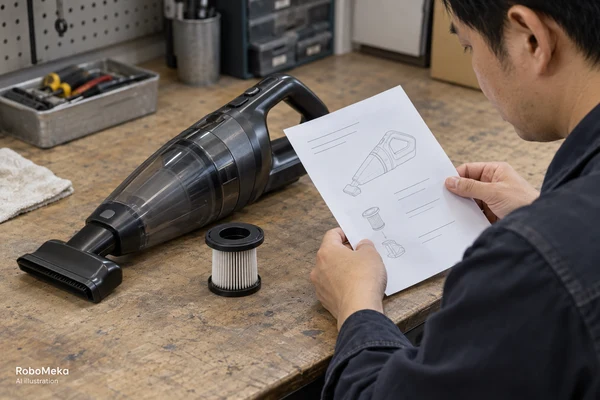
The following worksheet is a recommended purchasing tool, not a statement of available functions. Each row should name the proposed model and revision in the working document. The final column should hold an agreed decision and the evidence reference, rather than a salesperson's check mark indicating that a broad feature exists.
| Feature | Buyer question | Suggested acceptance evidence |
|---|---|---|
| Automatic power | What signal changes motor behavior? | Identified sensor, mode description, repeatable scenario record |
| Remaining runtime | Is the number an estimate, and when does it update? | Mode-change observation and matching user explanation |
| Maintenance alert | What action should the customer take? | Approved trigger review, clear message, recovery instruction |
| Accessory detection | Which tools support the advertised behavior? | Configuration matrix and tool-change observation |
| Local controls | Can essential cleaning proceed without connectivity? | Normal startup, mode selection, and recovery demonstration |
| Firmware revision | Which version was approved for production? | Revision record and controlled change process |
Add an unresolved status where the evidence is incomplete. For example, a supplier may demonstrate an alert but not explain its trigger. That is a request for clarification, not an automatic rejection or approval. Keeping uncertainty visible makes the next sample review more efficient and prevents unsupported claims from entering packaging while technical questions remain open.
The worksheet should also capture who owns each follow-up. Product management may approve the intended user experience, engineering may assess control behavior, and customer service may review the wording. One person should consolidate the decision so conflicting comments do not produce several different definitions of the supposedly approved feature.
Decide whether connectivity has a purchasing purpose
A manually operated vacuum does not need an app simply because a competing product has one. Assess whether connectivity contributes something customers actually need, such as a defined service workflow or an optional setting that is difficult to manage locally. Include the effort of onboarding, maintaining instructions, and supporting users who never connect the appliance.
If a connected option is proposed, first define the behavior available without it. Starting ordinary cleaning, selecting a basic mode, reading important status, and performing normal maintenance should have explicit requirements. Ask what happens when a phone is unavailable, an account cannot be accessed, or the connection fails. Approve the actual fallback experience on the sample.
Connected scope also needs named ownership for updates and support. Keep those questions proportional to the proposed function; a basic service feature should not expand accidentally into an entire branded software program. Detailed app procurement belongs in the separate private-label robot vacuum app guide, which addresses a different product and commercial relationship.
For a regular vacuum range, an offline feature set can be a deliberate product choice. Explain its benefits in concrete terms: understandable controls, visible maintenance information, and fewer setup steps. Avoid describing absence of connectivity as either automatically inferior or inherently superior. The right choice depends on the customer task and the support model the buyer can sustain.
Keep approved behavior consistent through production
Record the sample's hardware identity, accessory configuration, and firmware revision together. Save the approved display wording and the relevant manual pages. A production unit that uses a different sensor or control board may need renewed review even if the outside shell looks identical. The decision should follow the effect of the change, not its visibility to a casual observer.
Ask how routine factory testing checks the agreed functions. A production check might confirm control inputs, display segments, or a defined sensor response, depending on the design. Request the actual method and decision criteria rather than assuming every application scenario is repeated on every unit. Engineering validation and routine production checks serve related but different purposes.
Connect shipment inspection to configuration identity and observable behavior. Inspectors need the correct reference unit, applicable messages, and an approved method suitable for that stage. If a firmware change is proposed shortly before dispatch, require a clear explanation of its purpose, affected functions, evidence, and approval status. Calendar pressure should not turn an unexplained revision into the accepted baseline.
Discuss these handoffs through the RoboMeka manufacturing overview and request project-specific records. Keep marketing claims separate from factory capability descriptions. A general production discussion is useful context, but evidence for a particular smart function must refer to the actual appliance and the revision intended for the order.
Frequently asked questions
Does a vacuum need an app to qualify as smart?
No. Sensor-driven power adjustment, clear battery information, and useful maintenance alerts can operate locally. Buyers should define the customer problem before requiring connectivity. If an app is included, verify its purpose, ongoing support responsibilities, and the cleaning functions available when a phone or connection is unavailable.
Can a dirt counter prove that a floor is completely clean?
A displayed dirt count should be interpreted according to the supplier's documented sensing method and limitations. It does not automatically establish complete floor cleanliness, allergen removal, or a health outcome. Review the actual measurement claim and avoid extending a sensor reading beyond the evidence provided for the exact product.
What should buyers request when automatic mode behaves unpredictably?
Request the intended sensor input, accessory requirements, firmware identity, transition logic description, and approved evaluation conditions. Repeat the observation with the supplier using a consistent setup. Record whether the issue comes from expected behavior, an unclear user message, a configuration mismatch, or a problem requiring correction before approval.
Should a display change require another sample approval?
A change affecting messages, mode selection, estimates, or recovery instructions should receive a proportionate review. A purely visual change may need artwork approval, while functional changes can require additional application checks. Keep the approved firmware, display content, manual, and production configuration linked so the delivered experience remains identifiable.
Conclusion
Buy smart vacuum features as defined interactions. Identify the customer need, the actual sensor or information source, the resulting behavior, and the evidence needed to approve it. Evaluate transitions and recovery as carefully as the headline demonstration. A feature is easier to sell and support when the machine, manual, and service explanation all describe the same experience.
For your next sourcing discussion, prepare a smart vacuum requirements brief covering the product role, intended floor conditions, preferred local controls, display information, and maintenance expectations. Include any proposed connected function as a separate item with its purpose. RoboMeka can then discuss the relevant configuration and evidence needed for a project-specific review.