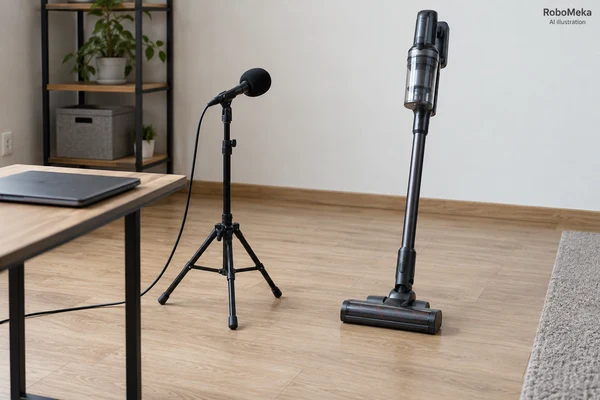
The short answer
Compare vacuum acoustic claims only after matching the measured quantity, method, mode and attachment. Review comfort separately through the complete cleaning task, including weight distribution, grip, controls and floor movement. Record user preferences and limitations honestly; a low unexplained decibel figure or small trial does not establish universal quietness, comfort or health benefits.
Introduction
Vacuum cleaner noise and comfort should be assessed together because customers experience the complete cleaning task. An operating mode that produces a lower sound reading may require more passes, while a light appliance can still feel tiring when its weight is concentrated near the hand. Buyers need measurement conditions and practical handling observations before approving a quiet or comfortable product proposition.
The useful question is not simply which vacuum has the lowest advertised decibel figure. Ask what was measured, which configuration produced the result and whether that configuration completes the intended task. Then evaluate grip, controls, movement and tool changes with people representative of the intended users. These are complementary evidence streams, not interchangeable scores.
This guide provides a sourcing framework for importers evaluating noise and comfort in household vacuum cleaners. Proposed checks and hypothetical examples are identified as such. It does not report completed RoboMeka acoustic measurements, establish a universal exposure limit or claim that an appliance prevents fatigue or injury. Public claims should follow the evidence for the offered model.
What does a vacuum noise figure actually describe?
A number followed by dB is incomplete without the measured quantity and conditions. Sound pressure describes sound at a measurement location, where position and surroundings matter. Sound power characterizes sound energy emitted by the source under defined operating conditions. They are different quantities, so a buyer should not rank unlike figures merely because both are expressed in decibels.
Ask whether weighting is stated and obtain the full reported designation rather than rewriting it as generic noise. Request the measurement method, report reference, appliance identifier and configuration. Include the operating mode, fitted floor head and relevant test surface. If a specification omits these details, treat the number as unresolved information rather than evidence of an advantage.
Standards provide a basis for defined measurement. IEC 60704-2-1:2026 addresses airborne acoustical noise for dry vacuum cleaners within its stated scope. Its existence does not certify any supplier's product. Ask the laboratory which current method applies to the proposed appliance and claim, including any related requirements that must be used with it.
Why should the buyer retain the actual report?
A cropped result can conceal the tested model or operating condition. Connect the report to the offered configuration and retain its qualifications. A genuine report can still be irrelevant to a different head or setting. Keep original evidence accessible to the people preparing specifications and retail artwork.
The IEC 60704-1 general requirements listing describes the broader household-appliance acoustic test framework. It supports asking for a defined procedure, not improvising one from a product brochure. Confirm the applicable edition and scope with the testing provider rather than claiming compliance from a casual room measurement.
Which conditions can make two figures unsuitable for comparison?
Operating mode is a first check. A minimum-power result should not be compared with another product's maximum-power result as if both represented normal use. Ask which mode the customer is expected to use for each essential floor task and whether the published acoustic evidence covers it. Automatic modes require a clear description of how operating behavior was established.
The attachment and surface also matter to the complete sound. A powered floor head introduces moving components and floor interaction that a handheld body-only setup does not represent. A motorized upholstery tool can create a different use experience from a passive crevice tool. Keep the exact attachment in the evidence record and avoid extending one configuration's claim across every bundle.
Sample condition needs attention as well. Record filter preparation, bin condition, assembly status and any other factors specified by the chosen method. A loose component or obstruction may require investigation rather than inclusion in a normal product comparison. Follow the approved instructions and avoid altering the air path to produce a more favorable reading.
What role does the room play in an informal comparison?
A room demonstration reflects its surroundings as well as the appliance. Distance, reflective surfaces, background sound and recording equipment can change what a listener hears or a device reports. Keep an informal listening setup consistent, but do not present it as a substitute for a suitable acoustic test. Label observations according to what was actually done.
Recordings can help discuss an unusual tone or intermittent rattle with the supplier. Different microphones or playback levels make them weak evidence for a universal quietness claim. If demonstrations appear publicly, explain their limitations and preserve the recording conditions.
How should quietness be connected to cleaning effort?
A low-noise setting matters commercially only in the context of the task it can support. Ask whether the intended floor and debris can be handled in that setting using the approved tool. If the customer routinely switches to a stronger mode, a claim based only on the quietest setting may poorly describe the ordinary ownership experience.
Compare task completion and sound separately before discussing the tradeoff. An appliance may produce a less intrusive sound during each pass but require more passes in the proposed scenario. Another may complete that scenario quickly while producing a sound some users dislike. There is no universal ranking without a defined customer priority and adequate evidence for the comparison.
Avoid converting a short listening preference into a health statement. Pleasantness, perceived loudness and measured acoustic quantities answer different questions. The buyer can ask participants how acceptable a sound is for their intended routine without asserting that a preferred product is medically safer or suitable for every person and environment.
What should a noise and comfort review matrix include?
Set essential requirements before samples arrive, then review each condition explicitly. The following matrix is an editorial purchasing framework. It is not an acoustic standard, ergonomic certification scheme or clinical assessment. Its purpose is to identify what needs formal measurement and what can be explored through a structured product application review.
| Review area | Information to obtain | Proposed observation | Evidence boundary |
|---|---|---|---|
| Acoustic claim | Quantity, method and configuration | Compare matched reported conditions | Unlike quantities are not rankings |
| Operating mode | Mode used for the intended task | Note switches during cleaning | Quietest mode may not be typical |
| Sound character | Relevant recordings or analysis | Record tonal or rattling concerns | Preference is not a health result |
| Grip and controls | Handle and control arrangement | Observe reach and repeated use | One evaluator is not every customer |
| Floor movement | Approved head and surfaces | Observe push, pull and turning | Mass alone does not describe effort |
| Carry and storage | Approved handling instructions | Review complete daily route | Do not invent lifting limits |
Keep acoustic evidence and handling observations visible as separate conclusions. Both influence purchasing, but combining them into an unexplained comfort index hides uncertainty. State which evidence supports the proposed wording and which observations inform the internal selection.
Send a vacuum noise and handling brief with your intended floor tasks, preferred operating mode and customer profile. Ask for matched acoustic evidence and the exact sample configuration so the discussion can connect the sound claim with how the product will actually be used.
Why is total weight an incomplete comfort specification?
Total mass tells buyers something useful, but its distribution changes how an appliance feels in different tasks. A stick vacuum places some components near the user's hand and some near the floor. When converted for handheld cleaning, the support arrangement changes. Record the mass of the relevant configuration instead of quoting one figure for every setup.
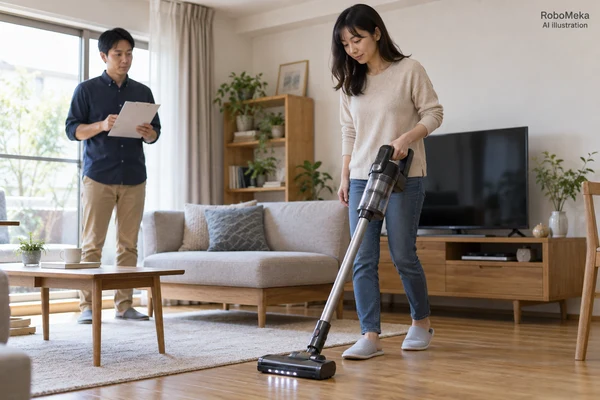
Ask participants to perform a representative route that includes the important transitions. Floor cleaning, reaching a permitted low area, briefly carrying the appliance and cleaning a seat can reveal different handling concerns. Do not select a demonstration solely because it makes the machine easy to hold. Keep trials within the instructions and participants' comfortable capabilities.
The HSE pushing and pulling guidance considers task context and posture when assessing manual effort in workplaces. It is not a household-vacuum comfort rating. Its relevant lesson for this purchasing review is that movement, environment and user involvement deserve attention alongside a simple weight specification.
How should push and pull effort be discussed?
Observe whether the user can start, reverse and turn the head smoothly on the intended surfaces. Record changes when moving between approved flooring and when the operating mode changes. If force measurements are required, agree a suitable method and equipment. Do not describe an evaluator's impression as a measured force or import a universal acceptance threshold without justification.
Separate the floor head's behavior from hand comfort. A head can move easily while the grip or control layout remains awkward. Conversely, a comfortable handle cannot compensate for excessive effort on the intended carpet. Ask evaluators to identify the specific part of the task that feels difficult so the supplier receives actionable feedback.
Which controls can create unnecessary fatigue or confusion?
Review the power control, mode selection, release buttons and any trigger used during normal cleaning. If continuous pressure is required, observe the actual task duration and hand position. If an on-off control is provided, check accidental activation and whether the user can confirm the current state. Neither arrangement is automatically preferable for every customer.
Look at control reach while the appliance is assembled for floor use and for handheld use. A button that is convenient in one configuration may be awkward in the other. Record whether users change grip, involve a second hand or stop cleaning to make an ordinary adjustment. Those observations can guide the product choice or improve instructions.
Feedback should be understandable and match the manual. A user who repeatedly chooses an unsuitable mode may report poor suction or noise when the problem is control comprehension. Record the misunderstanding before assuming the motor or head needs redesign.
How can buyers organize a useful user trial?
Use a small, varied group appropriate to the intended audience and record its limitations. Include different heights and hand sizes where feasible, without claiming demographic representativeness from a few participants. Ask about relevant cleaning familiarity and allow participants to stop if a task is uncomfortable. This is product feedback, not a challenge to endure discomfort.
Give consistent instructions, surfaces and tasks across candidates. Allow a reasonable familiarization period and record it. Vary the product order where practical so the first or last sample does not always receive the same advantage. Ask for individual feedback before a group discussion, because one confident participant can influence how others describe their experience.
Use concrete questions about the task: where did the grip feel awkward, when was a mode change needed, and which sound was distracting? Preserve the participant's meaning without turning it into a universal claim. A preference observed among a few evaluators can support internal selection while remaining insufficient for a broad public statement about all users.
What should be retained after the trial?
Keep configuration identifiers, task descriptions, participant context and the actual observations. Separate requested design changes from conclusions supported by the review. If several users report a recurring rattle, investigate the assembly and obtain appropriate technical assessment. If preferences differ, preserve the variation instead of selecting only comments that favor the desired proposal.
Connect this record to the vacuum sample evaluation process. When a revised grip, head or firmware changes operating behavior, review the affected tasks again. A previous preference result should not silently transfer to a materially different configuration just because the retail model name stays the same.
How would a hypothetical buyer resolve conflicting results?
Imagine a distributor evaluating two cordless stick vacuum proposals for compact homes. Proposal A has acoustic evidence for its quietest mode, while Proposal B has evidence for a normal mode with its powered head. The distributor initially places both figures in one comparison sheet, but the conditions do not support that ranking.
The buyer requests matched information and runs a separate proposed handling trial. In a hypothetical outcome, some participants prefer A's grip during handheld work, while others find B easier to turn on the intended rug. These observations identify segment-specific tradeoffs. They do not establish one model as universally comfortable or quieter under conditions that were never compared.
The purchasing team can then prioritize its actual proposition, such as frequent handheld cleaning or mixed-floor movement. It retains open acoustic questions until relevant evidence arrives and avoids printing a superiority claim prematurely. The decision becomes a documented choice for a target routine rather than an attempt to make every specification favor the same product.
Which production changes can affect the approved experience?
Noise and handling can depend on components beyond the main motor. Changes to a head drive, housing fit, wheels, airflow components, grip material or control behavior may be relevant. Request disclosure of changes affecting the approved configuration and ask what evidence needs review. Do not assume that an unchanged motor model preserves the complete acoustic result.
Factory testing and shipment inspection need clearly assigned purposes. A defined production check can help identify abnormal operation within its scope, while sampled shipment review can confirm parts, assembly and obvious handling issues. Neither automatically replaces the acoustic method used to substantiate a public number. Keep acceptance rules appropriate to the check being performed.
Use the pre-shipment inspection guide to retain reference configurations and instructions. Include relevant abnormal-sound observations only through an agreed procedure, with escalation when needed. A subjective listening check should not be described as verification of an exact decibel declaration unless the actual method supports that conclusion.
How should retail wording describe comfort responsibly?
State what the product offers and qualify any measured claim with its applicable configuration and conditions. Avoid the word silent for a device that generates operating sound. If using lightweight language, provide an accurate configuration-specific mass and avoid suggesting that weight alone establishes effortless cleaning. More ambitious comparative claims require appropriate comparative evidence.
Application images should show plausible posture and the approved tool. Label AI-generated evaluation scenes as illustrations; they are not photographs of actual user trials. Do not include invented instrument readings, testimonials or measurements.
Frequently asked questions
Can buyers compare any two vacuum decibel ratings directly?
Only after confirming that the reported quantities, methods and operating conditions are comparable. Sound pressure and sound power are different, and mode, attachment or test surface can change the result. Request the full evidence record before ranking products. A lower unexplained number is not enough to establish a quieter retail configuration.
Is the lightest vacuum always the most comfortable?
No. Weight distribution, grip shape, control reach and floor-head movement influence the complete task. Compare the relevant assembled and handheld configurations using representative users and approved surfaces. Record specific difficulties rather than relying only on total mass. A short trial can inform selection but does not prove universal comfort or health benefits.
Can a phone recording verify an advertised noise claim?
A recording can help describe an unusual sound or support an informal discussion. It does not automatically provide the calibrated method, controlled conditions or reported quantity needed to verify a public acoustic claim. Use suitable testing for numerical declarations and preserve recording conditions when clips are used for internal product comparisons.
Should noise and comfort be reviewed after a head change?
Yes, assess whether the change affects existing evidence. A revised head can alter floor movement, sound character and the operating conditions behind an acoustic claim. Review the relevant documentation and repeat affected evaluations as appropriate. Keep the new component identity linked to approval records instead of assuming the previous bundle's conclusions remain valid.
Conclusion
Source vacuum noise and comfort through matched acoustic evidence and a separate review of the complete cleaning routine. Record the measured quantity, mode and attachment, then examine grip, movement, controls and transitions with suitable users. Preserve tradeoffs and uncertainty so the chosen product proposition reflects the evidence available for the intended customer.
Prepare a noise and comfort sourcing inquiry with RoboMeka, including the main floor tasks, preferred bundle and proposed retail claims. A clear brief supports configuration-specific documentation and a practical sample review before purchasing or packaging commits the brand to an unsupported promise.