The short answer
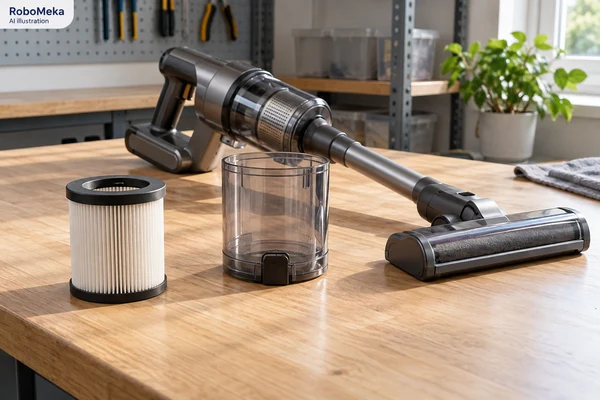
Approve cyclonic vacuums from a controlled loading curve that connects airflow-related behavior, useful pickup, warnings and deposit locations from clean condition to the declared emptying point. Cyclone count and an empty-bin number cannot establish customer performance after dust, hair and lint accumulate.
Introduction
A buyer comparing cyclonic vacuums should ask what happens after the machine has collected real dust, not only what airflow or suction it produces with an empty bin. The useful question is whether pickup, airflow, motor response and dust containment remain acceptable from a clean start to the declared emptying point. That requires a loading curve, not one impressive number.
Cyclonic separation can reduce the amount of material reaching a downstream filter, but it does not make the bin, shroud, airways or filters immune to loading. Dust composition, particle size, hair, lint, bin geometry and the location of the fill line can all change the result. A buyer therefore cannot infer loaded performance from the word “cyclonic,” the number of cyclones or a transparent-bin demonstration.
This guide proposes a buyer evaluation for household dry vacuums. It does not report completed RoboMeka tests or promise a particular configuration. For a separate explanation of pressure, airflow and air watts at a defined condition, read the vacuum suction measurement guide. The focus here is how the complete appliance behaves as dust accumulates.
Judge the loaded system, not the cyclone label
The direct purchasing answer is to compare at least three states: clean, meaningfully loaded and at the manufacturer-defined emptying point. At each state, use the same machine configuration, nozzle, power mode, surface, test material and operating procedure. Record airflow-related behavior and useful pickup together. A machine that preserves an air-data value but stops transferring debris from the floor has not preserved the customer outcome.
Cyclonic separation is one stage in a connected pressure path. Air enters through the nozzle, travels through a wand or hose, carries debris into the separation chamber, passes a shroud or screen, crosses one or more filters and exits through the motor and exhaust. Dust or fibre at any restriction can change the operating point. The test record should show where material accumulated rather than assigning every change to the cyclone.
This is distinct from comparing headline Pa or air-watt claims. It is also distinct from a filter-maintenance article. Maintenance instructions matter because they define the starting condition, but the buyer question is whether normal loading creates a predictable, supportable change before the user is expected to empty or service the machine.
Define acceptable behavior before loading begins
An importer should translate customer requirements into observable results. A cordless stick vacuum used for short hard-floor passes may have a different acceptable curve from a corded cylinder vacuum expected to clean several carpeted rooms. The agreed criterion might address pickup after a specified mass, time to complete a defined area, battery response, warning behavior, or the absence of nuisance pulsing before the fill line.
Avoid a vague requirement such as “no loss of suction.” It can be interpreted as a marketing phrase, a motor-control behavior, an airflow measurement or a cleaning claim. State the measured quantity, test point, loading condition and allowable change. If the supplier uses an automatic power response, record both the controlled result and its consequences for noise, input power or runtime.
Use current performance methods as a reference point
The IEC 62885-2:2026 scope covers methods for measuring performance of mains-operated and cordless household dry vacuums, while noting that environmental conditions, test materials and operator proficiency affect results. That is a strong reason to compare samples in the same laboratory under the same method. It is not permission to claim IEC conformity from an informal in-house trial.
The earlier standard history explicitly identified an “ability to maintain air flow performance” method, and the current edition retains air-data requirements within an updated structure. Buyers should obtain the applicable purchased standard, agree which clauses a qualified laboratory will use and state whether a proposed factory test is only an internal screening method. A product page should never cite a standard number merely because the engineering team borrowed part of its setup.
The European Commission also advises owners to empty collectors and replace bags regularly because an overfull receptacle can hurt performance; its vacuum cleaner consumer guidance separately warns that input power does not automatically equal cleaning performance. These points support testing a loaded appliance as a system. They do not define a universal fill mass or acceptable loss for every design.
Map the parts that can load
Begin with a flow-path drawing for the offered configuration. Mark the nozzle throat, tube bends, bin inlet, primary separation chamber, shroud openings, secondary cyclone inlets if present, pre-motor filter, motor inlet and exhaust filter. Add seals and any pressure or blockage sensors. This makes a post-run inspection much more useful than a single photograph of dust in the bin.
Different materials create different restrictions. Fine mineral-like test dust may penetrate further than coarse crumbs. Hair and lint can bridge across a shroud or inlet while adding little mass. A mixed household load can pack against one wall or occupy volume without evenly coating a filter. The amount in grams, the occupied volume and the distribution inside the product all deserve separate observations.
| Loading location | Possible customer symptom | Evidence to capture |
|---|---|---|
| Nozzle or brush chamber | Poor transfer or changing sound | Underside image, brush state and recovered debris |
| Wand, hose or elbow | Sudden restriction or pulsing | Airway inspection linked to the run |
| Bin inlet or shroud | Gradual or abrupt airflow change | Deposit location and bin mass |
| Pre-motor filter | Rising restriction or heat response | Condition, mass if appropriate and pressure data |
| Seal or bin interface | Dust bypass or unstable airflow | Seal seating and controlled leakage inspection |
Do not dismantle a powered appliance or defeat interlocks to observe the flow. Inspection should follow the supplier's safe procedure with the machine isolated. If the design does not permit access without damage, agree a non-destructive inspection method or have trained engineering personnel handle instrumented samples.
Build a repeatable dust-loading sequence
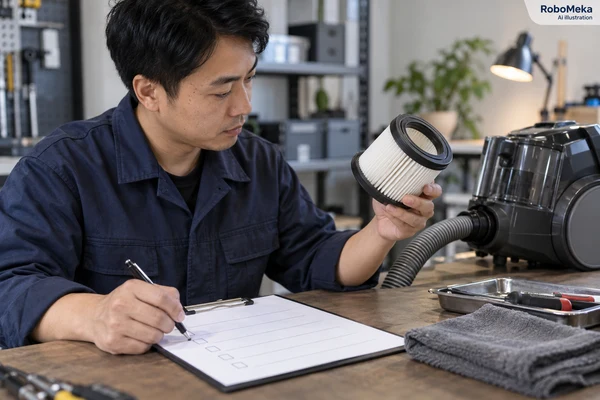
A useful sequence starts with conditioned samples and documented clean filters. Weigh the empty dust receptacle where the method allows, record filter identity and condition, verify correct assembly, and run a consistent baseline. Then introduce agreed increments of an appropriate test material through a controlled pickup task. Pause only at defined checkpoints.
The media must match the question. Standardized dust supports comparison, while a separately controlled mixture of hair, fibre and representative household debris may reveal bridging that fine dust alone misses. Never substitute unidentified sweepings. They vary in moisture, particle size, allergens and sharp objects, and they can expose staff or damage samples. Hazardous construction dust also falls outside a normal household demonstration; the fine construction dust guide explains that category boundary.
Record the mass offered, mass recovered where the method supports it, mass retained in the receptacle, run duration and any material left on the test area. Do not call material “captured by the cyclone” merely because it is no longer visible on the floor. Some may remain in the nozzle or airway, reach a filter or escape during handling. The system inventory is more credible than a close-up of a full bin.
Choose checkpoints that reveal the curve
An empty-versus-full comparison can hide the point at which behavior changes. Proposed checkpoints might include a clean baseline, two intermediate loads and the stated emptying threshold, but their values must come from the specific bin volume, declared capacity and intended application. More checkpoints are useful near any abrupt warning, pulsing or pickup decline.
Keep the stopping rule independent of a favorable result. A fill line, a specified mass, a machine warning or a defined performance boundary can be agreed before the run. If the machine stops earlier, record that result rather than quietly reducing the target. If debris physically reaches a prohibited level before the nominal volume, document the effective limit and ask which instruction controls the user.
To turn this into a model-specific comparison, send your dust profile and loaded-performance requirements to RoboMeka. Include the intended floor types, debris mixture, cleaning duration and the evidence your market needs so a proposed sample plan can be scoped without inventing a universal result.
Measure airflow behavior and pickup together
Air data can help locate a change, but it must be collected at a defined point and configuration. State the adapter, measurement location, power mode, battery state, filter condition, atmospheric conditioning and whether the nozzle or tube was attached. A bare motor or sealed-body result cannot stand in for airflow at the working head.
Useful pickup should use the same surface preparation, debris distribution, pass count and operator or mechanical motion. Report the initial quantity and the quantity remaining or recovered according to the chosen method. A photograph after repeated unscheduled passes is not comparable evidence. The cleaning appliance test-report guide can help buyers check whether two reports actually use compatible methods.
Listen for a changed pitch, pulsing or automatic shutdown, but treat these as observations rather than measurements of suction. Document indicator messages and recovery steps. Electrolux's current reduced-suction support page lists a full container, dirty filters and blockages in the channel, cyclone or floor nozzle as separate possible causes. That manufacturer example supports a multi-location diagnosis; it does not establish the behavior of another brand.
Account for motor control and battery state
Some machines react to restriction by changing motor speed, while others pulse or stop. The buyer should record what the control system does rather than interpreting a stable sound as stable airflow. If power rises to compensate, runtime or thermal behavior may change. If the unit protects itself, the trigger condition and owner recovery instructions become part of product usability.
For cordless models, use a controlled battery state and temperature at each comparison. A partially depleted pack can confound a loading result, especially in a high-power mode. Either use separate conditioned samples at equivalent state of charge or design the sequence so battery decline is measured and accounted for. Never recharge a hot or damaged pack merely to keep a demonstration moving.
Separate dust loading from abnormal blockage
Normal accumulation and a discrete obstruction are different failure modes. A wad of fibre across an inlet, a toy in a tube or a jammed brush can create a sudden loss that is not represented by gradual bin loading. The report should identify the event and preserve it as a separate result. Removing it without noting the intervention makes the curve look better than the customer experience.
Likewise, a bin packed beyond its marked limit is not a fair normal-use checkpoint unless misuse tolerance is the stated question. Test the instructed range first. An optional overfill assessment needs its own safety review, termination criteria and wording; it must not encourage owners to ignore the fill line.
Dyson's Digital Slim instructions provide a model-specific example: its blockage guidance says the motor pulses when it detects a blockage and directs the owner to isolate the machine before checking. Buyers should obtain equivalent documentation for the offered model and verify that alerts, diagrams and translations match the actual hardware.
Interpret the curve without overselling it
A relatively flat curve under one standardized dust does not prove equal behavior with every household mixture. A steep early change does not automatically mean poor cyclone geometry; a shroud bridge, nozzle loading, poorly seated seal or filter condition may be responsible. Use inspection and repeat runs to develop a supported explanation.
Compare replicates, not a single hero sample. Show individual results or at least the range, sample identities and any exclusions. If one unit behaves differently, investigate it before averaging the difference away. A buyer needs to know whether variation comes from assembly, components, conditioning, material delivery or ordinary measurement uncertainty.
Avoid ranking cyclone counts. More small cyclones, one larger cyclone or a multi-stage layout may each involve trade-offs in separation, restriction, packaging, noise and cleanability. The commercially relevant evidence is complete-appliance behavior under agreed loading. Patent-style diagrams and visible vortex demonstrations do not substitute for it.
Turn results into accurate customer language
A defensible statement names the condition. For example, a listing might say that loaded-performance evaluation was completed using a specified internal method and material up to a defined checkpoint, with the report available to the buyer. The exact wording must match real evidence and must not imply independent certification unless an authorized report supports it.
Do not write “never loses suction” from a short pickup video. Do not claim constant airflow if only pickup was observed. Do not claim filter protection merely because most visible debris fell into the bin. A transparent limitation is more useful: results depend on the material, maintenance state, nozzle and operating mode, and owners should follow the marked fill line and service instructions.
Carry the finding into production and shipment control
If sample behavior is accepted, identify the components and settings that produced it. The bill of materials may need to control cyclone mouldings, seals, filters, bin parts, firmware and motor-control parameters. A change to a shroud opening or filter medium can alter the loaded curve even when the external housing looks identical.
Proposed factory testing should be proportionate. A full standardized loading sequence may suit qualification or change validation, while production checks may use documented proxies such as airflow at a defined restriction, seal inspection and functional warning verification. The proxy must be correlated to the approved design; passing a quick empty-bin check does not recreate loaded performance.
Shipment inspection can confirm the correct filters, seals, bin, warning labels and instructions are present and assembled. It cannot prove every packed unit's complete dust-loading curve without destructive time and material. Retain traceable qualification reports and define escalation if a shipment sample misses the agreed empty-condition proxy.
Frequently asked questions
Does a cyclonic vacuum maintain full suction until the bin is full?
Not automatically. The result depends on the complete airflow path, debris, bin level, shroud, filters, nozzle and control system. Ask for a curve at defined loading checkpoints and a clear emptying rule. A cyclone label or an empty-bin measurement cannot prove performance at the marked limit.
Is cyclone count a reliable way to compare vacuums?
No. Cyclone number alone does not describe geometry, flow distribution, pressure loss, downstream filtration or pickup at the nozzle. Compare complete appliances under the same material, surface and loading method. Record maintenance burden and customer instructions alongside measured behavior.
Should a buyer test with household dust collected from homes?
Unidentified household sweepings are poor comparative media and may create exposure or contamination risks. Use controlled, documented test materials selected for the question. If hair or lint behavior matters, add a safe representative challenge with fixed composition and its own results rather than mixing unknown debris into the standard run.
Can a full-bin warning replace loaded-performance testing?
No. A warning can help owners act, but buyers still need to know when it triggers, what it senses, how repeatable it is and what performance exists before that point. Verify the alert under supported conditions and confirm the instructions explain the required response.
How many samples are enough for a sourcing decision?
There is no universal number. Use enough identified units and repeat runs to reveal sample and method variation, then expand evaluation according to order risk. One favorable sample is weak evidence for a production claim. Agree qualification, change-control and shipment checks before approval.
Conclusion
Cyclonic separation should be purchased on evidence of the loaded appliance, not on cyclone count or a clean-bin specification. Define the customer task, control the debris and checkpoints, measure airflow-related behavior with useful pickup, inspect the complete path and convert the result into conditional, traceable claims. Keep abnormal blockages and overfill separate from normal loading.
For a sourcing review, ask RoboMeka to discuss a proposed dust-loading and acceptance plan. Share your target application, candidate models and required customer language so the next step can focus on comparable evidence rather than an unsupported “no loss” promise.