The short answer
Evaluate pet-hair cleaning as a complete routine: surface pickup, brush wrapping, upholstery handling, bin emptying and maintenance. Use documented fibers, surfaces and passes, retain valid variation, and avoid treating a pressure figure or anti-tangle design feature as proof of universal performance.
Introduction
A vacuum intended for pet-owning households should be evaluated for hair pickup, tangling, emptying and maintenance as separate outcomes. A clean-looking patch of carpet after one pass does not show how much hair remains around the brush, whether the bin empties easily or how the upholstery tool handles a different fabric. Buyers need evidence for the complete routine.
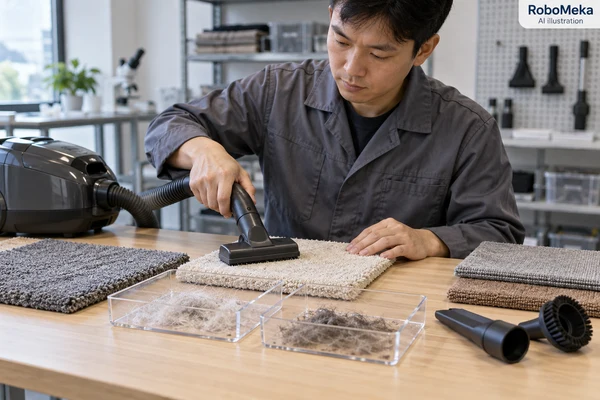
The most useful vacuum cleaner pet hair testing starts with a defined application. Long fibers on a rug, short hair embedded in upholstery and loose hair on hard flooring create different challenges. A distributor should choose the relevant tasks, prepare repeatable materials and assess the proposed retail bundle rather than assuming that an animal-themed product name establishes performance.
This guide provides a proposed purchasing workflow for vacuum cleaner configurations and their attachments. It describes how a buyer could evaluate samples; it does not claim that RoboMeka has completed these trials or that any listed platform achieves a particular result. No test described here requires a live animal.
Which pet-hair tasks should define the product range?
Start by describing the household, not by specifying maximum suction. A compact apartment with hard flooring may prioritize frequent, convenient pickup and easy storage. A carpeted household may place more importance on embedded fibers and brush maintenance. A buyer targeting upholstery cleaning needs to assess tool access, fabric compatibility and the effort of repeated handheld use.
Decide whether the product is intended for daily loose-hair collection, periodic detailed cleaning or both. The distinction changes the trial. Freshly distributed fibers can make a daily-cleaning demonstration plausible, but they do not establish removal from a deliberately worked-in carpet specimen. Explain exactly which condition is represented instead of calling every hair test deep cleaning.
Keep the vacuum's permitted use in view. Pet households can contain liquids, litter, sharp debris and biological contamination that a dry appliance is not designed to collect. Do not broaden a hair-focused trial into unsupported wet or hazardous-material use. Retail instructions should state relevant exclusions clearly rather than relying on customers to infer them from the product category.
How should a buyer choose test fibers?
Use a controlled material specification that suits the purpose and can be obtained consistently. If actual hair is used, appropriate handling and preparation should be agreed by the evaluation team. Synthetic fibers can support repeatability in an internal comparison, but they should not be described as identical to every animal's coat or as a validated standardized substitute without evidence.
Record the material source, length range, quantity and preparation. Different hair lengths and surface interactions can affect behavior, so one convenient sample should not represent all pet households. Keep photographs and retained specimens where practical. The material record matters if a supplier later attempts to reproduce an unexpected tangling or pickup observation.
How do pickup, tangling and retention differ?
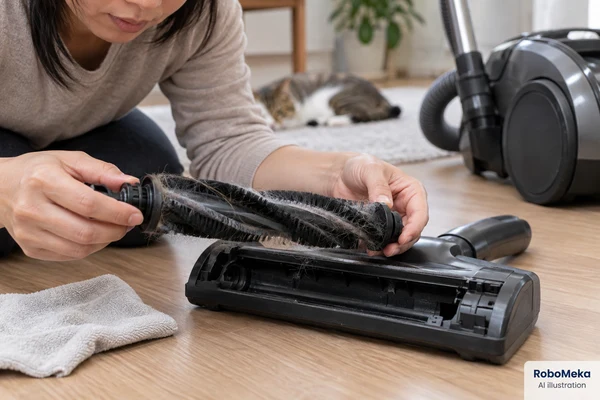
Pickup concerns material removed from the test surface. Tangling concerns fibers wound around the brush or associated parts. Retention concerns material remaining in the head, airway or bin after normal operation and emptying. These are connected but not interchangeable: a head can clear the floor while collecting a substantial wrapped bundle around its axle.
Inspect those locations separately after an agreed amount of work. Do not clean the brush secretly between runs and then claim the full sequence required no maintenance. If the procedure calls for cleaning between runs, state that condition. A maintenance-free interval and a freshly reset single-run comparison answer different questions and should have different result labels.
Use a descriptive anti-tangle claim only when the supporting method and conditions justify it. A design feature intended to reduce wrapping is not evidence that wrapping never occurs. Ask whether the supplier has data for the specific brush version and fiber condition, and avoid transferring a claim from one accessory to the entire appliance bundle.
What belongs in a practical test matrix?
Limit the initial matrix to scenarios that influence the purchasing decision. Too many loosely controlled demonstrations can be less informative than a smaller set of repeatable tasks. Include the intended surfaces and tools, then add a diagnostic scenario when the first results reveal a question that needs investigation.
| Scenario | Main observation | Additional record |
|---|---|---|
| Loose fibers on hard floor | Residual material after defined passes | Scattering and edge residue |
| Fibers on a specified carpet | Surface result under a fixed procedure | Push effort and repeat passes |
| Approved upholstery fabric | Tool pickup and maneuverability | Fabric interaction and user grip |
| Repeated hair collection | Brush wrapping and airway retention | Time before permitted maintenance |
| Normal bin emptying | Material released through the intended opening | Manual assistance and cleanup |
| Brush care | Access and reassembly | Tools, elapsed time and instructions |
For formal performance work, IEC's cordless dry vacuum standard listing provides a relevant scope reference. The matrix above is an editorial purchasing framework, not a reproduction of an IEC method. Ask a qualified laboratory what procedure is suitable when making a standardized or quantitative public claim.
Use the sample evaluation guide to define valid runs and exclusions. Record sample identity, head revision, operating mode and battery preparation. Hair tests should not be an exception to configuration control simply because the result is easy to film and appears visually persuasive.
How should carpet and upholstery be prepared?
What must stay consistent between candidates?
Identify the surface specimen and its relevant characteristics. Use the same preparation, fiber distribution, direction and pass pattern for each candidate. Restore the surface between runs through a documented process. If one specimen changes with repeated use, that may affect the comparison; monitor its condition and avoid presenting an aging surface as an unchanged reference.
If the procedure includes working fibers into the surface, document how that is done. An informal hand-rubbing step can introduce substantial variation if operators apply different pressure or duration. Choose a repeatable method appropriate to the internal trial, or use a specialist procedure when precise performance claims require stronger control.
Use consistent lighting and camera positions for visual inspection. A photograph taken along the carpet pile can look very different from one taken across it. Where weighing or another measurement is used, account for the method's limitations and avoid precision beyond the equipment's capability. Describe a visual score as a visual score.
What should the operator avoid changing during a run?
Do not add unplanned passes until the floor looks satisfactory while reporting only the planned pass count. Record both the prescribed result and any additional work needed to reach the desired condition. Keep deliberate operator pressure and head speed consistent. For upholstery, follow the fabric and appliance instructions rather than forcing a tool onto a surface it is not approved to clean.
Repeat significant scenarios and retain valid variation. If one sample tangles intermittently, report the pattern instead of choosing the cleanest result. The buying team needs to understand uncertainty before approving a pet-focused claim. A narrow result from a few samples can still be useful when its scope is stated honestly.
Prepare a pet-hair product brief with your main floor types, upholstery needs and preferred attachment bundle. A focused brief helps identify which demonstrations and maintenance checks will actually support the range you want to sell.
How can brush maintenance be assessed without hiding the work?
After the prescribed sequence, switch off and isolate the appliance according to its instructions before accessing the brush. Photograph the visible fiber accumulation and record where it occurs. Then follow only the authorized cleaning procedure. Do not remove guards or dismantle non-user-serviceable parts to make an inconvenient design appear easier to maintain.
Time the complete user task: recognizing the need for maintenance, opening the access point, removing fibers, restoring the part and confirming correct reassembly. Also record whether tools are required and whether they are supplied. A short brush-cleaning time means little if the user struggles to find the release mechanism or reinstall the part correctly.
Dyson's vacuum maintenance guidance discusses hair and debris on brush bars and notes that some cannot be washed. This is a useful example of why care instructions must be model-specific. It is not permission to wash another platform's head or use the same maintenance procedure on all accessories.
Check whether brush end caps, bearings and replacement rollers are identifiable service items. A low-cost appliance can create expensive support if the only remedy for a worn small part is replacement of an entire head. Ask for compatibility records and permitted service boundaries so the distributor can stock sensible parts without improvising repairs.
What does bin emptying reveal about daily usability?
Hair often makes the emptying experience different from a demonstration using free-flowing particles. Observe whether the collected material falls out using the intended procedure or remains caught around internal structures. Record any need for manual assistance, repeated opening or cleanup around the disposal container. Do not describe an emptying mechanism as touch-free if the evaluated condition requires contact.
Use a reasonable bin load within the marked limit. Overfilling can create an unrealistic failure, while testing only a tiny quantity may hide practical handling difficulties. State the preparation and inspect relevant seals and closures after emptying. Check that an inexperienced user can identify when the bin is correctly seated before restarting the vacuum.
Separate visible dust release from a formal emissions claim. A video cannot establish microscopic particle containment, and absence of a visible cloud does not prove a sealed filtration system. If the retail positioning includes filtration, consult the HEPA and whole-machine guide and request appropriate evidence for that separate proposition.
How would a hypothetical distributor score two bundles?
Imagine a distributor selecting between two proposed bundles for pet-owning apartment customers. Bundle A includes a general floor head and a small powered upholstery tool. Bundle B includes a different floor head and a non-powered upholstery attachment. Neither is assumed superior; the exercise is designed to identify where accessory choice changes the practical result.
The buyer defines three essential tasks: hard-floor hair pickup, cleaning a permitted fabric seat and normal bin emptying. The team also records brush wrapping after a repeated sequence. Results are hypothetical: A finishes the seat task with fewer passes, while B requires less brush cleaning in the prescribed floor sequence. Both meet the buyer's hard-floor criterion.
The decision depends on the intended proposition. If upholstery is central, A's accessory may justify its bundle cost and maintenance requirements. If daily floor care dominates, B may remain attractive. The buyer should request evidence and repeatability before approving either claim; a weighted score cannot compensate for an untested essential task.
Add an estimated ownership worksheet using the buyer's own assumptions: replacement brush cost, filter availability, accessory replacement and expected support workload. Do not invent field failure rates or universal maintenance frequencies. Mark unknown costs explicitly and ask the supplier for quotations and compatibility commitments rather than filling gaps with optimistic guesses.
What should private-label artwork and instructions say?
Describe the demonstrated application precisely. A phrase such as designed for routine hair pickup is still a product claim and needs a suitable basis, but it does not automatically promise complete removal from every surface. Avoid absolute phrases such as never tangles or removes all pet allergens unless the exact scope and substantiation truly support them.
Illustrations should show the correct accessory and a plausible approved surface. Do not pair an upholstery result with a photograph of a different tool. If AI imagery is used for explanation, label it as illustrative and avoid fabricated test readouts or before-and-after evidence. Product application images should clarify intended use, not replace performance documentation.
Provide a care sequence with clear identification of user-removable components. Explain any drying requirements only according to the actual manual, and separate washable parts from those that must remain dry. Include part identifiers for replacement heads and filters so customer support does not rely on visual similarity when recommending a spare.
Which changes should trigger another evaluation?
A revised brush profile, head clearance, drive setting or airway can change hair handling. A new filter or bin structure may affect other parts of the same routine. Agree that the supplier will disclose relevant changes, identify affected evidence and obtain approval before substituting components in the purchased configuration.
Retest the scenarios most likely to be affected, while preserving a clear link to the previous approval. Do not assume that a cosmetic model-name change means the mechanics stayed identical, or that a different color necessarily changes performance. The decision should follow documented technical changes, not appearances or marketing labels.
During shipment inspection, verify the approved head and accessory identities, assembly condition and required documents. Shipment checks do not replace design evaluation, but they help confirm that the configuration being shipped is the one whose evidence the buyer reviewed. Keep an approved reference and an accessible record of acceptable deviations.
Frequently asked questions
Does stronger suction guarantee better pet-hair pickup?
No. Brush contact, head geometry, airflow, surface and operating technique also influence the result. A pressure figure cannot establish how well a complete appliance removes fibers or how much maintenance follows. Compare the intended configuration using documented pickup, tangling and emptying scenarios before selecting a pet-focused range.
Is an anti-tangle brush maintenance-free?
That conclusion should not be assumed. A design may reduce wrapping under particular conditions while still requiring inspection and care. Ask for evidence covering the exact brush and test material, then evaluate a repeated sequence. Describe the supported benefit narrowly and provide the actual manufacturer's maintenance instructions.
Should buyers use real pets during evaluation?
No live animal is needed to evaluate floor and upholstery pickup. A controlled material and surface procedure is easier to reproduce and keeps the trial focused on the appliance's intended task. State what material was used and avoid claiming that one specimen represents every animal coat or household condition.
Can a clean floor photograph support an allergy claim?
No. A photograph shows only a visible result under its recorded conditions. It does not establish particle emissions, allergen exposure or a medical benefit. Evaluate filtration claims separately with appropriate evidence, and avoid turning a hair-pickup demonstration into a health promise on packaging or sales pages.
Conclusion
Select a pet-focused vacuum by evaluating the whole cleaning routine: surface pickup, brush wrapping, upholstery access, bin emptying and permitted maintenance. Defined materials and repeatable conditions make the result useful to both purchasing and support teams. A specific, supportable application claim is stronger than an unexplained pet label.
Discuss your pet-hair vacuum requirements with RoboMeka. Include the destination market, dominant surfaces and accessory expectations so a proposed bundle and sample evaluation can be reviewed together before final product claims are approved.