
The short answer
Choose a plumbed dock only when its approved water, drainage, power, space and service requirements fit the property. Refillable tanks avoid permanent plumbing but retain a manual handling routine. Compare installation responsibility and ongoing care rather than assuming either arrangement eliminates maintenance.
Introduction
A robot vacuum dock beside a convenient water connection can reduce routine tank handling. The same dock in a home without a suitable supply, drain, or accessible installation space can become an expensive placement problem. Plumbed robot vacuum docks and removable water tanks serve different ownership conditions, even when their cleaning robots look similar.
For distributors and private-label buyers, the decision should begin with installation feasibility and the customer's daily routine. Automatic refill and drainage describe particular water-handling functions. They do not establish maintenance-free operation, unlimited installation options, or compatibility with every home plumbing arrangement.
This guide compares the two approaches as a procurement and service decision. Use it to qualify robot vacuum and dock configurations, plan sample evaluation, and define the information an installer or customer needs. The procedures are proposed buyer checks; they are not reports of completed RoboMeka installations or a substitute for the exact model's instructions.
What changes when a dock is connected to plumbing?
A tank-based washing dock stores clean water and collects used water in removable containers. Someone must replenish and empty them according to the instructions. A plumbed configuration connects approved water-handling components to a suitable supply and drainage arrangement, reducing those particular carrying tasks.
The remaining functions vary. Charging, dust emptying, mop washing, drying, cleaning-solution handling, and wash-tray care may be present in different combinations. Confirm the scope line by line rather than assuming that “plumbed” describes every dock feature.
Roborock's refill-and-drainage configuration manual includes installation requirements for water connections, placement, and system checks. It demonstrates that automatic water handling adds site dependencies. Its instructions and limits apply to that documented configuration and should not be copied as specifications for a different dock.
Compare the complete product package
Some offers use a dedicated dock configuration; others may describe a manufacturer-approved accessory arrangement. Ask which robot, dock, kit, regional fittings, and software are included in the quotation. A photograph of a compact base does not establish that the necessary connection hardware is supplied.
Do not assume a tank dock can be converted by attaching generic tubing. Any conversion must be explicitly supported for the exact product and use approved components. Procurement should obtain the relevant documentation before treating two packages as interchangeable versions of the same offer.
Match the dock to the home and sales channel
Removable tanks can suit customers who need flexible placement and accept carrying water. A plumbed dock may suit a fixed location where installation is feasible and the user values reduced handling. These are starting hypotheses that should be tested against the actual floor plan and maintenance routine.
The sales channel matters as much as the home. A retailer offering delivery alone needs clear self-assessment information and a defined referral route when installation is needed. A dealer with trained installation support can evaluate sites before delivery, but must include that work in the commercial offer.
| Decision factor | Removable tank dock | Plumbed dock |
|---|---|---|
| Water handling | User fills and empties containers | Approved connections handle the specified refill and drainage tasks |
| Placement | Requires power, robot access, and tank access | Also requires a suitable water and drain route |
| Moving the dock | Usually fewer connection tasks, subject to model guidance | Requires an approved isolation and relocation process |
| Maintenance | Tanks plus the dock's other service items | Water-path components plus the dock's other service items |
| Customer handover | Demonstrate filling, emptying, and reseating | Explain installed system, isolation, alerts, and service contacts |
| Sales preparation | Confirm lifting and sink access | Qualify the site and installation responsibility |
A household with limited lifting ability may value reduced tank carrying, but access for cleaning and servicing still matters. Do not assume automation solves every handling difficulty. Evaluate what the user must reach, lift, wipe, replace, and inspect throughout ownership.
Survey the installation space before approving the order
Record the proposed dock position, floor surface, available power, robot approach path, and service access. Measure the space with doors and drawers in their normal positions. The dock needs to function after installation, not merely fit into a cabinet opening for a photograph.
Ask the supplier for its complete placement envelope, including front approach, side clearance, overhead access, ventilation where specified, and removal space for serviceable parts. Do not equate the dock's shipping dimensions with its installed-space requirement.
Water supply and drainage are separate checks
Have an appropriately qualified installer assess whether the site matches the model's water supply and drainage requirements. Confirm the permitted water source, operating conditions, connection type, pipe route, and drainage arrangement from the current installation documentation. Regional installation requirements should be reviewed by the responsible local professional.
Avoid publishing a universal pressure, pipe length, or drain-height limit. These values belong to specific designs and installation configurations. The procurement record should quote the offered model's documented limits and identify who checked the site against them.
Service access must remain usable
Locate the relevant isolation points and ensure the responsible user or service provider can access them as intended. A valve hidden behind fixed cabinetry can make a simple service task difficult. Record access in the site survey rather than discovering the problem after a fault.
Keep supply and drain routes protected from the robot, foot traffic, and doors according to the installation design. Do not stretch pipes across a hallway or improvise an exposed route to reach a convenient sink. If the site cannot accommodate the documented arrangement, a tank-based alternative may be the more practical choice.
Evaluate tank handling with the same care
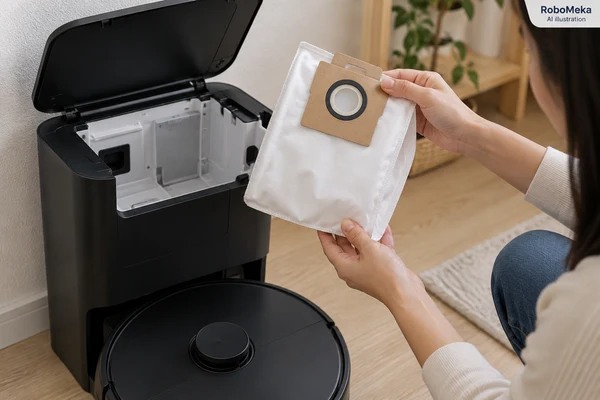
Tank docks also need a site-fit assessment. The user must lift the clean and used-water containers, carry them to an appropriate sink or disposal point, open them, and place them back correctly. A dock can fit under a shelf while leaving too little room to remove its tanks.
Roborock's tank-based dock manual separately identifies clean and dirty water tanks and gives placement and care instructions. This is a useful reminder that tank access and maintenance are part of the product design. Confirm the corresponding requirements for the offered candidate rather than transferring another model's clearances.
During sample evaluation, use only the approved fill level and handling procedure. Assess grip, lid access, visibility of fill markings, and the ability to reseat the container. Record drips encountered during normal handling without turning one observation into an unsupported leakage rate.
Check the route to the sink as well as the container itself. A large tank may reduce refill frequency for a particular routine but increase carrying burden. Capacity alone does not describe convenience, and advertised refill intervals should be tied to the actual cleaning conditions behind them.
For a package recommendation, send RoboMeka your proposed dock location and water-handling requirements. Include photographs, available space, target market, and whether your sales channel can provide installation and ongoing service.
Define who is responsible for each installation stage
A workable order has an owner for site qualification, connection work, commissioning, customer instruction, and later service. If these responsibilities are divided between the supplier, distributor, installer, and end customer, write down the handoff points before the first shipment.
The supplier should provide the installation documentation and product-specific requirements. The local installation provider should confirm site suitability and carry out work within its competence. The distributor should ensure the customer understands what is included in the price and what requires a separate arrangement.
Keep commissioning distinct from unboxing
Commissioning should follow the exact manual and the installer's approved process. It should establish that the installed system performs its supported refill, drainage, docking, and relevant cleaning functions without visible problems. Electrical and water isolation during connection work must follow the product instructions and appropriate professional practice.
Do not create leaks, block drains, or disconnect live systems as an improvised sales test. Fault-response validation requires a manufacturer-approved controlled method. A buyer can request documented fault behavior and witness normal commissioning without staging damage-prone conditions in a customer's property.
Document the completed installation
Retain the product identifiers, installation date, responsible provider, site checklist, and commissioning outcome. Include photographs that explain the layout without exposing private household details. Record any agreed limitation, such as a service-access requirement, in the customer handover.
If the location changes later, do not assume the original assessment still applies. Moving to another room can change the route, access, and connection conditions. The relocation process should identify when a fresh site check and professional involvement are needed.
Agree who keeps the installation record accessible after the sale. A later service provider should be able to identify the fitted configuration and approved components without guessing from an old marketing photograph. Keep that record with the product's service information and update it after an authorized modification or replacement.
Calculate ownership effort by task
Compare the tasks that remain rather than relying on a broad “hands-free” label. Dust collection, brush care, filter replacement, mop inspection, tray cleaning, and approved cleaning-solution replenishment may still require attention. The exact list depends on the model.
For each candidate, record who performs each task, what tool or consumable it requires, and how the user knows it is due. Use observed task time only where it has actually been measured. Do not manufacture an annual labor-saving figure from an assumed maintenance frequency.
The self-emptying dock buyer guide helps separate dust disposal from water handling. A base can automate one while leaving the other manual. Keep these functions distinct when comparing offers and writing the product page.
Treat consumables and water-path parts separately
Ask for the approved consumables and service parts applicable to each configuration. Filters, seals, tubing assemblies, connectors, or other water-path items should be identified by the supplier where relevant. Visual similarity is not enough to establish replacement compatibility.
Request availability, ordering identifiers, and the boundary between user maintenance and technician service. A distributor should not encourage customers to open a dock's internal water or electrical assemblies unless the manufacturer explicitly defines that as a supported user procedure.
Use the cleaning-product spare-parts planning guide to connect that list to stock planning. A plumbed offer needs a service plan that matches the installed equipment, not just spare brushes shared with the robot.
Compare cost under a defined scenario
Start with the complete landed equipment package, then add the actual quoted installation scope, any necessary approved accessories, consumables, and service arrangements. Include costs only when they are known or clearly labeled assumptions. A simple scenario comparison is more credible than an unsupported claim that one approach always saves money.
For example, consider a hypothetical customer with a suitable utility-room connection and a fixed cleaning routine. A plumbed dock may reduce repeated tank carrying after installation. Another customer in a rented apartment may have no suitable approved route and prefer removable tanks. The different conclusion comes from site and ownership conditions, not a universal ranking of dock technology.
Evaluate the consequences of a failed installation appointment. Who pays for a return visit, what happens if the site is unsuitable, and is a tank configuration available as an alternative? Resolve those commercial questions in the offer so installers are not pressured to improvise a connection to complete a sale.
Prepare sample and shipment evidence
Sample qualification should use the offered robot, dock, installation kit, app, and regional configuration. Request a component list and record any substitutions. A factory demonstration connected to a different kit does not establish that the retail carton contains a workable package.
For factory testing, distinguish normal function checks from broader design validation. Ask which water-handling functions are checked on production units, how the result is recorded, and what the shipping preparation requires. Do not invent a claim that every unit has completed a particular leak or endurance test without records.
Shipment inspection should verify package identity, supplied parts, instructions, labels, and agreed functional checks. If the product may retain traces from documented factory water testing, ask for the supplier's shipping and customer guidance rather than automatically treating residue as proof of prior use or acceptable condition.
The pre-shipment inspection guide can help organize those checks. Keep installation-sensitive findings visible in the release decision, particularly missing fittings or an incorrect regional manual.
Write useful product-page and handover copy
State whether the offer uses removable tanks or requires a water connection. Identify installation as part of the purchase decision, explain what is included, and make the site requirements easy to find. Avoid hiding connection details in a manual that customers see only after delivery.
Describe the specific automated tasks and the remaining maintenance. “Automatic refill and drainage on compatible installations” is clearer than a sweeping promise of no water handling under every condition. Include the model-specific conditions wherever they affect the practical value of the feature.
Customer instruction should cover normal operation, routine care, alerts, and whom to contact when an issue occurs. Provide the approved isolation guidance supplied for the installed product. Do not expect customers to diagnose internal plumbing faults from a generic error message or an online video for another model.
Frequently asked questions
Is a plumbed robot vacuum dock maintenance-free?
No. It automates specified water-handling tasks, while other care remains model dependent. Confirm the requirements for brushes, filters, dust collection, mop components, wash trays, and water-path parts. Describe the actual maintenance routine rather than using a universal hands-free claim.
Can any tank dock be converted to automatic refill and drainage?
No. Conversion is appropriate only when the manufacturer explicitly supports the exact robot, dock, and approved kit. Generic tubing or a visually similar fitting does not establish compatibility. Obtain the installation and service documentation before including a conversion in the offer.
Does a nearby sink guarantee a suitable installation?
No. The supply, drainage, route, placement, service access, and product requirements all need assessment. An appropriately qualified local installer should confirm suitability. A sink's proximity does not prove that connecting the dock is practical or appropriate.
Are removable tanks always easier for customers?
They can offer placement flexibility, but carrying, opening, cleaning, and reseating tanks still require effort. Evaluate the user's access to a sink and ability to handle filled containers. A tank dock should be assessed as an ownership workflow, not just a simpler installation.
What should a distributor request before ordering?
Request the exact configuration, included components, installation requirements, commissioning procedure, maintenance responsibilities, replacement-part list, and current manuals. Confirm who performs site assessment and connection work. The commercial package should cover both delivery and the path to usable operation.
Conclusion
The right dock is the one that fits the site, the sales channel, and the customer's routine. Compare plumbed and tank-based systems by connection feasibility, service access, remaining care, and complete cost. Automatic water handling has value when the installation and support arrangements make that value accessible.
For a sourcing brief that covers those details, ask RoboMeka to review your plumbed-dock or removable-tank requirements. Share the installation context and service model, and request a configuration-specific proposal with the evidence needed for sample approval.