The short answer
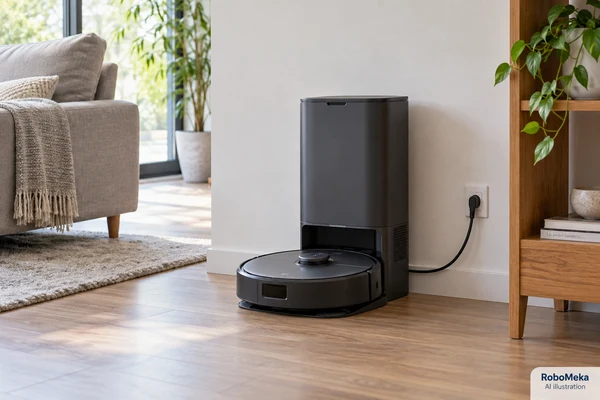
A self-emptying dock reduces one manual task but adds installation, consumable and service requirements. Evaluate the complete robot-and-dock bundle with representative permitted debris, realistic access and recorded maintenance. Treat advertised storage days as conditional, and confirm compatible replacement bags and parts before launching the range.
Introduction
A self-emptying robot vacuum dock transfers collected debris from the robot into a larger container or bag, reducing the frequency of manual robot-bin emptying. It does not remove every maintenance task. Buyers should evaluate debris transfer, installation space, consumables, noise, user care and support as one system before deciding whether the dock justifies its place in a product range.
The purchasing decision is broader than the dock's advertised storage duration. Actual convenience depends on what customers collect, how the evacuation path behaves and whether replacement consumables remain available. A dock that is easy to demonstrate with a small clean load may create a different ownership experience in a furnished home with frequent hair collection.
This guide proposes a buyer evaluation for robot and dock configurations. It is not a report of completed RoboMeka testing or a claim about the performance of an unverified model. Use it to turn a convenience feature into specific requirements for samples, product information and after-sales planning.
Which functions are included in the proposed dock?
Begin with a function list. Charging, dry-debris emptying, mop washing, pad drying and water handling are different features and may be offered in different combinations. A photograph of a large station does not establish which functions are included. Ask for the exact dock model and the compatible robot, bin and software versions.
For a dry self-emptying system, identify the debris transfer route, collection container and normal user-accessible maintenance points. For a station that also handles water, request a separate scope for tanks, pads and related care. Do not assume that evaluating dry emptying establishes the performance or maintenance requirements of the wet functions.
The robot vacuum product family can be compared with dock-equipped options, but quotations must identify the complete bundle. A charging base and a self-emptying station should not share an ambiguous accessory description. Confirm which bags, filters, cables and instructions are included in the retail package and which are optional replenishment items.
Why is compatibility more than physical fit?
A robot may need a particular bin outlet, docking interface or supported software to use a station. Similar dimensions do not establish compatibility. Ask for an explicit matrix covering robot and dock revisions, and make that matrix part of spare-parts control. A replacement station should not be selected only because its charging contacts appear aligned.
Confirm the procedure for pairing or initial setup where applicable. A distributor also needs to know whether replacing a robot, dock or related part requires an app action or service intervention. These details affect returns handling and should be documented before launch rather than discovered when the first replacement is shipped.
What does successful emptying look like?
Define the starting load, preparation and observation before a trial. The robot should collect or contain a documented quantity of permitted debris within its instructions and fill limit. After the normal emptying sequence, inspect the residual material in user-accessible areas and record whether the product reports completion or an error.
Do not require an unrealistic absolute of zero particles unless that is an appropriate, supported purchasing criterion. Instead, define what residual condition is acceptable for the intended application and measurement method. Separate loose residue, compacted hair, obstructed passages and material that remains in the brush rather than the bin; they point to different maintenance questions.
Observe the number of automatic attempts and any user intervention. A system that ultimately empties after several retries may have a different noise and convenience profile from one that completes its intended sequence directly. Record the full event instead of filming only the final successful moment.
Which debris conditions should a buyer evaluate?
Use representative permitted materials and identify them clearly. Fine dry material, larger household particles and fibers can behave differently in the transfer path. Begin with separate conditions if diagnosis is important, then use a controlled mixture that reflects the product proposition. Avoid hazardous dusts, liquids or materials outside the dry vacuum's authorized use.
| Trial condition | Main question | Additional observation |
|---|---|---|
| Light permitted debris load | Does routine transfer complete? | Residue and event duration |
| Defined fiber load | Does material remain compacted? | Bin outlet and user care |
| Mixed permitted debris | Does the complete sequence remain usable? | Retries and error messages |
| Partially used collection bag | What changes under the recorded condition? | Notifications and maintenance |
| Normal bag replacement | Can a first-time user complete the task? | Closure, access and cleanup |
| Repeated dock approaches | Does the robot align and finish correctly? | Placement sensitivity and intervention |
Keep every condition within the manual. Never deliberately block a duct, overfill a bag or bypass an interlock to create a dramatic result. If a fault or unusual heating is observed, stop and seek qualified guidance. Functional convenience evaluation is separate from specialist electrical and safety assessment.
iRobot's Clean Base troubleshooting guidance discusses debris in evacuation areas and tubing for its products. That supports including accessible path maintenance in the buying discussion; it does not establish a fault rate or authorize the same disassembly procedure on another dock.
How should installation space be assessed?
What dimensions matter beyond the footprint?
Record the station's physical dimensions and the clearances required by its instructions. Include room for the robot's approach, user access to the bag or container, lid movement and safe cable routing. A dock that fits under a cabinet on paper may be inconvenient if the user cannot open the collection compartment there.
Use a plausible installation location in the sample trial. Check whether the user can reach the socket and carry out normal maintenance without moving heavy furniture. For stations with water tanks, include the documented removal path and handling space. These observations help a retailer explain fit more accurately than a single width-and-depth diagram.
What does a docking trial need to record?
Evaluate return and alignment from the prescribed cleaning task, not only from a point directly in front of the station. Record the starting layout, location and any dock movement. Follow the product instructions for floor placement and surrounding space. A docking failure caused by deliberately unsupported installation is not evidence of behavior in the intended application.
If the station shifts during normal use, document the surface and event before proposing a solution. Do not silently add tape, weights or other modifications absent from the retail instructions. Any change intended to become part of the product setup should be reviewed and included in the approved configuration or guidance.
Prepare a dock configuration inquiry with the target home layout, available installation space and expected debris. These details help define the appropriate bundle and a sample test that reflects the customer's daily routine.
How should noise and scheduling be evaluated?
Emptying can be a short event with a different sound character from ordinary robot cleaning. Record event duration, retries and the location relative to the intended living space. A buyer can assess usability subjectively, but a numeric sound claim requires an appropriate measurement method and stated conditions. Do not turn a phone recording into a laboratory acoustic rating.
Ask whether the software permits scheduling, disabling or delaying emptying and what limitations apply. Test the supported behavior with the actual app and firmware. A quiet-hours setting may affect one function but not every sound the system makes; the product information should describe the observed and documented scope accurately.
Consider the customer proposition. A household that runs cleaning while occupants are away may value different scheduling options from one that cleans during a child's sleep. These are application preferences, not universal reasons to reject or accept a dock. Include them in the buyer brief so the comparison remains tied to a real use case.
What do bag capacity and days-between-emptying claims mean?
A volume specification describes a container characteristic; a number of days depends on use. Cleaning frequency, debris type, floor area and loading behavior all influence the interval. Ask for the conditions behind any days-based statement and avoid presenting it as a guaranteed maintenance schedule for every household.
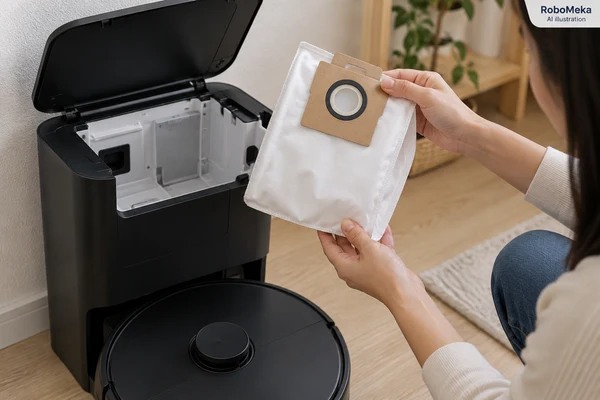
Compare the actual replacement experience. Does the bag close through its intended removal action? Can it be removed without excessive force, and can a new bag be seated clearly? Record visible handling observations while keeping microscopic emissions claims separate. A clean-looking replacement demonstration does not prove a particular particle-containment efficiency.
Confirm replenishment availability, part numbers, pack sizes and destination-market supply arrangements. A self-emptying system loses much of its convenience if customers cannot identify or purchase the correct consumable. Ask how long the supplier intends to support the part and what happens if the bag interface changes in a later revision.
Manufacturer maintenance schedules are product-specific. iRobot's dock care guidance separates care tasks for an identified product family. Use it as a reminder to request a complete schedule for the offered model, not as a universal interval for bags, sensors or other components in a private-label station.
How can a hypothetical ownership worksheet clarify the trade-off?
Imagine a distributor comparing a robot with a charging base against an otherwise suitable dock-equipped bundle. In this hypothetical exercise, the distributor estimates annual manual-bin interventions, dock bag changes and routine maintenance time for a defined customer scenario. These are planning inputs to be validated, not field data or claims about actual households.
Suppose the buyer's assumptions are 150 manual emptying events at one minute each for the base configuration. For the dock bundle, the assumptions are ten bag changes at three minutes each plus forty minutes of other annual dock care. The arithmetic gives 150 versus 70 minutes for those listed tasks, but it does not establish total ownership labor or a universal time saving.
The worksheet must show omissions and uncertainty. Brush cleaning, filter care and unexpected troubleshooting may remain in both scenarios. Change the assumptions to see whether the decision still holds when debris loads are higher or maintenance takes longer. If a small change reverses the preference, more application evidence may be needed before using convenience as the main sales argument.
Add quoted consumable and replacement costs separately. Do not invent retail prices or failure rates. The buyer can compare the incremental bundle cost against its intended positioning and support capacity, while recognizing that some customers value less frequent handling more than a calculated number of minutes.
Which service tasks remain after adding a dock?
The robot still needs the care specified for its brushes, wheels, filters and sensors. The station adds its own user maintenance and possible service requirements. Present a combined schedule that identifies the responsible component and approved procedure, rather than using a hands-free slogan that implies the system never needs attention.
Check access to normal blockage-clearing points and the clarity of error messages. A useful message should help support identify the relevant component without requiring the customer to dismantle the appliance. Record what the user can safely do and where the case must be escalated. Replacement of electrical assemblies belongs within the manufacturer's authorized service process.
Ask which parts can be supplied independently and how their revisions are tracked. A small damaged latch should not automatically become a whole-station replacement without understanding the approved service options. Conversely, do not promise component-level repairs if the supplier supports only an assembled module replacement.
Use the OEM sourcing guide to review support responsibilities alongside the hardware offer. A dock increases the number of interfaces in the product, making clear fault reporting, spare identification and escalation especially valuable for a private-label range.
What should be approved before production?
The approval record should identify the robot, dock, bin, consumables, electrical configuration and software baseline. Attach the accepted application results and the exact maintenance wording. If one item changes, the supplier should explain whether compatibility or prior evidence is affected before substitution is accepted.
Packaging deserves attention because the dock changes the shipment's size, weight distribution and protection needs. Verify the proposed pack with an appropriate logistics evaluation rather than assuming a robot-only package can simply be enlarged. Keep transit qualification separate from the cleaning and emptying trials; they answer different risks.
Review product claims for accidental overreach. Self-emptying describes a function, not a promise of zero maintenance. A stated bag interval needs its conditions; a filtration claim needs applicable evidence; a quiet claim needs a defined basis. Accurate wording helps retailers explain the feature without creating expectations the documented system cannot support.
Frequently asked questions
Does a self-emptying dock eliminate robot maintenance?
No. The robot still needs its specified brush, filter, wheel and sensor care, and the station adds its own maintenance. Evaluate the combined routine and describe the supported convenience accurately. Less frequent manual bin emptying should not be presented as a promise that the complete system needs no attention.
Can buyers compare docks by advertised storage days?
Only with the underlying conditions. The interval depends on cleaning frequency, debris and the application, so an unqualified days claim is a weak comparison. Ask for the documented basis, evaluate representative loads and confirm consumable availability. Treat the number as conditional rather than a guaranteed household maintenance schedule.
Will any self-emptying station work with a compatible-looking robot?
Do not assume so. The robot bin, transfer interface, charging arrangement and software may all matter. Obtain a model-and-revision compatibility matrix and the authorized setup procedure. Physical similarity is not enough to select a replacement dock or approve a different station in a private-label production bundle.
How should a buyer evaluate emptying noise?
Record the complete event, including duration, retries and scheduling behavior in the intended location. A subjective usability assessment is useful if labeled clearly. Numeric acoustic claims require an appropriate method and stated conditions; a phone recording or informal impression should not be presented as a standardized sound measurement.
Conclusion
Choose a self-emptying robot vacuum dock by evaluating the complete ownership routine. Debris transfer, installation access, consumables, scheduling and support determine whether the feature creates practical value for the intended customer. A documented bundle and realistic maintenance explanation make the convenience proposition more credible.
Discuss a robot-and-dock purchasing brief with RoboMeka. Include your destination market, installation constraints, expected debris and consumable plan so the proposed configuration can be assessed before final pricing, packaging and product claims are approved.