The short answer
A robot that repeatedly stops at a drain needs a site and model compatibility review. Record the intact cover geometry, nearby obstacles, approach direction and escape behavior. Never remove or modify a safety cover to improve cleaning; qualified pool professionals must assess any issue involving drainage equipment or circulation settings.
Introduction
A pool cleaner crosses the open floor, reaches a raised drain cover, and stops with its tracks still moving. That observation is more useful than a complaint that the robot is weak. It identifies a particular interaction between the cleaner, a fixed fitting, and the approach path. A distributor needs to understand that interaction before recommending another machine or promising an easy remedy.
A robot that gets stuck on a main drain needs a compatibility review. The review should preserve the pool's safety equipment, document the obstruction, and establish whether the selected model can escape under approved operating conditions. Removing a cover, attaching an improvised object, or altering circulation settings is not an acceptable buyer experiment.
This guide develops a practical purchasing and support method for raised drain covers, ladder bases, rails, and other fixed obstacles. The sample evaluations described here are proposals for buyers, not completed RoboMeka tests or records of customer installations. Qualified pool professionals must handle questions about drainage equipment, its condition, and the pool's circulation arrangement.
Why does a pool robot stop at a drain cover?
A raised cover can change how the robot is supported. The cleaner may approach successfully but lose useful contact as its underside passes over the highest point. Another approach angle may leave a track beside the cover or place the robot against a nearby slope. Appearance alone cannot identify the complete cause.
Maytronics' drain troubleshooting FAQ recognizes drain-related immobilization and discusses several model and installation factors. Its guidance is evidence that this is a known application issue, not permission to apply every suggested intervention to an unrelated pool or cleaner. Refer circulation questions and any proposed drain accessory to the responsible pool professional.
The initial distinction is between an obstacle encounter and a general movement fault. A robot that travels normally elsewhere but repeatedly stops at the same fitting presents a different question from one that barely moves anywhere. Record both patterns. Replacing a motor or buying a more expensive model before establishing that distinction can leave the original problem unresolved.
Treat the drain cover as safety equipment
A main drain cover is not a convenient surface to reshape for cleaning access. Keep it intact and correctly installed. Do not remove, drill, cut, weight, tape, bridge, or attach improvised parts to it. If the cover is loose, damaged, or missing, suspend the assessment and have the pool made safe by a qualified professional.
The Pentair StarGuard installation guide warns about broken, loose, or missing covers and directs users to a pool professional rather than self-alteration of the cover or frame. The practical purchasing consequence is simple: choose equipment for the approved pool arrangement and escalate incompatibility through the appropriate specialists.
An accessory advertised as helping cleaners cross drains still needs an application review. A product photograph cannot establish compatibility with the installed outlet, cover, flow conditions, or local requirements. The robot supplier and the pool professional should resolve the combination before any purchase or installation. This article does not recommend a particular drain attachment.
Build an obstacle record from safe observations
Describe the fitting and its surroundings
Record the drain cover's identification from existing pool documents when available. Note its visible shape, location, and relationship to slopes, walls, and neighboring fittings. Use drawings or measurements supplied by the pool builder or service professional. Do not enter the pool, handle a suction outlet, or remove a cover to complete a cleaner quotation.
A deck photograph should include enough surrounding floor to show the approach route. A close crop can hide the reason a robot turns toward the cover or loses support afterward. Where visibility is insufficient, say that the geometry is unconfirmed. Guessing a cover height from distorted underwater perspective creates false precision in the application brief.
Describe the cleaner configuration
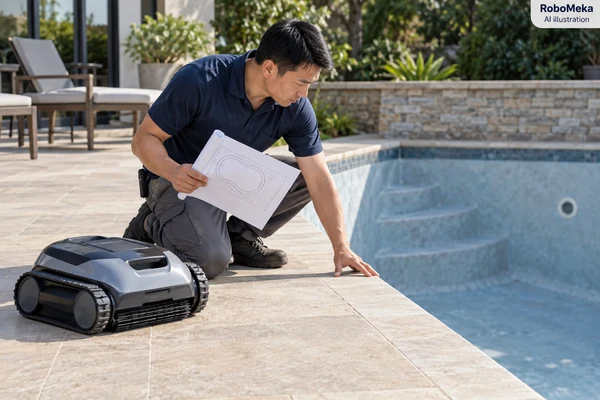
Capture the exact robot model, hardware revision if available, installed brushes or tracks, filter configuration, and selected cleaning mode. Record whether the unit is new, established in service, or recently repaired. Include a view of its condition after safe retrieval and isolation according to the manual, without opening sealed parts or operating it upside down.
The same exterior shell may be sold with different contact components or control features. A dealer should therefore compare the sample to its approved configuration, not only to a catalog photograph. If a customer has substituted a brush or track, identify that change before attributing the behavior to the original specification.
Separate raised drains from other fixed obstacles
Ladders and handrails create narrow approaches
A ladder can create a gap that admits part of a robot but does not allow a clean turn. The relevant observation is the entire entry and exit sequence, including where the cable passes on a corded machine. Do not assume that a ladder avoidance claim establishes compatibility with every rail angle or floor attachment.
Leave installed safety and access equipment in its approved arrangement. If a movable pool accessory is involved, the responsible operator should decide whether it can be removed under its own instructions before cleaning. Record that requirement in the handover; an undocumented assumption about removing equipment can become a recurring customer complaint.
Floor transitions change obstacle encounters
An identical drain cover can present a different problem near a slope transition than on a broad, level floor. Record where the cleaner starts turning, whether the front or rear reaches the cover first, and whether it approaches from the shallow or deep side. These observations guide a supplier discussion without claiming to prove a mechanical cause.
For shelves and stair geometry, use the separate steps, benches and tanning ledges guide. Here the purchasing question is whether fixed fittings interrupt otherwise permitted travel. Combining those two questions under a vague obstacle rating can conceal important limitations in the quotation.
Define what successful escape actually means
Crossing a fitting once is not enough to establish reliable cleaning. A useful assessment asks whether the cleaner continues its permitted route, retains normal orientation, avoids repeated immobilization, and completes the required area without human intervention. It should also establish whether debris remains around the obstacle after the cleaner passes.
| Observation | What it establishes | What remains uncertain |
|---|---|---|
| Robot avoids the fitting | A route was available on that approach | Cleaning immediately around the cover |
| Robot crosses and continues | That encounter was completed | Repeatability from other approaches |
| Robot reverses and escapes | Recovery occurred in the observed state | Behavior with another mode or load |
| Robot stops repeatedly | The tested combination needs review | Root cause and an approved remedy |
| Operator redirects the robot | Assisted completion was possible | Suitability for unattended cleaning |
Agree which outcome the customer actually needs. A service operator who can supervise a short targeted task may accept a limitation that a residential owner expecting routine autonomous operation would reject. The product recommendation should state the required intervention openly rather than hiding it behind a successful final photograph.
Plan a representative assessment without changing the pool
Begin with written permission for the robot's use on the installed surface and within its environmental limits. Confirm that the pool and its fittings are ready for normal operation. Keep swimmers out and preserve safe deck access. If the robot has already shown unsafe or damaging behavior, obtain manufacturer guidance before attempting another run.
Choose observation points from which the relevant encounter can be seen safely. Use a simple pool drawing to mark the obstacle and record the robot's starting location. Record the permitted mode and the pool's existing operating state without adjusting suction or pump settings as a troubleshooting shortcut. Any circulation change belongs to the qualified professional's assessment.
Observe the whole encounter, including approach, contact, response, and recovery. A short video is often more informative than a still image of the final stuck position. End the run using the manual's procedure when intervention is required. Retrieve with the approved method; do not pull on an unsuitable cable or reach into moving components.
Send your pool layout and obstacle details to discuss a model-specific evaluation brief with RoboMeka. Include the intended cleaning zones, the installed cover information if known, and the support conditions your customers can realistically provide.
Interpret results without overdiagnosing them
Repeated location points toward application review
If the same cleaner moves normally across the rest of the floor but repeatedly stops at one fitting, preserve that observation in the report. It supports a focused compatibility discussion. It does not independently prove excessive suction, inadequate torque, defective software, or an incorrect drain installation.
Use the pool-sizing buyer guide alongside the obstacle record. A model may satisfy the pool's length and depth requirements while failing the practical obstacle requirement. Dimensions qualify one part of the application; they do not certify every feature within it.
Broad movement problems require another path
If the cleaner slips, stalls, or turns poorly across multiple areas, check the owner's permitted inspection steps and refer unresolved issues to support. Filter condition, contact components, installation preparation, and the approved surface configuration can all belong in that conversation. Avoid turning a drain complaint into an unauthorized repair procedure.
For a corded product, record cable routing as well. A cable held around a rail can resemble a travel problem from a distance. The separate corded pool robot cable guide helps buyers qualify that arrangement. Removing cable restraint does not establish that a raised drain is compatible; each observation needs its own conclusion.
Turn a difficult pool into a useful sourcing decision
Consider a hypothetical distributor evaluating two candidates for customers with raised floor covers. Candidate A completes the open floor but repeatedly requires retrieval at one cover. Candidate B escapes the observed encounters but leaves a small area nearby untreated. Neither result justifies an unrestricted statement that the robot handles all drains.
The distributor can ask for another approved configuration, seek a manufacturer assessment, or limit the application claim. Candidate B may merit further evaluation if its residual cleaning requirement is acceptable. Candidate A may remain suitable for other pool arrangements. A failed site trial can improve assortment boundaries without proving the product is defective.
Describe the outcome in operational language. State where intervention occurred, what remained unclean, and which conditions were observed. Avoid unsupported percentages for obstacle success or whole-pool coverage. If the supplier proposes a revised robot component, record its identity and repeat the relevant assessment before updating the sales description.
Put obstacle requirements into quotation and shipment records
A quotation should identify the actual model configuration and the pool features that matter to the order. Attach the approved application notes where appropriate. Keep manufacturer limitations visible in dealer materials, especially when marketing includes obstacle avoidance or automatic escape. Those phrases need defined scope to support a procurement decision.
Factory testing can verify the supplied configuration against an agreed reference fixture, but a fixture is only an approximation of the customer's pool. Ask how its geometry relates to the intended application. A demonstration on a smooth ramp does not answer whether a robot will cross a particular raised cover beside a slope.
Shipment inspection should confirm that contact components, accessories, manuals, and relevant control settings match the approved sample. Do not turn an appearance check into a performance certification. Record substitutions before release because a small component change may make the original site assessment less representative of the delivered product.
Give dealers a useful escalation record
Provide support with the model identification, safe images of the fitting, a short account of the approach and recovery, and the applicable manual version. State what has and has not been tried. Explicitly record that the safety cover was left intact and that circulation changes were not made as part of an informal test.
The response should distinguish customer preparation, permitted robot settings, service work, and matters for the pool professional. Assign a responsible party to each unresolved item. An instruction to contact someone else without transferring the useful evidence leaves the customer repeating the same explanation and increases the temptation to improvise.
Close the case only when the operating boundary is clear. That may mean an approved configuration works, the pool requires professional attention, or this robot is unsuitable for the application. Each is a more useful conclusion than repeatedly restarting the machine and hoping the next cycle follows a different route.
Frequently asked questions
Can I remove the drain cover so the robot can pass?
No. Preserve the installed safety cover and refer any concern about its condition or compatibility to a qualified pool professional. Do not cut, drill, weigh down, or attach improvised devices to the cover. Robot access must be evaluated around a safe, approved pool arrangement, and a missing or damaged cover requires attention before the assessment continues.
Does a stronger motor solve every drain problem?
No. Motor specifications do not establish how the robot is supported when it reaches a particular fitting. Geometry, approach direction, contact components, and approved operating conditions all matter to the evaluation. Ask for relevant model evidence and observe the complete encounter. A more powerful model can still be unsuitable for the same physical arrangement.
Should I change pump speed when the cleaner gets stuck?
Do not use circulation or suction changes as an informal buyer troubleshooting step. Ask the qualified pool professional responsible for the installation to assess whether any change is appropriate, together with the cleaner manufacturer's guidance. Record the approved operating arrangement so the eventual recommendation remains reproducible and does not depend on an undocumented adjustment.
Is a drain-assist accessory automatically compatible?
No. Compatibility must cover the installed drain assembly and the robot, with professional review of the proposed installation. A generic product listing or an online demonstration cannot establish suitability for an individual pool. Obtain written confirmation from the relevant parties before considering such an accessory, and do not substitute a homemade attachment.
What evidence should a buyer send to the supplier?
Send the exact cleaner identity, approved component configuration, obstacle photographs taken safely, a pool sketch, and a description of the approach and escape behavior. Include a short video if it can be obtained from the deck. Note any required intervention and whether travel elsewhere was normal, while keeping unverified root-cause theories separate from observations.
Conclusion
Drain-related immobilization is a purchasing and application question that deserves precise evidence. Preserve safety equipment, document the obstacle and cleaner combination, and evaluate escape separately from debris removal. A responsible recommendation either demonstrates an acceptable operating routine or clearly identifies the application's limits and the specialist review still required.
Ask RoboMeka for a pool robot application review with your pool drawing, fixed-obstacle details, target market, and required cleaning outcome. These inputs help define a practical sample assessment and a defensible product specification.