The short answer
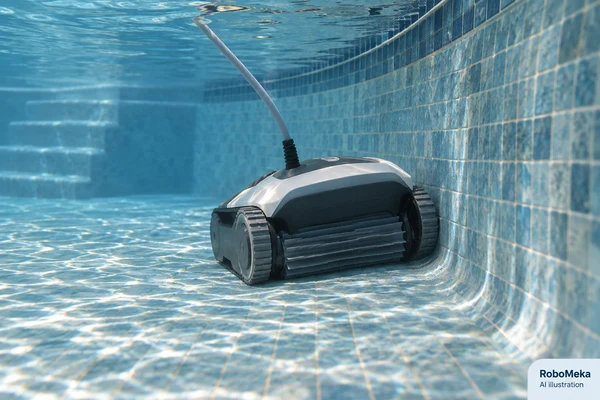
Ladders and handrails create three-dimensional clearance, route, coverage and sometimes cable-interference questions. Preserve approved access equipment, map each fitting, define acceptable avoidance or recovery, and test the exact robot from safe deck positions. A successful pass does not prove that the area behind the fitting is cleaned or that every approach will succeed.
Introduction
A robotic pool cleaner can pass a ladder repeatedly, wedge between its rails on the next approach, or complete the floor while its floating cable catches around a handrail. The direct buyer answer is that fixed fittings require a site-specific interference check. A general obstacle-avoidance claim cannot establish clearance, turning room, cable behavior, or recovery around every ladder and rail arrangement.
This guide focuses on ladders, handrails, wall anchors, accessibility rails, and similar fixed pool fittings. Raised main drains are a different safety and geometry problem. The proposed evaluation described here is not a completed RoboMeka test or customer record. It is a way for importers, dealers, and pool professionals to define evidence before selecting a model or publishing a compatibility claim.
Why ladders and rails cause several kinds of interference
A ladder creates more than one obstacle. Its legs or rails establish a narrow gate, the wall anchors change the near-surface route, lower treads can overlap the robot's climbing zone, and the space behind the ladder may admit only part of the machine. A corded cleaner also brings a flexible cable into the interaction.
The robot may contact a fitting with its housing, brush, track, handle, or cable. It may reverse cleanly, continue but miss the surface behind the rail, or become immobilized. Each observation has a different procurement meaning. Calling all of them “stuck” loses the information needed to compare models.
Maytronics' Wave 90i manual lists obstacles blocking an impeller, tracks, or wheels among causes of non-movement and separately addresses cable availability and power-supply positioning when only part of a pool is cleaned. That guidance applies to the named model, but it illustrates why mechanical contact, route coverage, and cable reach should be recorded separately.
Preserve the pool's access and safety arrangement
Do not loosen, bend, pad, tape, cut, or partly remove a fixed rail to help a robot pass. Ladders and handrails are part of the pool's access system, and their condition belongs to the pool owner and qualified pool professional. If a fitting is loose, damaged, corroded, or has sharp projections, suspend the trial and have the site assessed.
The U.S. Consumer Product Safety Commission's 2026 statement on pool ladder safety treats unsafe access points and ladder-related access as part of drowning prevention. It concerns above-ground and portable pools rather than robotic cleaners, but it reinforces the boundary that a cleaning trial must not compromise an access-safety arrangement. Requirements still vary by jurisdiction and installation.
Some pools use a ladder designed to be removed for winterization or particular maintenance. Removal before cleaning may be an acceptable operating condition only when the responsible party confirms that the fitting is designed for it, follows its instructions, controls pool access, and reinstalls it correctly. The robot supplier should never assume this routine without documenting it.
Create a fixed-fitting map before choosing a model
Record geometry from a safe position
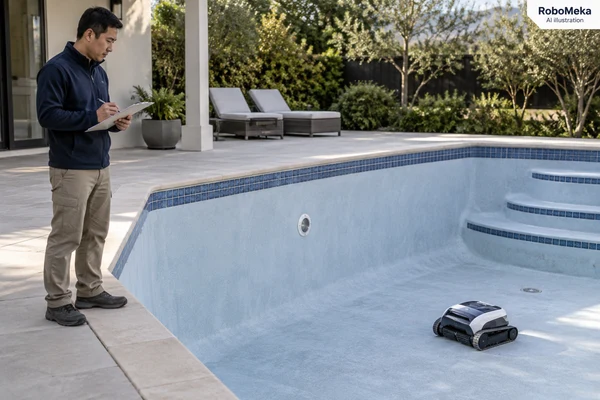
Use existing pool drawings, installation records, and photographs taken from the dry deck. Note the fitting type, position, visible clearances, water depth, nearby wall shape, and whether a lower tread or brace sits within the cleaner's route. Do not enter the pool during an operating assessment or reach between the cleaner and a rail.
Photographs should show both the fitting and enough surrounding surface to explain the approach. A close-up of an anchor does not reveal whether the robot enters from an adjacent curve or whether the cable crosses the rail from the opposite side. If dimensions cannot be obtained safely or reliably, mark them unconfirmed rather than estimating from underwater perspective.
Separate permanent and removable objects
Fixed ladders, built-in rails, and approved anchors must be assessed as part of the pool. Removable toys, thermometers, hoses, and cleaning tools should be managed under the pool operator's normal preparation routine. A test should not mix preventable loose-object jams with compatibility around permanent fittings.
Use the main-drain obstacle guide for raised outlet covers and drainage-related questions. The fitting map in this article should not recommend changes to drains, suction, or circulation. A robot that clears a ladder has not thereby proved it can clear a drain, and the reverse is also true.
Define the possible contact paths
Floor travel beneath and beside the fitting
On the pool floor, identify whether the robot can enter the space between two ladder legs, whether it has room to turn, and whether its housing can pass beneath a tread or brace. A gap wider than the robot at one height may narrow above the tracks. Use documented product dimensions as an initial screen, then evaluate the three-dimensional encounter.
A machine that avoids the space may still be suitable if it cleans the accessible floor and the residual area can be maintained acceptably. The buyer should state that residual area rather than treating avoidance as complete obstacle compatibility. Conversely, squeezing through once is not enough if later approaches cause repeated immobilization.
Wall climbing near anchors and rails
A wall-climbing cleaner changes orientation as it transitions from the floor. Its top, handle, cable connection, or rear body can meet a rail before the tracks do. Record where it disengages and whether it returns to normal travel. Do not infer that a waterline mode will solve the issue; the fitting may occupy the same route.
For built-in shelves and steps, use the separate steps, benches, and tanning ledges guide. This evaluation is about interference from attached hardware, even when that hardware is beside a step. Keeping the questions separate leads to clearer acceptance criteria.
Cable travel around projecting hardware
On a corded model, observe the floating cable as well as the robot. A rail can act as a guide, pivot, or snag point. Cable restraint may shorten reach to another area or pull on the cleaner during a turn. Do not thread or tie the cable around the fitting to control it.
The corded pool robot cable guide explains deployment and route observations in more detail. Cordless equipment removes the floating-cable interaction, but it does not remove housing clearance, entrapment, retrieval, or coverage questions around the ladder itself.
Define acceptable behavior before the trial
An obstacle assessment needs more than a pass-or-fail label. Decide whether the robot must avoid the fitting, pass through the space, reverse without help, clean behind it, or merely complete the wider zone without damage. The required behavior depends on the customer's operating model and the importance of the residual area.
| Observed behavior | What it supports | What it does not prove |
|---|---|---|
| Avoids the fitting and continues | A route around it existed | Surface behind the fitting was cleaned |
| Contacts and reverses | Recovery occurred on that approach | Recovery from every angle |
| Passes through the rail gap | One clearance path worked | No upper-body or cable contact later |
| Stops until retrieved | Human intervention was required | The product is defective |
| Cable loops around a rail | A site interaction needs review | The cable alone caused every missed area |
Agree on an intervention limit. An operator supervising a commercial cleaning session may accept a documented redirection that a residential buyer expecting unattended cycles will not. Make that assumption visible in the product recommendation and handover.
Run a safe representative evaluation
Start only when the pool owner or responsible professional confirms that the pool and fittings are ready for normal use. Keep swimmers and bystanders away from the operating cleaner. Provide a clear dry-deck route for observation and retrieval, and never use a ladder that is within the robot's operating zone while the machine is running.
For a corded unit, use its approved power supply and cable. Supply location, outlet protection, and setup must follow the exact model manual, applicable local code, and a qualified electrician's direction. There is no universal outlet distance; do not copy one from a different manual or improvise with an extension cord. Before handling the cleaner, cable, filter, or obstruction, stop, unplug or isolate it exactly as instructed.
Begin from more than one permitted starting position because the approach angle can change the result. Observe floor passes beside and toward the fitting, wall transitions on both sides, and the cable route during turns. A short deck-level video can document timing and contact points without creating an unsupported diagnosis.
Stop the evaluation if the robot strains repeatedly, damages a finish, traps the cable, presses on a loose fitting, or requires someone to enter the water. Repeatedly restarting an immobilized machine does not demonstrate obstacle handling. It only repeats an unresolved condition.
Send your ladder and handrail layout for a proposed model-specific compatibility brief. Include full-area photographs, reliable dimensions where available, the intended cleaning zones, corded or cordless preference, and the maximum intervention your customer can accept.
Interpret a stop without guessing the cause
When the cleaner stops, record the exact contact points, robot orientation, cable position, selected mode, filter state, and whether travel elsewhere was normal. Do not declare weak motors, faulty navigation, or an incorrect ladder installation from one image. Those explanations require additional evidence and responsible specialists.
If the robot moves poorly across the whole pool, follow the manual's permitted checks and contact support. Filter loading, blocked moving parts, surface traction, or a hardware issue may be relevant. If it operates normally except at one rail, the result points more strongly toward application compatibility, while still not proving a single mechanical cause.
Clear only what the exact manual permits after power isolation. Never place fingers near tracks, brushes, belts, or an impeller while the cleaner can energize. Do not use a tool to lever the robot off a fitting or modify a guard for extra clearance. Escalate recurring entrapment with the evidence intact.
Evaluate coverage around the fitting
A robot can escape every encounter and still leave a meaningful dirty strip behind a ladder. Mark residual areas on a simple pool diagram after the cycle. Note whether debris remains directly behind the rails, beneath a tread, at the wall-floor transition, or along the waterline near anchors.
Use the wall and waterline testing guide to assess vertical coverage outside the interference zone. That broader performance should not hide a fitting-specific miss. Report both: the cleaner covered the permitted wall generally, and it left a defined area near the rail.
The remedy may be an acceptable manual touch-up, an approved operating preparation, or a different model geometry. Do not promise software will correct a physical clearance problem unless the exact supplier provides relevant evidence. Likewise, a narrower robot can still become trapped if its turning behavior sends it deeper into the gap.
Convert observations into supplier questions
Ask the supplier for the exact machine envelope, including handles and connectors, the approved contact and recovery behavior, cable guidance, and any known minimum-clearance instructions. Request the manual for the proposed region and revision. Generic renderings and dimensions from a related model are not sufficient.
A hypothetical factory fixture can compare candidate robots around a documented rail geometry. If used, label it as a proposed reference fixture, explain its dimensions, and avoid presenting it as proof for all pools. Water depth, wall curve, surface, anchor shape, and approach pattern can make the site encounter different.
Shipment inspection should verify the housing, brushes, tracks, handle, cable, manual, and approved accessories against the assessed sample. A changed handle or cable connector could alter clearance even if the product name remains the same. Record substitutions before release and reassess when they affect the interaction envelope.
Write a clear operating boundary for dealers
Dealer material should distinguish “avoids a fitting,” “escapes after contact,” and “cleans the surface behind a fitting.” Those are not interchangeable claims. Name the observed setup and the area requiring manual attention. Avoid statements such as “navigates all obstacles” unless a supplier can define and substantiate that scope.
The handover should say whether a removable ladder must be managed, who is responsible, and how pool access is controlled during removal. It should also explain safe stopping and retrieval. An undocumented preparation step becomes a recurring complaint, especially when a new owner assumes the cleaner can operate around every installed fitting as delivered.
Model and region differences matter. One revision may have a swivel, different handle, or revised route logic. Do not transfer a successful observation to another configuration without reviewing those changes. A responsible boundary can still be commercially useful because it tells the buyer which pools are suitable and what evidence is needed for exceptions.
Frequently asked questions
Should I remove the pool ladder before every robot cycle?
Only if the ladder is designed to be removed, its own instructions and the responsible pool professional permit that routine, access is controlled, and correct reinstallation is assured. Never loosen or remove a fixed fitting merely to make a robot pass. Document any approved preparation as an operating requirement before sale.
Does a cordless robot eliminate ladder problems?
It eliminates the floating power cable, not the entire interaction. The housing, tracks, brush, handle, and retrieval route can still contact or enter a narrow space. Evaluate clearance, reversal, coverage behind the fitting, and safe retrieval for the exact cordless model.
Can padding be added to a rail to stop the robot entering?
Do not add improvised padding, ties, blocks, or guards. They can affect safe use of the access fitting, detach into the pool, or create another entrapment point. Ask the pool professional and robot manufacturer for an approved solution or choose a model and operating boundary suited to the existing installation.
Is one successful pass between ladder legs enough?
No. Approach angle, cable position, filter load, and selected mode can change later encounters. Observe repeat approaches from realistic starting positions and define whether avoidance, passage, or recovery is required. Report residual cleaning around the rails as well as successful escapes.
What evidence should be sent when the robot gets trapped?
Send the exact model and revision, the manual version, safe wide and close photographs, reliable fitting dimensions, selected mode, cable position, and a short description of approach, contact, and recovery. State whether normal travel continued elsewhere. Keep unverified cause theories separate from these observations.
Conclusion
Ladders and handrails create a three-dimensional compatibility problem involving clearance, route choice, coverage, and sometimes cable behavior. Preserve approved access equipment, map each fitting, define acceptable recovery, and test from safe deck positions under the exact manual. A qualified result may be compatibility, a documented preparation step, a residual touch-up area, or a clear exclusion.
Ask RoboMeka to review your fixed pool fittings with a pool drawing, photographs, confirmed dimensions, intended model type, target cleaning zones, and acceptable operator involvement so a proposed assessment can be prepared without promising universal obstacle avoidance.