The short answer
Choose an above-ground pool robot only after checking the exact pool construction, liner condition, floor profile and retrieval arrangement against the selected model's instructions. A soft-sided pool introduces support and access questions that an area rating cannot answer. Confirm the permitted cleaning zones and test a representative pool before approving an assortment.
Introduction
A distributor receives two inquiries for a cleaner for an above-ground pool. Both customers describe a rectangular pool of roughly the same area. One pool has a rigid wall and a well-supported liner; the other has a seasonal frame, flexible sides, a rounded floor transition and a high rim with no surrounding deck. Those inquiries should not automatically receive the same recommendation.
Choose an above-ground pool robot only after checking construction, liner condition, floor profile and retrieval access against the exact model's instructions. The above-ground label describes where a pool sits, not every condition the cleaner will encounter. A suitable product must perform its specified task without depending on unsupported assumptions about the pool.
This guide helps importers, dealers and private-label buyers turn customer requirements into a defensible selection brief. The evaluation examples are proposed purchasing exercises, not reports of completed RoboMeka projects. Keep people out of the water during operation, follow both manufacturers' instructions, and treat the robot as a cleaner, not a sanitizer.
What does above-ground compatibility actually mean?
Compatibility means that the cleaner manufacturer permits the exact application and that the installation meets its conditions. Relevant conditions can include pool construction, surface, floor shape, depth, operating water conditions and cleaning scope. An area rating is only one part of that decision. It cannot establish that a flexible wall can support a wall-climbing cleaner.
Manufacturer descriptions already show why qualification matters. Aiper's Scuba SE product page identifies above-ground applications and floor-cleaning coverage. The useful lesson is to distinguish the pool category from the cleaning scope, rather than assuming that one product description approves every seasonal installation or includes wall cleaning.
Ask for the current manual supplied with the intended market version. A translated marketplace listing may omit an exclusion, combine features from different models or describe an older configuration. Keep the approved application statement alongside the model code, brush configuration and manual revision used for the purchase decision.
Do not confuse automatic cleaners with electrically driven robots. Intex describes its ZX100 as a pressure-side automatic pool vacuum connected to the pool inlet. Its operating arrangement differs from a self-contained robotic cleaner. Comparing the categories requires checking the whole system, including any pump requirements, rather than comparing the word automatic on two cartons.
Identify the pool construction before discussing features
Framed soft-sided pools
A framed pool uses its structure and water load together, with a flexible liner forming the underwater surface. Ask for the pool maker and model, installation date and current installation condition. Photograph the overall pool and floor from safe positions. A picture of the box cannot show wrinkles, local depressions, repairs or the actual route available for handling the cleaner.
The dealer should not diagnose structural adequacy from a customer photograph. Where the frame appears uneven, the liner is damaged or the floor differs from the pool manufacturer's requirements, refer the owner to the appropriate pool professional. A robot trial should not become an experiment in whether a questionable installation can tolerate additional contact.
Inflatable-ring and other flexible-wall pools
An inflatable top ring creates a different access boundary from a rigid coping edge. Obtain explicit suitability confirmation before recommending a cleaner for this construction. Do not rest the cleaner on the ring, use the side as a lifting support or infer that a rounded wall is equivalent to the vertical wall shown in a demonstration video.
Customer language can be misleading here. Someone may call every temporary pool an inflatable pool, while another uses above-ground to mean a permanent rigid installation. A simple construction photograph and manufacturer model number are more useful than repeatedly asking the customer to choose a broad category from a dropdown menu.
Rigid-wall above-ground pools
A rigid wall does not remove the need to check liner condition, floor geometry or access. These pools may have a floor-to-wall cove, stairs or a surrounding deck that changes retrieval. Record those features individually. Compare the surface questions with the separate guide to pool robot compatibility with vinyl, fiberglass and tile.
Inspect the floor profile and liner condition
A pool sold as flat-bottomed may still contain installation wrinkles or localized depressions. The purchasing question is whether the installed floor meets the cleaner's documented limits. Do not deliberately create folds, depressions or obstacles to test a product beyond its permitted application. Establish a representative, properly installed pool first, then assess the cleaning task.
Look at the full floor-to-wall transition. A broad curved cove can reduce the usable flat floor and alter how the robot approaches the perimeter. A cleaner that reverses normally on one pool may approach a different transition differently. Record the condition without claiming that any particular radius will work unless the manufacturer supplies that limit.
Liner age also matters to the assessment. Existing abrasion, loose material, patch edges and discoloration should be documented before a trial so that later observations have context. If a repair is present, ask the pool and repair-material suppliers whether robotic cleaning is permitted near it. A general vinyl compatibility statement does not answer that question.
Use photographs of fixed areas before and after the proposed evaluation. Keep lighting and camera position reasonably consistent, because reflections can resemble scuffing. Any unexplained change requires inspection before further operation. The purpose is to detect and investigate a concern early, not to establish an unsupported guarantee that a cleaner can never mark a liner.
Define what the robot is expected to clean
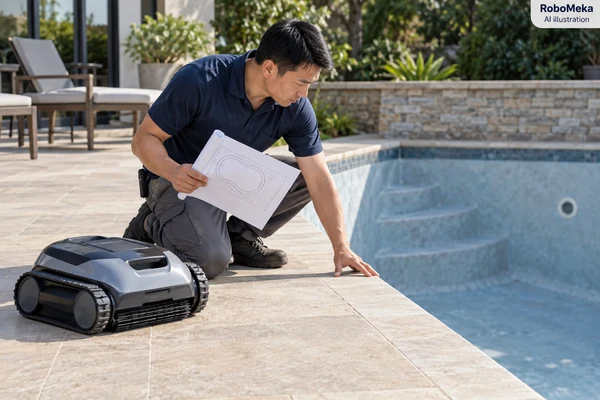
For many buyers, the useful task is routine floor-debris pickup. Wall cleaning, waterline cleaning and step cleaning are additional functions that need separate approval. A floor-only cleaner can be a coherent product choice when the customer understands what remains manual. It becomes a poor recommendation when a sales page implies whole-pool coverage.
Describe debris by type and condition. A few scattered leaves, fine settled dirt and a compact layer of wet leaves are different workloads. Ask whether the customer expects a routine maintenance product or a tool for opening a neglected pool. The pool-cleaner filter selection guide explains why the filter and loading pattern need to match the intended task.
Surface appearance and sanitation must remain separate in the handover. A robot may collect visible debris while water quality still requires professional attention. Keep circulation, filtration and water-treatment responsibilities in the pool's care plan. Any chemistry correction should be handled by a qualified pool professional using the pool and product instructions, rather than an improvised dosing recipe.
| Customer requirement | Evidence to request | Decision boundary |
|---|---|---|
| Routine cleaning of a flat floor | Exact model approval and representative cycle record | Do not extend to slopes without permission |
| Use in a soft-sided framed pool | Pool construction details and written compatibility | A surface label alone is insufficient |
| Wall or waterline cleaning | Specific permission for the pool structure | Do not infer from another pool demonstration |
| Fine settled dirt collection | Approved filter and observable collection result | Visible movement is not collection evidence |
| Easy removal across a high rim | Demonstrated permitted handling sequence | Dry weight alone is insufficient |
Plan retrieval before choosing corded or cordless
A cleaner that works well underwater can still be unsuitable for an owner who cannot retrieve it safely. Record rim height, deck availability, the permitted standing area and the distance to the eventual storage location. The trial should include removing, draining and carrying the unit according to its instructions, not merely watching it drive across the floor.
A retrieval hook or parking feature may help bring a supported model within reach, but it does not turn a flexible side into a lifting platform. Use the intended handle and approved retrieval method. Do not climb on a pool frame, lean body weight onto a top ring or improvise a rope attachment to make an otherwise unsuitable arrangement work.
For a corded unit, check the manufacturer's complete power-supply and cable layout requirements with the real installation. For a cordless unit, check safe charging and the path between the pool and charging area. Do not modify electrical connections or use unsupported extensions. Compare the broader tradeoffs in corded versus cordless robotic pool cleaners.
To build a quotation around the actual installation, send RoboMeka your above-ground pool requirements, including the pool model, floor photographs, cleaning scope and retrieval access. This allows compatibility questions to be identified before an assortment or sample configuration is agreed.
A proposed sample evaluation for a seasonal pool range
Consider a hypothetical importer serving households with framed garden pools. The importer wants a cleaner for routine floor care and has no evidence supporting wall climbing on those pools. A useful evaluation would begin with that restricted claim, two representative approved installations and one documented configuration of the proposed robot. No result is assumed in advance.
Establish an approved starting condition
Confirm that each pool is correctly installed, undamaged and filled to its operating level. Check that water conditions, depth and temperature fall within the cleaner's requirements. Record the liner condition and any features that may affect movement. Prepare the cleaning equipment only after the pool professional has resolved installation or water-quality concerns.
Use naturally occurring, permitted debris where practical. If a controlled demonstration needs added material, obtain approval for a harmless, recoverable test material first. Never introduce sharp fragments, metal, large stones or material likely to damage the pool or cleaner. The test should represent the intended customer task without manufacturing an unnecessary hazard.
Observe movement and collection separately
Mark observation zones on a sketch rather than putting improvised markers into the water. Record which zones the robot reaches, where debris remains, whether the unit repeatedly returns to the same area and whether intervention is required. A time-lapse can support observations, but it should not replace the written record of starting conditions and interruptions.
Inspect the filter and the floor after the permitted cycle. Debris that disappears from one corner may simply have moved elsewhere. If the basket is full, note when that condition was discovered and whether the run still represents normal operation. Do not describe a pass that required repeated undocumented assistance as uninterrupted autonomous cleaning.
Evaluate the complete user task
Include setup, safe deployment, retrieval, filter rinsing and storage in the assessment. Ask an appropriately briefed adult operator to follow the proposed instructions. Record unclear steps, awkward access and accessories that are missing from the sales bundle. These observations can be more useful to a distributor than a feature that customers rarely use.
Repeat within the agreed operating conditions before generalizing. One completed cycle in one pool is evidence for that observation, not proof of universal compatibility. If a second pool produces a different result, investigate floor shape, debris, water conditions and configuration before deciding whether the product or the sales scope needs to change.
Turn the findings into an honest sales specification
Write the application statement in language the customer can check. For example, a proposed statement might describe approved framed pools with a specified floor profile and floor-only cleaning, subject to the supplied manual. The actual wording should follow the manufacturer's documented permission and evaluation evidence; the example is not a RoboMeka specification.
Keep exclusions close to the main compatibility statement. Hiding them in a downloadable document creates avoidable returns when a customer reads only the listing. If inflatable-ring pools, damaged liners, unusual slopes or particular surface finishes are outside the agreed scope, make that boundary clear at the point of selection.
Avoid a universal compatibility matrix filled only with check marks. Add a notes field that distinguishes confirmed applications from questions requiring review. If the supplier has not evaluated a construction type, record it as unconfirmed. An empty evidence field should never become a positive compatibility claim through a catalog formatting decision.
Include seasonal storage and repeat installation
Temporary pools can change between seasons. The owner may reinstall the same pool on a different base, change the surrounding access or add a ladder. Ask dealers to repeat the relevant site checks after reinstallation. A robot approved for the previous setup should not be assumed suitable for every later arrangement bearing the same pool brand.
Storage instructions should cover both the robot and the supplied accessories. Drain, clean and store the unit according to its manual, with battery care specific to the exact cordless model. A seasonal bundle should include a clear explanation of what must happen before the first use after storage, including inspection for damage and replacement of unsuitable parts.
Factory testing can confirm the agreed product configuration and functional checks under documented conditions. It cannot reproduce every customer's installation. Shipment inspection should verify the correct robot, filter, retrieval accessory, charger or power supply, and market-specific instructions against the approved order. Keep those records separate from claims about individual pool performance.
Frequently asked questions
Can every above-ground pool use a robotic cleaner?
No. The exact cleaner must be approved for the pool's construction and installed conditions. Above-ground pools include flexible-wall, framed and rigid-wall designs with different access and floor profiles. Check both manufacturers' instructions and resolve any uncertainty before operation. Pool area alone is not enough to decide suitability.
Is a floor-only robot a poor choice for a soft-sided pool?
Not necessarily. It may match the intended routine task if the manufacturer approves the application and the customer accepts the remaining manual care. The decision should reflect permitted use, collection performance and handling. More advertised functions do not automatically make a model better suited to a flexible pool structure.
Can a robot remove wrinkles from a pool liner?
No. Liner wrinkles are an installation or condition issue to discuss with the pool supplier or a qualified professional. Do not use a cleaner to press, pull or smooth the liner. Resolve the condition first and then confirm that the installed pool remains within the cleaner's permitted operating scope.
Does a cordless model avoid every installation requirement?
No. Cordless operation removes the operating cable from the water, but the buyer must still check pool compatibility, deployment, retrieval, charging and storage. A high rim or inaccessible edge can remain a handling problem. Only use the approved charging equipment and follow the model's requirements for a dry, suitable charging location.
What should a distributor request before approving a listing?
Request the exact configuration, current manual, written application scope and a representative evaluation record. Include the proposed sales wording, accessories and exclusions in the review. The listing should describe the supported pool types and cleaning zones precisely, with no claim that a test in one installation proves universal compatibility.
Conclusion
Above-ground pool selection becomes clearer when the buyer starts with construction and handling rather than an area label. Confirm the installed floor, liner condition, permitted cleaning zones and safe removal route, then evaluate the exact configuration in a representative approved setting. Keep seasonal reinstallation and support instructions part of the product decision.
For a sourcing discussion based on that evidence, contact RoboMeka with your pool application brief. Share the destination market, pool types, expected quantities and required cleaning scope so the available configuration and evaluation needs can be reviewed together.