The short answer
Compare electric lawn mower prices by identifying whether each offer is a corded unit, a battery bare tool or a complete battery kit, then matching the specification and support scope. These packages can serve different customers, so their unit prices should not be placed in one ranking without explanation. Missing energy components or regional-version costs can change the apparent value substantially.
Introduction
Compare electric lawn mower prices by identifying whether each offer is a corded unit, a battery bare tool or a complete battery kit, then matching the specification and support scope. These packages can serve different customers, so their unit prices should not be placed in one ranking without explanation. Missing energy components or regional-version costs can change the apparent value substantially.
For B2B buyers, the useful price is the cost of a defined, supportable customer offer. That includes the machine, required accessories, applicable documentation, logistics assumptions and agreed service responsibilities. A low factory quotation may still be appropriate, but only when the buyer understands what remains outside it.
This guide explains quote normalization for an electric mower assortment. It is not a current market-price survey or a RoboMeka price list. Product availability, MOQ, commercial terms and charges need direct confirmation for the actual project, and tax or contractual questions require appropriate professional advice.
Identify the three common package types
A corded unit depends on the approved mains arrangement described by its manufacturer. The package may or may not include every accessory the customer expects for that arrangement. Record the actual contents and the destination-market version rather than assuming that all corded offers are ready for the same use out of the carton.
A battery bare tool normally requires approved energy components that may be sold separately. It can be a sensible offer for existing platform owners, but it needs clear compatibility information. A low bare-tool price is misleading to a first-time buyer if the listing does not explain what else is needed.
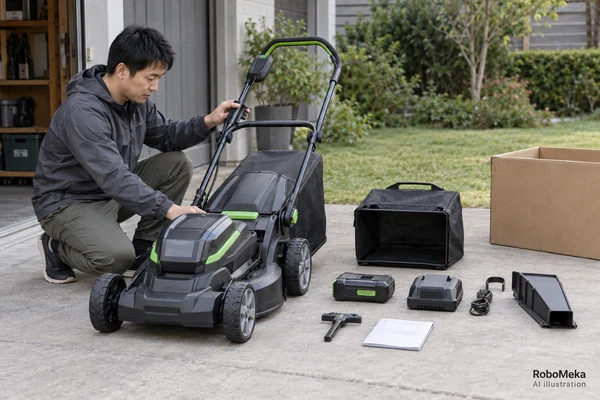
A complete battery kit should identify the pack models, quantities and charger, not simply state battery included. Some systems require more than one pack as the operating set. Distinguish those required components from optional spares when comparing the total package.
The electric mower battery-and-charger guide explains the configuration record in detail. Use that record as the basis of the quotation comparison so that the commercial spreadsheet and technical approval describe the same items.
Start with a customer segment, not a target price alone
Define the customer’s lawn, power access, mowing routine and existing equipment. A platform owner who already has approved compatible packs may value a bare tool, while a first-time customer needs a clearly complete starting package. These are different offers, not necessarily good and bad versions of one product.
For a corded range, evaluate whether the intended customers can use the approved supply arrangement practically. A low purchase price does not solve unsuitable cable routing or electrical access. Likewise, a large battery kit does not resolve narrow gates or terrain outside the mower’s instructions.
Set the essential performance and service requirements before asking suppliers to meet a price point. If the budget requires trade-offs, identify which features can change without undermining the customer need. Do not allow an unspecified battery, charger or cutting-system substitution to become an invisible cost reduction.
The electric mower site-fit guide helps connect the offer to the property. Price tiers are easier to explain when each serves a recognizable application rather than relying on a sequence of increasingly large but poorly defined power numbers.
Normalize the machine specification
Match cutting width, height adjustment, propulsion, clipping modes and supplied accessories where they are important to the application. Record overall dimensions and storage features if they affect the sales channel. A superficially similar deck does not establish equivalent handling or customer contents.
Ask suppliers to define electrical ratings and performance claims. Input power, peak labels and useful cutting results should not be treated as interchangeable. A higher number may reflect a different measurement convention or configuration rather than a benefit that the buyer should pay for.
For battery products, tie runtime evidence to the quoted kit. EGO’s mower information illustrates the importance of identifying variables that affect endurance. Its results are not transferable to another brand, but the disclosure principle is relevant to comparing offers fairly.
Keep optional upgrades on separate lines. A larger approved pack, collection accessory or different handle arrangement may be valuable for a particular segment. Showing the incremental scope makes the comparison more transparent than allowing every supplier to quote a different bundle under one common product heading.
Build a complete-offer comparison sheet
The table below provides a structure for normalization. Enter confirmed amounts where available and mark unresolved items explicitly. Do not fill a missing quotation line with zero simply to make a total possible.
| Cost or scope line | Corded offer | Battery bare tool | Complete battery kit |
|---|---|---|---|
| Machine configuration | Confirm electrical version | Confirm approved platform | Confirm approved platform |
| Energy components | Identify supplied and required arrangements | Price missing approved packs and charger if needed | List exact included packs and charger |
| Cutting accessories | Confirm bag, insert and other contents | Confirm actual contents | Confirm actual contents |
| Documentation | Match market and model | Include compatibility information | Match all kit components |
| Packaging and logistics | Use actual carton data | Confirm no battery is included | Review actual battery shipment |
| Project charges | Separate artwork or variant costs | Separate platform or label costs | Separate kit or regional-version costs |
| Service provision | Define electrical fault support | Define tool and compatibility support | Define mower, pack and charger support |
| Replacement planning | Identify applicable parts | Confirm approved energy availability | Confirm kit replacement identities |
Have purchasing, logistics and service teams review the comparison. Each can identify exclusions that another department may overlook. A complete offer is not necessarily one in which the supplier pays every cost; it is one in which the responsibilities are visible and agreed.
Retain the original quotations and record clarification dates. A normalized spreadsheet is a buyer’s interpretation. If a supplier changes a pack, charger, shipping term or validity period, update the comparison and preserve the revision so the final decision can be traced.

Examine regional-version costs without shortcuts
An electric product’s destination version can affect components, instructions, labels and evidence. Ask the supplier to describe the actual scope rather than quote a plug change as though it were always the only difference. Qualified reviewers should determine the applicable requirements.
The NIST conformity-assessment overview explains that different assessment activities serve specific purposes. A document package has value when it applies to the supplied configuration, not merely because it is lengthy. Do not pay a premium for unspecified certifications without reviewing their relevance.
Clarify whether translation, artwork review, samples or additional evaluation are one-time charges or recurring costs. A first order may carry project work that later orders do not, while a new regional variant can introduce additional scope. Keep those distinctions visible in the business case.
Do not remove a required review simply to reach a target price. If the proposed market version cannot be supported within the budget, reconsider the product or launch scope. Commercial pressure does not establish that a different electrical configuration is technically equivalent.
Evaluate operating cost with honest assumptions
Electricity cost depends on actual energy use and the relevant tariff, not only the mower’s rated input or battery label. A useful estimate defines the task and measurement basis. This article does not provide current electricity prices or claim a universal cost per lawn.
For battery products, replacement planning may affect ownership cost, but buyers should not invent a guaranteed service life or replacement interval. Use applicable supplier evidence and clearly labeled scenarios. Battery warranty terms and measured capacity retention are different kinds of information and should not be merged casually.
For corded products, the approved supply arrangement and storage routine can affect customer convenience. These are real selection considerations even when they do not appear as a recurring invoice. Avoid forcing every practical difference into a speculative monetary figure simply to produce a single exact-looking total.
Compare equivalent useful work where possible. A product that uses less energy during a short interval but leaves an unacceptable result has not necessarily delivered a lower-cost mowing task. University of Minnesota Extension’s mowing guidance helps explain why the intended turf outcome and routine matter.
Send your electric mower quotation requirements with the customer segment, destination and exact package you want compared. The downloaded brief supports a scope discussion with RoboMeka; it does not establish a current price or confirm the availability of every format in this guide.
Include packaging and transport in the decision
Request carton dimensions, gross weights and packing details for the production package. A sample shipment may use different protection or accessory placement. Do not build a full-order logistics estimate from an early sample carton without confirmation.
Battery kits need shipment-specific review. IATA’s battery transport resources provide air-transport guidance, but qualified logistics staff must assess the actual shipment and route. A bare-tool offer and a kit with spare packs can have different transport implications even when the mower is identical.
Clarify the agreed delivery term, named place and responsibilities with suitable commercial advice where needed. Freight included is not a complete description of who bears every cost or risk. Use verified logistics quotations and destination information rather than introducing universal percentages for duties, damage or handling.
Packaging changes should be assessed for protection and receiving practicality as well as cube reduction. A smaller carton can create customer assembly work or accessory-identification problems. Ask warehouse and service staff to review the proposed package before counting every reduction in carton size as an unqualified saving.
Price the service model behind the warranty
A headline warranty period does not explain the diagnosis, replacement and communication process. Ask which party handles inquiries, what information is required and how the agreed responsibilities are fulfilled. Obtain appropriate advice for destination-market obligations rather than assuming a supplier’s wording settles every local requirement.
For battery products, support must distinguish mower, pack and charger questions. Replacing an entire kit may be unnecessary, while an incorrect component recommendation can create further problems. The value of clear identities and an approved escalation process should be considered in the supplier comparison.
Parts information is a practical part of the offer. Toro’s parts resources illustrate a model-based identification approach. Your supplier must provide applicable references for the actual product, and any future availability commitment should be specific enough to rely on rather than a general promise of lifetime support.
Maintenance tasks need suitable competence and instructions. HSE’s machinery-maintenance guidance provides relevant principles. Do not select a low-cost support model that depends on local staff performing unauthorized electrical or cutting-system repairs.
Assess proposed cost reductions individually
Imagine a supplier proposes a lower-priced battery kit by changing the charger, removing a spare pack and simplifying the carton. These are three separate changes. The charger requires compatibility and evidence review, the pack removal changes the customer offer, and the carton change affects protection and handling.
Ask for the saving and affected requirements for each proposal. Some changes may be sensible for a defined segment; others may undermine the approved application. The decision should be based on the trade-off, not on an aggregated saving that hides how the product has changed.
Production and inspection scope should also remain explicit. NIST’s acceptance-sampling introduction explains lot sampling’s role and limitations. Reducing inspection activity does not make the underlying quality risks disappear, and a passed inspection does not replace product qualification.
Finally, examine the order quantity attached to the price. A larger volume may reduce the unit quote while increasing inventory exposure and service stock needs. Compare the offer against a realistic launch and replenishment plan instead of assuming that the lowest quantity-based price is the best business outcome.
Keep customer-facing prices consistent with the package
When the range is prepared for sale, check that each price is attached to the correct contents and compatibility explanation. A photograph of a complete kit beside a bare-tool price can create confusion even if the internal quotation spreadsheet is accurate. Make the distinction visible at the point of comparison and keep optional accessories clearly separate from required operating components.
Frequently asked questions
Why can a battery bare tool look much cheaper than a kit?
The bare tool may exclude packs and a charger that a new customer needs. It can still be appropriate for owners of approved compatible components. Identify the target customer and normalize the missing items before comparing prices. Do not assume that every battery platform owner already has a suitable operating set.
Is a corded electric mower always the lowest-cost choice?
Not necessarily for every customer or purchasing program. Package contents, regional version, logistics, service and site suitability matter. A low unit price can be attractive where the approved operating arrangement fits, but it does not resolve an unsuitable cable route or missing support responsibilities.
Should buyers include battery replacement in ownership estimates?
Consider it using applicable evidence and clearly labeled scenarios, not an invented universal lifespan. Confirm replacement identities and current commercial information. Separate warranty terms from measured battery performance, and explain the assumptions so that the estimate does not appear more certain than the underlying information supports.
Can a cheaper charger be substituted to reduce kit cost?
Only after the responsible manufacturer and reviewers approve the complete configuration. Connector fit or a similar label is not enough. Assess compatibility, regional evidence, instructions and any charging claims, then update the package record. Treat the proposal as a controlled change rather than a warehouse-level substitution.
What makes an electric mower quote comparable?
It identifies the machine and electrical version, exact contents, relevant evidence, project charges, delivery responsibilities and support scope. Unresolved exclusions are visible, and the application is defined. A comparable quotation lets the buyer explain what the customer receives and what obligations remain after the unit price is paid.
Conclusion
Electric mower price comparison should begin with package identity and end with a clear allocation of costs and responsibilities. Distinguish corded units, bare tools and complete kits; normalize the application and evidence; and assess service and logistics alongside the factory quote. This produces a more useful decision than ranking unlike offers by unit price alone.
Prepare a complete-kit quotation inquiry, review the downloaded document and email it to info@RoboMeka.com. The form does not automatically send email or establish pricing, MOQ, delivery terms or confirmed product availability.