The short answer
Choose an electric lawn mower for the usable mowing area and the way that area must be reached, not the property’s total size alone. Corded products need a practical, approved electrical supply and cable arrangement. Battery products need an appropriate energy plan. Both require suitable access, handling and operation within the manufacturer’s terrain limitations.
Introduction
Choose an electric lawn mower for the usable mowing area and the way that area must be reached, not the property’s total size alone. Corded products need a practical, approved electrical supply and cable arrangement. Battery products need an appropriate energy plan. Both require suitable access, handling and operation within the manufacturer’s terrain limitations.
A garden can be small but difficult because it contains narrow gates, disconnected grass zones or awkward transitions. A larger open lawn can present a simpler route while demanding more sustained work. For buyers, the useful question is whether the complete mowing session is practical for the intended user and product, rather than whether one area figure appears below another.
This guide addresses electric walk-behind site qualification. It does not authorize operation on any particular slope or provide electrical installation instructions. RoboMeka’s availability must be confirmed for the requested format; the educational coverage of electric mowers should not be read as a catalog of confirmed models.
Separate grass area from property area
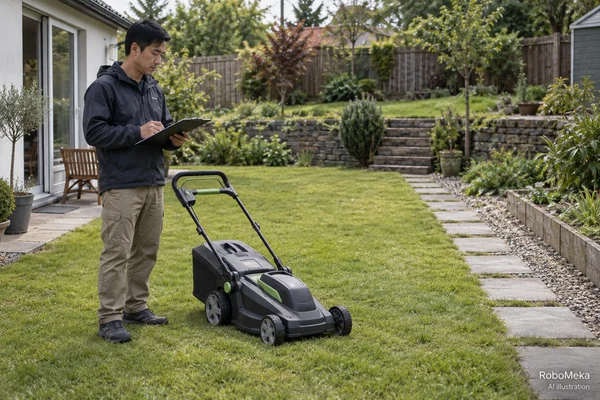
Start with a simple site plan. Mark the grass that will actually be maintained and separate buildings, paths, beds and other excluded surfaces. A property listing or plot size may substantially overstate the mowing task. Equally, a single visible lawn may conceal another zone that the customer expects the same machine to maintain.
Record how the area was estimated and the uncertainty involved. A rough customer sketch is useful for an initial conversation but should not become a precise performance claim. If the purchase depends on a close capacity margin, obtain better site information or a relevant application evaluation.
For a hypothetical site, a 360-square-meter garden containing 75 square meters of paving and planting would leave 285 square meters of grass, assuming those measurements and exclusions are correct. This arithmetic explains the method; it does not establish that any particular mower can finish that lawn in one session.
Keep maintenance expectations with the area record. Regularly maintained grass and occasional heavy cutting represent different workloads. University of Minnesota Extension’s mowing guidance explains why mowing frequency and the amount removed matter. Adapt the application brief to local turf conditions rather than using area alone.
Map access before considering coverage claims
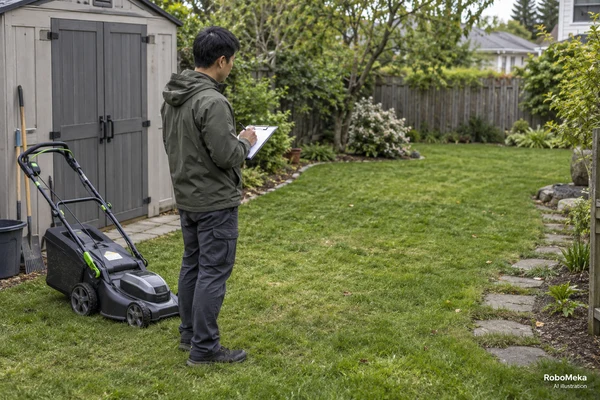
Identify gates, passages, steps, storage doors and surface transitions along the route. Ask whether the mower will be moved between front and rear lawns, carried or transported, and whether those activities are permitted and practical under the instructions. Do not assume that a folding handle makes every transfer manageable.
Compare access openings with the overall machine dimensions in the relevant configuration, not only the cutting width. Collection or discharge accessories can affect the space needed. A dimension that works for storage may not describe the machine while operating or being moved according to its manual.
Consider the user’s handling requirements without making assumptions about their strength or ability. Where lifting is necessary, ask for the manufacturer’s handling information and assess suitability for the intended customer. A product that performs well on the lawn may still be a poor recommendation if it cannot be moved safely along the access route.
Document obstacles that force frequent turns or changes in direction. Trees, furniture and narrow strips reduce straightforward mowing and can make a wider deck less useful than expected. The site plan should show those features before the buyer translates nominal width into an estimated completion time.
Assess the corded operating route separately
For a corded mower, electrical access is an essential site question. Identify where the approved supply would be obtained and whether the manufacturer’s permitted cable arrangement can serve the intended zones. Do not prescribe a cable type, length or protective arrangement without the actual product instructions and applicable local expertise.
The route should be evaluated as part of ordinary use, including movement around obstacles and between zones. A straight-line distance from socket to lawn does not describe every turn or obstruction. The customer needs a workable routine that follows the manual, not merely a cable that reaches the farthest point on a drawing.
Avoid suggesting improvised extensions, adapters or altered protection to make an unsuitable site appear compatible. If the approved setup is unclear, resolve it with the manufacturer and a qualified person before recommending the product. An unresolved electrical-access question is a reason to pause that configuration choice, not to hide the limitation.
Manufacturer support materials such as Toro’s residential help resources illustrate the importance of product-specific instructions. Use the selected mower’s own documentation for actual arrangements; guidance for another brand or model does not establish approval for the proposed product.
Assess battery logistics without ignoring the site
A battery mower can move between zones without a trailing supply cable, but the work still includes travel, maneuvering and any required stopping. Record whether the machine must be powered down or handled in a particular way during transitions according to its instructions. These activities affect the customer’s session even when they do not cut grass.
The battery plan should use the approved pack configuration and a realistic workload. Grass condition, height reduction, propulsion and clipping mode can affect endurance. EGO’s mower information provides a manufacturer example of explaining such variables; it cannot predict performance for an unrelated product.
Ask where charging will take place and whether that location can meet the charger and pack instructions. Do not assume that an outdoor storage box, unheated shed or convenient extension arrangement is suitable. The product documentation and local electrical requirements should guide the setup.
If a spare-pack plan is proposed, check the complete working routine. The user must be able to identify, handle and charge the approved packs as instructed. Additional energy can address one constraint, but it does not solve narrow access, unsuitable terrain or a mismatch between mower format and user expectations.
Treat slope as a qualification boundary
Ask the manufacturer for the product’s intended terrain conditions and slope limitations, including any distinctions between operation, transport and storage. Do not transfer a limit from another model, from a riding mower to a walk-behind product, or from a robotic mower to manually operated equipment.
Slope descriptions need units and context. Percent grade and degrees are different measures. Even a correctly stated angle does not capture surface condition, traction, unevenness or nearby hazards. A buyer should not use a conversion calculation as permission to operate a mower on the site.
Record the location and nature of sloped areas, and refer uncertain cases to the manufacturer or a competent assessor. Where the site falls outside the product’s instructions, choose another supported solution rather than proposing an unapproved operating technique. The purchasing objective is appropriate equipment, not pushing a sample to its limit.
OSHA’s landscaping hazard resources provide broader workplace context for machinery and site risks. They do not replace a model-specific manual or local assessment, but they reinforce why terrain decisions should include the surrounding work environment rather than only a headline slope figure.
Use a site-qualification worksheet
The worksheet below helps sales and purchasing teams collect consistent information. It is a screening tool, not an approval certificate. Any unanswered safety-critical question should remain visible until the responsible manufacturer or qualified reviewer resolves it.
| Site feature | Information to collect | Purchasing consequence |
|---|---|---|
| Grass area | Separate zones and measurement basis | Defines the actual mowing task |
| Access | Openings, steps and handling route | Checks physical suitability |
| Surface | Uneven areas and transitions | Informs terrain review |
| Slopes | Location, description and reliable assessment | Requires model-specific confirmation |
| Corded supply | Approved access and permitted cable arrangement | Determines corded feasibility |
| Battery setup | Pack package and compliant charging location | Determines readiness planning |
| Obstacles | Narrow strips, turns and excluded areas | Affects practical route efficiency |
| Maintenance routine | Grass condition and mowing frequency | Defines expected workload |
| User requirements | Storage, lifting and handling constraints | Guides format selection |
Include a photograph or sketch only where it helps explain the site. Avoid collecting unnecessary personal information or showing private details in supplier communications. A concise diagram with relevant dimensions can be more useful than a large collection of unstructured photographs.
Have the customer confirm the important assumptions in plain language. If the recommendation depends on mowing regularly, using a specific approved package or excluding a particular area, make that condition explicit. Hidden assumptions create service disputes that a clearer initial assessment could prevent.
Send your electric mower site requirements with a simple lawn-zone description, access constraints and preferred power format. Review the downloaded brief before sharing it with RoboMeka, and omit private details that are unnecessary for assessing product fit.
Estimate completion time with realistic losses
Nominal cutting width and forward movement describe only part of the session. Overlap, turns, obstacles, emptying and transitions reduce effective coverage. For procurement, record those activities rather than presenting a theoretical straight-line calculation as a guaranteed area rating.
Consider two hypothetical lawns with the same grass area. One is a single open rectangle; the other has several narrow sections connected by paths. The second may require more maneuvering and transfers even though the total area is identical. The example explains a planning variable, not a measured performance difference between products.
Use representative application checks when the decision depends on completion time. Keep the product configuration and relevant lawn conditions documented. If the result is close to the customer’s required session, acknowledge the uncertainty rather than describing the sample as comfortably suitable.
The electric mower power-and-runtime guide explains why energy and load claims need defined conditions. Connect its evidence questions with the site worksheet so that a supplier’s runtime figure is not interpreted independently of the lawn it is expected to maintain.
Review uneven ground and turf outcomes
Surface irregularity can affect handling and the finished cut. The mower’s wheel and deck geometry interact with the ground, so a height setting that works on a level area may not produce the same appearance elsewhere. Do not solve every uneven-lawn problem by recommending a lower setting or a wider deck.
University of Maryland Extension’s lawn-problem guidance discusses mowing-related turf problems and site factors. It is useful background for distinguishing an equipment issue from an application or maintenance issue. Local turf advice may be needed where the site itself requires improvement.
Inspect the intended area before a demonstration and remain within the product’s permitted use. The evaluation should not deliberately expose the machine or operator to hidden objects, unstable ground or other hazards to prove robustness. A responsible procurement test answers a defined application question safely.
Record limitations in the customer-facing recommendation. If an area needs separate treatment or a different tool, explain that rather than promising that one mower can solve every part of the property. An honest scope boundary improves both customer satisfaction and the usefulness of the sourcing brief.
Keep walk-behind and robotic site assessments distinct
Robotic mowing introduces boundary, docking, navigation and scheduling questions that do not map directly onto a walk-behind route. A site suitable for one format may need different preparation for the other. Do not use a robotic area rating to justify a manual electric mower’s capacity, or vice versa.
Buyers considering RoboMeka’s robotic category can review the robotic mower installation checklist alongside their site information. Confirm the actual model and installation requirements before presenting a solution. This article’s wider electric category discussion is educational, not evidence that every machine format is supplied.
Service arrangements also differ. A walk-behind issue may involve transport to a service point, while a robotic issue can require site-specific diagnosis. HSE’s maintenance guidance supports appropriate planning and competence, but each product needs its own approved procedures and responsibilities.
Revisit the site assessment when the customer changes the lawn layout, storage location or operating expectations. Suitability is based on a defined application. A new gate, added planting area or different charging arrangement can change the practical recommendation even though the mower itself has not changed.
Frequently asked questions
Can buyers use the total property size to choose a mower?
Use the actual grass area and its layout instead. Buildings, paths and planting areas should be excluded, while all grass zones should be included. Then consider access, obstacles, terrain and the maintenance routine. A single plot-size figure does not describe the work that the mower must perform.
Does a small lawn always favor a corded electric mower?
No. The approved electrical arrangement and practical cable route matter as much as area. A small divided garden may be inconvenient for a corded product, while a simple site may suit it well. Evaluate the actual conditions and instructions rather than applying one category recommendation to every small lawn.
Can a larger battery compensate for difficult terrain?
It may change available energy if approved for the machine, but it does not change the mower’s permitted terrain or resolve unsafe access. Confirm compatibility and model limitations first. Treat energy planning and site suitability as separate requirements that both need to be satisfied.
How should buyers assess a slope claim?
Ask for the exact model’s instructions, units and operating conditions, and obtain a reliable assessment of the site where necessary. Surface and surrounding hazards matter as well as the angle. Do not borrow limits from another mower format or treat a mathematical conversion as authorization to operate.
What should be included in a site-based inquiry?
Provide the approximate grass area, separate zones, access openings, terrain concerns, mowing routine and available power arrangements. State the basis and uncertainty of measurements. A simple relevant sketch can help. Avoid unnecessary personal information and ask the supplier to identify any questions requiring further assessment.
Conclusion
Electric mower site fit depends on grass area, route, access, terrain and the complete power arrangement. Qualify those conditions before interpreting coverage claims, and preserve any limitations in the recommendation. A clear site brief helps buyers select equipment that customers can actually use and support within its intended scope.
Prepare a site-fit sourcing brief, check the downloaded file and email it to info@RoboMeka.com. The form does not transmit the document automatically or confirm suitability, availability or installation approval for a particular site.