The short answer
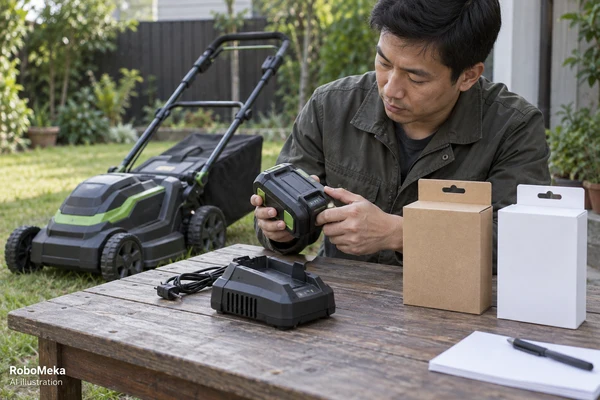
For an electric mower range, battery and charging procurement begins with SKU clarity: determine which machines are corded, which use batteries, which packs are approved and exactly what each customer package contains. Then verify the charger’s destination-market version, the documented operating conditions and the replacement plan. Similar product names do not establish compatibility.
Introduction
For an electric mower range, battery and charging procurement begins with SKU clarity: determine which machines are corded, which use batteries, which packs are approved and exactly what each customer package contains. Then verify the charger’s destination-market version, the documented operating conditions and the replacement plan. Similar product names do not establish compatibility.
This distinction matters because electric does not always mean cordless. A corded walk-behind mower may have no removable traction or cutting battery, while a battery mower can be sold as a bare tool or in several kits. Robotic equipment introduces another charging arrangement again. Buyers should not apply one battery checklist indiscriminately across all of these products.
This guide focuses on controlling the energy subsystem within an electric assortment. It does not provide unverified pack specifications, charge times or battery safety approvals for RoboMeka. Confirm available models and use the actual manufacturer’s instructions and qualified technical advice for the selected configuration.
Separate machine identity from package identity
The same basic mower may appear in a bare-tool offer, a single-kit offer and a larger package with additional approved components. Each needs an identity that makes the contents unambiguous to purchasing, the warehouse and the customer. A machine model alone may not distinguish those commercial packages.
Record the mower model and revision separately from the pack and charger models. Include the quantity of each item and any essential adapters or mounting accessories that are approved for the system. Do not assume that an accessory is included because it appears in a lifestyle photograph.
For a corded SKU, identify the electrical version and supplied cable-related components according to the manufacturer’s documentation. Mark battery fields as not applicable rather than leaving them blank. A deliberate not-applicable entry is clearer than an empty cell that a later employee may interpret as missing information.
The electric mower selection guide explains the broader format decision. Once that choice is made, the battery-and-charger record should describe the exact package being purchased, not a general family of products that happen to share branding.
Verify compatibility through approved documentation
Request a compatibility matrix from the supplier identifying approved mower, pack and charger combinations. Check whether revisions, regional versions or operating modes affect that approval. Physical fit and similar voltage labels are not sufficient evidence that components can be safely or correctly combined.
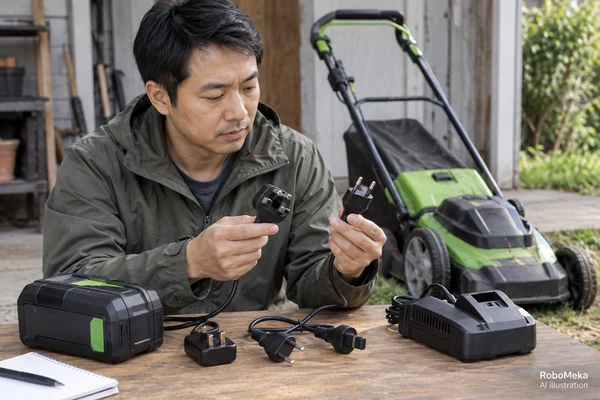
Do not propose third-party adapters or modified connectors to close a package gap. Such changes can affect protections, control communication and the validity of the original evidence. If the buyer needs an alternative component, have the responsible manufacturer assess and document the proposed configuration.
Clarify whether the mower requires one pack, two packs or another defined arrangement to operate. Distinguish simultaneous operating requirements from optional spare packs. A carton containing two batteries can represent a single operating set rather than two separate sessions, depending on the product design.
Manufacturer support systems such as Greenworks’ customer support hub illustrate the importance of product-specific assistance. They do not establish compatibility for other brands. Your supplier must provide an applicable, maintained record for the equipment actually ordered.
Interpret battery labels without creating false equivalence
Voltage, ampere-hours and watt-hours describe different aspects of a pack. Ask whether voltage is nominal or expressed using another convention. Where the label values support it, nominal voltage multiplied by ampere-hours provides a nominal energy figure; it does not directly state useful mowing time or mechanical output.
Two packs with similar headline energy can differ in approved application, control interface, construction and operating limits. Purchasing should therefore avoid treating capacity as the sole equivalence criterion. A proposed substitution needs review of the complete system and the relevant evidence.
Ask the supplier to identify the pack model, revision and traceability method. The information should remain usable when a customer contacts support months later. A battery described only as the large one or the latest version creates avoidable ambiguity in replacement and diagnosis.
Performance claims must remain tied to the specified pack arrangement. EGO’s mower information gives a manufacturer example of explaining runtime variables. Use that as a reason to request clear conditions, not as permission to transfer its results to an unrelated battery system.
Review the charger as a destination-market product
The charger is not a generic accessory that can be changed casually at packing. Verify its model, approved pack compatibility, input characteristics and destination-market version through the supplier’s documentation. A plug that physically fits a socket does not by itself establish a suitable electrical configuration.
Have the relevant product and conformity specialists review the evidence for the intended market. This guide does not prescribe universal electrical ratings or certify a particular regional version. The NIST conformity-assessment overview helps explain why reports and declarations must be evaluated for their specific scope.
Instructions should identify charging conditions, indicators and the response to abnormal behavior. Confirm that the manual illustrations and terminology match the charger in the carton. A translated booklet for an older version can confuse users even if the mower itself has not changed.
Keep regional package changes controlled. If the supplier proposes a different charger to meet availability or cost targets, review compatibility, documentation, labeling and any performance claims before approval. Do not allow the warehouse to treat all chargers within a brand as interchangeable.
Build an energy-package release matrix
Use a matrix to connect the physical components with commercial and technical records. The example below defines questions rather than acceptable answers. It should be completed for each relevant SKU and reviewed when any component changes.
| Record | Required detail | Release question |
|---|---|---|
| Mower | Model and revision | Does it match the approved sample? |
| Operating pack set | Models and quantity needed in use | Is the combination explicitly approved? |
| Spare packs | Included quantity and identity | Are these additional to the operating set? |
| Charger | Model and regional version | Does it match the packs and destination? |
| Instructions | Language and revision | Do they describe the actual components? |
| Claims | Runtime or charging statement with conditions | Does the evidence cover this package? |
| Transport | Shipment-specific battery information | Has logistics reviewed the actual consignment? |
| Replacement support | Part identity and ordering route | Can the customer obtain the correct item? |
Add a status for unresolved items and name the responsible reviewer. A package should not be marked ready simply because the mower passed an earlier evaluation if the charger or battery identity is still undecided. The release decision concerns the complete customer offer.
Use the same identifiers on quotations, purchase orders, inspection instructions and service records. Where internal and supplier codes differ, maintain a controlled cross-reference. Consistent naming is a practical defense against wrong-kit shipments and unsuitable replacement recommendations.
Ask the right questions about charging time
A charging-time claim should state the pack, charger, starting condition and relevant environment. Ask whether the stated endpoint means a particular indicated state or another defined condition. Without those details, two apparently similar charge-time claims may not answer the same question.
The interval after mowing may include more than the charger’s active cycle. The product may require conditions to be met before charging begins, and the user must follow the manual. Do not assume that a hot, recently used pack will behave exactly like the pack in a controlled demonstration.
For a household package, evaluate whether the arrangement suits the normal gap between mowing sessions. For a more demanding schedule, build a documented rotation plan using approved components. Additional packs are not a substitute for understanding charger throughput and handling requirements.
Avoid presenting fast charging as universally better. It may be useful for a defined schedule, but the buyer should assess the approved system, commercial cost and support implications. A larger charger label is not a complete explanation of customer value.
Send your electric mower battery-kit requirements with the destination, proposed package and expected mowing routine. Use the downloaded brief to confirm product scope and the information needed for an applicable quotation; it is not itself a compatibility approval.
Include storage and routine handling in the support plan
Ask for the pack and charger storage instructions, including relevant environmental limits and preparation for extended non-use. Do not invent one storage state or temperature recommendation for all battery chemistries and products. The approved documentation should define the conditions for the actual system.
Customer guidance should make it clear how to identify damaged or abnormal components and where to seek help. Do not instruct customers to open a battery pack, repair internal connections or continue using a suspect component. Escalation procedures should be reviewed by the responsible manufacturer and service organization.
The local support team needs a boundary between basic identification and authorized technical work. HSE’s machinery-maintenance guidance emphasizes planned work and competence. It is not a battery repair manual, but it supports the need for a defined service scope rather than improvised troubleshooting.
Keep photographs and instructions truthful. A staged illustration can explain where labels are located, but it should not be presented as evidence of a real safety test or customer incident. The support record should distinguish illustrative content from observations of an identified product.
Coordinate battery transport with qualified logistics staff
Battery shipping requirements depend on the actual articles, packaging, transport mode and route. Involve the logistics provider early, particularly if the package changes from a bare tool to a kit or adds spare packs. Do not wait until production is complete to discover that the shipping plan was based on different contents.
IATA’s lithium-battery resources provide current air-transport guidance. The actual consignment still requires competent assessment. A generic statement that batteries are approved for shipping does not identify the applicable conditions for every package or carrier.
Ask for the relevant transport documentation and verify that its identities match the shipped battery. A test summary serves a specific purpose and should not be described as a complete certification of the mower’s safety or a substitute for all shipping requirements. Keep the evidence boundaries clear.
Record who supplies documents, who checks them and who authorizes shipment readiness. If the supplier changes a pack revision or quantity after logistics review, reassess the implications before release. Technical, commercial and transport records must describe the same physical package.
Inspect package identity and prepare replacement support
Shipment inspection should verify agreed identities and contents using safe, approved procedures. Inspectors need the release matrix and applicable documents, not only a sales photograph. A sample of cartons can support a lot decision, but it does not establish that every pack will perform identically over its life.
NIST’s acceptance-sampling introduction explains the limits and role of sampling. Keep package inspection distinct from battery qualification and long-term reliability evaluation. Each answers a different purchasing question.
Before launch, establish how replacement packs and chargers will be identified and ordered. Ask what happens if a revision is discontinued and how approved alternatives are communicated. Do not promise customers indefinite availability unless the supplier has made a specific, supportable commitment.
Run a simple support rehearsal using an imagined customer inquiry. Can staff identify the kit from the carton or receipt? Can they distinguish a missing accessory from a fault? Can they find the correct escalation contact? This exercise tests the information system without inventing failure statistics or claiming a completed field trial.
Check the customer’s first-use information
Review the unpacking and identification information for the final kit. A new owner should be able to recognize the approved charger and operating pack set, locate the applicable instructions and understand which optional items are absent. This is an information check, not a substitute for the manual’s preparation procedure.
Ask warehouse and customer-service staff to read the same package record. If they interpret included batteries differently, resolve the terminology before shipment. Consistent first-use information can reduce avoidable confusion without making unsupported promises about charging duration or the area that the initial kit will complete.
Frequently asked questions
Does every electric mower need a battery?
No. Corded electric products use a mains supply arrangement, while battery products use an approved pack system. Different formats can have other electrical components, so identify the actual architecture rather than relying on the word electric. Mark non-applicable battery fields explicitly in the purchasing record.
Can buyers substitute a charger with the same connector?
Not on that basis alone. Connector fit does not establish electrical or control compatibility. Use combinations approved for the specific pack and mower system, and have proposed substitutions reviewed by the responsible manufacturer. Update the package identity, documentation and relevant evidence before accepting a changed charger.
Why is a two-battery kit not always two runtimes?
Some products require more than one pack as the operating set, while others use one pack at a time. The kit description must distinguish operating requirements from spares. Ask how the exact configuration works and request applicable performance evidence rather than assuming that battery quantity directly multiplies useful session time.
What should a charging-time statement include?
It should identify the pack and charger, starting condition, relevant environment and defined endpoint. Ask about conditions following actual use as well as a controlled demonstration. This information helps buyers compare like with like and avoid promising a fixed turnaround that the supplied system does not support.
Which records help prevent wrong replacement batteries?
Maintain mower, pack and charger model identities, revisions, compatibility documentation and a clear ordering cross-reference. Make those identifiers accessible to the customer and service team. A controlled replacement process is more reliable than selecting a component by appearance, capacity label or a broadly similar product-family name.
Conclusion
Battery and charging procurement for an electric mower range is fundamentally a configuration-control task. Define the package, verify approved combinations, review the regional charger and connect performance, transport and service records. Buyers gain a clearer offer and fewer avoidable support ambiguities when every component has a traceable role.
Prepare an energy-package sourcing inquiry, review the downloaded document and email it to info@RoboMeka.com. The form saves a local brief and does not automatically send email, approve compatibility or confirm the availability of a proposed mower kit.