
The short answer
Approve the battery, charger and appliance as one identified bundle. Separate nominal energy, documented usable energy and qualified runtime claims, then map relevant evidence to each decision. Negotiate change notification and replacement terms before production, and give service and logistics teams consistent part identifiers and supporting documents.
Introduction
Procurement approval for a cordless vacuum battery should cover the pack, charger, appliance controls and supporting documents as one identified bundle. Buyers need to know what energy ratings mean, which combinations are approved, how changes will be controlled and how replacement parts will be supported. A long runtime claim is not enough to close those questions.
This is particularly relevant when quotations describe a battery by voltage and capacity but omit the pack revision, charger model or evidence behind the ratings. Two offers can look equivalent commercially while relying on different cells, protective controls or charging arrangements. The approval record should expose those differences before a purchase order fixes the product configuration.
This guide addresses bundle approval and the support lifecycle for manually operated cordless vacuums. It complements the cordless runtime testing guide, which explains how to evaluate operating duration. The proposed document reviews and factory checks below are sourcing recommendations, not claims that RoboMeka has completed those evaluations or offers a particular battery specification.
Make the approval object an exact product bundle
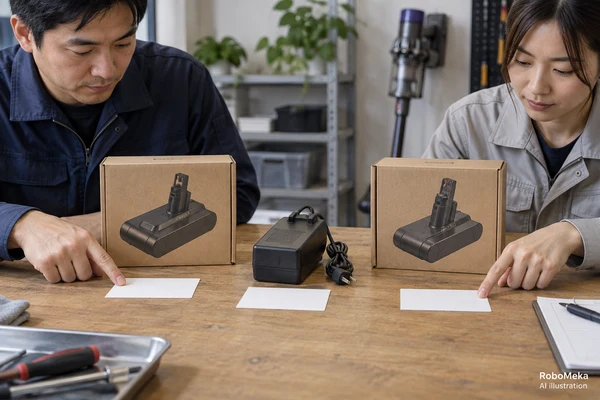
Identify the appliance model, battery pack part number and revision, approved charger and relevant accessories in the quotation. Include control software or hardware references when they influence charging, discharge limits or operating modes. The necessary detail depends on the design, but the buyer should be able to distinguish the approved combination from a similar-looking alternative.
Ask the supplier to reconcile names across the documents. A commercial model name may differ from a factory code or a battery assembler's identifier. That can be legitimate, but the relationship must be traceable. Request a mapping that connects the quotation, sample labels, technical records and replacement-part references without relying on a sales representative's memory.
Treat optional packs and chargers as separately reviewable combinations. A larger pack may change weight, enclosure fit or operating behavior. A faster charger may impose different requirements even if its connector fits. Ask for explicit compatibility evidence and applicable evaluation records before adding either option to the accepted retail bundle.
The cordless stick vacuum overview can help define the appliance brief. State whether the product is intended for main floor cleaning, a secondary household task or above-floor use. Do not assume a battery, charger or accessory shown in a concept image is an available or approved configuration.
Distinguish nominal energy from usable energy
Nominal watt-hours describe a rated energy quantity. For comparable definitions, multiplying nominal volts by ampere-hours gives a nominal energy figure. The result is useful for identifying the offered pack, but it is not a promise that all of that energy will be available at the appliance under every operating condition.
Usable energy depends on how the battery and appliance operate together. Discharge load, temperature, control limits, cutoff conditions and battery condition can influence what the system delivers before stopping or reducing operation. Ask for the supplier's defined rating and measurement basis. Do not infer available energy from an attractive cell datasheet without confirming its relevance to the assembled pack.
The public description of IEC 61960-3:2017 addresses performance tests and other requirements for specified portable lithium cells and batteries. It provides context for requesting documented ratings. It does not establish the usable cleaning duration of the quoted vacuum, nor prove that a report for one battery configuration applies to another.
Keep three fields separate in the approval record: the nominal battery rating, any documented pack-level usable-energy result and the appliance's qualified runtime statement. Each should identify its conditions and source. This prevents a mathematical capacity calculation from becoming an unsupported consumer promise about how long a powered floor head will clean.
Ask for an evidence map, not a folder of unrelated reports
Request a concise index showing which document supports which approval question. Battery performance evidence, battery safety evidence, appliance assessment and transport documentation have different purposes. A complete-looking collection can still contain gaps if report identities do not match the quoted components or if no reviewer has checked their applicability.
For performance records, ask for the tested pack identity, relevant conditions, method and results needed for the proposed claims. For safety-related evidence, have the responsible qualified reviewer confirm the applicable scope and configuration. An unfamiliar logo on a report cover should not replace verification of the issuer, document authenticity and actual items assessed.
The public scope of IEC 62133-2:2017 concerns safe operation of specified portable lithium cells and batteries under intended use and foreseeable misuse. Treat it as a scope reference when requesting evidence. It does not turn a cell document into approval of an entire vacuum and charger combination or establish that the supplier holds any certification.
If information is missing, record the gap precisely. For example, the charger identity may be unresolved even though the pack has supporting documents. Decide what is needed to close that item and who will review it. Avoid a single vague status such as paperwork complete that hides different technical and commercial decisions.
| Approval item | Evidence to connect to the bundle | Decision the buyer records |
|---|---|---|
| Pack identity | Model, revision, ratings and identifier mapping | Exact battery covered by the order |
| Energy statement | Rating basis and relevant performance conditions | Which energy wording is supported |
| Charger compatibility | Approved combinations and operating instructions | Included charger and permitted alternatives |
| Safety assessment | Applicable documents tied to the actual configuration | Reviewer conclusion and any open conditions |
| Runtime claim | Appliance, tool, mode, battery and endpoint | Consumer wording permitted for that bundle |
| Transport handoff | Test-summary access and shipment details | Documentation ready for logistics review |
| Lifecycle support | Replacement references and negotiated change terms | Responsibilities beyond the first shipment |
Review charging as a system function
Record the complete charging path. Depending on the design, the user may connect an adapter directly to the appliance, place the appliance on a charging stand or remove the pack for an approved charger. Ask which parts perform charging control and which are passive holders. The answer should be reflected in the bill of materials and instructions.
Request documentation for permitted supply conditions and the destination-market variant. A universal-looking adapter housing does not establish electrical suitability. Match the charger model, input information, cable and plug arrangement to the actual offer and applicable review. Any alternative should be identified rather than absorbed into a generic accessory description.
Ask what the user will see during normal charging and when charging cannot proceed. Temperature-related delay, connection problems or a battery fault may require different indications and actions. The instructions should use language that customers and support staff can understand. Do not infer diagnostic capability from a display image or an unexplained indicator light.
Review recharge statements with their conditions. The initial state, temperature, endpoint and required delay after use can change the interpretation of a quoted time. A procurement approval should identify the accepted wording and any qualification. Detailed time measurement belongs in the evaluation plan; the bundle review ensures that the result follows the charger and pack actually being purchased.
With those records available, send your cordless battery and charger approval requirements. Include the destination market, proposed bundle, energy claims and document gaps so the next discussion can address the specific combination under consideration.
Keep protection behavior visible in the product proposition
Ask for the manufacturer's documented operating limits and user responses. The pack and appliance may limit operation under certain conditions to protect the system. Procurement needs to understand the effect on the intended cleaning task and service process without asking unqualified staff to defeat protections or recreate hazardous faults.
Separate a normal endpoint from an unexplained interruption. If a product reduces output before stopping, the runtime statement should identify what the measurement counts. If an indicator requests maintenance, the customer instructions should explain the action. These issues connect the control design with the meaning of useful runtime and the volume of avoidable support questions.
A protection document does not establish endurance. Conversely, a successful operating demonstration does not prove that all protective functions have been assessed. Keep those approvals separate and assign each to the appropriate reviewer. The buyer's evidence map should show which questions are answered and which require further information or qualified testing.
Request enough information for service diagnosis. Support staff should be able to distinguish the approved pack and charger, gather relevant symptoms and follow the manufacturer's process. They should not need to open a battery enclosure or improvise electrical tests. Clear diagnostic boundaries improve the practicality of the support arrangement agreed during procurement.
A hypothetical usable-energy approval worksheet
Imagine two hypothetical quotations for the same proposed cordless floor-cleaning role. Both list a similar nominal watt-hour rating. Offer A provides only the capacity field and a maximum-minute claim. Offer B identifies the pack, charger and conditions behind its claims. That difference makes B easier to review, but does not yet prove superior runtime or quality.
The buyer's worksheet records the appliance configuration, intended mode, included powered head and each document reference. It then separates nominal rating evidence from any pack-level measurement and complete-appliance runtime evidence. Where a field is unsupported, the buyer marks it open rather than estimating a value from the other supplier's information.
Suppose A later submits a report for a related battery using a different cell configuration. The technical reviewer asks for a documented explanation of relevance to the offered pack. The buyer cannot close the gap merely because the voltage and capacity labels appear similar. The decision is whether the evidence supports that exact design and the intended claim.
Suppose B offers a lighter pack as an alternative. The buyer records it as a separate bundle and requests the corresponding charger approval, ratings and runtime wording. The lighter option may fit the customer role better, but that conclusion must follow the application review. Nominal energy is one input, not an automatic ranking of the two proposals.
The final approval sheet states which combination is accepted, what wording can be published and which conditions remain outstanding. This hypothetical example provides a document structure only. It does not represent measured supplier results, available RoboMeka packs, predicted failure rates or a guaranteed relationship between battery size and cleaning performance.
Negotiate change control before placing production orders
Ask suppliers to identify changes that require notification and review. Relevant changes can include cell type, pack assembly, protective components, firmware, charger design or connector arrangements. The buyer and supplier should agree which records need updating and how evidence will be assessed before a revised combination enters the order stream.
A substitution described as equivalent still needs a defined basis. Matching nominal capacity does not establish identical behavior under the appliance's load or identical relevance of existing documents. Request the changed identifiers, reason, assessment of affected requirements and proposed verification. The appropriate review can be targeted, but it should be documented.
Define how revised parts are distinguished in stock. Labels, packaging references and service documentation should allow staff to identify the correct version without guessing from appearance. If old and new versions remain compatible, record the permitted combinations. If they do not, the transition plan should explain how sales and support will avoid mixing them.
The cleaning-product RFQ framework can help place these requirements into quotation terms. Include the approval process, responsibility for evidence and treatment of deviations. Do not leave technical change control entirely to informal correspondence after tooling, packaging and shipment dates have already been agreed.
Make replacement support commercially specific
Discuss the replacement pack and charger as service items before the first bulk order. Request part numbers, proposed supply terms, packaging, ordering conditions and the process for superseded versions. Any desired support period should be negotiated explicitly. A general statement that parts are available does not define quantities, pricing or future continuity.
Link the support plan to the actual customer replacement route. A user-removable battery and a service-only replacement require different instructions, labor and stock arrangements. Confirm who performs the work, which assemblies are supplied and how the service provider identifies the correct revision. Avoid promising effortless replacement until the process is documented and evaluated.
Use the spare-parts planning guide to connect this decision to service inventory and forecasting. Battery storage and stock review should follow the manufacturer's requirements. A large initial spare order is not automatically a solution to long-term support if the business lacks an appropriate storage and replenishment process.
Prepare the production and transport handoff
Recommended factory testing should address the approved design and production risks through documented controls. Ask how pack and charger identity, relevant functional checks and nonconforming units are managed. The production record should connect sampled or monitored checks with the shipped configuration. Such checks complement design evidence rather than replacing it.
For transport, the PHMSA guidance on lithium battery test summaries explains the role of summary information for battery design tests. Request access to the relevant summary and check that its identifiers map to the offered battery. Do not treat a material safety sheet or a generic transport statement as an automatic substitute.
Provide logistics with the actual shipment arrangement, including whether packs are installed, packed with equipment or shipped separately. The responsible specialist should confirm applicable current requirements for the route and carrier. Shipment inspection can verify pack identities and order contents; it cannot independently establish that all design or transport obligations have been satisfied.
Frequently asked questions
Is the cell brand enough to approve a cordless vacuum battery?
No. The assembled pack also includes its configuration, connections, protective functions and enclosure, and it operates with specific appliance and charger controls. Request evidence tied to the offered pack and bundle. A recognized cell name can be relevant information, but it does not establish complete-product performance, compatibility or conformity on its own.
Can a buyer calculate runtime directly from nominal watt-hours?
A simplified calculation can illustrate energy and power relationships, but it cannot establish a product claim without relevant operating conditions. Appliance load, controls, cutoff behavior and battery condition influence useful duration. Keep nominal energy, documented usable energy and appliance runtime in separate evidence fields, then approve wording supported by the actual offered configuration.
Does a charger substitution require a new procurement review?
It requires a documented assessment of the affected bundle and evidence. The extent of further verification depends on the change, design and applicable requirements. Ask for the new charger identity, approved compatibility and reviewer conclusion before accepting it. A matching connector or similar output label is insufficient evidence that the substitution is suitable.
What should a battery replacement agreement contain?
It should identify the approved replacement parts, compatibility references, ordering terms, proposed support period and process for changes or discontinuation. Clarify whether replacement is performed by the user or a service provider. Record unresolved commercial terms explicitly and connect the agreement to storage, service documentation and the correct charger for each supported combination.
Conclusion
Cordless battery procurement is complete when the accepted pack, charger and appliance combination is traceable to relevant evidence and a practical support plan. Keep energy ratings distinct from runtime claims, review substitutions before acceptance and give service and logistics teams the identifiers they need.
For a structured starting point, prepare a cordless vacuum battery approval brief with the proposed bundle, destination market, performance wording and replacement expectations. Use it to resolve documentation gaps and establish clear responsibilities before a production order turns assumptions into customer-facing commitments.