The short answer
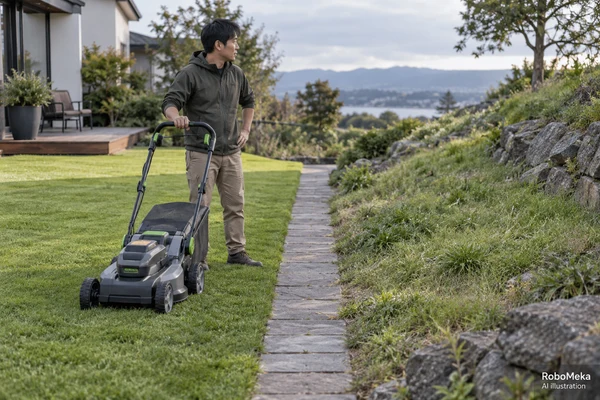
Match a cordless lawn mower to the lawn’s actual grass area, route and terrain before deciding how much battery capacity to buy. Separate zones, narrow access, slopes and clipping handling can make two equally sized lawns very different tasks. The approved battery package must support a suitable application; it cannot make an unsuitable site safe or practical.
Introduction
Match a cordless lawn mower to the lawn’s actual grass area, route and terrain before deciding how much battery capacity to buy. Separate zones, narrow access, slopes and clipping handling can make two equally sized lawns very different tasks. The approved battery package must support a suitable application; it cannot make an unsuitable site safe or practical.
For dealers and importers, this means qualifying the property before repeating a maximum-area claim. Ask how the customer reaches each zone, where the mower is stored and what a normal session looks like. A simple site brief often reveals more useful selection information than another comparison of voltage labels.
This guide addresses cordless walk-behind site fit. It does not approve a model for a particular slope, provide operating directions for hazardous terrain or report RoboMeka field results. Confirm the actual product scope and use the manufacturer’s instructions and competent assessment for the proposed site.
Measure the grass task and identify uncertainty
Record each grass zone separately and exclude buildings, paths and planting areas. Note how the measurements were obtained. A rough sketch is useful for initial screening, but an estimated area should not become a precise performance promise without an appropriate basis.
Add the customer’s maintenance routine and the usual grass condition. A lawn cut regularly at suitable settings presents a different workload from one left to grow between occasional sessions. The required finish and clipping mode also belong in the brief.
University of Minnesota Extension’s mowing guidance explains why mowing frequency, height and blade condition matter. Use locally appropriate turf advice to define a reasonable application rather than assuming every square meter of grass represents the same work.
If the estimated task is close to a supplier’s conditional capacity claim, obtain better information or a relevant evaluation. Do not round the lawn down and the capacity up to make the recommendation appear comfortable. The uncertainty should remain visible to both the buyer and the supplier.
Map the route between separate zones
Cordless operation removes a trailing mains cable during mowing, but it does not remove access and transfer work. Identify paths, gates, steps and changes of surface between grass areas. Review how the mower must be moved according to its instructions and whether that process suits the intended user.
Record where operation must stop and where handling or transport is required. Do not count every minute between zones as cutting time, but include it in the customer’s complete session. A property with several small lawns may require more coordination than one open area of the same total size.
Ask whether the mower can pass through the narrowest required opening in the relevant configuration. Overall dimensions, not just nominal cutting width, matter. Collection accessories and approved handling positions should be included in the review.
For a hypothetical property with three grass zones of 120, 90 and 70 square meters, the grass total is 280 square meters. That total says nothing by itself about gate access, transfer time or terrain suitability. Use the arithmetic as the start of a site description, not the end of selection.
Assess obstacles and effective route efficiency
Mark trees, beds, furniture and narrow strips that influence maneuvering. A wide deck can reduce straight passes while offering less benefit in a fragmented layout. The practical route should be considered before the buyer converts deck width into a completion-time expectation.
Record the overlap needed in a representative approved evaluation and any corrective passes required for an acceptable result. These observations help explain effective coverage. They should not be turned into a universal operating prescription for a product or site that has not been reviewed.
The cordless mower width-and-height guide connects deck dimensions with access and energy-package decisions. Use the same site assumptions in both reviews so that the selected width and battery kit are not justified by different imagined customers.
Avoid treating obstacles as a reason to recommend unsafe shortcuts or unapproved lifting. If the route is impractical, reconsider the machine format or define a separate solution for the affected area. The buying objective is a manageable maintenance routine, not proving that one mower can reach every patch at any cost.
Treat slopes as a model-specific boundary
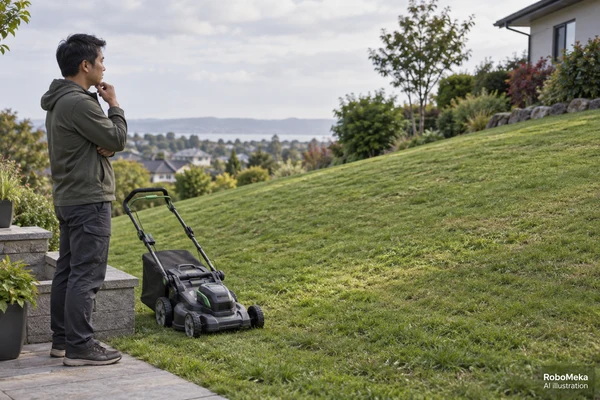
Obtain the actual manufacturer’s instructions and permitted terrain conditions. Do not borrow a slope figure from a robotic mower, a ride-on machine or another cordless model. The machine format, design and operating requirements can differ materially.
Slope descriptions should identify units and a reliable assessment basis. Percent grade and degrees are not the same quantity, and neither alone captures traction, surface irregularity or nearby hazards. A mathematical conversion does not authorize operation on the property.
Where the site is uncertain or close to a stated limitation, seek competent assessment and manufacturer clarification. Do not propose extra battery capacity, altered tires or a different operating technique as an unapproved way to overcome the boundary. Selection should remain within the product’s supported use.
OSHA’s landscaping hazard resources provide broader workplace context for machinery and site risks. They do not replace the product manual or a site-specific review, but they reinforce the need to consider the surrounding environment rather than only a headline terrain number.
Examine surface condition and the desired finish
Uneven ground can affect handling, wheel support and the relationship between the deck and the grass. A height setting that produces a satisfactory appearance on one area may not produce the same result elsewhere. Do not diagnose every uneven finish as a battery or motor problem.
University of Maryland Extension’s lawn-problem guidance discusses mowing-related issues and site conditions. It can help buyers recognize when turf or surface factors deserve attention. Local expertise may be needed where the site itself requires improvement.
Ask about expected conditions without encouraging operation outside the manual. Moisture, debris and other hazards must be handled according to the product’s instructions and appropriate site assessment. A procurement demonstration should not deliberately introduce unsafe conditions to advertise toughness.
Record any areas that need a separate maintenance approach. A recommendation can be useful even when it does not assign one mower to the entire property. Clear exclusions are more trustworthy than a broad coverage promise that ignores awkward or unsuitable sections.
Use a cordless site-and-session worksheet
The worksheet below connects the property with the energy and support plan. It is a screening and discussion tool, not proof of suitability. Assign unresolved questions to the supplier or a competent reviewer before approving the recommendation.
| Site or session item | Information to record | Decision it supports |
|---|---|---|
| Grass zones | Area and measurement basis for each zone | Defines the actual task |
| Access route | Gates, steps and required handling | Checks physical practicality |
| Obstacles | Turns, narrow strips and exclusions | Explains route efficiency |
| Terrain | Model-specific limits and site assessment | Establishes permitted use |
| Turf routine | Frequency, condition and intended height | Defines expected cutting load |
| Clipping plan | Approved mode and emptying arrangements | Describes the complete session |
| Energy package | Pack identities and operating quantity | Connects capacity evidence to the offer |
| Charging location | Compliance with actual instructions | Establishes readiness between sessions |
| Storage | Approved arrangement and access | Checks ownership practicality |
Use a simple annotated sketch where it clarifies the layout. Share only information relevant to the product decision and avoid unnecessary personal details. A concise plan can be more useful to a supplier than a large set of photographs with no identified dimensions or questions.
Have the customer confirm the assumptions that materially affect the recommendation. If the plan depends on regular mowing or excludes a particular zone, state that plainly. Conditions hidden in an internal spreadsheet will not help the customer understand the product before purchase.
Send your cordless mower site brief with the lawn zones, access constraints and intended session. Review the downloaded document before emailing it to RoboMeka, and use only the site information needed to assess the available product scope.
Build a battery plan from the work, not the plot label
Use the exact approved pack configuration and relevant session evidence. Grass condition, propulsion and clipping mode can affect endurance, while transfers and emptying affect elapsed time. A supplier’s maximum area should be interpreted through its stated conditions, not treated as a universal property-size entitlement.
EGO’s mower information provides a manufacturer example of explaining runtime variables. It does not predict the performance of another supplier’s mower. Ask for evidence that applies to the actual proposed kit and customer task.
If a spare-pack arrangement is suggested, verify how many packs make an operating set and how replenishment fits the schedule. Additional packs can address an energy constraint in an approved system, but they do not resolve access, terrain or an unsuitable cutting application.
The cordless mower power-and-runtime guide distinguishes active cutting from the complete session. Apply that distinction when a divided property appears to require more time than its grass area alone would suggest.
Consider propulsion and handling as application choices
Self-propulsion can be useful for some operating patterns, but it should not be presented as a universal solution to difficult terrain. The product’s approved limits still apply. Evaluate the controls and handling in a permitted representative application with the intended user requirements in mind.
Record how propulsion was used in any performance evaluation. A result from a different operating pattern may not describe the customer’s experience. Buyers should know whether the evidence supports the proposed complete kit and route, not merely the mower under a favorable demonstration condition.
Handling includes storage and movement before and after mowing. Confirm approved folding, carrying or transport arrangements and assess their practicality. Do not infer that a compact-looking mower is easy for every user to lift or that a removable battery makes any handling method acceptable.
Maintenance and inspection must follow the actual instructions. HSE’s machinery-maintenance guidance supports planning, isolation and competence. It does not provide model-specific handling directions, so unresolved questions should go to the responsible manufacturer or service organization.
Validate the recommendation with a controlled application review
Where the decision warrants it, evaluate a representative permitted section or session. Record the sample, energy setup, blade, mode and site conditions. Decide in advance what the exercise should establish and what would require further review.
Observe the finished lawn and the complete route, not just the time before the pack reaches a defined endpoint. Record interruptions and any corrective work. A sample that runs for the advertised duration may still be a poor fit if access or maneuvering makes the session impractical.
The NIST conformity-assessment overview helps distinguish evidence types and their purposes. A dealer application check can support a site recommendation within its limits; it should not be described as an independent laboratory test or a guarantee for every similar property.
If results are uncertain, explain the uncertainty and seek more relevant evidence rather than forcing a yes-or-no conclusion from a short demonstration. The customer may need another configuration, a different format or a separate approach for one zone.
Keep robotic mowing and walk-behind capacity distinct
Both robotic and manually operated products can be battery powered, but their work patterns differ. Robotic systems introduce installation, boundary, navigation, docking and scheduling questions that are not equivalent to a person completing one walk-behind session.
RoboMeka’s site includes a robotic mowing category. Buyers considering that format can consult the robotic mower area-capacity guide. Do not use a robotic scheduled-area claim as evidence of walk-behind runtime, or assume a walk-behind site brief completes robotic installation qualification.
Ask the supplier to confirm the actual available format before proceeding. The broader educational discussion in this article does not establish that RoboMeka manufactures cordless walk-behind equipment. A clear scope conversation prevents the customer from treating an informative guide as an unverified product specification.
Revisit the site plan when the lawn changes. New beds, gates, storage arrangements or maintenance expectations can alter suitability. The original recommendation applies to a defined set of conditions, and the support team should be able to explain when those conditions need reassessment.
Frequently asked questions
Can a maximum-area label replace a site assessment?
No. Area claims depend on their stated configuration and conditions, while access, terrain and layout create additional requirements. Use the label as one piece of information, then compare it with the actual grass task and manufacturer instructions. A similar total area does not guarantee a similar mowing session.
Are several small lawns easier than one larger lawn?
Not necessarily. Separate zones can add transfers, gates, turns and handling even when the total grass area is modest. Map the route and include non-cutting activities in the session plan. The practical comparison should reflect how the customer reaches and maintains each area.
Can extra batteries make a mower suitable for a slope?
No. Energy capacity and permitted terrain are separate questions. Use only approved packs and follow the exact model’s terrain instructions. If the site is outside those limits or uncertain, seek competent assessment or another supported solution rather than treating additional energy as a safety or traction upgrade.
Should buyers choose the widest deck for a large lawn?
Evaluate access, obstacles, terrain and the complete energy package before deciding. A wider deck can help on suitable open areas, but maneuvering and handling may limit its benefit elsewhere. Use representative evidence and the intended route instead of selecting width from area alone.
When should a cordless site recommendation be reviewed again?
Review it when layout, access, terrain, storage, charging arrangements or the customer’s mowing expectations change materially. Product revisions can also affect the evidence behind the recommendation. Keep the original assumptions documented so the supplier and service team can identify what needs reassessment.
Conclusion
Cordless mower site selection should connect grass area, route, terrain and the complete energy plan. Qualify access and permitted use first, then evaluate whether the approved package can support the intended session. A transparent site brief helps buyers avoid treating battery capacity as a solution to every property constraint.
Prepare a cordless site-fit inquiry, check the downloaded brief and email it to info@RoboMeka.com. The form does not transmit the document automatically or confirm site suitability, slope approval, runtime or product availability.