The short answer
Evaluate cordless mower power and runtime by measuring a useful mowing task with the exact approved battery, blade and accessory configuration. Ask whether the machine completes the intended lawn to an acceptable finish, how long the full session takes and what interrupts it. A no-load duration or a large voltage label cannot answer those questions on its own.
Introduction
Evaluate cordless mower power and runtime by measuring a useful mowing task with the exact approved battery, blade and accessory configuration. Ask whether the machine completes the intended lawn to an acceptable finish, how long the full session takes and what interrupts it. A no-load duration or a large voltage label cannot answer those questions on its own.
For a buyer, runtime is most useful when it supports a clear package recommendation. The same mower may be offered with different approved packs, but the results and claims must remain tied to the evaluated arrangement. Additional capacity can change the customer offer without proving that the motor or cutting system is inherently more efficient.
This guide proposes a transparent evidence process for cordless walk-behind procurement. It does not report RoboMeka test results or prescribe a standardized laboratory method. Follow the actual product instructions, use competent reviewers where needed and confirm the available platform before relying on any proposed specification.
Define the outcome before starting a runtime test
Write the customer task in practical terms: the grass area and layout, normal maintenance condition, desired clipping mode and expected session. Decide what an acceptable finish means for the evaluation. A mower that continues running but leaves substantial corrective work has not necessarily completed the task successfully.
Separate three outcomes: active cutting time, total elapsed session time and acceptable area completed. These can answer different purchasing questions. A customer may care most about finishing before another activity, while an engineer may need to understand energy use during a defined operating segment.
Identify the endpoint in advance. It might be completion of the planned area or another approved, clearly described stopping condition. Do not change the endpoint after seeing the result to create a more favorable claim. Any interruption should be recorded and interpreted through the manufacturer’s instructions.
University of Minnesota Extension’s mowing guidance helps explain why height, frequency and blade condition affect the task. Local turf guidance should inform the application rather than letting an unusually easy demonstration stand in for ordinary customer use.
Record the complete energy configuration
Identify the mower, pack models, revisions and number required in operation. Distinguish the operating set from spare packs. Record the approved charger and the starting condition using the manufacturer’s method, without inventing a universal preparation procedure across different systems.
Ask whether the voltage figure is nominal or uses another convention. Where appropriate, nominal voltage multiplied by ampere-hours estimates nominal stored energy. That calculation does not directly measure usable energy at the blade or establish a guaranteed mowing duration.
For illustration, a hypothetical operating set with 240 watt-hours of nominal energy and an assumed average system draw of 480 watts gives a simple ratio of half an hour. This is arithmetic, not a product prediction. Usable energy, changing load and the actual system limits must be established through appropriate evidence.
Do not compare packs solely by external size or connector appearance. The supplier must confirm approved combinations. A runtime evaluation performed with an unsupported pack is not a valid basis for the customer offer, even if the mower appears to operate during a short demonstration.
Distinguish power capability from endurance
Power concerns the rate at which energy is used or delivered under a defined condition; endurance concerns how long the system can sustain the relevant task. A product can have sufficient energy on paper but still be unsuitable for the intended cutting load. Conversely, strong short-duration behavior does not establish a long useful session.
Ask what a supplier’s power claim measures and whether it is an input, output, peak or other defined value. Require conditions and limitations. A marketing label should not be ranked against a differently defined value from another supplier without clarification.
The complete motor, controller, blade and deck determine useful cutting behavior. Do not infer that the highest-voltage platform or largest input rating must produce the best finished lawn. Evaluate the actual system and preserve the distinction between engineering explanation and demonstrated results.
The NIST conformity-assessment overview supports matching evidence to the question being asked. A brief functional demonstration can show basic operation, but it should not be described as a verified sustained-power or lifetime-performance test unless the method supports that claim.
Document the lawn and operating pattern
Record relevant grass condition, intended height reduction, surface layout and clipping arrangement. Describe the basis of area measurement and any uncertainty. Conditions need not be artificially identical to every customer’s lawn, but the report should make clear what the session represents and what it does not.
Include the route and the use of self-propulsion where applicable. Turning, obstacles, transfers and collection handling contribute to the complete session. A test with propulsion disabled answers a different question from ordinary use where the customer expects to rely on it.
Use the manufacturer’s permitted operating conditions. Do not deliberately overload the machine, defeat protection functions or continue after an instruction requires stopping. A procurement evaluation should answer a useful application question without creating an unapproved stress test.
Manufacturer examples such as EGO’s mower information show why runtime variables require disclosure. The example supports the need for context, not a numerical expectation for a different brand, deck or battery configuration.
Build a session evidence log
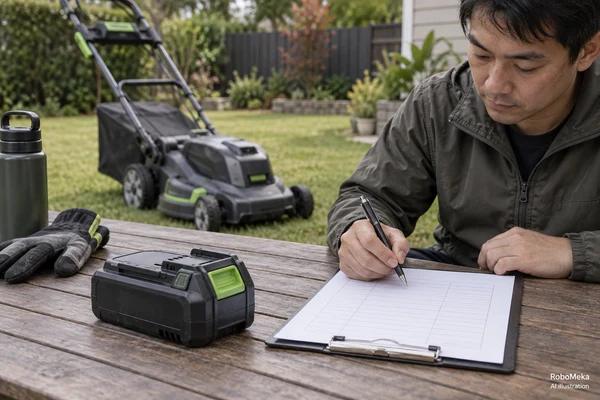
The following log separates the information needed to understand a result. It is a proposed buyer worksheet, not a claim that RoboMeka has carried out these tests. Agree the method and responsible reviewers before collecting evidence.
| Log field | What to record | Why it matters |
|---|---|---|
| Configuration | Mower, blade, accessories and revisions | Identifies the evaluated system |
| Energy setup | Approved packs, operating quantity and starting condition | Defines the available package |
| Lawn task | Area, layout and relevant grass condition | Establishes application context |
| Operating pattern | Height, clipping mode and propulsion use | Explains workload differences |
| Active work | Defined cutting intervals | Separates useful operation from pauses |
| Interruptions | Turns, emptying, stops and their stated reasons | Describes the complete session |
| Finished result | Agreed observations and any corrective work | Prevents runtime-only approval |
| Endpoint | Completion or defined approved stop | Makes durations interpretable |
| Limitations | Uncontrolled factors and unanswered questions | Keeps the claim within the evidence |
Use clear event notes rather than relying only on a final stopwatch reading. If a stop occurred, record what was observed and how it was handled under the instructions. Do not assign a fault cause without sufficient technical evidence.
Retain the raw observations and distinguish them from the summary interpretation. This allows reviewers to understand whether a result supports a complete-kit recommendation, a conditional capacity statement or only a limited observation that needs further work.
Send your cordless runtime requirements with the intended lawn task, package and acceptable outcome. The locally downloaded brief can support a discussion of available product scope and evidence; it does not confirm a runtime or constitute a test report.
Evaluate propulsion and clipping modes transparently
Self-propulsion can influence both the work pattern and the energy used by the complete system. Record how it was used and whether the route represents the intended customer. Do not advertise a result obtained without propulsion as though it necessarily describes ordinary assisted operation.
Collection and mulching can also create different tasks. Identify the approved blade and accessories for each mode, and evaluate the finished result accordingly. A runtime advantage in one configuration should not automatically be applied to another without relevant evidence.
The cordless mower cutting-system guide explains why blade, deck and energy configuration should be considered together. If a supplier changes a component to improve a headline duration, check whether the acceptable cutting outcome and customer package remain the same.
Avoid comparing only time per charge when the useful work differs substantially. A more informative report may show the task completed, relevant conditions and elapsed time, with limitations clearly stated. The purpose is to help the buyer select a fit, not to produce the largest possible number.
Include recharge and pack rotation in the operating plan
The first run does not describe the whole day for a customer who needs multiple sessions. Ask how the approved charger and pack conditions affect readiness after use. A charge-time claim should identify the starting state, charger and relevant conditions rather than imply an identical turnaround every time.
Build any spare-pack plan around the actual operating set. If a mower requires two packs together, a single additional pack may not provide the assumed replacement set. Verify the quantities and compatibility before turning a proposed rotation into a sales promise.
Consider a hypothetical task lasting 25 minutes per operating set and a charging process that cannot replenish a used set before the next one finishes. Simply adding one set would not establish indefinite uninterrupted work. The example illustrates a scheduling question, not a product’s actual charging performance.
For the commercial and support implications, consult the cordless battery-and-charging guide. The buyer should understand both the session evidence and the practical system required to repeat the work under the approved instructions.
Interpret temperature and protection behavior responsibly
Operating and charging conditions can affect a battery system’s behavior. Use the limits and instructions for the actual product rather than a generic temperature recommendation. If protection or an abnormal indication occurs, follow the prescribed response and seek competent review where necessary.
Do not bypass controls to extend a runtime result. Such a result would not represent the product customers are authorized to use. Record the event and determine whether the application, setup or product requires further assessment before making a purchasing conclusion.
HSE’s machinery-maintenance guidance emphasizes planning, safe isolation and competence. It supports the need for a controlled evaluation and service boundary, while the mower and battery manuals provide the specific procedures.
Avoid diagnosing pack health from one short session. If the buyer needs evidence about aging or retained performance, define a separate appropriate evaluation with qualified input. Initial runtime, warranty duration and battery service life are different subjects and should not be represented as interchangeable measures.
Review repeatability and production equivalence
Repeat relevant sessions where needed to understand variation, and explain the limits of the available sample. A small purchasing exercise can reveal useful application differences, but it does not justify invented statistical confidence or a universal capacity guarantee.
Ask whether the evaluated sample represents the intended production configuration. Changes to the pack, controller, blade or accessories can affect the result. Require the responsible technical reviewer to assess applicability before reusing a claim for the revised product.
Shipment inspection serves a different purpose. NIST’s acceptance-sampling introduction explains sampling in lot decisions. An inspection pass does not establish the runtime of every unit or replace the application evidence behind a published capacity statement.
Battery shipping also needs its own review. IATA’s battery transport resources provide air-transport context, but logistics documents should not be described as proof of mowing performance. Keep each evidence type connected to the question it actually answers.
Turn the result into an honest customer claim
State the model and package behind a runtime or area figure, and place important conditions close to the claim. If the result concerns a particular clipping mode or operating pattern, say so. Avoid a headline that suggests the bare tool provides the performance of a larger optional kit.
Explain that site and maintenance conditions can change the experience without using that caveat to excuse every discrepancy. Support staff should investigate the actual configuration and circumstances safely. Clear evidence helps distinguish an application mismatch from a potential product issue.
Where the evidence remains limited, publish a qualified description or invite an application discussion instead of inventing a precise guarantee. Buyers can still communicate the package and intended use clearly. Trustworthy technical marketing is useful because customers can understand the basis and boundaries of the recommendation.
Retain unsuccessful and interrupted sessions
Do not discard a session simply because it produces an inconvenient result. Record why it stopped, whether the method remained valid and what review followed. An invalid run may need exclusion from a comparison, but the reason should be documented. This protects the evaluation from selective reporting and helps the buyer understand unresolved application questions before committing to a published claim.
Frequently asked questions
Is no-load runtime useful for choosing a cordless mower?
It may answer a limited engineering question, but it does not establish useful mowing duration or lawn capacity. Cutting grass, propulsion and clipping handling change the task. For procurement, request a relevant loaded application with the configuration, conditions, endpoint and finished result documented.
Can buyers calculate runtime directly from battery capacity?
A nominal energy calculation can help explain the specification, but actual runtime depends on usable energy, changing load and system behavior. Treat arithmetic examples as illustrations, not performance promises. Obtain evidence for the exact approved mower and pack configuration used in the customer offer.
Why should total session time be recorded separately?
Customers experience turning, emptying, transfers and interruptions as well as active cutting. Separating these activities helps explain whether a product finishes the intended task conveniently. It also prevents a favorable cutting-only figure from being mistaken for the time required to complete the entire property.
Does a larger approved pack always double mowing time?
No exact multiplier should be assumed without evidence. Capacity, usable energy, system limits and operating conditions affect the result. A larger package may be useful, but its performance should be evaluated and communicated for the actual configuration rather than extrapolated automatically from a smaller-pack test.
What should trigger a review of an existing runtime claim?
Relevant changes to the battery, controller, blade, clipping accessories or operating method can affect applicability. The responsible technical reviewer should determine the necessary verification. Keep the original evidence and revised configuration traceable, and update the wording when the production offer no longer matches the evaluated system.
Conclusion
Cordless mower runtime is most valuable when it describes an acceptable completed task with a traceable energy and cutting configuration. Define the outcome, record the full session and review repeatability, recharge planning and production changes. Buyers can then recommend packages on evidence rather than a single unqualified duration.
Prepare a session-based performance inquiry, review the downloaded brief and email it to info@RoboMeka.com. The form does not transmit the document automatically or establish runtime, product availability or a commercial commitment.