The short answer
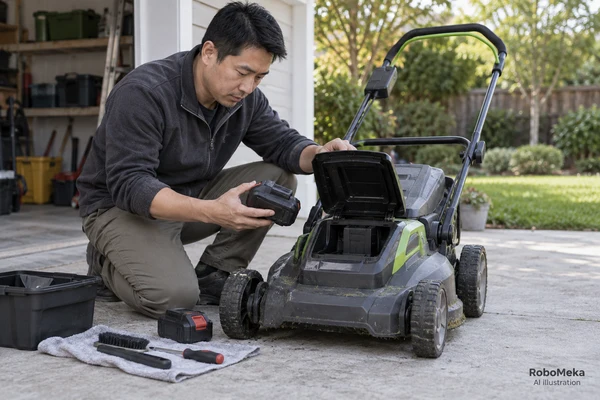
For cordless lawn mower sourcing, verify the approved battery system, model-specific isolation instructions and clear boundaries between customer care and competent service. Removing the mains cable does not remove the hazards of a powered cutting machine. Buyers need a product and support system that can respond appropriately to damaged components, abnormal behavior and seasonal storage questions.
Introduction
For cordless lawn mower sourcing, verify the approved battery system, model-specific isolation instructions and clear boundaries between customer care and competent service. Removing the mains cable does not remove the hazards of a powered cutting machine. Buyers need a product and support system that can respond appropriately to damaged components, abnormal behavior and seasonal storage questions.
Safety and maintenance information should be reviewed before launch, alongside the sample and commercial package. The manual, charger, battery identities and service records must match what customers receive. A generic statement that the mower is safe or easy to maintain does not establish that the local support team can handle real ownership situations.
This article is a procurement and documentation framework, not operating, repair or emergency instructions. Follow the actual manufacturer’s guidance and obtain qualified assessment for the product, market and circumstances. RoboMeka specifications, available platforms and any technical commitments require direct confirmation.
Identify the complete cordless configuration
Record the mower model and revision, approved operating pack set, charger and relevant accessories. The quantity of batteries needed for operation should be explicit. A kit with multiple packs can be misunderstood if purchasing, marketing and service use different descriptions.
Check the identity and scope of the applicable product evidence with competent reviewers. NIST’s conformity-assessment overview explains why reports, inspections and other assessment activities serve different purposes. Do not treat a component document as universal approval of every mower combination.
The intended user and market also matter. Consumer, workplace and robotic applications can involve different requirements and support models. The CPSC mower standards overview is a starting point for category context, not a declaration that a particular product meets every applicable requirement.
Preserve any use limitations in the release record and customer information. A sales opportunity should not quietly expand the product’s intended terrain or operating conditions beyond the reviewed scope. Unresolved applicability questions belong with the responsible technical and market specialists.
Review isolation instructions before maintenance content
The manual should explain how to prevent unintended operation during each permitted maintenance activity. Do not assume that one switch position or the visible absence of a cable establishes complete isolation. The actual product may require a defined sequence involving its energy components and controls.
Review whether the instructions are understandable and match the physical sample. Illustrations, labels and terminology should help the user identify the relevant parts without guessing. If several models share a manual, their differing procedures must be clearly distinguished.
Do not invent a universal blade-access or disassembly method. Where work requires competent service, the user-facing information should direct the customer appropriately rather than encourage improvised repairs. The supplier should provide the approved technical material for authorized personnel.
HSE’s machinery-maintenance guidance emphasizes planning, safe isolation and competence. Apply those principles to the support model while using the mower’s own instructions for the specific procedures. A general procurement article cannot replace a model-specific maintenance manual.
Define the response to a suspect battery or charger
Ask the manufacturer for customer-facing guidance on damaged or abnormal components and a clear escalation route. The support team should know when to direct a customer to stop use and seek qualified assistance. Do not encourage continued operation, internal pack repair or experimentation with another unapproved charger.
Collect necessary identity and circumstance information without asking the customer to recreate a potentially hazardous event. A model label and a safe description can help the responsible reviewer. Video evidence should never be obtained by repeating unsafe behavior merely to make the support case easier to assess.
Returns require appropriate assessment. A battery reported as damaged or otherwise suspect may need a different handling and transport process from a new item. IATA’s battery resources provide air-transport context, but qualified logistics personnel must determine what is appropriate for the actual condition and route.
Agree who provides the customer with applicable instructions and how urgent concerns are escalated within the business. This article does not prescribe emergency response or legal reporting duties. Those responsibilities need product-specific and jurisdiction-appropriate procedures developed with qualified advice.
Verify charging and storage guidance for the actual system
The supplied manual should identify permitted charging conditions, the approved charger and the meaning of indicators. Check that the regional charger version and pack identities match the documentation. Physical connector fit does not establish compatibility or suitability for the destination electrical supply.
For storage, obtain the actual manufacturer’s requirements for the pack, charger and mower, including extended non-use. Do not create one universal storage percentage, temperature range or periodic charging rule for every cordless system. A simplified support article must remain consistent with the reviewed instructions.
Seasonal guidance should explain how the customer finds the correct model information and where to ask about uncertainty. Owners may have several similar packs or tools, so broad family descriptions can be inadequate. Clear revision and compatibility records help prevent mistaken recommendations.
The cordless battery-and-charging guide addresses package and rotation planning. Keep its commercial assumptions aligned with the safety information: a proposed spare-pack routine should never depend on handling or charging outside the approved conditions.
Use a maintenance responsibility worksheet
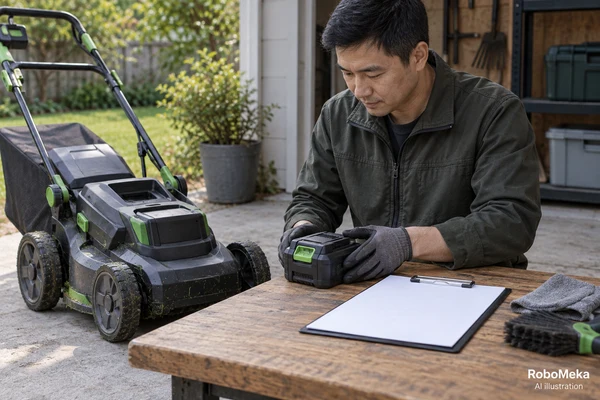
The worksheet below helps assign information and service responsibilities. It is not a complete risk assessment, compliance checklist or repair procedure. Adapt it with the responsible manufacturer and qualified local reviewers.
| Ownership situation | Required information | Responsibility to define |
|---|---|---|
| Routine cleaning | Permitted methods and isolation instructions | What the customer may do |
| Cutting-system inspection | Model-specific criteria and procedure | When competent service is required |
| Battery or charger concern | Stop-use and escalation guidance | Who assesses the component |
| Seasonal storage | Actual conditions and preparation requirements | Which instructions apply to the revision |
| Replacement component | Approved part and compatibility record | Who authorizes alternatives |
| Transport or return | Condition-specific logistics assessment | Who supplies handling and shipment instructions |
| Product revision | Updated documents and affected identities | Who informs distributors and service staff |
| Potential wider issue | Internal escalation and qualified review | Who manages applicable corrective action |
Give unresolved items a named owner. A launch file should not be considered complete if the technical documents exist but no local team knows how to use them. The support process needs both information and a practical route to the person authorized to make the next decision.
Review the worksheet with the actual service network. A distributor may provide intake and identification while another organization performs technical work. That arrangement can be effective if the boundaries and handoffs are clear, rather than implying that every dealer can perform every repair.
Send your cordless mower service requirements with the intended market, customer group and local support model. The downloaded brief can support a scope discussion with RoboMeka; it does not certify a product or establish that a proposed repair or platform is approved.
Keep cleaning claims within the manual
Customers may assume that outdoor equipment tolerates any convenient cleaning method. The product instructions should state what is permitted and what is restricted. A protection claim for one condition or component should not be interpreted as authorization to wash every part or use an unapproved method.
Review sales images and demonstration content for consistency with those instructions. A visually appealing scene can create an unsafe expectation if it shows handling that the actual product does not permit. Illustrative content should be technically reviewed and should not be presented as evidence of a real test.
Routine care should be easy to locate in the manual and support page. Do not bury an important restriction in a separate document that customers are unlikely to associate with the supplied kit. The same terminology and component names should appear across the carton, manual and service system.
Where cleaning or maintenance requires access to hazardous parts, follow the manufacturer’s competence boundary. The buyer’s goal is a usable support system, not a simplified procedure that omits necessary isolation or service requirements to make the product appear easier to own.
Prepare cutting-system service without generic repair shortcuts
Obtain model-specific blade and mounting identities, replacement criteria and authorized procedures. A blade’s nominal length is not enough to select a replacement. Toro’s parts resources illustrate the value of model-based identification; the actual supplier must provide applicable information for the sourced mower.
Do not publish universal fastening values, sharpening methods or balancing advice across unrelated cordless models. Those details require the correct manufacturer documentation and suitable competence. If information is missing, resolve the gap rather than asking local staff to improvise from experience with another product.
Unexpected sound, vibration or cutting behavior should follow the approved stop-use and assessment process. Support staff should gather relevant circumstances safely without immediately attributing the problem to the battery, blade or operator. A short customer description may not establish the cause.
The cordless cutting-system guide connects part identity with application evidence. Use that system view during service so that an attempted repair does not introduce an unapproved component and undermine the original product configuration.
Review terrain and workplace instructions separately
Battery power does not expand the mower’s permitted terrain limits. The actual manual should define the relevant operating conditions, and uncertain sites need competent assessment. Do not recommend added capacity, modified components or unapproved techniques to make a marginal site appear suitable.
For workplace customers, the broader task and environment require attention. OSHA’s landscaping hazard resources provide useful context on machinery and related exposures. A product manual is essential, but it does not by itself complete the employer’s site-specific planning or training responsibilities.
Mowing practices also affect the task. University of Minnesota Extension’s lawn-care guidance discusses height, frequency and blade condition. Use local turf advice where appropriate, without treating lawn-care guidance as a substitute for the mower’s safety instructions.
Keep these information types distinct in customer content. Technical product limits, site assessment and turf recommendations answer different questions. Combining them into a short list of universal rules can create misleading certainty where model- or location-specific review is needed.
Preserve safety information through production changes
Ask the supplier to notify the responsible reviewers of relevant changes to the battery, charger, controller, cutting assembly or instructions. A familiar model name and unchanged exterior do not guarantee the same approved configuration. Review the effects before accepting the revised product.
The production release should identify current documents and their relationship to the shipped lot. Service staff need to know which instructions apply to which customers. A revised manual should not silently replace the archive if earlier units require different information.
Shipment inspection can verify agreed identities and package contents within its scope. NIST’s acceptance-sampling introduction explains the limits of sampling. A passed inspection does not resolve an unreviewed engineering change or prove the future behavior of every unit.
Define how findings and customer feedback reach the supplier. Where evidence suggests a broader issue, use the organization’s appropriate escalation and corrective-action process with qualified input. Avoid either dismissing all reports as misuse or declaring a systemic defect from an isolated, unverified account.
Rehearse the support process before launch
Use a hypothetical inquiry involving a customer preparing the mower for seasonal storage. Ask staff to identify the kit, locate the correct instructions and explain where uncertainty should be escalated. The exercise should use documents, not simulate a hazardous battery or cutting-system fault.
Then test a replacement request. Can the team find the approved component and revision without guessing from a photograph? If the record is unclear, improve the cross-reference or supplier response route before customers depend on it.
These rehearsals are information-quality checks, not safety certifications or real customer case studies. Their purpose is to make the approved support process usable. A technically reviewed product still needs clear handoffs and accurate local information throughout its ownership cycle.
Review support translations with technical context
Fluent language is not enough if a translated instruction changes the meaning of isolation, charging or service boundaries. Have an appropriately competent reviewer compare the localized content with the approved source and actual product. Preserve the revision relationship so that a later correction reaches the relevant manuals and support pages instead of leaving conflicting guidance in different channels.
Frequently asked questions
Is a cordless mower safe to service once it is switched off?
Do not assume that a switch position alone completes isolation. Follow the exact manufacturer’s procedure for the task and use competent service where required. The battery arrangement and controls can vary between models. A general guide should not replace the product-specific steps that prevent unintended operation.
Can support staff advise customers to repair a battery pack?
They should not improvise internal repair instructions. Follow the manufacturer’s approved escalation and service process for the actual product and condition. Collect relevant identity information safely, and use qualified assessment for handling, repair eligibility or transport rather than encouraging experimentation with a suspect component.
What is the best universal storage charge level?
This guide does not prescribe one. Storage requirements depend on the actual battery system and manufacturer instructions. Buyers should obtain clear, revision-matched guidance and make it accessible to customers. Avoid replacing product-specific requirements with an unsupported rule copied across an entire cordless range.
Does water resistance mean the mower can be cleaned any way?
No. A protection claim has a defined scope and does not override the manual’s cleaning restrictions. Review the permitted methods for the actual components and configuration. Customer images and support content should follow those instructions rather than imply that all outdoor equipment tolerates every washing method.
Why should maintenance documents be reviewed before ordering?
They reveal whether the product can be supported by the intended customer and service network. Missing isolation guidance, unclear part identities or an undefined escalation route can create problems after launch. Resolve those gaps alongside technical approval rather than assuming they can be written safely after shipment.
Conclusion
Cordless mower safety and maintenance sourcing requires a verified energy configuration, usable model-specific instructions and clear service boundaries. Prepare abnormal-condition, storage and replacement workflows before launch, and keep them aligned with production revisions. Buyers then have a support system grounded in approved information rather than generic cordless assumptions.
Prepare a cordless maintenance-support inquiry, review the downloaded document and email it to info@RoboMeka.com. The form does not automatically send the brief, certify safety or establish repair approval, product availability or a commercial commitment.