The short answer
Source a cordless mower battery system by defining the operating pack set, approved charger, replenishment schedule and replacement process together. Capacity is only one part of the decision. Buyers need to know which components are compatible, what conditions apply to charging and whether the proposed package can support the customer’s actual mowing routine.
Introduction
Source a cordless mower battery system by defining the operating pack set, approved charger, replenishment schedule and replacement process together. Capacity is only one part of the decision. Buyers need to know which components are compatible, what conditions apply to charging and whether the proposed package can support the customer’s actual mowing routine.
A spare-pack offer should solve a defined scheduling problem rather than imply unlimited operation. The mower may require multiple packs at once, and a recently used set may not be ready for immediate charging under every condition. Clear identities and manufacturer instructions are more reliable than assumptions based on connector shape or a headline charge time.
This guide focuses on procurement and support planning for cordless walk-behind systems. It does not publish RoboMeka battery specifications, approve substitutions or provide pack-repair instructions. Confirm available platforms and use qualified technical and logistics advice for the actual products and shipment arrangements.
Define the operating set before counting spares
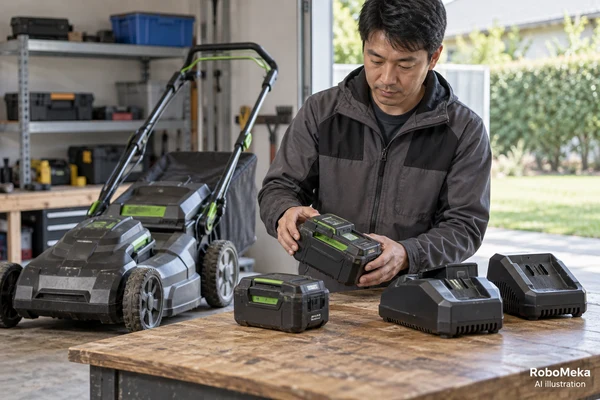
Ask how many packs the mower requires during normal operation and which models are approved. Record whether packs are used together or in another manufacturer-defined arrangement. A carton with two batteries may contain one operating set rather than one pack plus a spare.
Separate required packs from additional sets in the quotation and listing. Customers should understand what the mower needs to start and what the extra components are intended to support. Ambiguous package descriptions create avoidable inquiries and can lead buyers to compare unlike offers.
Include the charger model and regional version. A kit is a complete configuration, not simply a mower and whichever charging device is available at dispatch. The compatibility record should identify the exact combinations and any relevant revision restrictions.
The cordless mower selection guide explains how the package relates to customer type. Existing platform owners and first-time buyers may need different offers, but both need verified compatibility rather than a general assurance that the batteries belong to the same family.
Read capacity and voltage without overinterpreting them
Clarify whether the voltage label is nominal or uses another convention. Where the specification supports it, nominal voltage and ampere-hours can be used to estimate nominal watt-hours. That estimate describes stored energy at a stated basis, not the useful mowing time guaranteed by the complete machine.
Two packs with similar energy labels can differ in approved application, control interface and operating limits. Buyers should not use capacity as the only equivalence test. A proposed alternative needs manufacturer approval and an assessment of the evidence affected by the change.
Ask for traceable model and revision information that remains accessible during service. A description such as the larger battery is not sufficient when several kits or generations are in the market. Product labels, carton records and the service database should lead to the same identity.
The NIST conformity-assessment overview provides a useful distinction between claims and the assessment supporting them. A battery label or a component document does not, by itself, establish the runtime, safety or market suitability of every mower combination using it.
Verify the complete compatibility chain
Request a matrix connecting mower, pack and charger models, including applicable revisions. Ask who approves changes and how dealers are notified when a component is replaced or discontinued. The record should be usable by sales and service staff, not only by the supplier’s engineers.
Physical fit does not establish approval. Do not recommend adapters, modified connectors or unlisted packs to fill a supply gap. Such changes can affect protection and control behavior, and an apparently successful short run does not validate the combination.
Manufacturer support resources such as Greenworks’ customer support hub illustrate why model-based assistance matters. They cannot establish compatibility for another brand. Require applicable documentation from the responsible supplier for the exact system being purchased.
If the buyer wants a shared platform across several tools, ask for explicit approval of each intended combination. A broad platform claim should not conceal exceptions in charger requirements, operating quantity or performance conditions. Keep the customer’s actual equipment list within the scope of the review.
Turn charging time into a readiness question
Ask what the quoted charging duration measures: the pack and charger, starting state, endpoint and relevant conditions should be identified. A demonstration with one preparation state may not describe the interval after a demanding mowing session. The manual should explain how the system indicates readiness or an abnormal condition.
Separate active charging from the total interval before the customer can resume work. Any manufacturer-required handling or conditioning steps belong in the operating plan. Do not assume a used pack can always be placed into an immediate, fixed-duration cycle regardless of its condition.
For occasional household use, the gap between sessions may make a standard approved charger entirely practical. For repeated work, throughput becomes more important. Evaluate the schedule rather than presenting the fastest advertised charger as universally the best purchase.
Avoid calculating charge time from battery capacity and charger labeling alone as though it were a guarantee. The actual charging process and limits require product-specific evidence. Use simple calculations only as explanatory estimates, clearly separated from verified performance statements.

Build a pack-rotation worksheet
The following worksheet makes scheduling assumptions visible. It is not a recommended operating procedure for an unidentified battery system. Complete it using the actual approved components and instructions, then assess whether it serves the intended customer task.
| Planning item | Information required | Question to resolve |
|---|---|---|
| Operating set | Pack identities and quantity used together | What must be installed for normal use? |
| Work segment | Relevant mowing duration and conditions | How much useful work occurs before replenishment? |
| Replacement set | Approved additional packs | Is a complete compatible set available? |
| Charging arrangement | Charger model and supported configuration | What can be replenished at the same time? |
| Readiness interval | Defined conditions and manufacturer guidance | When is the used set actually ready again? |
| Handling and storage | Approved locations and procedures | Can the customer use the arrangement correctly? |
| Contingency | Response to an unavailable or suspect component | What happens when the ideal cycle is interrupted? |
| Commercial package | Included and separately priced items | Does the offer match the proposed routine? |
Consider a hypothetical system whose operating set completes a 30-minute work segment while replenishment takes longer than the next segment. Two sets alone would not prove continuous all-day operation. The actual conclusion depends on the approved system and conditions; the example simply exposes the timing dependency.
Do not turn the worksheet into a promise of uninterrupted work unless relevant evidence supports the complete plan. A customer may still find a planned break acceptable. The right package is the one that fits the routine honestly, not necessarily the package with the greatest number of packs.
Send your cordless battery rotation requirements with the intended work pattern, operating-set quantity and destination. The downloaded brief can support a scope discussion with RoboMeka; it does not approve a rotation plan or confirm a particular platform’s availability.
Evaluate runtime with the intended package
Battery procurement should be connected to a useful mowing result. Record the mower, blade, clipping mode and lawn conditions behind a runtime claim. A longer no-load duration does not establish that the customer can complete more acceptable mowing.
EGO’s mower information provides a manufacturer example of acknowledging factors that affect endurance. The figures remain product-specific. Ask the proposed supplier for relevant evidence rather than borrowing a familiar brand’s performance to justify a private-label package.
The cordless mower power-and-runtime guide separates active work from the full session. Use that distinction when a pack plan depends on transfers, collection emptying or frequent turns. Those activities affect the customer’s schedule even when they do not represent continuous cutting load.
If a supplier proposes a higher-capacity approved pack, assess the revised package rather than assuming a precise runtime multiplier. The change may affect handling, charging, logistics and price as well as available energy. Keep the commercial benefit tied to the actual customer requirement.
Plan storage and seasonal non-use from the manual
Request the actual storage instructions for the pack, charger and mower, including relevant environmental conditions and preparation for extended non-use. Do not invent a universal storage percentage or temperature range across different products. The approved documentation should supply the applicable guidance.
Ask how customers can identify the correct instructions after a revision. Seasonal support content should link to the relevant model rather than offer one generic battery rule for the entire range. Clear identification matters when a household owns several tools or different pack generations.
Define the response to damaged or abnormal components. Customers should not be encouraged to open packs, repair internal parts or continue use to see whether a problem disappears. The supplier and service organization should establish a qualified escalation path and applicable handling guidance.
HSE’s machinery-maintenance guidance emphasizes planning and competence. It is not a battery repair procedure, but it supports a clear boundary between routine customer care and work reserved for qualified personnel. Keep that boundary visible in local support materials.
Prepare transport documents for the real shipment
Battery quantities, configuration, condition, packaging and transport mode affect logistics planning. Involve qualified staff before finalizing a kit or adding spare packs. A freight estimate based on a bare mower should not be assumed valid for a later battery-heavy package.
IATA’s battery transport resources provide current air-transport guidance. The actual consignment still needs assessment by the responsible logistics provider. A general statement that the battery has passed transport testing does not settle every packing, documentation or carriage requirement.
Match document identities to the packs being shipped. A test summary has a defined purpose and should not be described as complete certification of the mower or proof of its runtime. Preserve the distinction between transport evidence, product assessment and performance evaluation.
Returns require their own review, especially when the reported condition differs from a new product. Do not direct a customer to use an ordinary return route for a suspect battery without appropriate assessment. Agree who provides the necessary instructions and how the case is escalated.
Establish replacement and revision control
Ask how replacement packs and chargers will be identified, priced and ordered. Clarify the supplier’s actual commitment and avoid promising indefinite availability without support. If a revision is replaced by another model, require explicit approval and updated compatibility information.
Maintain a cross-reference between branded kit SKUs and the underlying technical identities. This helps a service team determine what the customer originally received. A broad product-family name or purchase date may not be enough when multiple configurations were sold concurrently.
Use shipment inspection to verify agreed identities and contents, not to infer lifetime battery quality. NIST’s acceptance-sampling introduction explains the role of sampling in lot decisions. Product qualification and long-term performance evidence remain separate requirements.
Have relevant changes reviewed before production. A supplier should not substitute a charger or pack simply because it looks similar and is available sooner. Update instructions, claims, logistics records and service information when the approved configuration changes.
Test the support process with a practical scenario
Imagine a customer who bought a starter kit and later requests an additional operating set. The support team should identify the original kit, check the current approved options and explain the required quantity. It should not recommend a pack solely because its capacity is larger or its connector appears familiar.
Next, consider a customer reporting that a pack is not ready when expected. Staff should gather the relevant identity and circumstances safely, consult approved guidance and escalate where needed. They should not diagnose internal failure or promise a fixed remedy from a short description alone.
These are hypothetical workflow checks, not reports of real RoboMeka service cases. Their value lies in revealing missing information before launch. A well-designed battery program includes the documents and responsibilities needed to answer ordinary questions without improvising compatibility or repair advice.
Keep kit labels useful after purchase
Ensure that the customer can identify the original package without retaining a sales brochure indefinitely. The mower, pack and charger records should support a clear service cross-reference. This becomes especially useful when a household adds another tool or purchases a replacement later. Identification should guide staff to approved information, not encourage them to infer compatibility from a familiar brand color.
Frequently asked questions
How many spare batteries should a cordless mower kit include?
There is no universal number. Start with the quantity required for operation, then evaluate the intended work segments and approved charging arrangement. Additional packs should solve a defined customer need. Do not assume that one extra battery forms a usable replacement set for every mower design.
Can a charger’s label predict the full turnaround time?
Not reliably on its own. The actual pack, starting state, charging process and relevant conditions matter. Ask for a defined charging claim and the manufacturer’s instructions after use. The interval before useful work resumes can differ from an isolated active-charge duration shown in a demonstration.
Are packs with the same voltage interchangeable?
No. Voltage labeling and physical fit do not establish compatibility. Use the manufacturer’s approved mower, pack and charger combinations, including relevant revisions. Do not add adapters or modified connectors to close a supply gap. Proposed alternatives need responsible technical review and updated documentation.
What should buyers request for seasonal storage guidance?
Obtain the actual pack, charger and mower instructions and ensure they match the supplied revisions. Ask for clear customer-facing guidance and an escalation route for abnormal components. Avoid replacing model-specific requirements with a universal storage percentage, temperature or charging schedule invented for the whole product range.
Does battery transport testing prove product quality?
It addresses a particular transport-related purpose and should be interpreted within that scope. It does not establish mowing runtime, complete product approval or long-term reliability. Buyers need separate applicable evidence for those questions, along with shipment-specific logistics review and a traceable configuration record.
Conclusion
Cordless battery procurement should connect compatibility, useful work, charging readiness and replacement support. Define the operating set, verify the actual charger and make scheduling assumptions visible. A clear system plan helps buyers offer practical packages without unsupported promises of universal compatibility or continuous operation.
Prepare a battery-system sourcing inquiry, review the downloaded document and email it to info@RoboMeka.com. The form does not send the inquiry automatically or establish compatibility approval, battery specifications, charging time or product availability.