The short answer
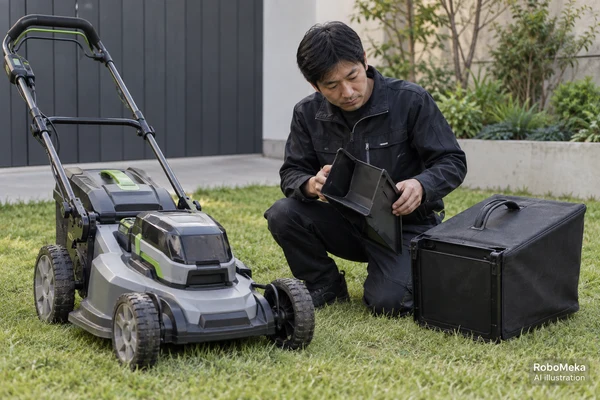
Evaluate a cordless mower blade by the useful cutting result it produces with the approved deck, controls and battery package. Claims about reduced energy use, improved collection or better mulching should be supported by a defined comparison of the complete system. A blade that extends running time but leaves unacceptable grass or clippings has not necessarily improved the customer’s mowing task.
Introduction
Evaluate a cordless mower blade by the useful cutting result it produces with the approved deck, controls and battery package. Claims about reduced energy use, improved collection or better mulching should be supported by a defined comparison of the complete system. A blade that extends running time but leaves unacceptable grass or clippings has not necessarily improved the customer’s mowing task.
For B2B sourcing, blade identity is also a service and configuration-control issue. Similar length or appearance does not establish interchangeability. Buyers need the correct part reference, approved operating modes and a process for reviewing changes before the product reaches production or the replacement-parts channel.
This guide concerns procurement evaluation, not blade modification or repair instructions. Follow the actual manufacturer’s isolation, inspection and service procedures, using competent personnel where required. No blade specification, test result or cordless walk-behind availability is being claimed for RoboMeka without direct confirmation.
Define the cutting result the customer needs
Begin with the intended lawn routine and clipping treatment. Collection, mulching and other approved modes have different outcomes to observe. The buyer should state what counts as an acceptable finish before comparing blade options or runtime figures.
Record grass condition, intended height reduction and mowing frequency. University of Minnesota Extension’s mowing guidance discusses practices that influence lawn results. Use appropriate local guidance rather than assuming one blade can compensate for every unsuitable mowing interval or setting.
The customer’s route also matters. A blade-and-deck combination that performs well on an easy straight section may need further evaluation around the site’s typical turns and obstacles. The useful question is whether the complete task can be finished satisfactorily under permitted conditions.
Avoid defining success only as the longest time before the battery reaches an endpoint. The task includes the result left behind and any corrective passes. Energy-aware procurement should consider useful work, not reward a configuration simply because it consumes less power while doing less effective cutting.
Identify the approved assembly
Ask for the mower model and revision, blade part number, mounting components and supported clipping arrangements. Include any required bag, insert or other accessory. The quoted package and the technical records should identify the same system.
Do not infer suitability from nominal length, mounting-hole appearance or the claim that a part fits many models. Geometry, balance, clearance and the intended drive system can matter. Any alternative must be approved by the responsible manufacturer for the actual configuration.
The service documentation should make the correct part easy to identify. Toro’s parts resources illustrate the value of a model-based lookup, but they do not validate another brand’s replacement. The selected supplier must provide applicable references and a route for resolving revisions.
Keep the battery and controller identities with the cutting record where they affect the evaluation. A blade comparison conducted with one energy setup should not be reused casually for another package without assessing whether the result remains applicable.
Understand energy-related claims without guessing from shape
Blade geometry can influence cutting and clipping movement, while the deck and motor control affect the assembled system. Buyers should ask how a proposed design is intended to improve the application and what evidence supports that explanation. A visual difference alone does not establish lower energy use or better finish.
Terms such as efficient, high-lift or optimized need context. Ask what was measured, which configuration served as the comparison and whether the same useful task was completed. Do not convert a plausible engineering explanation into a quantified customer benefit without appropriate results.
Material and mass should not become universal quality shortcuts. A lighter blade is not automatically more efficient in every application, and a heavier blade is not automatically more durable or better. The approved assembly and relevant evidence determine suitability.
The NIST conformity-assessment overview supports matching a claim to the assessment behind it. A component inspection, an engineering calculation and a mowing comparison answer different questions. Keep those evidence types distinct when reviewing supplier presentations.
Compare clipping modes separately
For collection, observe the intended transfer and storage of clippings using the approved bag or receptacle. For mulching, evaluate the resulting distribution and finish under the permitted setup. Do not assume that a result in one mode proves equivalent performance in another.
Check the contents needed to change modes and the instructions for doing so safely. Removing a bag does not automatically create an approved mulching configuration. The customer should know which parts are supplied, which are optional and which combinations are not supported.
University of Maryland Extension’s lawn-problem guidance offers context for mowing-related turf issues. It can help buyers avoid attributing every undesirable appearance to the blade without considering grass and surface conditions. A particular sample still needs its own appropriate assessment.
If the supplier proposes separate blades for different purposes, review the resulting service and customer complexity. More options can be valuable when their use is clear, but they also require accurate identification and approved change procedures. A multi-option package should not leave the user guessing which assembly is correct.
Build a blade comparison worksheet
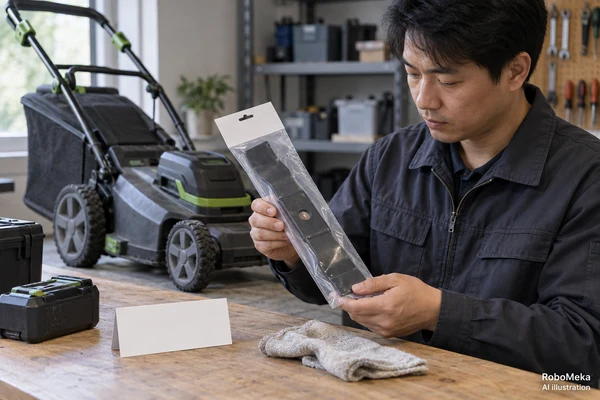
The following worksheet keeps the energy and cutting questions connected. It is an evaluation plan, not a workshop procedure or proof of performance. Agree the method and responsible reviewers before collecting results.
| Review item | Information to retain | Claim it can help assess |
|---|---|---|
| Assembly identity | Mower, blade, mounting and accessory references | Applicability of the comparison |
| Energy configuration | Approved pack set and relevant control revision | Whether the system remained comparable |
| Lawn condition | Area, grass state and intended height reduction | Relevance to customer use |
| Clipping mode | Exact approved arrangement | Mode-specific cutting outcome |
| Operating pattern | Route, propulsion and relevant settings | Workload consistency |
| Finished result | Agreed observations and corrective passes | Useful task completion |
| Session evidence | Defined time and energy-related observations | Conditional endurance or efficiency statements |
| Service implications | Part availability and authorized procedures | Ownership practicality |
| Limitations | Uncontrolled differences and open questions | Boundaries of the conclusion |
Do not hide changes between runs. If a blade option requires a different accessory or control setting, record it and explain what the comparison now represents. The evaluation may still be useful as a comparison of complete approved modes, but it may not isolate the effect of the blade alone.
Keep raw observations available for review. A final statement such as better runtime should be traceable to the configuration, method and acceptable result. Otherwise, the buyer cannot determine whether the advantage survives in the actual package offered to customers.
Send your cordless cutting-system requirements with the intended clipping mode, lawn routine and package. The downloadable brief can support a scope discussion with RoboMeka; it does not approve an alternative blade or confirm a particular cordless mower platform.
Design an energy-aware application session
Use a representative permitted lawn task and document the starting conditions. Record the approved pack setup, blade condition, height setting and accessories. Follow the manufacturer’s instructions throughout; do not bypass controls or create an unapproved overload to force a difference between options.
Observe the complete session, including turns, emptying and corrective work. The cordless mower power-and-runtime guide explains why active cutting time and elapsed task time answer different questions. A useful blade evaluation should preserve that distinction.
If electrical energy is measured, the method and equipment require appropriate technical competence. Do not improvise access to live systems or interpret an uncertain reading as a precise efficiency result. A purchasing team can request qualified evaluation without turning the article into a hazardous measurement guide.
Manufacturer examples such as EGO’s mower information show why runtime claims need conditions. Those results cannot be assigned to another cutting assembly. Ask the actual supplier for evidence tied to the proposed blade, deck and energy configuration.
Interpret trade-offs instead of declaring one universal winner
An approved option may improve one aspect of a defined task while introducing another consideration. For example, a proposed collection-focused configuration should be evaluated for the collection result, session behavior and support requirements rather than assumed superior for every clipping mode.
Describe the result in terms of the customer application. A retailer serving regularly maintained residential lawns may choose differently from a buyer whose permitted use profile places different demands on the system. Avoid inventing a universal best blade when the evidence concerns one set of conditions.
Where results are close or variable, acknowledge the uncertainty and consider whether more relevant evaluation is needed. A small purchasing trial does not justify precise market-wide claims or statistical confidence that the method did not establish.
If a supplier’s energy claim lacks a clear useful-work basis, ask for clarification before using it in a listing. Less energy per minute and less energy per acceptable completed lawn are different statements. The denominator should match the benefit the customer is being promised.
Review sound, vibration and abnormal behavior responsibly
A changed cutting assembly can affect the system’s behavior, but buyers should not predict the direction or magnitude from appearance alone. Relevant claims require suitable evidence. An informal recording or a subjective impression should not be presented as a standardized acoustic comparison.
Unexpected sound or vibration during an evaluation should be handled under the product’s instructions and reviewed by competent personnel. Do not continue operating a suspect assembly to finish a planned runtime test. Record the configuration and circumstances without diagnosing the cause prematurely.
HSE’s machinery-maintenance guidance emphasizes planning, isolation and competence. The actual mower manual should define the specific inspection and service procedures. This article does not provide fastening values, sharpening instructions or a balancing method for an unidentified blade.
Maintain the boundary between customer observation and technical work. Support staff can collect relevant identity and symptom information safely, but should not ask a customer to remove protections, modify a component or reproduce a potentially hazardous event for demonstration.
Prepare replacement parts and service information
Obtain the approved blade references, applicable revisions and replacement criteria from the supplier. Confirm who performs the work and which instructions apply. A low component price is not enough if the service network cannot identify or install the correct part through an authorized process.
The package and manual should explain the available modes without encouraging unapproved substitutions. If a customer later requests a different clipping capability, support should check the actual approved options rather than recommend a similar-looking aftermarket part by dimension alone.
Maintain a cross-reference between the brand’s mower SKU and the supplier’s technical identity. This becomes important when a model name remains familiar but the blade or mounting system changes. Service staff should not have to infer the revision from a photograph if a controlled record can resolve it.
Ask about the actual parts-availability commitment and the process for discontinuation or replacement. Do not promise indefinite support without a basis. A clear, limited commitment is more useful than a broad assurance that all parts will always be available.
Control production and cost-reduction changes
The approved sample should be linked to a released configuration and relevant inspection criteria. Ask how the supplier verifies blade and accessory identities during assembly and packing. Similar-looking options can create errors if the control relies only on an operator recognizing the shape.
Any proposed change to material, geometry, mounting, deck or relevant controls needs assessment by the responsible technical team. A supplier should not describe it as equivalent solely because the nominal cutting width remains the same or the quoted cost is lower.
Shipment inspection can check agreed identities and observations within a safe scope. NIST’s acceptance-sampling introduction explains sampling as a lot-decision tool, not a guarantee of every unit’s future cutting performance or durability.
After an approved revision, update the performance claims, parts records and instructions as necessary. A marketing page should not continue using the original blade comparison if the production package no longer matches the evaluated configuration. Traceability protects both technical accuracy and customer expectations.
Use a realistic purchasing decision example
Imagine a buyer evaluating two approved cutting configurations on the same cordless platform. One produces a longer measured run in the chosen session, but the finish requires additional passes. The other completes the agreed result sooner. The purchasing conclusion should reflect the useful task, not automatically favor the longer-running option.
The team would review whether the method was appropriate, whether other variables changed and whether the observations are repeatable enough for the intended claim. It might request further evaluation rather than declare either configuration universally better. This is a hypothetical decision process, not a reported RoboMeka trial.
The resulting customer offer should explain the supported clipping mode, included parts and relevant conditions. That clarity is valuable even when no dramatic efficiency percentage is published. Buyers can communicate a well-defined solution without inventing a performance advantage that the evidence does not establish.
Frequently asked questions
Does an energy-saving blade automatically improve mowing capacity?
No. The claim needs a defined method and an acceptable cutting result with the approved complete system. A longer run that leaves more corrective work may not improve useful capacity. Ask whether the comparison measured the same task and whether the evidence supports the actual customer package.
Can a cordless mower use any blade of the same length?
No. Length does not establish the correct mounting, geometry, balance or system approval. Use model-specific part information and documented alternatives from the responsible manufacturer. Do not modify a blade or mounting arrangement to make a superficially similar replacement fit an unsupported configuration.
Should collection and mulching results be combined into one claim?
Only if the evidence and wording genuinely cover both approved configurations. The modes can involve different parts and outcomes. Record each setup and evaluate the relevant finish. A successful result in one mode should not silently become a promise of equivalent performance in another.
How should buyers respond to unusual vibration during evaluation?
Follow the actual product’s stop-use and isolation instructions and obtain competent review. Record the configuration and circumstances without continuing merely to complete a test. Do not diagnose the cause from appearance alone or ask an unqualified person to improvise a balancing, fastening or modification procedure.
What records are essential for blade replacement support?
Maintain the mower and blade identities, relevant revisions, approved alternatives and applicable service instructions. Connect branded SKUs to the technical configuration and define an escalation route for uncertainty. This helps staff select the correct information without relying only on dimensions, photographs or a broad product-family name.
Conclusion
Cordless cutting-system procurement should measure useful lawn results with the approved battery and drive configuration. Evaluate energy claims alongside finish, clipping mode and service implications, then preserve the assembly through production changes. This gives buyers a credible basis for selecting and supporting blade options without assuming universal interchangeability or efficiency gains.
Prepare a cordless cutting-system inquiry, review the downloaded requirements document and email it to info@RoboMeka.com. The form does not automatically transmit the brief or establish blade approval, measured performance or product availability.