The short answer
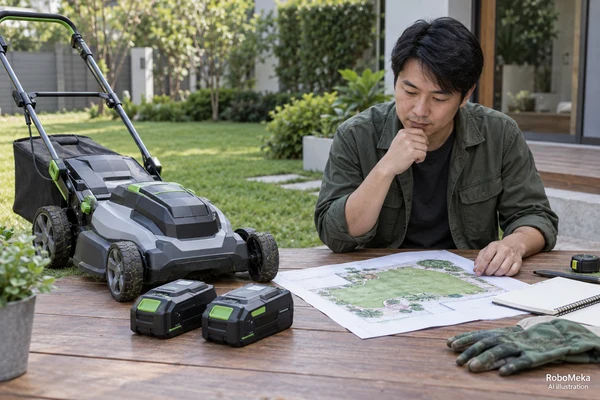
Choose a cordless lawn mower as a complete mower, battery and charger system matched to a real mowing session. Start with the customer’s lawn, handling needs and existing equipment, then verify the approved energy package, cutting result and replacement support. The best choice is not necessarily the product with the highest voltage label or the longest unqualified runtime claim.
Introduction
Choose a cordless lawn mower as a complete mower, battery and charger system matched to a real mowing session. Start with the customer’s lawn, handling needs and existing equipment, then verify the approved energy package, cutting result and replacement support. The best choice is not necessarily the product with the highest voltage label or the longest unqualified runtime claim.
For distributors, cordless selection is also a platform decision. The initial kit determines how easily a first-time customer can start, while compatibility and parts information affect later purchases and service. A bare tool, a starter kit and a package with additional packs can each be appropriate, but only for a clearly defined customer.
This guide focuses on cordless walk-behind procurement. It does not confirm that RoboMeka supplies every format or battery platform discussed. Use it to prepare a product application brief, then verify available models, evidence and commercial scope directly before making a purchasing commitment.
Define the mowing session before the product tier
Describe the grass area, separate zones, access route and normal maintenance routine. Ask whether the customer expects to finish in one session or is comfortable dividing the task. That expectation influences the value of capacity and spare packs more usefully than a broad small, medium or large label.
Include the desired clipping mode and acceptable finish. Regular collection, mulching and occasional heavier growth can present different workloads. A supplier’s demonstration should be interpreted against the intended task, not treated as proof that every lawn of the same area will produce the same result.
University of Minnesota Extension’s mowing guidance discusses mowing frequency, height and blade condition. Use locally appropriate turf guidance when defining the application. A machine selection should support a reasonable lawn-care routine rather than depend on unsuitable cutting practices to achieve a marketing claim.
For a retail assortment, write a short customer story for each package. One might serve a first-time owner with a straightforward garden; another might serve a verified existing platform user. Keep those stories based on actual requirements and avoid inventing customer results or sales data to justify the range.
Decide whether the customer needs a bare tool or a kit
A bare tool can be useful when the customer already owns components explicitly approved for the mower. Confirm the exact pack and charger identities and any required operating quantity. Ownership of another tool from a similar-looking range does not automatically establish compatibility.
A starter kit should clearly identify everything required for the intended basic operation. State which packs and charger are included and which accessories remain optional. If two batteries are required simultaneously, explain that they form the operating set rather than implying that one is a spare.
An expanded kit should have a defined purpose, such as supporting a particular work schedule with additional approved packs. Do not add components only to create an apparently premium tier. Evaluate whether the customer can use and store the complete arrangement according to the instructions.
The electric mower price-factor guide explains how unlike packages distort quotation comparisons. Apply that normalization before comparing cordless supplier prices, especially when one offer includes an energy system and another leaves it to the buyer.
Examine the battery platform as a support commitment
Request an approved compatibility matrix for the mower, packs and chargers. Ask how revisions are identified and how future changes are communicated. Similar connectors or voltage labels are not a sufficient basis for recommending a replacement or cross-selling another tool.
Clarify the supplier’s actual replacement-parts and energy-component plan. Do not promise customers indefinite availability unless a specific, supportable commitment exists. A distributor needs to understand how it will handle discontinued revisions and which organization approves alternatives.
Manufacturer support resources such as Greenworks’ support hub illustrate why product-specific information matters. They do not validate another brand’s platform. The selected supplier must provide records that local sales and service teams can use for the actual products.
Consider the commercial risk of concentrating a range around one system, but do not invent a universal answer. A shared approved platform can simplify some customer decisions, while a poorly documented platform can create dependence without reliable support. Evaluate the supplier’s evidence and process rather than the ecosystem slogan alone.
Interpret voltage and capacity in context
Ask whether a voltage label is nominal or uses another convention, and what the capacity figure describes. Nominal energy can sometimes be estimated from appropriate voltage and ampere-hour values, but that calculation does not directly establish cutting performance or useful runtime.
Higher voltage is not a universal quality ranking. The complete motor, controller, pack and cutting assembly determine the product’s behavior. A buyer should request defined performance evidence rather than infer that a larger label number must produce a better lawn result.
Runtime statements need the exact pack configuration and operating conditions. EGO’s mower information provides a manufacturer example of acknowledging variables such as application and setup. Those results remain specific to its products and cannot be transferred to a proposed private-label mower.
Use energy specifications to understand the offer and ask better questions, not to produce unsupported promises. The cordless mower power-and-runtime guide develops a session-based evidence approach for buyers who need to evaluate endurance more closely.
Compare handling and access with the energy package installed
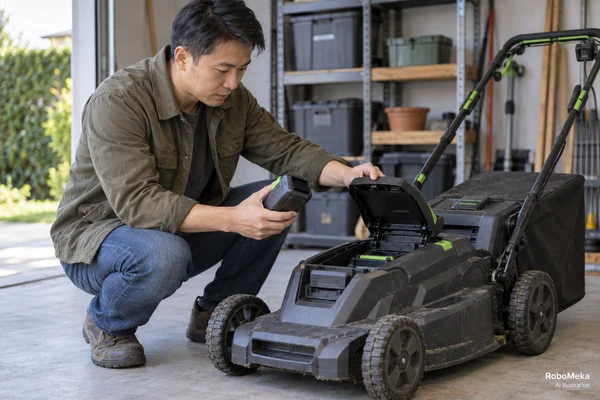
Assess the mower in the configuration customers will actually use. Packs, collection accessories and other required items can affect the complete handling experience. A bare-machine photograph or shipping weight does not necessarily describe the operational product.
Record overall dimensions, access clearances and the approved storage arrangement. Cutting width is relevant to coverage, but the machine must also pass through the customer’s gates and fit the storage route. Folding features should be evaluated using the manufacturer’s instructions rather than improvised handling methods.
If self-propulsion is offered, review how it fits the user’s route and operating expectations. It is a feature with application and energy implications, not an automatic upgrade for every customer. The buyer should understand the controls and assess the complete session within the product’s intended use.
Terrain limitations remain separate from battery capacity. A larger approved pack does not authorize operation on an unsuitable slope or surface. Obtain the actual model’s instructions and seek competent site assessment where needed before making a recommendation.
Use a cordless selection worksheet
The following worksheet connects customer requirements to the complete package. It is a buying aid, not a certification or a promise that every listed feature is available. Keep unresolved questions visible until the supplier or responsible reviewer answers them.
| Customer question | Product information needed | Selection implication |
|---|---|---|
| What lawn must be finished? | Area, layout and maintenance routine | Defines the useful work session |
| What does the customer already own? | Verified approved pack and charger identities | Determines bare-tool suitability |
| What must come in the carton? | Exact operating set and accessories | Defines the complete starting offer |
| How will the mower be handled? | Operational dimensions and approved handling | Checks access and storage fit |
| How is energy replenished? | Approved charger and relevant conditions | Establishes readiness between sessions |
| What result is expected? | Clipping mode and application evidence | Connects features to lawn outcomes |
| Who provides support? | Parts records and escalation route | Defines ownership practicality |
| What happens after a revision? | Change and replacement policy | Tests platform continuity claims |
Use the worksheet during both supplier selection and customer-facing range planning. The answers should remain consistent across the quotation, carton, website and service records. A technically suitable package can still disappoint if different channels describe its contents differently.
For important trade-offs, record why a feature was included or excluded. This helps future staff understand the offer and prevents a later cost-reduction proposal from removing a component that was essential to the original customer requirement.
Send your cordless mower selection brief with the customer profile, intended session and proposed kit contents. The downloadable document helps organize a product-scope discussion with RoboMeka; it does not confirm compatibility or availability of a cordless walk-behind platform.
Evaluate a representative complete session
Identify the sample, blade, clipping arrangement and approved pack configuration before evaluation. Document the lawn conditions and use the manufacturer’s starting and operating instructions. The purpose is to observe a relevant customer task, not to push the machine beyond its permitted use.
Record useful mowing time, turns, emptying, transfers and any interruptions separately. Assess the finished result as well as the duration. A long-running mower that needs repeated corrective passes may not provide the customer value suggested by the headline number.
Where comparisons involve different kits, state that clearly. A package with more stored energy may better fit the customer, but the evaluation does not isolate motor efficiency unless its design supports that conclusion. Keep the claim aligned with what was actually compared.
The NIST conformity-assessment overview supports a useful evidence discipline: identify the question, method and configuration. An informal purchasing session can provide practical observations, but it should not be represented as an independent laboratory study or broad reliability proof.
Review charging, storage and abnormal-condition guidance
Ask for the actual pack and charger instructions, including permitted conditions and the response to abnormal indications. Do not create one universal charging or storage rule for every cordless system. The destination-market charger version should match the package and reviewed documentation.
The local service team needs to know when to direct a customer to stop using a component and seek qualified help. Do not encourage internal battery repair, bypassing controls or continuing with a suspect pack. Product-specific escalation should be clear before launch.
HSE’s machinery-maintenance guidance emphasizes planned work and competence. Use those principles to define service boundaries, while the actual manual determines isolation, cleaning and maintenance procedures. A cordless product is not free of powered-cutting hazards because it lacks a mains cable.
Battery shipment and returns require separate logistics review. IATA’s battery transport resources provide air-transport context, but a qualified provider must assess the actual consignment and condition. Do not assume that the original delivery route is automatically suitable for every later return.
Approve the production offer, not just the sample
The accepted sample should have a recorded configuration and a defined relationship to production. Ask how the supplier controls pack, charger, blade and controller identities. A visually unchanged mower can still differ in ways that affect performance, documentation or support.
Require review of relevant substitutions before implementation. Commercial pressure to use an available battery or charger should not bypass compatibility and evidence checks. Update the package and service records when an approved revision changes what the customer receives.
Shipment inspection should use the current contents and identity list. NIST’s acceptance-sampling introduction explains sampling’s role in lot decisions. It does not replace product qualification or establish that every unit will reproduce a favorable demonstration result throughout its life.
Before launch, rehearse a simple support inquiry using the actual records. Can staff identify the kit and the correct replacement component? Can they explain whether a battery is required or included? These information checks can prevent avoidable customer confusion without inventing field-performance statistics.
Choose a range customers can understand
Consider a hypothetical two-offer range: a verified bare-tool option for existing compatible-platform owners and a complete kit for first-time buyers. The products may share a mower platform but require different listing language and sales guidance. The lower-priced offer is not inherently incomplete for its intended customer; it is incomplete only if the required context is missing.
If an additional kit is proposed, explain the specific need it serves and the evidence behind the package. Avoid multiplying near-identical options that make compatibility and contents harder to understand. More SKUs can increase warehouse and service complexity without improving the customer’s decision.
Revisit the range using actual receiving, inquiry and service observations after launch. Keep measured information separate from assumptions, and revise guidance when evidence supports it. A good cordless selection process continues through ownership rather than ending when the first quotation is accepted.
Frequently asked questions
Is the highest-voltage cordless mower the best choice?
Not automatically. Voltage conventions and complete system design vary, and the label does not directly establish cutting quality or useful session length. Evaluate the intended application, approved energy package and relevant performance evidence. A larger number should prompt a clearer technical question, not replace the buying decision.
When is a bare-tool mower appropriate?
It can suit a customer who already owns the exact approved packs and charger required by the mower. Verify compatibility and operating quantity before recommending it. For a first-time buyer, clearly explain the additional components needed or provide a complete-kit option with unambiguous contents.
Does a spare battery guarantee uninterrupted mowing?
No. The operating set, workload, charger arrangement and any required conditions affect readiness. A rotation plan must be checked against the actual system and instructions. Extra energy may help a defined schedule, but it does not automatically remove charging intervals or solve an unsuitable application.
What should a distributor ask about platform continuity?
Request compatibility records, revision identification, replacement arrangements and the process for approving alternatives. Ask what commitments the supplier can actually make, and avoid promising indefinite availability without support. Platform value depends on usable documentation and service capability as well as the number of products carrying the same brand.
How should buyers evaluate a cordless sample?
Use a representative permitted mowing session with the exact pack, blade and accessory configuration documented. Record the finished result, interruptions and handling as well as runtime. State the evaluation’s limitations and review production equivalence before turning sample observations into customer-facing claims or purchasing assumptions.
Conclusion
Cordless mower selection is a system and ownership decision. Match the customer’s mowing session to an approved package, verify compatibility and performance, and prepare replacement and service information before launch. Buyers can then offer clear choices without relying on oversized labels or unsupported promises of effortless, unlimited operation.
Prepare a cordless platform inquiry, review the downloaded requirements brief and email it to info@RoboMeka.com. The form does not send email automatically or establish product availability, compatibility approval or commercial terms.