The short answer
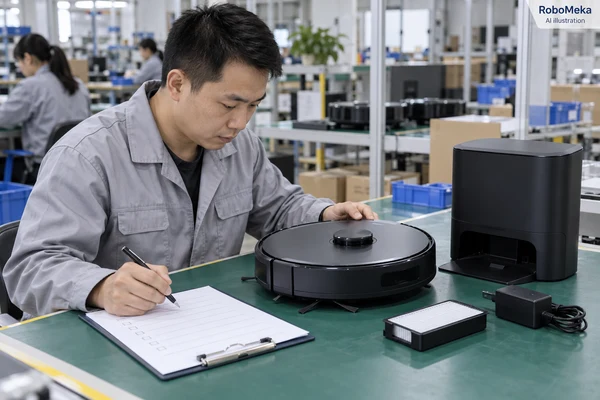
Verify capacity against the exact product configuration, requested delivery window and known constraints. Ask the supplier to connect demand, materials, tooling, labour, testing and packing to dated output, then compare the plan with actual records during a sample or pilot order. A maximum monthly number is not the same as reserved, demonstrated capacity.
Introduction
A supplier says its factory can make 80,000 cleaning appliances per month. The buyer needs 12,000 robot vacuums in twelve weeks, with a new accessory bundle, printed cartons and a destination-specific charger. The large monthly figure sounds reassuring, yet it does not answer the delivery question. It may describe all products, all shifts, an exceptional peak or installed equipment rather than output that is available for this configuration.
Cleaning-appliance production capacity should be verified as a dated plan for a defined product, quantity and quality scope. Buyers need to understand the limiting process, material readiness, changeover assumptions, test and packing capacity, competing demand and recovery options. A maximum rate is useful context; it is not evidence that capacity is reserved or that the promised mix can ship on time.
This guide proposes a commercial verification workflow for importers and private-label teams. It does not describe a completed RoboMeka factory study or guarantee a delivery date. Use the workflow to improve a cleaning robot RFQ, then confirm model-specific facts with the proposed supplier.
Define the demand before asking for capacity
Capacity has meaning only in relation to demand. Give the supplier the product configuration, quantity, requested ex-factory dates, shipment split and expected launch ramp. Identify which elements are firm and which are forecast. A request for “monthly capacity” without those details encourages a broad answer that cannot be tested against the order.
Separate the base appliance from configuration work. A cordless vacuum may share a motor body with other models while using a unique battery, floorhead, colour, accessory set and carton. A robot cleaner may need different software, dock, filter or charger. The shared assembly line does not make every required component interchangeable.
Ask for at least three demand scenarios: the planned order, a reasonable upside case and a delayed-material case. This is not a request for the supplier to promise all three. It reveals whether the plan depends on overtime, an unapproved second source or inventory that has already been allocated elsewhere.
Distinguish orders from forecasts
A forecast helps a supplier plan materials and labour, but it is not automatically a purchase commitment. State the horizon, update frequency and decision date. If a battery cell, motor or custom carton has a longer procurement time than the finished-goods lead time, identify when the buyer must authorize that exposure and who owns unused material if the forecast changes.
Document the demand version used for the capacity review. When a quantity or bundle changes, the old answer should not remain attached to the new requirement. This simple version link prevents a delivery promise for one configuration from being reused for another.
Translate the product into process demand
Build a proposed process map from incoming material through subassembly, final assembly, functional checks, charging or conditioning where applicable, cleaning, packing and shipment release. The purpose is not to prescribe the supplier's factory layout. It is to find which operations consume time, share equipment or depend on scarce skills.
The slowest average station is not always the constraint. A leak check may be quick but available on only one fixture. Firmware loading may normally take minutes yet become a queue after a late release. Packaging may have enough labour but not enough printed cartons. The capacity discussion should cover the entire route required for the exact saleable unit.
For each significant step, ask for the planned hours, number of resources, realistic output rate, yield or rework assumption and changeover need. Avoid calculating a final promise from nameplate speed alone. Breaks, preventive maintenance, inspections, material handling and model transitions use calendar time even when the machine's nominal cycle is fast.
| Capacity question | Evidence that can clarify it | What the evidence does not prove alone |
|---|---|---|
| How many hours are available? | Shift calendar and planned downtime | Attendance or effective productive time |
| What output rate is realistic? | Recent records for the same or comparable process | Future yield for a changed configuration |
| Which resource limits the plan? | Load-versus-capacity view by operation | That every upstream material is ready |
| Can packing keep pace? | Packing trial and carton-material plan | Carrier space or destination receipt date |
| Can output recover after delay? | Approved recovery scenario | That overtime or outsourcing is automatically authorized |
Ask for demonstrated output, not a perfect spreadsheet
A credible capacity file connects assumptions to recent evidence. Ask for anonymized production records or a controlled summary showing planned versus actual output for the same line or a genuinely comparable product. The goal is not to collect another customer's confidential data. It is to understand whether the rate used in the proposal has been achieved under relevant conditions.
Look at the time period. A single best day can reveal technical potential, but it cannot establish a repeatable weekly rate. A monthly average may hide a launch delay followed by overtime. Compare planned hours, completed good units, rework, downtime and model mix. If the supplier excludes a category from its calculation, record that definition.
The NIST Manufacturing Extension Partnership supplier-selection article recommends asking about supplier capacity and what the stated utilization actually means. It also highlights dependence on key people and equipment. Apply that principle to the proposed cleaning-appliance line rather than adopting any utilization percentage as a universal approval rule.
Use comparable evidence carefully
When the exact configuration has not entered production, a comparable product may be the only evidence available. Define why it is comparable: similar number of stations, fastening operations, test time, pack complexity or component flow. Then list the differences that require a pilot assumption. A simpler vacuum should not validate the rate for a self-emptying robot-and-dock bundle merely because both are called cleaning appliances.
Keep observations and conclusions separate. “The line completed 3,200 units of Model A during five recorded shifts” is an observation if supported. “Therefore it can deliver Model B at the same rate” is a conclusion that still needs evidence.
Identify materials that control the schedule
Finished-goods capacity is irrelevant if a critical battery, motor, electronic board, sensor or molded housing is unavailable. Ask the supplier to connect the delivery plan to a material-readiness view. The buyer does not need every purchasing price, but should know which items determine the start date, whether they are standard or custom, and which approvals release them.
For buyer-specific components, confirm artwork, colour, sample and data deadlines. A forecasted carton is not an approved carton. A booked electronic component is not necessarily the correct programmed board. Use configuration references consistent with the golden-sample and change-control process.
Check whether quoted lead time begins at purchase order, deposit, artwork approval, sample approval or receipt of a complete production file. Ambiguous start conditions make both buyer and supplier schedules look correct while producing different shipment dates.
Review shared and constrained components
Shared components can reduce risk when they are genuinely interchangeable and controlled. They can also create allocation risk because several customers depend on the same stock. Ask how the supplier prioritizes demand when the component is short, and whether the proposal assumes inventory that is not specifically reserved.
Do not treat an alternative source as available until its part and approval status are clear. Substituting a battery, charger, filter media or resin may affect fit, performance, documentation or market requirements. Capacity recovery cannot silently override change approval.
Test the plan with a pilot order
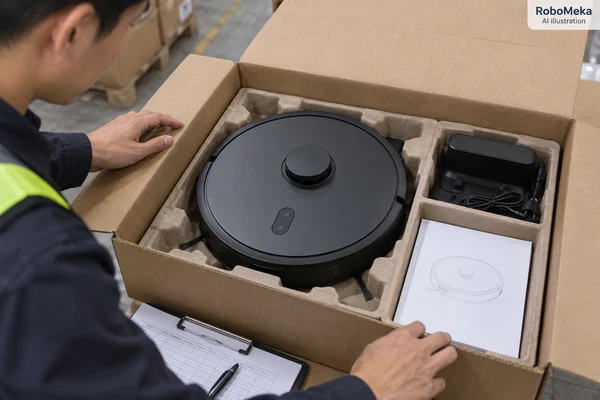
A pilot or controlled sample build provides evidence about labour balance, fixture use, software loading, test time and pack flow. It should represent the intended configuration as closely as practical. Record deviations, because a hand-built engineering sample with generic packaging may not predict production packing capacity.
Define what the pilot is meant to learn. The sample-testing guide covers application evaluation; a capacity pilot has a different purpose. It examines process time, queues, yield and information flow. Both can use the same physical units, but their records should distinguish product performance from manufacturing readiness.
During the proposed pilot, timestamp major operations or use the supplier's existing production records. Investigate waiting and rework rather than reporting only total output. A line can reach the target quantity while consuming unsustainable overtime or borrowing operators from another order.
If you want to discuss a configuration-specific delivery scenario, send RoboMeka your quantity, target market and requested shipment window. The response should be treated as a proposal requiring model, material and scheduling confirmation, not as reserved capacity until commercially agreed.
Review quality capacity separately from assembly speed
Quality checks consume resources and can become constraints. Define the routine checks, inspection frequency, fixture capacity, data recording and response to a failed result. Increasing assembly output without matching test capacity may create a queue or pressure to shorten controls.
Distinguish routine production checks from development or laboratory testing. A line may perform a functional run, charging check, leak check or sensor check according to its work instructions. That does not mean each finished unit receives every performance evaluation mentioned in a product report. The capacity plan should use the actual production control time.
Rework deserves explicit capacity. Ask how suspected units are segregated, diagnosed, repaired where authorized and retested. A plan that assumes every unit passes the first time can exaggerate output even when the target first-pass yield is strong. Avoid inserting a generic rework percentage; request a justified assumption for the proposed configuration and maturity stage.
Connect inspection sampling to shipment release
Pre-shipment inspection may occur after production, during packing or across completed lots, depending on the agreed plan. Reserve time for access, corrective action and reinspection where required. The pre-shipment inspection guide explains why a sampling result has a defined scope and is not proof about every unit.
Make the release gate visible in the delivery schedule. “Production complete” should not be used as “ready to ship” when records, quantity reconciliation or buyer approval remain open.
Examine labour, skills and shift assumptions
Headcount is not equivalent to trained capacity. Ask which operations need authorized or experienced operators, how training is recorded and what coverage exists for absence or turnover. A second shift added on paper may not have the same skill mix, supervision or maintenance support as the established shift.
If temporary labour or overtime is proposed, ask how quality controls, breaks and supervision remain effective. This is not a reason to reject flexible labour. It is a reason to include the operating condition in the plan and observe results during a controlled ramp.
Critical knowledge can sit outside assembly. Firmware release, test-fixture support, incoming inspection and production planning may depend on a small number of people. The capacity review should identify these dependencies without collecting personal information or presenting individual employees as guarantees.
Challenge the plan with realistic disruptions
Capacity verification is stronger when it includes recovery logic. Use a small set of plausible scenarios: a late custom carton, lower-than-planned yield, a key fixture unavailable for a shift, or an inspection hold. Ask what decision is made, who approves it and how the customer delivery is recalculated.
The NIST Manufacturing Extension Partnership supply-chain risk feature connects demand planning with supply and capacity planning and recommends considering whether suppliers can grow with the buyer. Use that relationship as a planning concept. It does not establish that any particular supplier has reserve capacity.
Recovery actions have limits. Overtime, alternate lines, split shipments or subcontracting may change cost, quality control or approval scope. List which actions are already permitted and which require buyer consent. A recovery plan based on an unapproved site should not be treated as ready.
Avoid double-counting flexible resources
The same spare line or weekend shift may appear in several customer recovery plans. Ask whether the resource is dedicated, conditionally available or merely possible. The supplier may not disclose other customers, but it can explain allocation rules and the assumptions behind its offer.
Similarly, safety stock cannot solve two shortages if it is counted twice. Link inventory to an item, revision, owner and reservation status. A photograph of shelves is not a material-availability record.
Convert capacity into contractual milestones
The purchasing documents should state the product reference, quantity, delivery basis, milestone dates and buyer dependencies. Include the consequence of a late approval or quantity change, and define how revised dates are accepted. This article is operational guidance, not contract drafting; qualified commercial and legal advisers should review binding terms.
Use intermediate milestones that reveal risk while there is time to respond. Examples include production-file freeze, long-lead material authorization, approved packaging proof, pilot completion, material readiness, start of volume production, planned inspection and shipment release. Each milestone needs an owner and objective evidence.
Monitor the order without micromanaging the factory
Agree a concise status report covering quantities planned, started, completed, held and released; critical material exceptions; current constraint; and the effect on milestones. Definitions should remain stable across reporting periods. Large spreadsheets are not useful if the buyer cannot tell whether “completed” means assembled, packed or released.
Compare actual progress with the approved curve. An order that is numerically on plan may still be at risk if easy configurations were completed first and a constrained variant remains. Track by saleable configuration and shipment, not only by total unit count.
Compare suppliers on usable capacity
When comparing quotations, normalize the assumptions. One supplier may quote output after the production file is frozen; another may include customization time. One may count good packed units; another counts units leaving assembly. Ask both to answer the same scenario and define their terms.
Consider cost alongside resilience. A lower unit price can be outweighed by additional inventory, emergency freight, missed retailer windows or repeated inspection. The total sourcing cost guide provides a framework for those trade-offs without pretending every risk has a precise monetary value.
Factory area, line count and peak monthly output remain useful screening data. Treat them as the beginning of due diligence. The decision should rest on fit between the buyer's demand and a demonstrated, controlled process with clear assumptions.
Frequently asked questions
What does cleaning-appliance production capacity mean?
It means the output a defined process can produce over a defined period under stated conditions. For a buyer, the useful measure is good, correctly configured and releasable units for the requested schedule. Installed machines, theoretical cycle rate and historical peak output describe parts of the picture but do not by themselves show available capacity.
How can a buyer verify a supplier's monthly capacity claim?
Define the required configuration and schedule, review the process constraint and material plan, compare proposed rates with anonymized recent evidence, and observe a representative pilot where appropriate. Also verify the meaning of the number: product mix, shifts, downtime, yield, packing and inspection status. The result is an evidence-based estimate, not certainty about future events.
Should capacity be reserved before placing an order?
Reservation is a commercial arrangement, not an automatic result of a quotation. Buyers should establish what resource or material is being reserved, for which period, at what cost and under what release or cancellation conditions. A forecast may support planning without reserving anything. Put the agreed treatment into the purchase documents.
Can overtime solve a cleaning-appliance delivery delay?
Overtime may be one recovery option when trained people, materials, fixtures, supervision and quality controls remain available. It cannot recover a shortage at an external supplier or an unresolved product approval. Review the specific constraint and the sustainable good-output rate before accepting overtime as the solution.
How often should buyers update a capacity review?
Update it when demand, configuration, materials, process route, shift plan or major constraints change, and at agreed checkpoints during the order. A review from supplier selection should not be treated as permanently valid. Revalidation should be proportional to the order's risk rather than performed as paperwork with no new information.
Conclusion
Cleaning-appliance capacity is credible when a supplier can connect a buyer's dated demand to materials, people, tools, testing, packing and release, then show how those assumptions compare with demonstrated output. A single monthly figure cannot make that connection. Define the configuration, find the constraint, test representative conditions and keep changes linked to the plan.
To review a proposed order, send your product configuration, quantity range and target shipment window to RoboMeka. The team can prepare a model-specific discussion of samples, customization and production planning; final capacity, lead time and availability require written confirmation for the selected project.